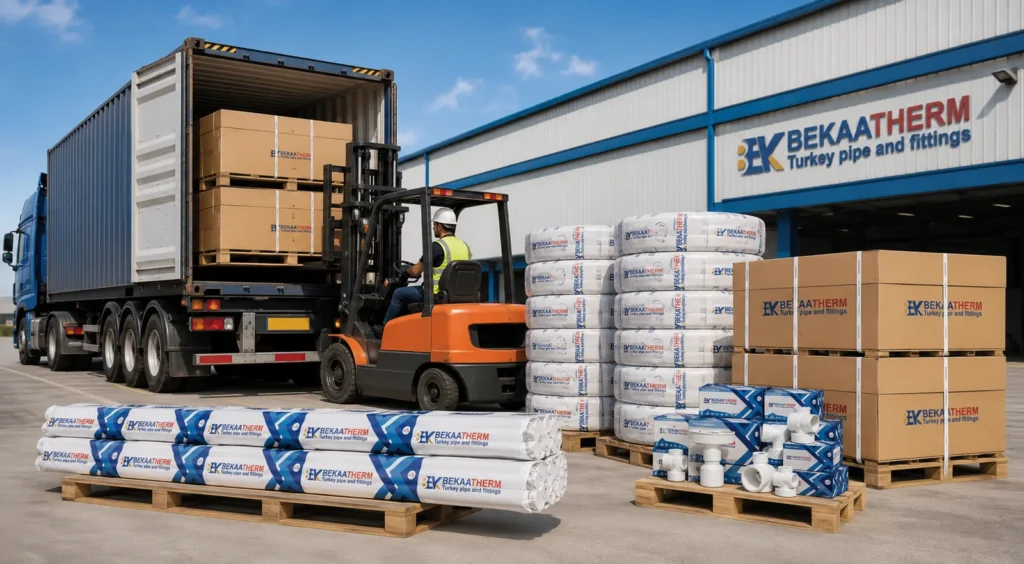
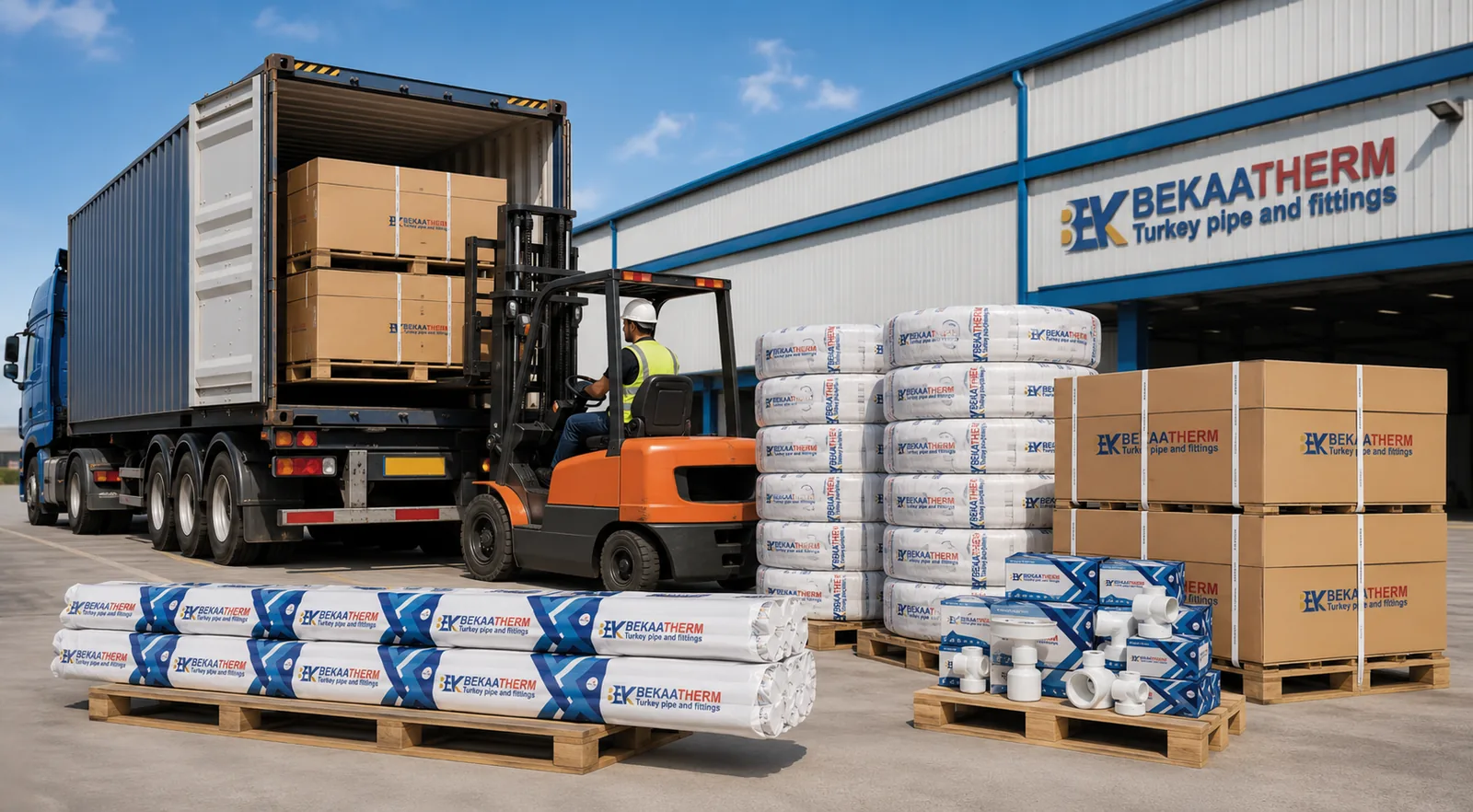
Nobody can tell you how long a container takes from Türkiye to your port. Not honestly, not in 2026. The Red Sea situation moved twice in the last eighteen months, carriers rewrote their loops around it, and any page quoting you “22–28 days to Jebel Ali” is copying a number written before those changes.
What can be pinned down: which port your goods leave from, what FOB actually buys you, how many metres of pipe fit in a box, the production time before that box exists, and the documents that decide whether it clears in a day or sits. This page covers those, plus the three 2026 rule changes that touch a pipe shipment — and how to pull a real transit time for your own lane instead of trusting one printed here.
Key Takeaways
- Default terms are FOB İstanbul or Mersin. CFR and CIF are quoted on request — ask for them when you have no freight contract of your own.
- Port choice follows destination, not habit. Ambarlı (İstanbul) suits Europe and the Atlantic; Mersin is the natural gateway for the Gulf, the Levant and East Africa.
- A 20GP gives roughly 33 m³ usable against a ~28 tonne payload; a 40HQ gives roughly 76 m³. Pipe fills the volume long before it reaches the weight limit.
- Telescoped bundles change the maths: a 20GP takes roughly 8,000–9,000 m of 20mm PN20 pipe when the smaller sizes are nested inside the larger ones.
- Production runs 15–25 days for regular stock sizes and 30–45 days for private-label, plus 7–10 days for a first colour match or new tooling. That sits in front of the sailing time, not inside it.
- The Suez Canal Authority’s 15% rebate for containerships of 130,000 SCNT and above was suspended from 7 April 2026, three months before its stated expiry — a signal that routing economics are still unsettled.
- Cape of Good Hope routing adds close to 11,000 nautical miles and as much as 10–14 days versus the Suez routing. Ask your carrier which way your specific service is running.
- CBAM does not cover plastics. The mechanism applies to cement, iron and steel, aluminium, fertilisers, electricity and hydrogen — PPR, PE and PVC piping sits outside its scope.
- The EU packaging regulation (PPWR) applies from 12 August 2026 in all 27 Member States, covering all packaging regardless of material or origin.
- Turkish-made goods move to the EU on an A.TR; goods from the partner plant in China do not. Origin is confirmed in writing on the proforma invoice before anything is booked.
Four Turkish gateways, and which one your cargo should use
Türkiye is not one export point. It has a western cluster facing Europe and the Atlantic, and a southern port facing the Gulf and East Africa. Loading from the wrong one adds inland trucking and, worse, puts your box on a service that tranships twice.
Ambarlı, on the European side of İstanbul, is a cluster rather than a single terminal — Marport, Kumport and Mardaş together offer more than 3 million TEU of capacity across 20-plus berths, with Kumport alone running 2,080 m of quay at up to 16.5 m depth. Density is the point: more terminals means more services calling, which means more sailing days per week for your lane.
Mersin is the southern gateway. It is mid-way through a USD 455 million expansion lifting annual capacity from 2.6 to 3.6 million TEU on full completion of the East Med Hub 2 terminal in early 2026, with the quay extended to 880 m at 17.5 m draft — deep enough to work two ultra-large container vessels at once. For a buyer in Jeddah, Dammam or Mombasa, Mersin is usually the shorter routing. Asyaport at Tekirdağ is the one that confuses people: it is an MSC-affiliated transhipment hub, not an origin port, so you rarely name it on a booking even though your box may route through it.
| Gateway | Verified capacity facts | Best for | Not for |
|---|---|---|---|
| Ambarlı (İstanbul) |
Marport, Kumport, Mardaş; 3m+ TEU combined; 20+ berths; Kumport 2,080 m quay, 16.5 m depth | Northern Europe, Mediterranean Europe, North and West Africa, US East Coast | Gulf and Red Sea buyers who would pay for the extra leg |
| Mersin | 2.6 → 3.6m TEU on completion of the USD 455m East Med Hub 2; 880 m quay, 17.5 m draft; two ULCVs at once | Gulf states, Levant, Egypt, East Africa, Iraq overland | Buyers whose carrier contract is priced off İstanbul |
| Asyaport (Tekirdağ) |
MSC-affiliated hub; 2,000 m quay; 18 m draft; up to 2.5m TEU designed; 2m+ TEU handled in 2024; shore power | Transhipment inside an MSC network routing | Naming as a load port on your own booking |
| İzmir / Aliağa | Aegean coast cluster serving the western industrial belt | Aegean-region consolidation, some short-sea Mediterranean services | Long-haul deep-sea where Ambarlı offers more sailings |
The practical rule: let your destination pick the port, then check how many weekly sailings serve that pair. A lane with three sailings a week absorbs a missed cut-off. A lane with one sailing a fortnight turns a two-day delay into a fifteen-day one. Frequency matters more than the headline capacity figures above.
Transit times: why this page refuses to print a number, and how to get yours
Search “shipping from Turkey” and you get tidy tables: 25–35 days to the US East Coast, 12–18 days to Northern Europe. Those come from freight-forwarder blogs, they contradict each other, and no carrier stands behind them. Here is the scale of the problem: Sea-Intelligence measured global schedule reliability between 59.0% and 64.7% across the first half of 2026, 62.6% in June, against a 2023 full-year average of 62.1% and a 66.8% peak in mid-2023 before the Red Sea diversions began. Roughly two ships in five still arrive later than their own operator said they would. A quoted “28-day transit” built on that base is a planning assumption, not a delivery date.
So pull the number yourself. It takes about ten minutes and it is specific to your box:
- Fix your port pair first. Not “Turkey to UAE” — “Mersin to Jebel Ali”. Transit time is a property of a service between two named terminals.
- Use the carrier’s own schedule tool, not an aggregator. Maersk, MSC, CMA CGM and Hapag-Lloyd each publish point-to-point schedules with sailing dates and quoted transit days for the coming weeks.
- Read the routing, not just the day count. A direct service and a two-tranship service can show similar headline days; they behave completely differently when something slips.
- Check three consecutive sailings, not one. If the quoted transit swings by more than a few days across three departures, the lane is unsettled and you should plan against the longest one.
- Ask one question in writing: Suez or Cape? For anything routing between the Mediterranean and Asia, the Gulf or East Africa, that single answer moves your arrival date by more than a week.
Do this once per lane and keep the screenshot. When your customer asks why the goods are late, a dated carrier schedule beats a forwarder’s estimate.
The Red Sea in 2026: what actually changed for your booking
Türkiye sits at the top of the Suez corridor, so every eastbound and southbound box is directly exposed to whether carriers are transiting the canal or sailing around Africa. Going the long way costs close to 11,000 additional nautical miles and as much as 10–14 days of transit. That is not a surcharge you can negotiate away; it is distance.
Carriers did start moving back. CMA CGM returned INDAMEX to a full Suez loop, cutting the round trip by two weeks to 77 days and freeing two ships, and shifted the backhaul legs of MEX and FAL1 to Suez. Maersk announced that MECL becomes solely Maersk-operated and transits via the Red Sea, improving westbound transit times by an average of seven days, effective during August 2026. Those are the carriers’ own published figures for their own services — evidence the corridor is reopening, not a transit time for your lane.
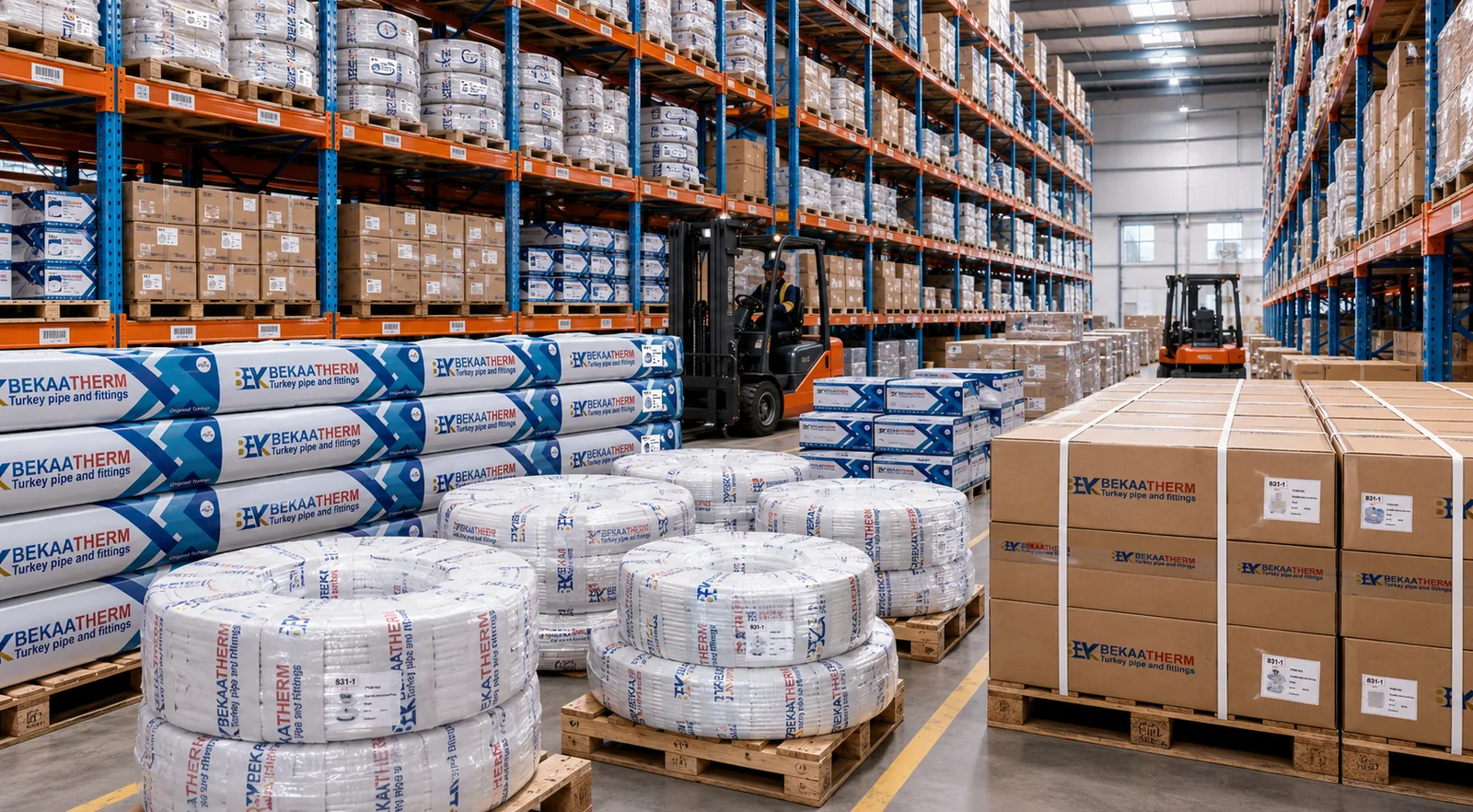
The recovery is partial. Canal transits in early 2026 remained roughly 60% below pre-diversion levels, and January 2026 recorded 150 containership transits — the weakest January in a decade, down 16.7% year on year. The Suez Canal Authority then suspended its 15% transit-fee rebate for containerships of 130,000 SCNT and above from 7 April 2026, three months ahead of its 30 June 2026 expiry. A canal confident of its traffic does not usually pull an incentive early.
So stop treating routing as the carrier’s business. Put “Suez or Cape of Good Hope?” in the same email as your rate request, and build your customer promise on the written answer rather than the booking confirmation’s ETA.
FOB, CFR, CIF: what the default term does and does not include
Our default is FOB İstanbul or Mersin, with CFR and CIF quoted on request. Most experienced importers want FOB, and for a good reason: it puts the ocean leg on their own carrier contract, which is usually cheaper than any rate a supplier can pass through. But FOB only helps if you actually have that contract.
FOB means the goods are produced, packed, trucked to the named port, cleared for export and loaded on board the vessel you nominate. From that moment the freight, the insurance and the arrival-side costs are yours. If you have a forwarder in Türkiye and a rate agreement, take it.
If you do not — first order, new market, no local agent — FOB quietly transfers a job you are not set up to do: nominating a carrier, booking space, catching the cut-off and managing on-carriage from a different time zone. Ask for CFR instead. Take CIF when your bank or L/C requires the seller to hold marine insurance, or when you have no cargo policy of your own.
| Term | Who books the ocean leg | Who insures the voyage | Choose it when |
|---|---|---|---|
| FOB İstanbul / Mersin (default) |
You | You | You hold a carrier or forwarder contract and want your own freight rate |
| CFR (on request) | Seller | You | First order or new market, no agent in Türkiye, but you carry your own cargo policy |
| CIF (on request) | Seller | Seller | Your L/C or bank requires seller-provided marine insurance, or you have no policy |
One warning that catches first-time buyers: CFR and CIF cover the sea leg to your port and nothing beyond it. Destination handling, clearance, duty and inland delivery still land on you. A CIF price is not a delivered price, and treating it as one is how landed-cost calculations go wrong by a wide margin. The breakdown of FOB pricing and container loading goes through a quotation line by line.
Container maths for pipe: volume, weight and the telescoping trick
Pipe is a volume cargo, not a weight cargo. That single fact governs every loading decision, and it is where buyers from other product categories get their forecasts wrong.
A 20GP offers roughly 33 m³ usable against a payload of about 28 tonnes; a 40HQ offers roughly 76 m³. Load a 20GP with PPR pipe and you run out of cubic metres with most of that 28-tonne allowance unused — the box is full and comparatively light. So bundle construction, not tonnage, decides how much product you get per container and therefore your freight cost per metre.
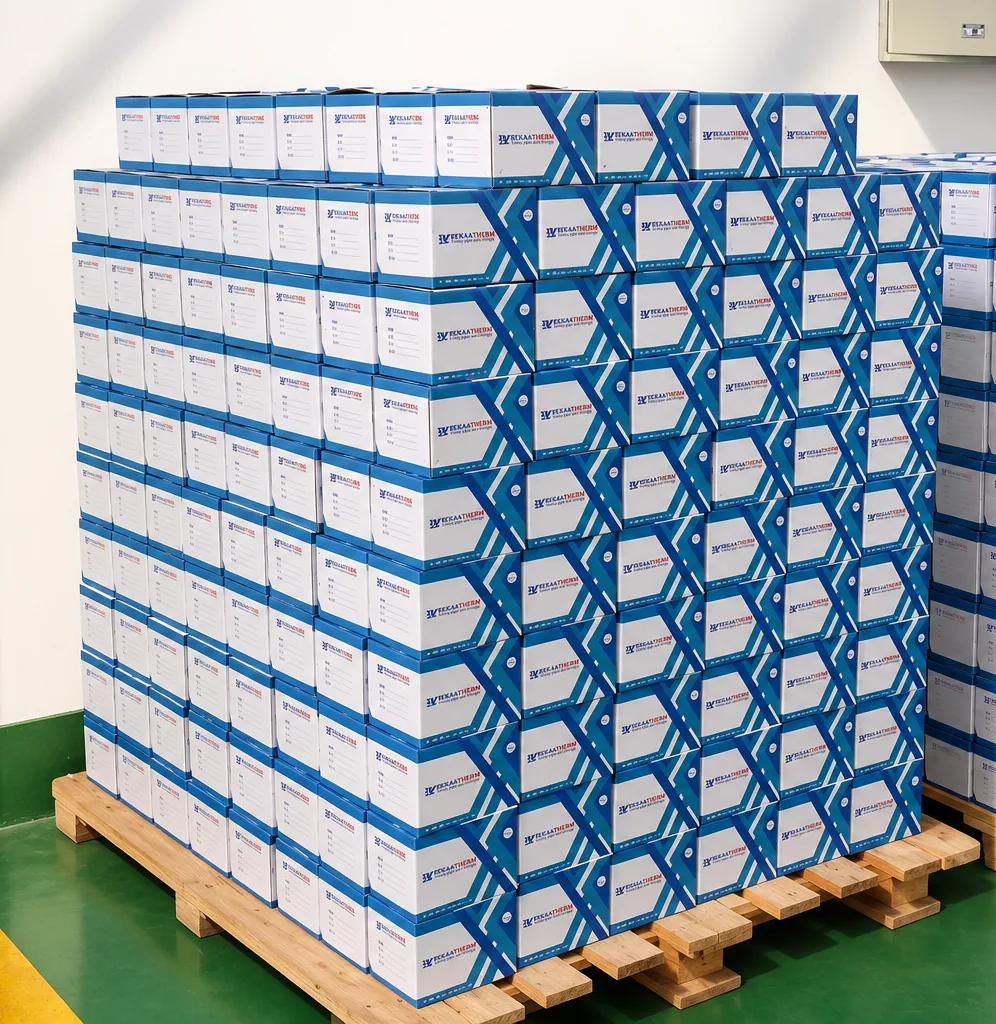
Which is why telescoping matters. Nest the smaller diameters inside the larger ones so the bundles carry no dead air, and a 20GP takes roughly 8,000–9,000 m of 20mm PN20 pipe. Ship the same order as loose single-size bundles and you are paying ocean freight to move empty space across the Mediterranean. Ask any supplier, us included, to state on the proforma how the bundles will be built. A quote that does not mention it is not a complete quote.
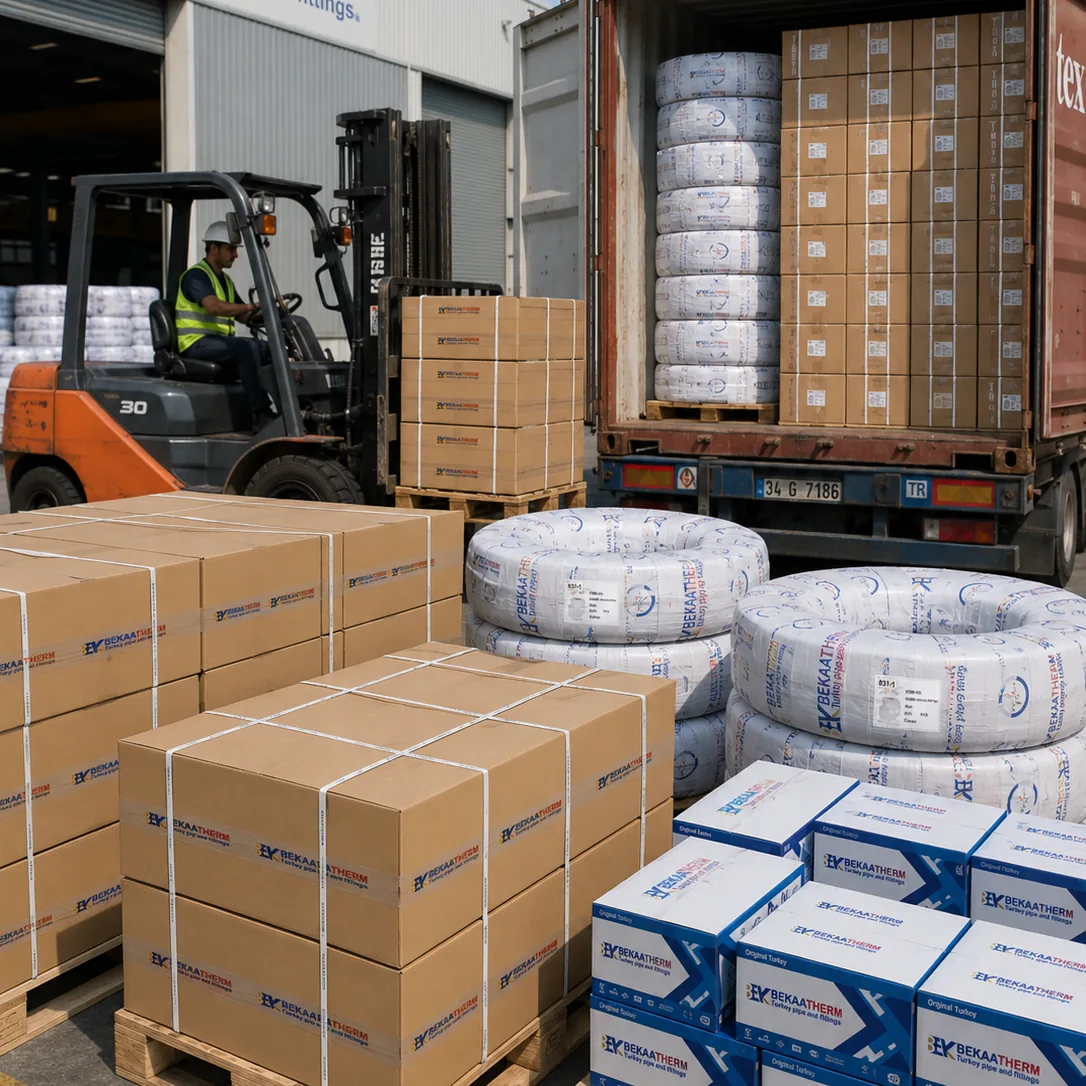
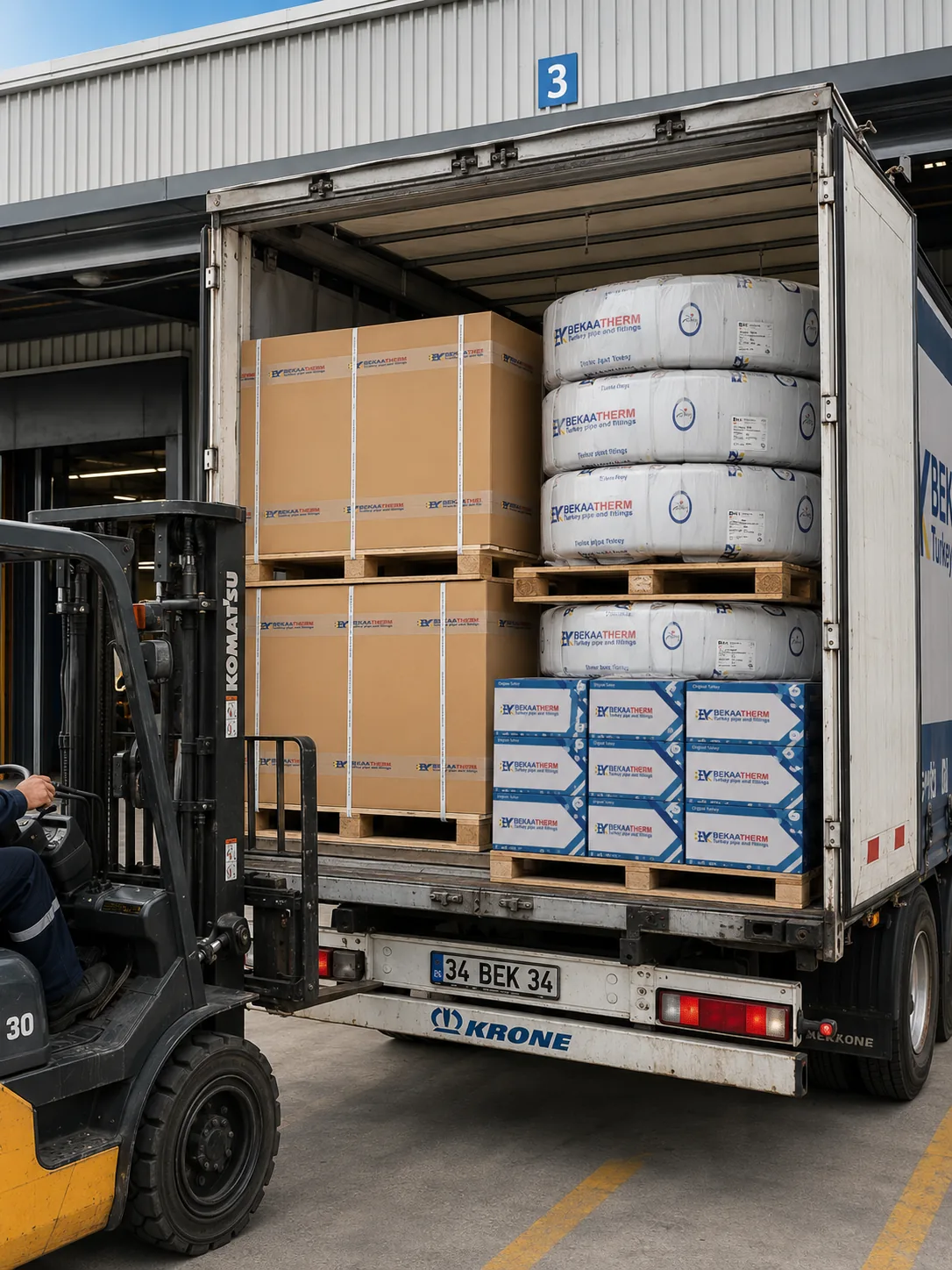
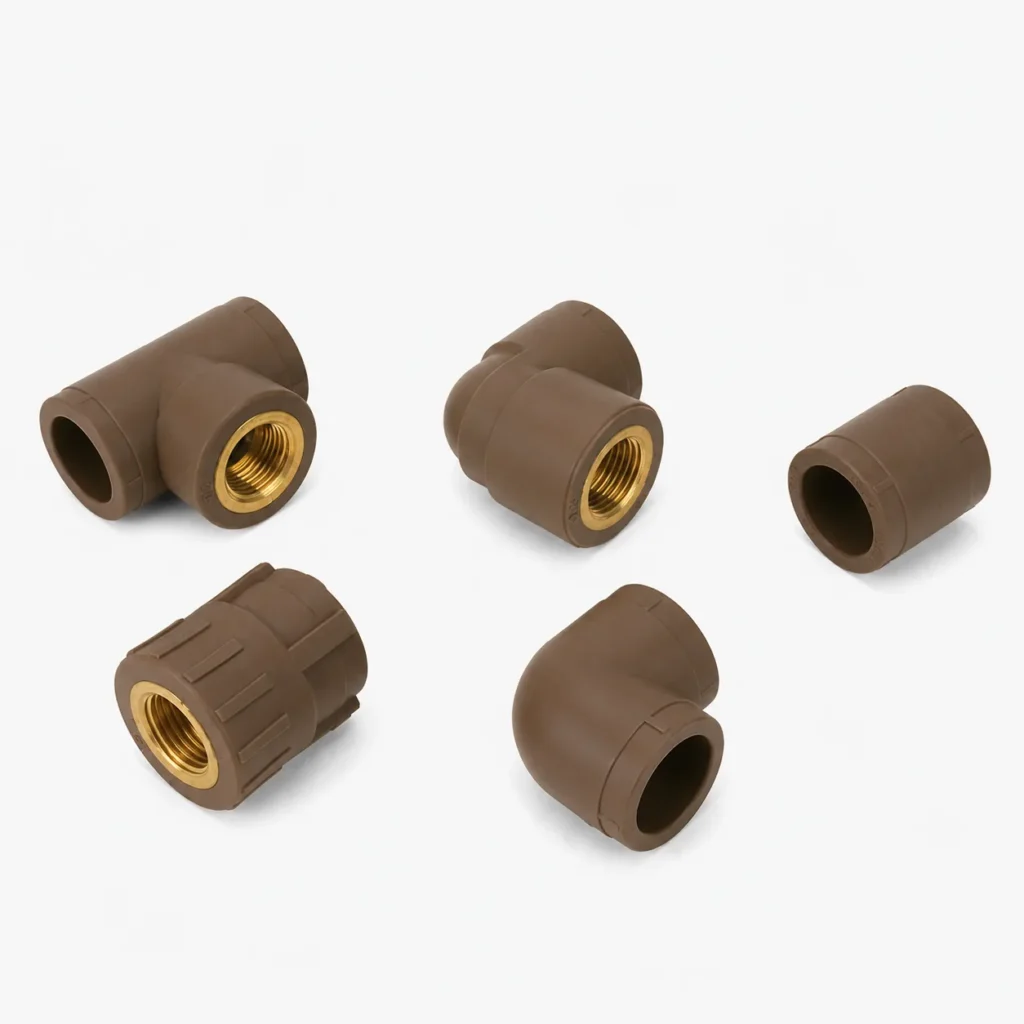
For a first order the entry point is one 20GP mixed container of pipe, fittings and valves, split roughly 60% pipe, 30% fittings and 10% valves by volume. That ratio approximates what a plumbing merchant actually sells, so the container turns over evenly instead of leaving you with pipe you cannot fit and fittings you cannot connect. For a specific size and colour beyond the mixed load, the minimum is 500 kg per size and colour. Private label starts at one 40HQ, or 3 tonnes per colour on a first branded run.
Two loading points repay attention. Valves are dense and small, so they belong low and distributed rather than stacked in one corner concentrating weight on a single floor section. And fittings cartons crush — they go on top of pipe bundles, never underneath. Any competent crew knows this; confirming it in writing costs one sentence and occasionally saves a claim.
PO to arrival: building a timeline you can defend to your customer
The mistake that damages distributor relationships is quoting the sailing time as the lead time. Your customer hears “21 days” and expects goods in three weeks. The container has not even been produced yet.
Production is the first block, and the part we can state precisely. Regular stock sizes run 15–25 days, private-label runs 30–45 days, and a first colour match or new tooling adds 7–10 days. The start date matters: the clock begins when the 30% T/T deposit clears and the specification is signed off, not when the enquiry arrives.
Work an end-to-end example. A Gulf distributor orders a mixed 20GP of standard green PPR in stock sizes, loading Mersin, on 30% T/T deposit with the balance against copy B/L. Deposit clears on day zero. Production occupies days 1–25 at the outer end of the band. Loading, export clearance and trucking to Mersin take a few days more, then the box waits for the next sailing on that service — which is where the weekly frequency question from the port section bites. Only then does the ocean leg begin, at whatever transit the carrier quoted for that week. Arrival clearance follows, and its length depends almost entirely on whether the documents agree with each other.
Notice what that example does not contain: a total. Anyone giving you one confident PO-to-arrival number is adding a real production figure to an invented sailing figure. Build the promise as production (known) + sailing (from the carrier, this week) + clearance (a function of your paperwork), and date the sailing component.
For buyers sizing a first container
If you are working out whether one 20GP covers your first season, send your size and colour list and the destination port. You will get a loading plan showing what fits, the production band that applies, and FOB or CFR terms — not a generic price sheet. This is for importers and distributors placing a trial order, not for single-site contractors.
Seasonality: the 2026 booking windows to avoid
Turkish factories close for the two religious holidays, and these are not one-day affairs. If your production window straddles one, your 15–25 days becomes something else and no amount of expediting recovers it.
In 2026, Ramazan Bayramı falls on 19–23 March, with the afternoon of 19 March a half-day. Kurban Bayramı runs 25–30 May, with 27 May the principal day; an extended nine-day national break covering 23–31 May has been widely reported, so treat the last third of May as effectively closed and confirm the actual working days with your supplier before you commit to a customer date. The remaining public holidays are 1 January, 23 April, 1 May, 19 May, 15 July, 30 August, the afternoon of 28 October and 29 October.
Count backwards. To get goods on the water before Kurban Bayramı, a 15–25 day production band means the deposit clears by late April — early April for a private-label run at 30–45 days. Miss that and you are not waiting a week; you are waiting for the plant to restart, clear its backlog and get your box onto a sailing everyone else is chasing.
There is a demand-side rhythm too. Plumbing materials move with the construction season, so Northern-Hemisphere buyers want stock landed before spring. That pulls everyone’s bookings into the same weeks and tightens space for reasons unrelated to your order. Booking three weeks earlier than feels necessary is cheap. Air-freighting a shortfall is not.
The document set, and the dual-origin question you must settle first
Containers are rarely stopped by duty. They are stopped because two documents disagree — a packing list that does not match the invoice, or a certificate of origin naming a country the B/L does not support.
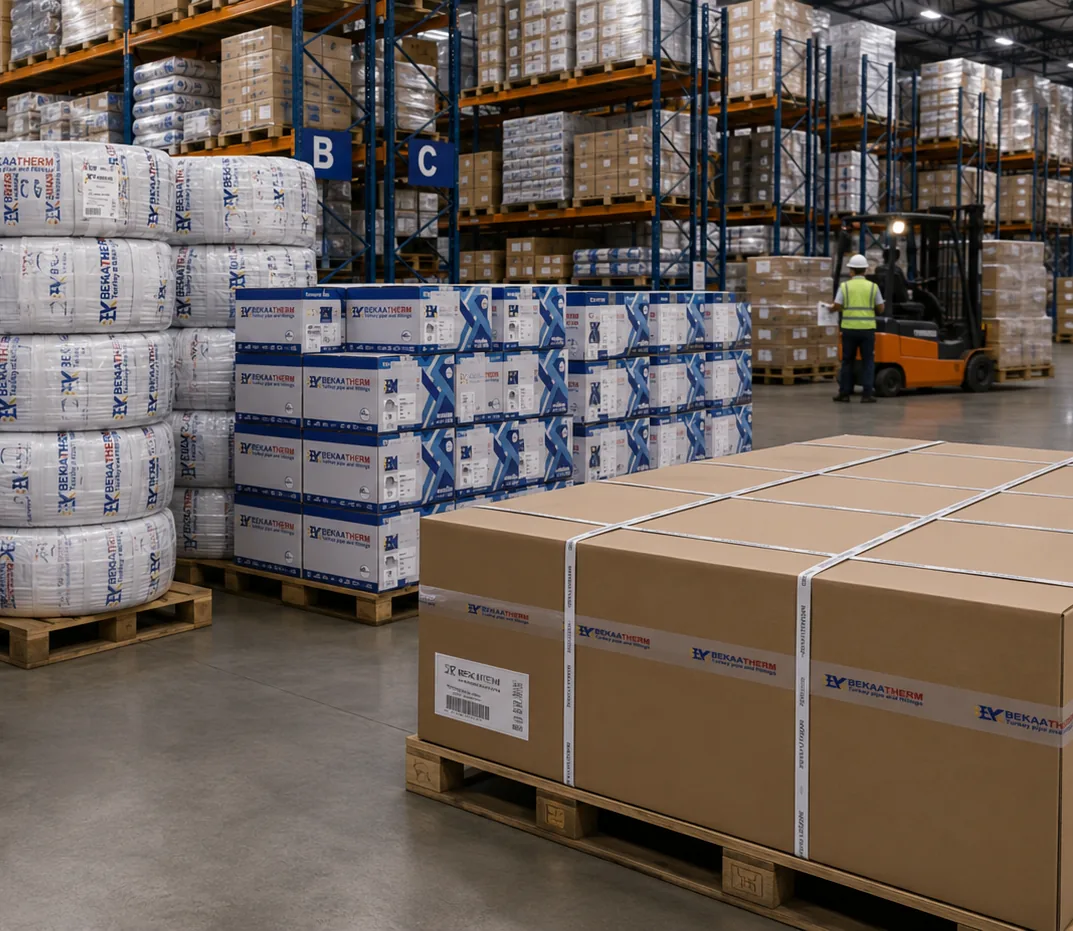
This is where our supply structure demands an early conversation. Bekaatherm supplies from Türkiye and from a partner plant in China, with origin allocated by market — an advantage when it shortens lead times into your region, a documentation problem if nobody names the origin before the goods are made. So it is confirmed in writing on the proforma invoice, and the certificate of origin, packing list and bill of lading are kept consistent with it.
For EU buyers the two origins travel on completely different paperwork. Turkish goods move inside the EU–Türkiye Customs Union on an A.TR movement certificate, which proves free circulation status rather than origin; without it, EU customs applies normal third-country rates. Since 8 July 2024, Member States accept A.TR certificates issued electronically by the Turkish authorities, carrying a QR code and no wet-ink signature — so a broker calling a printed electronic A.TR invalid is working from an outdated instruction. Chinese-origin goods cannot use an A.TR at all; they move with a chamber-issued non-preferential certificate of origin, which attests country of manufacture and confers no tariff preference.
Non-preferential origin is decided either by the “wholly obtained” test or, where materials come from more than one country, by substantial transformation — a fundamental change in form, appearance, nature or character. Extruding resin into finished pipe is a substantial operation on any reading, but the determination belongs to the customs authority in your market. Requirements vary by market and by the importer’s role, so confirm current rules with a licensed customs broker before you book.
| Document | What it does | The detail that causes holds |
|---|---|---|
| Commercial invoice | Declares value, terms and goods description | Pipe and fittings are separate HS lines; a single-line mixed container invites reclassification |
| Packing list | Bundle and carton counts, net and gross weights | Must reconcile to the invoice item by item, not just in total |
| Bill of lading | Contract of carriage and title document | The copy B/L triggers your 70% balance payment, so consignee details must be right first time |
| A.TR (EU destinations, Turkish origin) | Proves free circulation in the EU–Türkiye Customs Union | Not an origin document; electronic QR-coded versions accepted since 8 July 2024 |
| Certificate of origin | Attests country of manufacture (non-preferential) | Must match the origin agreed on the proforma and supported by the B/L routing |
| Test and certification pack | SKZ, ISO 15874, CE and WRAS evidence for the supplied line | Some markets require it pre-shipment; request it with the proforma, not after loading |
| ISPM 15 marking (wooden pallets) | Evidence of phytosanitary treatment | Mark must appear on at least two opposite sides of each pallet |
On that last row: solid-wood packaging in international trade must be heat treated to a core temperature of 56°C for at least 30 continuous minutes, or fumigated, then marked with the IPPC logo, country code, treatment code (HT) and producer identifier on at least two opposite sides. Buyers assume this is handled, and usually it is — but an unmarked pallet can get a container refused entry, and the fix at destination is expensive. One line on the purchase order removes the risk. Which certificates travel with your order is set out on the certifications page.
Three 2026 rule changes that touch a pipe container
Three regulatory items are live in 2026 for anyone importing pipe into the EU. One of them is being mis-sold to buyers, so start there.
CBAM does not apply to plastic pipe
The EU’s Carbon Border Adjustment Mechanism covers cement, iron and steel, aluminium, fertilisers, electricity and hydrogen. Plastics and polymers are not among the covered sectors, so PPR, PE and PVC piping falls outside its scope. If someone is quoting you a CBAM cost line on a plastic pipe container, ask them which covered sector they believe the goods sit in.
The mechanism is real, just not yours: the definitive period started 1 January 2026, a mass-based threshold of 50 tonnes per calendar year applies, importers above it must hold authorised CBAM declarant status, and the first declaration covering 2026 is due by 30 September 2027. Two caveats. If you import steel pipe, brass inserts or metal fittings alongside plastics, those items may be in scope on their own merits. And the covered-sector list can be widened by future legislation — check the official Commission list rather than relying on this page in two years’ time.
PPWR applies from 12 August 2026
The EU Packaging and Packaging Waste Regulation entered into force on 11 February 2025 and applies from 12 August 2026, directly in all 27 Member States. Being a regulation rather than a directive, there is no national transposition step to wait for. It covers all packaging regardless of material or origin, so for a pipe importer the exposure is shrink wrap, strapping, cartons and pallets — not the product.
Do not let anyone conflate the timelines. The obligations that bite hardest — recycled-content minimums, recyclability grading — carry their own later dates in the 2028–2030 window. What matters on 12 August 2026 is that the framework is in force. Confirm your obligations against the Commission’s packaging waste pages, since duties differ depending on whether you are the importer, distributor or brand owner.
HS classification: 3917.22 is not 3917.21
Not new, but consistently wrong on competitor pages. Heading 3917 covers tubes, pipes and hoses and fittings therefor, of plastics. Rigid pipe of propylene polymers — PPR and PP — sits in 3917.22; rigid pipe of ethylene polymers, meaning HDPE and PE, sits in 3917.21. Declaring PPR under the PE subheading gets an entry amended after the goods land. Your tariff then extends the six digits to eight or ten, so confirm the full national code with your broker.
What we check before a container is released
Every exporter says their documentation is careful. Here is what that means in practice on our side — hold us to it, or run the same list against whoever else you are evaluating.
- Origin fixed on the proforma, before production. Türkiye or the partner plant, named in writing at quotation stage — never decided during loading.
- Three-document consistency. Certificate of origin, packing list and bill of lading are reconciled against each other and against the agreed origin before release.
- Invoice split by HS line. Pipe and fittings are separated on the invoice so your broker enters the correct subheadings without guessing.
- Loading plan agreed in advance. Bundle construction and the telescoping approach are set out before the box is stuffed, because that is what determines whether you get 8,000 or 9,000 metres in a 20GP.
- Certification pack matched to the destination. SKZ, ISO 15874, CE and WRAS evidence assembled for the market being shipped to, not a generic bundle.
- Balance triggered on copy B/L. The 70% falls due against the copy bill of lading, so you see the shipping document before the final transfer.
On payment: 30% T/T deposit with 70% against copy B/L is the standard, and irrevocable L/C at sight is accepted from USD 50,000. An L/C costs bank fees and paperwork time, so below that threshold it rarely justifies the friction. Above it, on a first shipment into a new relationship, it is often worth paying for — every consistency check above becomes a bank-examined condition rather than a promise.
Prices are quoted on request, per order. What a quotation contains is fixed: the FOB unit price, the loading plan for your mix, and the certification pack for your market. If you are still comparing suppliers rather than sizing a container, the Turkish manufacturing overview covers the plant side, and the full export process sits on the global export page. Goods reach buyers in 118+ countries from these two origins, which is why this page can be specific about what goes wrong.
Two ways to move this forward
If you are an importer or distributor ready to price a specific container, send the size and colour list, the destination port and whether you want FOB or CFR. You will get a loading plan and terms back. If you are earlier than that and still checking whether the certification matches your market’s requirements, the importer and distributor page is the better starting point.
Frequently asked questions
Which Turkish port should I ship from?
Let the destination decide. Ambarlı in İstanbul — the Marport, Kumport and Mardaş cluster, with over 3 million TEU of combined capacity across 20-plus berths — serves Europe, North and West Africa and the US East Coast. Mersin, whose capacity rises from 2.6 to 3.6 million TEU on completion of the USD 455 million East Med Hub 2 terminal, is the natural gateway for the Gulf, the Levant and East Africa. Default terms here are FOB İstanbul or Mersin, so either is straightforward to quote.
How long does sea freight from Türkiye take to my port?
Published averages will not settle it for your port pair: Sea-Intelligence measured global schedule reliability between 59.0% and 64.7% over the first half of 2026, so roughly two ships in five arrive later than scheduled, and whether a service transits Suez or routes via the Cape changes the picture again. Get the number from the carrier’s own point-to-point schedule tool for your named port pair, check three consecutive sailings, and ask in writing whether the service transits Suez or routes via the Cape of Good Hope. The Cape routing adds close to 11,000 nautical miles and as much as 10–14 days.
Are carriers using the Suez Canal again in 2026?
Partially. CMA CGM returned INDAMEX to a full Suez loop, cutting the round trip by two weeks to 77 days and freeing two ships, and Maersk announced that MECL becomes solely Maersk-operated transiting via the Red Sea, improving westbound transit times by an average of seven days during August 2026. But canal transits in early 2026 were still roughly 60% below pre-diversion levels, and January 2026 saw 150 containership transits, the weakest January in a decade. The Suez Canal Authority also suspended its 15% rebate for containerships of 130,000 SCNT and above from 7 April 2026, ahead of its 30 June 2026 expiry.
How much PPR pipe fits in a 20ft container?
A 20GP offers roughly 33 m³ usable against a payload of about 28 tonnes, and a 40HQ offers roughly 76 m³. With bundles telescoped so smaller diameters nest inside larger ones, a 20GP takes roughly 8,000–9,000 m of 20mm PN20 pipe. Pipe fills the volume well before it reaches the weight limit, so bundle construction, not tonnage, decides your freight cost per metre.
What is the minimum order for a first shipment?
One 20GP mixed container of pipe, fittings and valves, typically about 60% pipe, 30% fittings and 10% valves by volume. For a specific item beyond the mixed load the minimum is 500 kg per size and colour. Private label starts at one 40HQ, or 3 tonnes per colour on a first branded run.
What are the production lead times before the container ships?
Regular stock sizes run 15–25 days. Private-label production runs 30–45 days. A first colour match or new tooling adds 7–10 days. The clock starts when the 30% T/T deposit clears and the specification is signed off, and this production time sits in front of the sailing time rather than inside it.
Does FOB include the ocean freight?
No. FOB covers production, packing, inland transport to the named port, export clearance and loading on board. Freight, insurance and all arrival-side costs are the buyer’s. Ask for CFR if you have no forwarder in Türkiye, or CIF if your bank or letter of credit requires seller-provided marine insurance. Neither CFR nor CIF is a delivered price — destination handling, clearance, duty and inland delivery remain yours.
What payment terms apply, and when is a letter of credit worth it?
The standard is a 30% T/T deposit with the 70% balance against copy bill of lading. An irrevocable L/C at sight is accepted from USD 50,000. Below that figure the bank fees and documentary handling usually outweigh the benefit; above it, on a first shipment into a new relationship, the discipline an L/C imposes on both sides is often worth the cost.
What is an A.TR certificate, and do I need one?
A.TR proves free circulation inside the EU–Türkiye Customs Union, in force since Decision 1/95 in 1996. It is not an origin document. Without it, EU customs applies most-favoured-nation rates. Since 8 July 2024 EU Member States accept A.TR movement certificates issued electronically by the Turkish authorities, bearing a QR code and no wet-ink signature. Goods produced outside Türkiye do not move on an A.TR; they travel with an ordinary non-preferential certificate of origin.
What changes if my goods are made at the partner plant in China rather than in Türkiye?
The documentation path changes entirely. Turkish-made goods can move to the EU on an A.TR; Chinese-made goods cannot, and travel instead with a chamber-issued non-preferential certificate of origin that attests country of manufacture without conferring tariff preference. Origin is allocated by market and confirmed in writing on the proforma invoice, with the certificate of origin, packing list and bill of lading kept consistent. Settle this at quotation stage, never during loading.
Does CBAM apply to imported plastic pipes?
No. The Carbon Border Adjustment Mechanism covers cement, iron and steel, aluminium, fertilisers, electricity and hydrogen. Plastics and polymers are not covered sectors, so PPR, PE and PVC piping falls outside its scope. The definitive period began 1 January 2026 with a 50 tonne per calendar year mass threshold and the first declaration due by 30 September 2027, and metal items shipped alongside plastics may be in scope on their own merits. The covered-sector list can be extended by future legislation, so verify against the Commission’s official list.
What happens on 12 August 2026 under the EU packaging regulation?
The Packaging and Packaging Waste Regulation, which entered into force on 11 February 2025, starts to apply on 12 August 2026 directly in all 27 Member States. It covers all packaging regardless of material or origin, so for a pipe importer the exposure is shrink wrap, strapping, cartons and pallets rather than the product. The heavier obligations such as recycled-content minimums carry their own later dates, so check your specific duties against the Commission’s guidance and your role in the supply chain.
Which HS code covers PPR pipe?
Heading 3917 covers tubes, pipes and hoses and fittings therefor, of plastics. Rigid pipe of propylene polymers — PPR and PP — classifies under 3917.22, while 3917.21 covers polymers of ethylene such as HDPE and PE. Declaring PPR under 3917.21 is a common error. Your national tariff extends the six digits to eight or ten, so confirm the full code with your customs broker.
Do the pallets need ISPM 15 treatment?
Solid-wood packaging used in international trade must be heat treated to a core temperature of 56°C for at least 30 continuous minutes, or fumigated, and marked with the IPPC logo, the country code, the treatment code HT and the producer identifier on at least two opposite sides. Unmarked wood can get a consignment refused at arrival, so confirm ISPM 15-marked pallets on the purchase order rather than assuming.
Which months are risky to book because of Turkish holidays?
In 2026, Ramazan Bayramı falls on 19–23 March, with the afternoon of 19 March a half-day, and Kurban Bayramı runs 25–30 May with 27 May the principal day; an extended nine-day break covering 23–31 May has been widely reported. Other public holidays are 1 January, 23 April, 1 May, 19 May, 15 July, 30 August, the afternoon of 28 October and 29 October. Count backwards from these dates using the 15–25 day production band and confirm actual working days with your supplier before committing to a customer date.
Why does this page not publish ocean freight rates?
Because container rates move week to week with routing, capacity and fuel, and any figure printed here would be wrong by the time you read it. Pricing is quoted on request per order. What a quotation always contains is fixed: the FOB unit price, the loading plan for your specific mix of pipe, fittings and valves, and the certification pack for your destination market.