Ask ten suppliers about PPR pipe lifespan and you will get the same sentence back: 50 to 100 years. Almost none of them can tell you where the 50 came from, what temperature it assumes, or what happens to it when your boiler runs at 80°C instead of 20°C.
Key Takeaways
- The “50 years” is a statistical extrapolation, not a countdown. ISO 9080 estimates the 97.5% lower prediction limit of stress a thermoplastic pipe can withstand for 50 years at 20°C, using hydrostatic pressure tests run to ISO 1167-1 and ISO 1167-2.
- 50 years does not mean 50 years at one temperature. ISO 10508 Class 5 spells the profile out: 20°C for 14 years, then 60°C for 25 years, then 80°C for 10 years, then 90°C for 1 year, plus 100°C for 100 hours.
- Overheating has a hard budget. Malfunction temperature (Tmal) is allowed up to a total of 100 hours across the whole 50 years — and if you specify a service life shorter than 50 years, every other time in the table scales down while the 100 h does not.
- Exceed the class limits and the standard walks away: for values of TD, Tmax and Tmal above Table 1, ISO 10508 states it is not applicable. That, not a warranty clause, is the cleanest definition of “what voids it.”
- The “100 years” claim is real, but it is not PP-R’s. The 2024 Leoben meta-study for TEPPFA found no studies on polypropylene pressure pipes — the dig-out evidence behind 100 years comes from PE and PVC.
- Failures found in the field were traced to manufacturing deviations, foreign inclusions and poor joining — not to material ageing or incorrect pipeline design. Quality is set at the extruder, not by time in service.
- Bekaatherm ships a 50-year warranty against material and manufacturing defects, matched to the 50-year design life at rated pressure and 20°C under ISO 15874.
The number is not marketing. It is the output of a defined statistical procedure, tied to a defined set of operating conditions, and it stops meaning anything the moment you leave those conditions. A 2010 PIPA report put the problem bluntly: based on the use of 50-year stress regression data, it has been incorrectly assumed that plastic pipe systems have a life expectancy of 50 years.
Design life, service life and lifetime are three different things
Most arguments about PPR pipe lifespan are really arguments about vocabulary. The 2024 meta-study on plastic pipe lifetimes, produced by Montanuniversität Leoben for TEPPFA, separates three terms that suppliers routinely mash together. Design life is the time during which a pipe is expected to function by its producer, as long as application conditions meet the specified boundary conditions. Read that qualifier twice — it is doing all the work. Service life is the time defined by maintenance operators; its end can be a failure, or simply an operator’s decision to replace. Lifetime is the actual time for which a pipe operates until failure.
So a datasheet saying 50 years is stating a design life: a producer’s expectation, conditional on boundary conditions. It is not a prediction of your lifetime, and it is not a promise about your service life — which might end at year 12 because a developer gutted the building, or run past year 70 because nobody had a reason to touch the risers.
“As long as application conditions meet the specified boundary conditions” is the entire answer to “what voids it.” The rest of this article is just naming those conditions.
The difference is commercial, not academic. A design life you can defend with a class certificate survives a site meeting. A lifetime figure repeated from a brochure does not — and if the system runs hotter than the certified class, the person who quoted the number owns the problem.
Where the 50-year number actually comes from
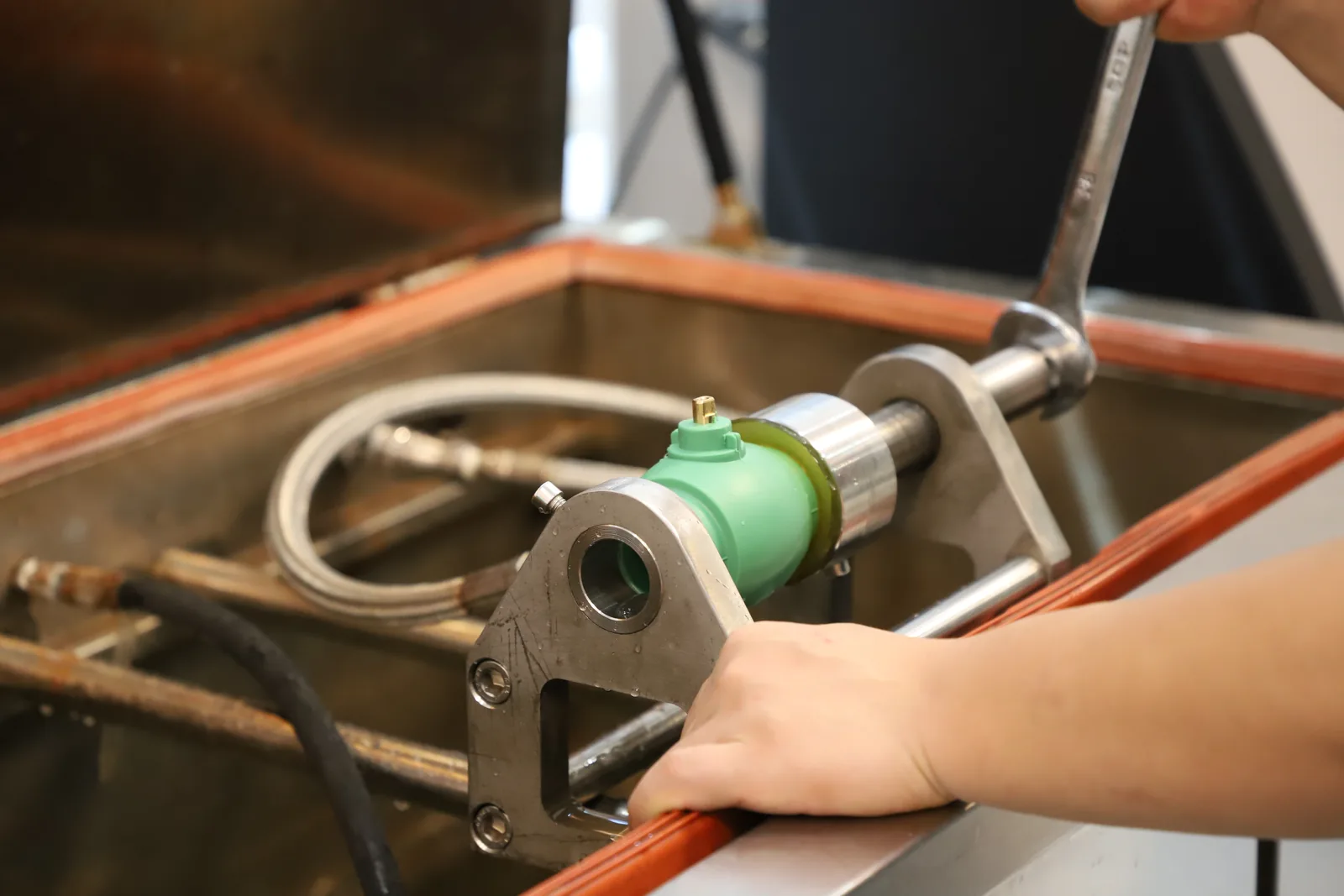
Nobody ran a pipe for 50 years and then wrote the datasheet. The number is extrapolated, and the chain starts with hydrostatic pressure tests carried out at different temperatures, defined by ISO 1167-1 and ISO 1167-2. Samples are held under internal pressure at raised temperatures until they fail, which compresses decades of ageing into months. The failure times and stresses feed the extrapolation method defined in ISO 9080.
What ISO 9080 produces is more careful than a single lifespan figure. It provides an estimation of the 97.5% lower prediction limit of the stress (σLPL) which a thermoplastic pipe is able to withstand for 50 years at 20°C. That is a conservative statistical floor, not a central estimate — the value is set so that the great majority of the population sits above it.
From stress limit to the number on the label
The estimated σLPL then determines the material’s minimum required strength (MRS) under ISO 12162 — a classification step that rounds the measured value down into a standard grade. The clearest published illustration uses polyethylene: a PE material with σLPL = 9 MPa falls in the range 8 < σLPL < 10 MPa, so MRS = 8 and the designation is PE80. The grading logic is the same for other thermoplastics, though the specific PP-R values are not the PE ones and should not be borrowed across.
MRS is not what the pipe is rated to carry. ISO 12162 specifies a method for calculating the design stress σs from the MRS and a design coefficient C, where σs = MRS/C. That coefficient is a deliberate margin baked in before the pressure rating is printed. So the pressure on your pipe marking already sits below the statistical floor, which itself already sits below the measured population.
One more piece matters for anyone running hot systems. ISO 12162 also allows determination of a categorized required strength CRSθ,t for design at times other than t = 50 years and at constant temperatures other than θ = 20°C, with CRS20,50 equal to MRS. Change the temperature and you are on a different point of the curve. The 50-year figure does not travel with you.
The temperature profile hiding inside “50 years”
This is the part almost no supplier page shows, and it is the single most useful table in the whole subject. ISO 10508 defines classes of service condition for hot and cold water plastic piping systems. Each class is a temperature-versus-time profile that adds up to a design period, and each is tied to a typical application.
Three terms carry the table. TD is the design temperature — the normal operating condition. Tmax is the maximum design temperature, permitted for a limited stretch. Tmal is the malfunction temperature: the highest temperature that can be reached when the control limits are exceeded, which the standard notes can occur up to a total of 100 h over a period of 50 years.
| Class | Design temperature TD and duration | Tmax / Tmal | Typical field of application |
|---|---|---|---|
| Class 1 | 60°C for 49 years | 80°C for 1 year / 95°C for 100 h | Hot water supply (60°C) |
| Class 2 | 70°C for 49 years | 80°C for 1 year / 95°C for 100 h | Hot water supply (70°C) |
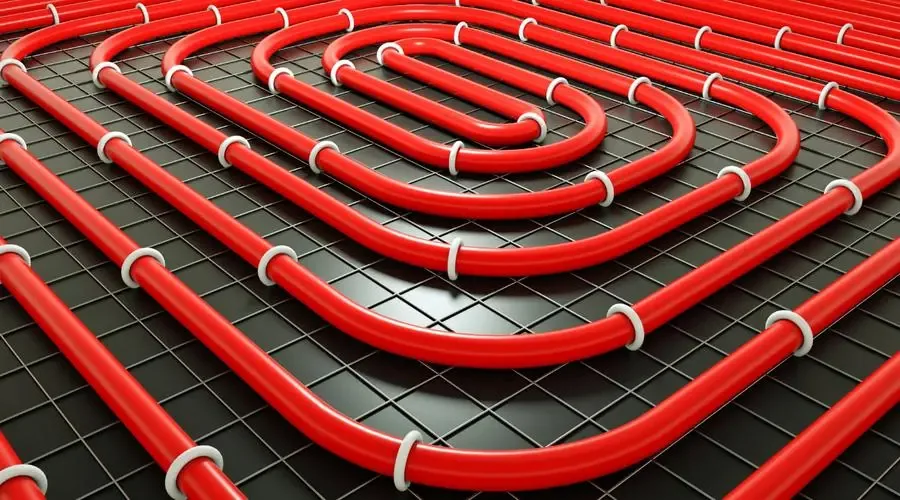
| Class 4 | 20°C for 2.5 years + 40°C for 20 years + 60°C for 25 years | 70°C for 2.5 years / 100°C for 100 h | Under-floor heating and low-temperature radiators |
| Class 5 | 20°C for 14 years + 60°C for 25 years + 80°C for 10 years | 90°C for 1 year / 100°C for 100 h | High temperature radiators |
Add up Class 5 and the arithmetic tells the story: 14 + 25 + 10 + 1 = 50 years. The standard’s own footnote states the design temperature profile for 50 years for class 5 as 20°C for 14 years, followed by 60°C for 25 years, 80°C for 10 years, 90°C for 1 year and 100°C for 100 h. That is what a certified 50-year rating buys on a high-temperature radiator circuit — a weighted mixture, with only ten of those years spent at 80°C.
There is a floor underneath all of it. Every system satisfying one of the five classes shall also be suitable for the transportation of cold water for a period of 50 years at 20°C and a design pressure of 10 bar, demonstrated using the standard extrapolation method specified in ISO 9080.

Best for / not for
Class 4 is best for underfloor heating and low-temperature radiator work, where the media spends 20 of its 50 years at 40°C and never has a design phase above 60°C. It is not for a building with high-temperature radiators fed straight off a boiler flow at 80°C — that duty belongs in Class 5, and specifying Class 4 pipe into it puts you outside the profile the certificate was issued against.
Class 1 and 2 are best for domestic hot water supply, which is the majority of PPR tonnage moving through most distributors. They are not for space heating, because neither profile contains a 60°C-plus phase long enough to model a heating season repeated for decades.
One note that saves arguments: when the specified service life is less than 50 years, all the times given in the table shall be reduced by a proportionate amount, except for the time for malfunction, which shall remain at 100 h. A 25-year specification does not halve your overheating allowance. The 100 hours is absolute.
What voids it: five ways the 50 years stops applying
Now the boundary conditions have names. Each of the following moves the system outside the assumptions the extrapolation was built on.
1. Running above the class you bought
The standard is unusually direct here. For values of TD, Tmax and Tmal in excess of those in Table 1, ISO 10508 states that it is not applicable. There is no derating table to fall back on and no partial credit. Above the class values you have left the document, and any 50-year figure derived from it goes with you.
2. Burning the 100-hour malfunction budget
Here is the scenario that costs real money. A boiler thermostat sticks and the flow circuit sits at 95°C. Nobody notices for three weeks, because the building is warm and the bills are somebody else’s problem. Three weeks is roughly 500 hours — five times the entire malfunction allowance the standard budgets across half a century. The pipe may well survive the event. What has not survived is the basis for calling it a 50-year system.
3. Aggressive disinfection chemistry
Hydrostatic extrapolation models mechanical creep. It does not model chemical attack on the polymer’s stabiliser package. Disinfectants in potable water react with antioxidants in the pipe material, decreasing the amount of effective antioxidant until none remains and the polymer is left unprotected against oxidation. Where that endpoint sits depends on free chlorine level, temperature and flow.
ASTM F3497-21 is the polypropylene-specific method for it: Standard Test Method for Evaluating the Oxidative Resistance of Polypropylene (PP) Piping Systems to Hot Chlorinated Water, applicable to PP piping systems used for transport of potable water containing free chlorine. If you are importing into a market that chlorinates hard, this is a legitimate question to put to any supplier, ours included. Note it is a PP method — do not accept a PEX oxidative test report as a substitute.
4. Joints, not pipe
The Leoben meta-study reviewed the failures that were actually found in service. Cases of failed pipes were caused by not following the standardized process of manufacturing, which resulted from the presence of foreign inclusions, or improper installations — mainly faulty trench backfill and poor joining. The authors add the line that ought to end most lifespan debates: no failure was found to be caused by material ageing or incorrect pipeline design.
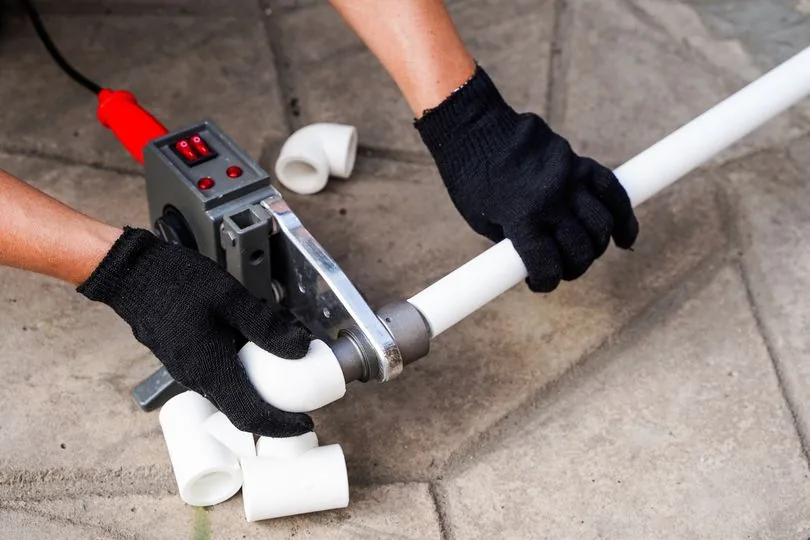
For PPR that translates directly to socket fusion. A joint welded at the wrong temperature, held for the wrong dwell, or pushed with the pipe end still contaminated is a defect the extrapolation never modelled. If you want the design life you paid for, the heat fusion procedure is where it is won or lost.
5. Mixed-temperature duty that nobody calculated
Real systems do not sit on one class profile. A solar-assisted circuit might stagnate hot in summer and run mild in winter. There is a standard for exactly this: ISO 13760 specifies a method for calculating the maximum allowable hoop stress for pipes exposed to varying internal pressures and/or temperatures during their expected lifetime, applying Miner’s rule for cumulative damage. The standard requires Miner’s rule to be applied to each failure mechanism separately.
Most projects skip this and hope the class rating covers it. Sometimes it does. If your duty profile is genuinely unusual — long stagnation periods, frequent thermal cycling, sustained operation near the class ceiling — ask whether anyone has run the calculation for your case.
Can PP-R really last 100 years?
The 100-year claim circulating on supplier blogs is a real finding, and it is being misapplied. The Leoben meta-study concluded that product standards for plastic pipes are conservative compared to real operating conditions, so the safe service life may very well exceed the design life of 50 years — and that as long as design, manufacturing, trenching and operating conditions follow currently valid EN and ISO standards, the actual lifetime of the pipes can be expected to be well above 100 years.
Now the part that gets left out. In the case of pressure pipes, the same study reports that no studies were found on polypropylene pipes. The excavated-sample evidence behind 100 years comes from PE and PVC. For PP-R specifically, what exists today is standards-based extrapolation, not dig-out data.
That is an uncomfortable thing for a PPR manufacturer to publish, and it is still the accurate position. PP-R has a defensible 50-year design life derived by a recognised method. It does not currently have a published field-excavation record proving 100 years, and any supplier telling you otherwise should be asked for the study.
Why real installations still tend to outlast the design life
The conservatism is structural, and the meta-study names four reasons it stacks up. Real ground and media temperatures usually run below the 20°C design assumption. Wall thickness tolerances are always 0+, so walls come off the line thicker than the minimum rather than thinner. A design coefficient is already included in the design stress. And actual internal pressure is usually significantly below the maximum operating pressure the standards are based on. Four independent margins, all pointing the same direction — which is why the 50 years behaves like a floor rather than an expiry date, provided the boundary conditions hold.
A 50-year warranty and a 50-year design life are not the same promise
Bekaatherm carries a 50-year warranty against material and manufacturing defects, matched to the 50-year design life at rated pressure and 20°C under ISO 15874-1. Those two numbers are deliberately the same, and they cover different things.
The design life is a technical statement about how the material behaves under defined conditions. The warranty is a commercial undertaking about defects in material and manufacturing — the resin batch, the extrusion, the mould. It does not convert an installation error into a claim, and no manufacturer’s warranty does.
Even the standards bodies hedge here. ASTM F3497 carries its own disclaimer that extrapolated values do not constitute a representation that a PP pipe or system will perform for that period of time under actual use conditions, and that performance depends on installation methods, water quality and other variables. If the test method that generates the number will not promise it, treat any supplier who promises it flatly as someone who has not read the method.
Warranty terms, exclusions and claim procedure vary by market and contract, so ask for the current written terms with your quotation rather than relying on a blog page — ours included. Requirements and interpretations also differ between jurisdictions; confirm against your local plumbing code and the relevant approval body before specifying.
How to test a supplier’s 50-year claim in four questions
The Leoben review reached one conclusion that should reorganise how you buy: the decisive parameter in terms of lifetime is the pipe’s quality coming from the manufacturing process, not the time in use. Which means the useful due diligence is about the factory, not about the year count on the brochure.
Four questions, in the order that filters fastest:
- Which service condition class is this certified to? If the answer is “50 years” rather than a class number, they are quoting a brochure. Class 1, 2, 4 or 5 is a checkable answer; “long lasting” is not.
- Is the classification ISO 9080-based, and against which pipe series? The extrapolation is material- and geometry-specific. A certificate covering one wall thickness series does not automatically cover the one in your order.
- Has anyone applied Miner’s rule to my actual duty profile? Relevant when your system cycles or stagnates hot. A supplier who knows what ISO 13760 is will engage; one who does not will change the subject.
- If my market chlorinates, is there ASTM F3497 data? A “no” is an acceptable answer. A confident “yes” with no report attached is not.
What we check before a batch is allowed to ship
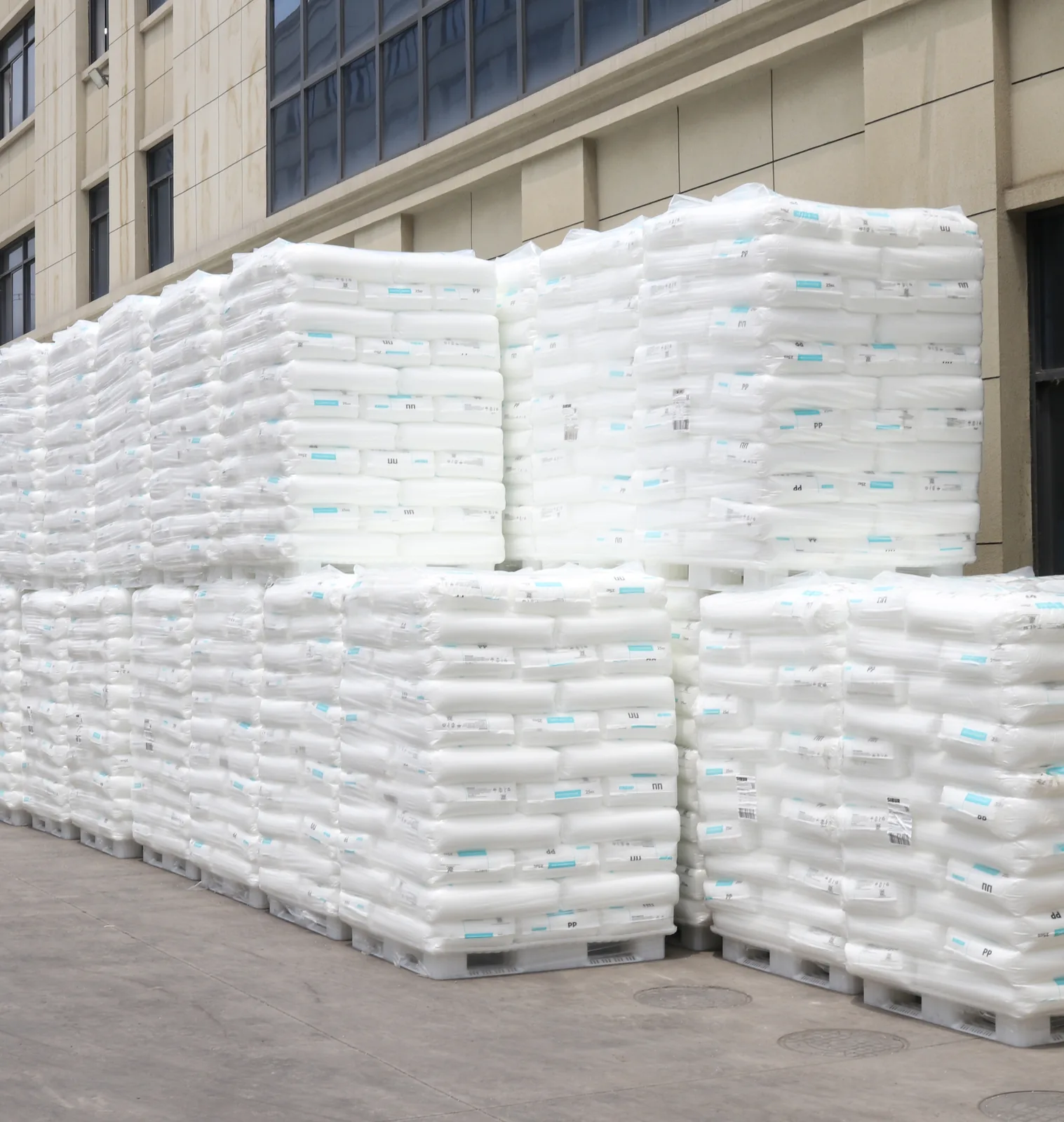
Since foreign inclusions and manufacturing deviation are the two named failure causes in the literature, our controls sit at those points rather than at the end of the line. Incoming resin is 100% virgin material to a fixed specification, checked at goods-in before it reaches a hopper — recycled or regrind content is what puts inclusions into a wall. Dimensional control runs in-line on the extrusion line, because DIN 8077 sets the dimensions and DIN 8078 the general quality requirements and testing, and wall thickness that drifts below the series minimum invalidates the pressure rating the extrapolation assumed. Hydrostatic pressure testing is done batch by batch on the sample regime. Third-party oversight comes through SKZ (Germany), plus ISO, CE and WRAS for potable water contact — ISO 10508 requires that all materials in contact with water intended for human consumption, up to a temperature of 80°C, shall not present any health risk.
The full specification detail, pressure series and certification scope for each line sits on the PPR pipe range, and the batch-level controls are set out on the quality control page. One disclosure worth making plainly: supply is dual-origin. Production is allocated between our Türkiye plant and a partner factory in China depending on market, the origin for your order is confirmed in writing on the proforma invoice, and the certificate of origin, packing list and bill of lading are issued to match.
Conclusion
A 50-year design life is a real, method-backed number: an ISO 9080 extrapolation to the 97.5% lower prediction limit of stress at 20°C, wrapped in a design coefficient, tied to a service condition class with a published temperature profile. It behaves like a floor in practice, because four separate margins all point the same way. It stops applying the moment the system runs outside the class it was certified against — and the standard says so in as many words.
If you are specifying now, work out which ISO 10508 class your duty actually falls in before you compare quotations, then ask each supplier to name the class they are certified to. It is a two-minute filter, and it separates the suppliers who understand the number from the ones repeating it.
Frequently Asked Questions
How long do PPR pipes actually last?
PPR pipe carries a 50-year design life at rated pressure and 20°C, derived by ISO 9080 extrapolation rather than by observation. Real installations often outlast it, because operating temperature, wall thickness tolerance and actual pressure all sit on the conservative side of the design assumptions.
Does 50 years mean 50 years at any temperature?
No. ISO 10508 Class 5, for high temperature radiators, spends 14 years at 20°C, 25 years at 60°C, 10 years at 80°C, one year at 90°C and 100 hours at 100°C. The 50 years is that whole mixture added together, not 50 years at the top figure.
What happens if my boiler thermostat fails and the system overheats?
ISO 10508 budgets malfunction temperature at up to a total of 100 hours across the full 50 years. A stuck thermostat left running for a few weeks consumes several times that allowance in one event, which puts the system outside the profile its class rating assumes.
Can PPR pipe really last 100 years like some suppliers claim?
The 100-year finding comes from excavated-sample studies of PE and PVC pressure pipes. The 2024 Leoben meta-study for TEPPFA reports that no such studies were found on polypropylene pressure pipes, so for PP-R the defensible figure remains the standards-based 50-year design life.
Does hot water shorten PPR pipe life more than pressure does?
Temperature moves you onto a different point of the stress regression curve, which is why ISO 12162 defines a categorized required strength for temperatures other than 20°C. Pressure and temperature act together, and ISO 13760 exists precisely to compute the combined effect of a varying duty.
What is the difference between a 50-year warranty and a 50-year design life?
The design life is a technical expectation under defined operating conditions. The warranty is a commercial undertaking covering material and manufacturing defects. Bekaatherm’s 50-year warranty is set to match the 50-year design life, but it does not turn an installation fault into a claim.
Which service condition class do I need for underfloor heating?
ISO 10508 Class 4 is the profile for under-floor heating and low-temperature radiators: 20°C for 2.5 years, 40°C for 20 years and 60°C for 25 years, with a maximum of 70°C for 2.5 years. High-temperature radiator circuits need Class 5 instead.
Does chlorinated water shorten PPR pipe life?
Disinfectants react with the antioxidants in the pipe material, consuming them until the polymer is left unprotected against oxidation. ASTM F3497-21 is the polypropylene-specific test method for this, and it is a fair question to put to any supplier serving a heavily chlorinated market.