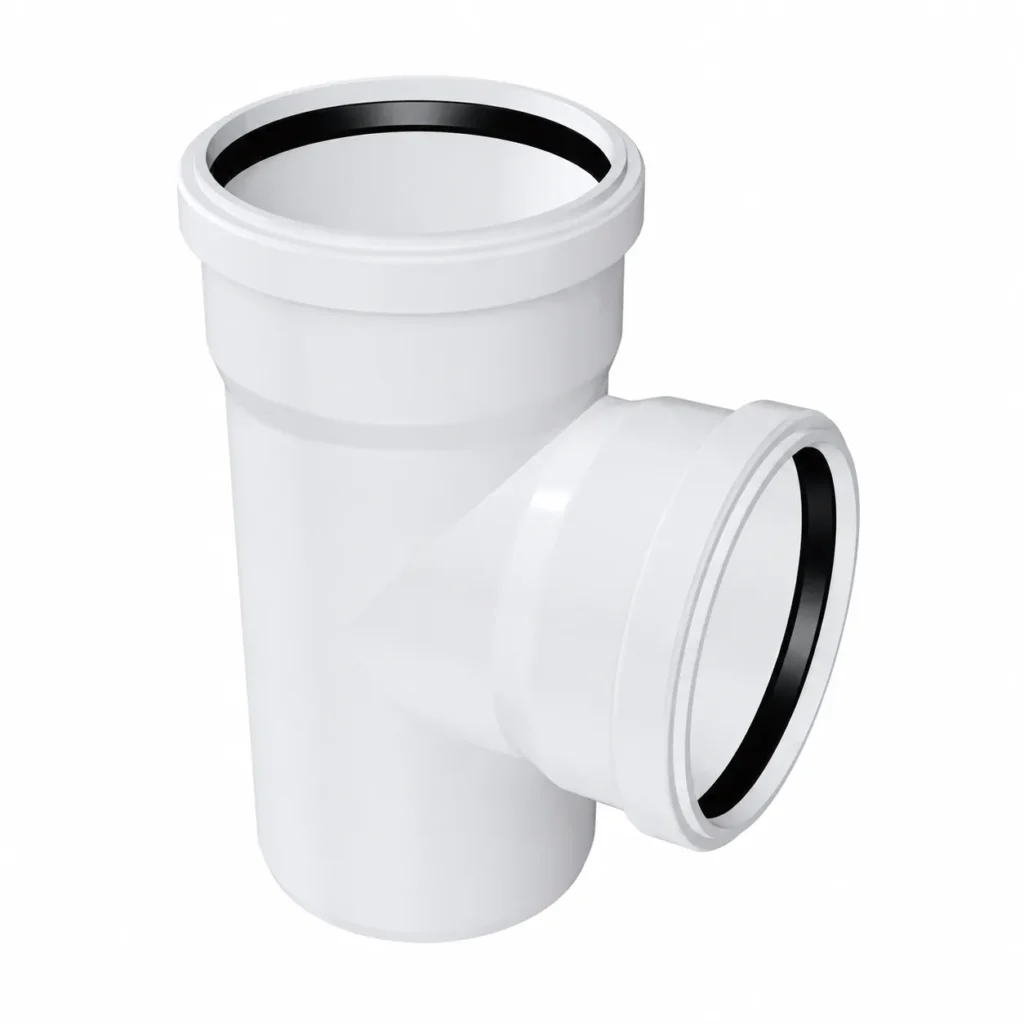
A UPVC NRV valve is not governed by the pipe standard printed on the carton. Anti-flooding devices for buildings sit under EN 13564, a separate standard with six device types — and which of those six types you are allowed to install is decided by national law, not by the European standard. That single distinction is missing from almost every product listing selling a 110mm non-return valve, and it is the difference between a valve that passes inspection and one that does not.
Key Takeaways
- The device standard is EN 13564 “Anti-flooding devices for buildings” (Part 1 Requirements, DIN EN 13564-1:2002-10). EN 1329 covers the pipe and fittings — it is not the valve standard.
- EN 13564-1 defines six types. Types 0–3 are backflow stops for continuous pipes; Types 4 and 5 sit in cellar floor drains.
- Under EN 12056, the backflow level is normally the road surface above the sewer, not the sewer invert — far higher than most people assume.
- In Germany, wastewater containing faeces may only be protected by a Type 3 device with “F” marking. A passive mechanical flap valve cannot lawfully protect a WC there.
- EN 12056-4 requires protection only for drainage below the backflow level. Fixtures above it must drain by natural gradient and must not drain through a backflow stop.
- Cite EN 1329-1:2026 in a 2026 specification. CEN approved it on 27 March 2026, superseding EN 1329-1:2020, and it now permits recyclate content up to 100%.
- Bekatherm supplies a UPVC Non Return Valve in DN110–200, article numbers BK-383 to BK-386.
Which Standard Actually Governs the Valve
Search for a UPVC NRV valve and you get product listings citing EN 1329, or nothing at all. EN 1329 is a real and relevant standard, but it specifies the pipes and fittings of a PVC-U soil and waste system. It does not specify an anti-flooding device.
The device standard is EN 13564, “Anti-flooding devices for buildings”, in three parts: Part 1 Requirements (DIN EN 13564-1:2002-10, 12 pages), Part 2 Test methods, Part 3 Quality assurance. Part 1 sets the types and the requirements for materials, performance, design, construction and marking of factory-made anti-flooding devices — for faecal and/or non-faecal wastewater, in building drainage systems or within the curtilage of a building, operated under gravity.
Two phrases there do real work. “Faecal and/or non-faecal” splits the six device types apart; “operated under gravity” excludes pumped systems, which take a different route. So a specifier who writes “non-return valve to EN 1329” into a schedule has cited the pipe standard and left the device unspecified — while the inspector checks the installed device against EN 13564.
Both belong in the specification, doing different jobs: EN 1329-1 for the PVC-U pipework the valve connects into, EN 13564-1 for the valve, its type classification and its marking. Bekatherm’s UPVC drainage line is referenced to EN 1329 and EN 1401, which covers the piping system. The EN 13564 type is a separate question you should put to any supplier, including us.
Finding the Backflow Level on Your Project
Everything here keys off one datum, and it is the one most often placed wrong. Under EN 12056 the backflow level is the highest possible wastewater level at a specified position in a sewer system. As ACO’s building drainage handbook puts it, “the critical backflow level defined in accordance with EN 12056 is usually the surface of the road (unless another point is specifically mentioned).” The road surface — not the sewer pipe, not the invert. In a surcharge, wastewater rises up the sewer shafts until it floods the shaft, flows out through the manhole cover, and floods the road. That manhole rim is the ceiling of the system, so it is the level your drainage gets judged against.
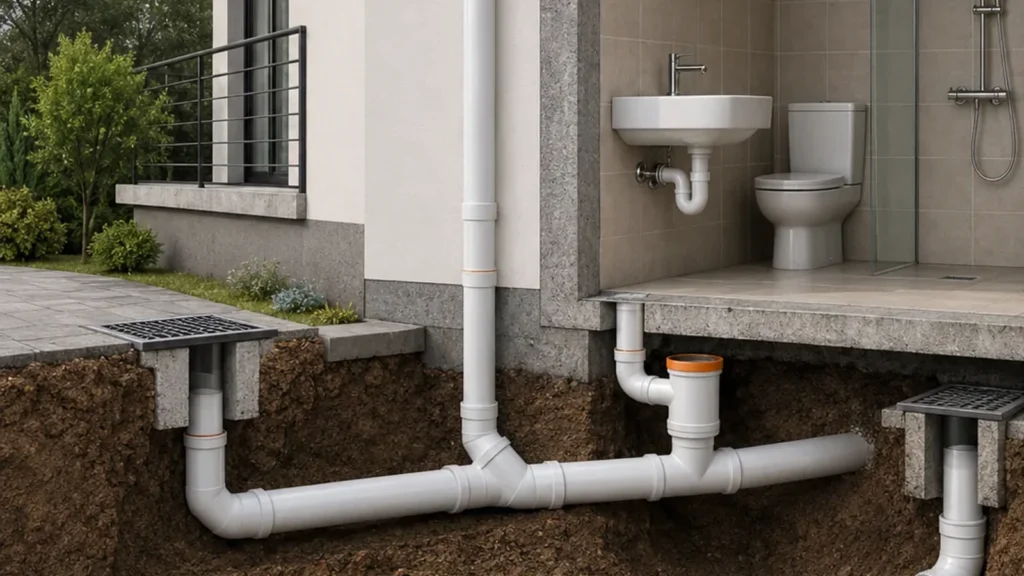
This is why so many ground-floor and semi-basement fixtures turn out to sit below the backflow level once someone measures. A shower tray 400mm below the pavement looks fine on a section drawing; against a backflow level set at the road surface it is a below-level fixture and needs protection. Get this datum from the drainage authority for the specific connection point, in writing, and put it on the drawing. Every type decision that follows depends on it.
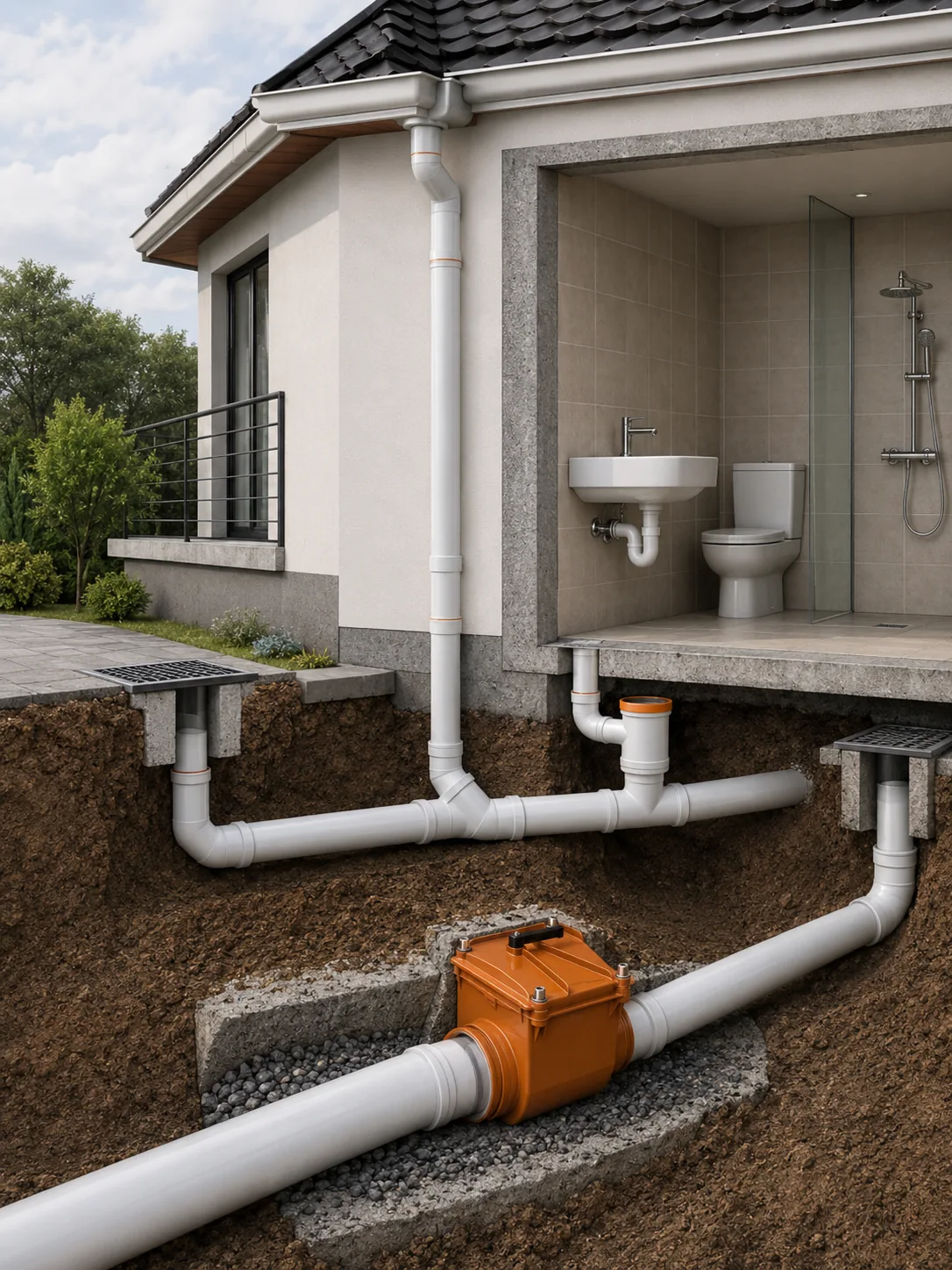
The Six EN 13564-1 Device Types
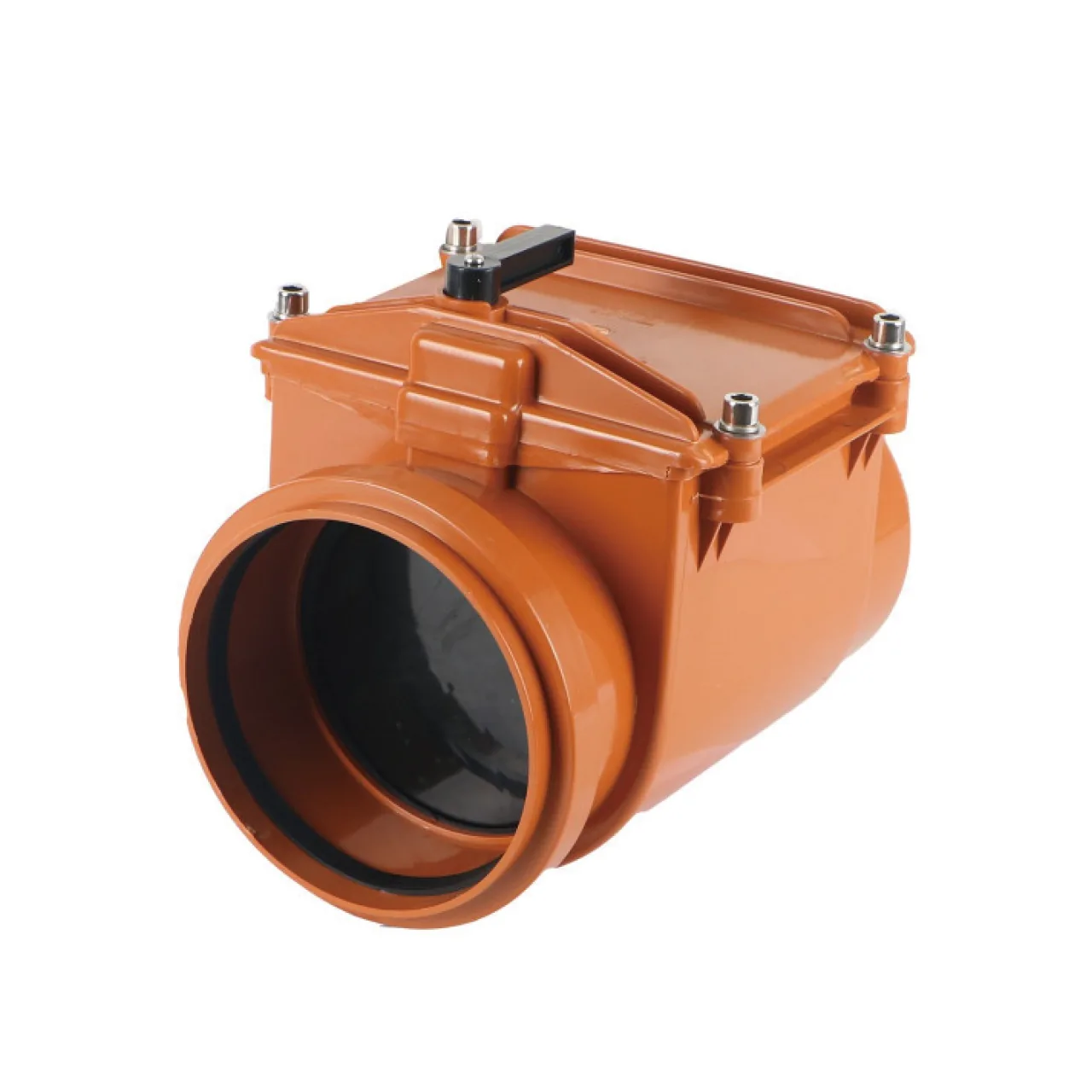
DIN EN 13564-1 defines six types. Types 0 to 3 are backflow stops for continuous pipes — the in-line devices that look like the valve at the top of this page. Types 4 and 5 are built into cellar floor drains. They differ by how many closing devices they carry and whether they include a manually lockable or powered emergency seal.
The table below is summarised from ACO’s building drainage handbook, section 2.1, “Assignment of backflow stop types pursuant to EN 13564-1” — a manufacturer’s summary rather than the standard text. Confirm the row you rely on against EN 13564-1 directly before it goes into a specification.
| Type | Installation | Automatic seals | Emergency seals | Intended wastewater |
|---|---|---|---|---|
| Type 0 | Horizontal pipe | 1 | 0 | Rainwater utilisation plants |
| Type 1 | Horizontal pipe | 1 | 1 | Rainwater utilisation plants |
| Type 2 | Horizontal pipe | 2 | 1 | Rainwater utilisation plants; wastewater free of faeces |
| Type 3 | Horizontal pipe | 1, operated electrically or pneumatically | 1 | Wastewater with and without faeces — marked “F” |
| Type 4 | Installed in floor drains | 1 | 1 | Wastewater free of faeces |
| Type 5 | Installed in floor drains | 2 | 1 | Wastewater free of faeces |
Two things jump out. Only Type 3 handles wastewater containing faeces, and it does so with a motor-driven closing mechanism rather than a passive flap. Type 3 is also the only backflow stop with an alarm — Types 0 to 2 have none. A backflow pressure switch closes its motor-driven seal when backflow starts and reopens it once the backflow subsides, with a manual blocking mechanism as the emergency seal.
The design constraint nobody mentions
If a Type 3 is protecting a WC below the backflow level, the people using that WC need access to another WC above the backflow level. That is a constraint on the building, not on the valve — and it is the kind of thing that surfaces at handover, long after the valve schedule is closed. If the below-level WC is the only WC in a basement flat, the design has a problem no product can fix.
Cellar drains and faecal wastewater
Cellar drains, with or without backflow stops, must only carry wastewater free of faeces. Toilets and urinals must not drain through them — hygiene, smells, and blockage risk. They are normally supplied with a DN 100 lateral outlet socket and class K3 gratings suitable for walking on.
Where They Are Mandatory: National Law Decides
EN 13564 defines the six device types. It does not tell you which of them you are allowed to install. As ACO states plainly: “The use of the different types is regulated by national law.”
The European standard is a menu of device types; the national regulator decides which items on that menu are legal for which application. A valve fully compliant with EN 13564-1 can still be unlawful for the duty you have in mind, in your country.
| Country | Approved types |
|---|---|
| Germany | Rainwater utilisation plants: Types 0 and 1. Wastewater free of faeces: Types 2, 3 and 5. Wastewater containing faeces: only Type 3 with F marking. |
| Austria | Wastewater free of faeces: Types 0 to 5. Wastewater containing faeces: only Type 3. |
| Switzerland | Backflow stops may only be used following project-related authorisation. |
Take the German row seriously — it disqualifies a whole category of product. For a toilet below the backflow level in Germany, only a Type 3 with F marking may be used, and Type 3 is powered. So a plain mechanical flap valve, the kind dominating the search results for this product, cannot lawfully protect a WC there, however well made it is. If your schedule says “110mm PVC non-return valve” against a below-level WC in that market, the schedule is wrong.
Outside those three countries we did not verify a national position and will not guess at one — that includes the UK, the US, Türkiye and the Gulf. Requirements vary by jurisdiction and by the role of the connection, so confirm yours with the local drainage authority or building control body before the type selection is fixed. The framework still applies everywhere: find the backflow level, establish whether the wastewater carries faeces, then find out which types your regulator accepts for that pairing.
When a Non-Return Valve Is the Wrong Answer
There are two lawful routes to protecting below-level drainage, and the passive valve is only one. The standards stipulate that sanitary installations beneath the backflow level must be protected either by lifting plants — active prevention — or by backflow stops, which are passive.
The passive device has no power supply and no pump: the flap lies passively on a seat and opens only under the pressure of water draining out through it. The active route uses lifting plants, pumps and pump stations, which need external energy to move effluent against the backflow. Layout and calculation for that route sits in BS EN 12056-4:2000, published 15 September 2000, which covers lifting plants for faecal and faecal-free wastewater and rainwater within buildings and sites.
The hard constraint on the passive route: a gradient to the sewer is needed for backflow stops to work. Where the sewer base sits higher than the sanitary installations, a lifting plant must transport the wastewater into the sewer via a backflow loop. No valve solves that geometry — if your invert levels do not fall to the connection, stop looking at valves.
The four conditions that must all hold
Passive backflow safety valves are only permissible under certain conditions. All four of these must be true, not just one or two:
- Wastewater must be capable of draining away along a natural slope.
- There must only be a small number of users.
- Installation must be located in a room with inferior utilisation.
- The drainage points cannot be used during a backflow situation.
“A room with inferior utilisation” means a cellar or utility room — not a habitable space, not a commercially critical one. Run that test against a basement laundry in a 40-unit block and it fails on user count before you reach the room-use clause. That building needs a lifting plant. Saying so costs us a valve sale, but it is what the standard says.
Best for / not for
| A passive UPVC backflow stop fits | Specify a lifting plant or powered Type 3 instead |
|---|---|
| A cellar floor drain or utility-room gully carrying faecal-free wastewater, with fall to the sewer | Any WC, urinal or faecal branch below the backflow level in Germany or Austria |
| A rainwater utilisation connection where the regulator accepts Type 0 or 1 | Sites where the sewer base sits above the fixtures — no gradient, no passive function |
| Low-occupancy buildings where drainage can simply stop during a surcharge event | Apartment blocks, hotels, hospitals and anywhere drainage must keep working through a surcharge |
| Retrofit into an existing DN110–200 gravity run with an accessible inspection point | Commercially critical rooms — server rooms, cold stores, retail stock areas |
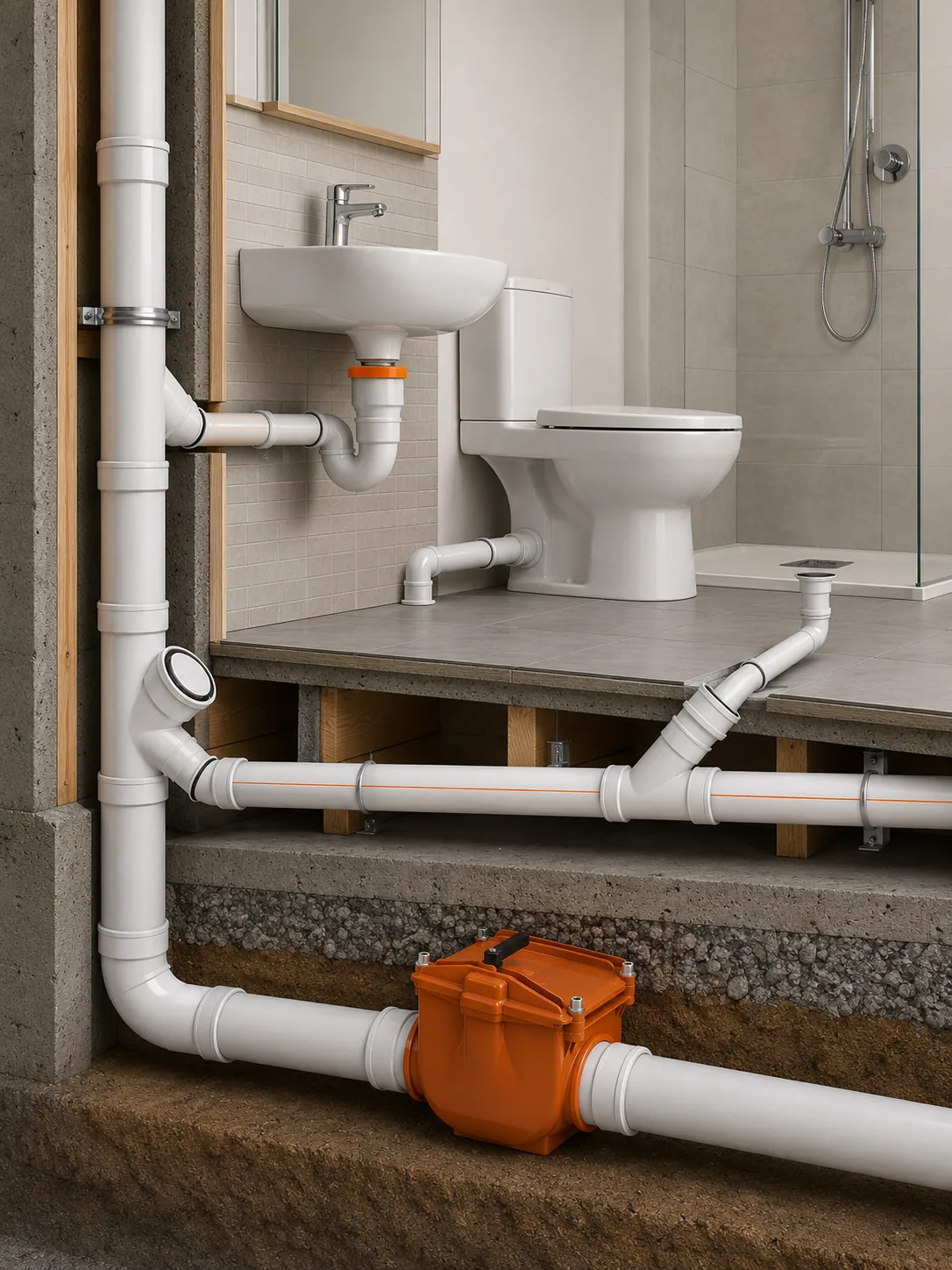
The Main-Drain Mistake the Standard Forbids
The instinct is to fit one large valve on the main outgoing drain and protect the whole building at once. It looks efficient, costs less in fittings, and is a design error the standard rules out.
Under EN 12056-4, only drainage installations beneath the backflow level have to be protected. Wastewater generated above that level must be able to flow past any backflow stop installed. EN 12056 stipulates that drains above the backflow level are drained by natural gradient — and that those drainage points must not drain via lifting plants or into backflow stops.
The reason is in how the device behaves during an event. These units do not seal in one direction only: they totally seal off backflowing wastewater, and they also seal off any wastewater pipes flowing to the backflow stop. While the sewer is surcharged, everything upstream is locked in. Put the valve on the main drain and you have connected forty above-level bathrooms to a device that shuts them all down the moment the sewer backs up. The basement stays dry; the rest of the building has nowhere to drain.
Correct practice is narrower: protect only the branch serving the below-level fixtures, and let everything above the backflow level run to the sewer by gravity, past the device. On a drawing the valve sits downstream of the basement group and upstream of nothing else. Check this on every layout you review — it is a common error, and visible in ten seconds once you know to look.
Which EN 1329 Edition to Cite in 2026
The pipework standard around the valve moved this year, so a specification carrying the old edition number now cites a superseded document. EN 1329-1:2026 — “Plastics piping systems for soil and waste discharge (low and high temperature) within the building structure — Unplasticized poly(vinyl chloride) (PVC-U) — Part 1: Specifications for pipes, fittings and the system” — was approved by CEN on 27 March 2026 and published in May 2026. It runs to 48 pages under ICS 23.040.20 and 91.140.80, and it supersedes EN 1329-1:2020.
One change carries real commercial weight: the 2026 edition allows recyclate content up to 100%, with material sources expanded to virgin, reworked and recyclate, and guidance on PVC-U recyclate use in Annex A. It also adds annealing procedures for Vicat softening temperature testing and aligns definitions with EN 14541-1.
Read that as a specification-writing warning, not an accusation about anyone’s product. If your schedule says only “to EN 1329-1” and stays silent on material, you can now legally be supplied a 100% recyclate product against that citation with no contractual basis to reject it. If recyclate content matters on your project, name a limit yourself — the standard has stopped doing that job for you.
The companion conformity document also moved: CEN/TS 1329-2:2026, Part 2 Assessment of conformity, released May 2026. It adds procedures for recyclate-containing products and new guidance on batch and process testing frequencies for those formulations. Manufacturers must run quality plans aligned with EN ISO 9001 principles across type testing, batch release testing, process verification testing and audit testing.
Buried in that is the best audit question on this page: type tests must be performed on both virgin and maximum-recyclate-content formulations. Ask any supplier whether their type testing covers the maximum-recyclate formulation, not just the virgin one. It is specific, answerable, and separates suppliers who have read the new edition from those who have not.
The contrast is useful: while the pipe standard moved to a 2026 edition, DIN EN 13564-1:2002-10 is still listed as current with no superseding edition found. The device standard has been stable; the product standard around it has not.
What We Check on Delivery and What You Should Ask Us
The B versus BD marking
EN 1329-1 uses application area codes reflected in the product marking. Code “B” means above ground inside the building, or outside fixed onto the wall. Code “BD” means both inside buildings and buried in ground within the building structure — and that buried use covers only components with nominal outside diameters of 75 mm or greater.
A component marked “B” that ends up in a buried chamber is a specification failure — one you catch by reading the print on the part before it goes in the ground. Our Non Return Valve is DN110–200, clearing the 75 mm threshold on size, but size is not the marking. Check that the marking on what you receive says what your application needs, on our product and anyone else’s.
The documentation gap, stated plainly
Bekatherm has not published an EN 13564-1 type classification, an F marking, or a test certificate number for the BK-383 to BK-386 valve, and we are not going to assign it a type number in an article to make this page more convincing. Ask us against your project and size, and we will tell you what documentation exists and what does not.
Put the same question to every supplier on your tender list — a listing showing a price and a size but no EN 13564 type is not enough for a specifier to sign against. Our broader certification position (SKZ, ISO, CE, WRAS) is on the certifications page; those cover the ranges they were issued for and are not EN 13564 conformity for this valve.
Maintenance and who is allowed to do it
Backflow safety valves must be regularly maintained and inspected to guarantee safe operation, in accordance with the relevant standards and the manufacturer’s maintenance regulations. The work belongs to properly qualified personnel — staff whose training, knowledge and practical experience let them carry out the necessary tests — or to qualified technicians from third parties with certified knowledge of operating and testing drainage installations.
Be careful what you write into an O&M schedule. Typical supplier guidance runs roughly every 6 to 12 months, more often on dirty systems, but no standards-body figure was found for this article and that range is not a code requirement. Specify the access that makes inspection possible — a valve you cannot reach will not be maintained — and treat seal replacement as a lifecycle item. One caveat: these valves are widely marketed as blocking rodent ingress, which is real and worth having, but it is retailer framing rather than an EN 13564 performance requirement. Do not write it into a specification as a certified function.
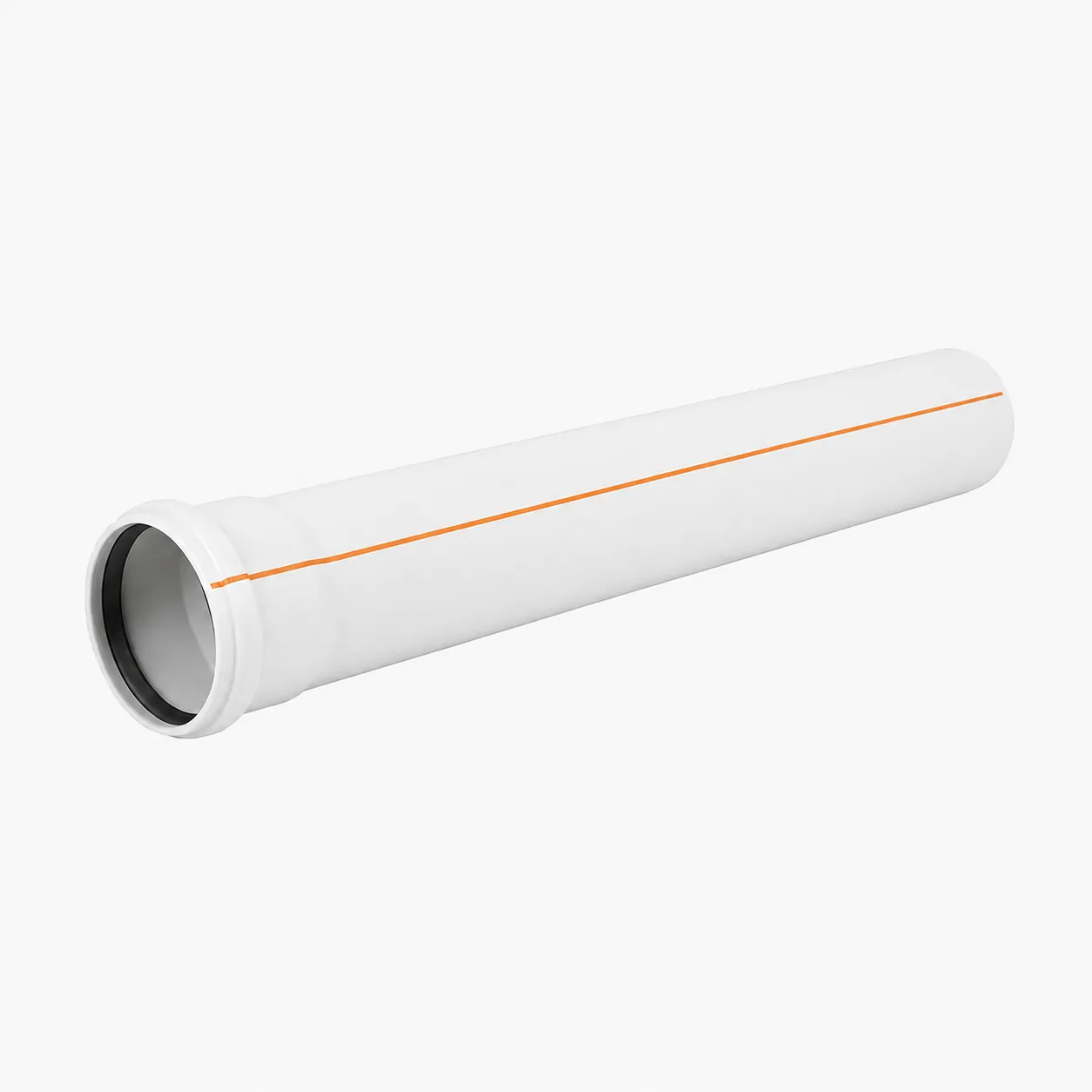
Sizes, Article Numbers and Sourcing
The Bekatherm Non Return Valve runs DN110–200 under article numbers BK-383 to BK-386. That covers main soil-stack and buried-drain sizes but not small waste branches. The product page describes its function as stopping sewer backflow entering the building during surcharge.
It ships as part of a system. The surrounding UPVC drainage line runs from drainage pipe TYPE1 (DN50–200, s=3–3.9mm, BK-223–264) and TYPE2 (s=1.8–3.2mm, BK-265–306) through elbows, branches, sockets, reductions, cleaning tees in DN110–200, plugs, siphons, a DN110 floor drain and clamps. Where an internal stack carries an acoustic requirement, look at the PP drainage system instead — referenced to EN 1451-1, EN 12056 and EN 14366, the last covering laboratory measurement of noise from waste water installations.
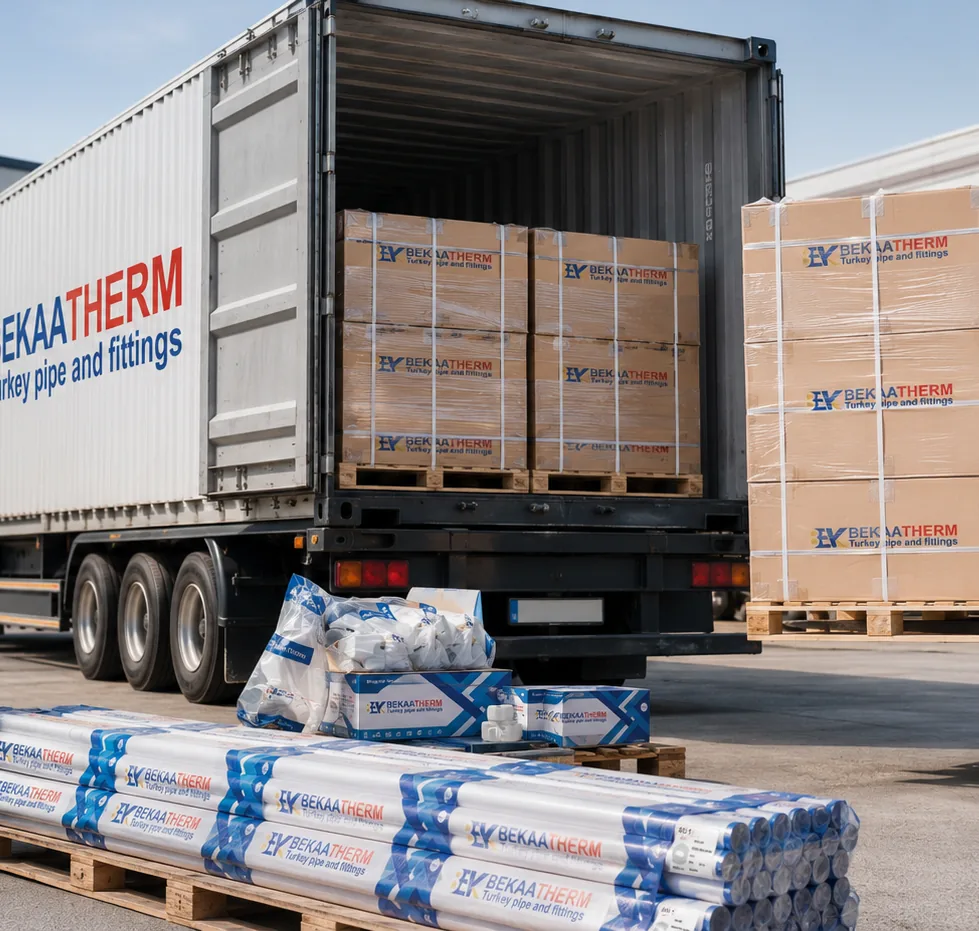
Commercially: a mixed trial is one 20GP mixed container of pipe, fittings and valves; single-size orders run at 500 kg per size and colour. Lead time is 15–25 days on in-production sizes, 30–45 days for private-label runs. Payment is 30% T/T deposit with 70% against copy B/L, and an irrevocable L/C at sight is accepted from USD 50,000. A 20GP gives roughly 33 m³ usable against a roughly 28 tonne payload. A typical mixed load splits about 60% pipe, 30% fittings and 10% valves by volume — worth knowing on a first order, because valves take less space than importers expect and are easy to under-order against the pipe.
Two disclosures belong in a specifier’s file. Supply is dual-origin — Türkiye plus a Chinese partner factory, allocated by market and confirmed in writing per order on the proforma invoice, with certificate of origin, packing list and bill of lading kept consistent. Ask for that confirmation rather than assuming it. On customs classification, this product sits genuinely between HS 3917 (plastic pipes and fittings) and HS 8481 (taps, cocks and valves): it functions as a valve but sells as a drainage fitting. Confirm the code with your broker for the destination before the entry is filed.
Prices are quoted on request against a size and quantity list. Our products carry a 50-year warranty against material and manufacturing defects — with the caveat that a moving flap in a drain is a wear part, and no warranty replaces the maintenance regime above.
Conclusion
Take the order of operations. Establish the backflow level from the drainage authority, classify the wastewater as faecal or faecal-free, then check what your national regulator permits for that combination — EN 13564 gives you six types, your country decides which are legal. Only then choose between a passive backflow stop and a lifting plant, and only then look at products.
Work a real case that way and most of it is datum, classification and law — the product choice comes last, which is why an e-commerce listing showing a 110mm valve and a price cannot answer the question. Two failure modes account for most of what goes wrong: specifying a passive flap valve where the law demands a powered Type 3 with F marking, as on German WC branches; and fitting the device on the main drain instead of the below-level branch, which converts a flood-protection measure into a building-wide drainage shutdown during the exact event it was bought for.
Requirements vary by jurisdiction and by project, so treat this as the framework rather than approval for your installation — confirm with your local drainage authority or building control body before it is fixed. When you are ready to check a product against it, ask us for the EN 13564-1 classification and test documentation for your size, and hold every other supplier to the same question.
Frequently Asked Questions
Is a UPVC NRV valve the same thing as a backflow stop or an anti-flooding device?
In practice yes — the terms are used interchangeably across markets, which is exactly why buyers order the wrong product. EN 13564 calls the product family “anti-flooding devices for buildings” and the in-line versions “backflow stops for continuous pipes”. Trade listings usually call the same item a non-return valve or NRV. When you order, quote the EN 13564-1 type and the DN size rather than the trade name.
Can I fit a mechanical UPVC non-return valve on a toilet?
Not in Germany. For wastewater containing faeces, only a Type 3 device with F marking may be used, and Type 3 has a motor-driven closing mechanism operated electrically or pneumatically. Austria also restricts faecal wastewater to Type 3. Switzerland requires project-related authorisation for backflow stops. Outside those three countries, confirm the rule with your local authority.
Where exactly is the backflow level?
EN 12056 defines it as the highest possible wastewater level at a specified position in the sewer system, and it is usually the surface of the road unless another point is specifically mentioned. During a surcharge, wastewater rises in the sewer shafts, floods the shaft and flows out through the manhole cover onto the road surface. That is why it sits much higher than the sewer pipe itself, and why many ground-floor fixtures turn out to be below it.
Should the non-return valve go on the main drain to protect the whole building?
No. EN 12056 requires that drains above the backflow level are drained by natural gradient and must not drain into backflow stops. A backflow stop seals in both directions, so it blocks upstream fixtures from draining during an event. Protect only the branch serving the below-level fixtures.
Which EN 1329 edition should I cite in a 2026 specification?
EN 1329-1:2026, approved by CEN on 27 March 2026 and published in May 2026, superseding EN 1329-1:2020. The companion conformity-assessment document is CEN/TS 1329-2:2026. The 2026 edition allows recyclate content up to 100%, so name a recyclate limit in your specification if it matters for the project.
What sizes does the Bekatherm non-return valve come in?
DN110 to DN200, under article numbers BK-383 to BK-386, as part of the UPVC drainage range. That covers main soil-stack and buried-drain sizes but not small waste branches. Lead time on in-production sizes is 15 to 25 days, and valves account for roughly 10% of a typical mixed container by volume.
How often should a drainage backflow valve be inspected?
The documented obligation is that backflow safety valves are regularly maintained and inspected in accordance with the relevant standards and the manufacturer’s maintenance regulations, by properly qualified personnel or technicians. Typical supplier guidance suggests roughly every 6 to 12 months, more often on dirty or high-use systems, but that range is trade guidance rather than a code requirement — follow the manufacturer’s stated interval.
Written by the Bekatherm technical team. Bekatherm manufactures PPR, UPVC, HDPE and PP piping systems in Türkiye — 30 years of manufacturing, a 120,000 m² plant, 1000+ staff, 10,000 moulds, and 98 items across 4 systems exported to 118+ countries. Questions on drainage specification: contact the team or see the FAQ.