Key Takeaways
- Neither joint is a compromise. EN 1329-1 covers jointing by solvent-cement socket or elastomeric ring seal, and EN 1401-1 applies to ring seal, adhesive and welded joints alike. Both are compliant, so the choice is driven by movement, temperature and access.
- The withdrawal gap is not one number. Brett Martin’s above-ground soil and waste instruction is to withdraw the spigot to 10 mm from the socket face. Wavin’s buried OsmaDrain instruction is a minimum of 12 mm. Using one figure everywhere means one of your two systems is wrong.
- EN 681-1 rates seals for drainage at 45 °C continuous flow and 95 °C intermittent. A commercial kitchen or laundry branch that runs hot most of the shift sits against that continuous ceiling — that is the honest technical case for solvent weld on those branches.
- Solvent weld buys joint security and costs you time: a 90-second window before the cemented surfaces must be joined, a 30-second hold, 2 hours to strength and 24 hours before testing.
- Solvent weld does not remove the expansion problem. Brett Martin states plainly that an expansion allowance is also necessary in solvent weld systems. PVC-U moves 0,06 mm per metre per °C, so 2 m of pipe grows 2,4 mm over a 20 °C rise.
- Check the edition your supplier declares against. EN 1329-1:2026 was published on 5 May 2026 and supersedes the 2020 edition; the unamended EN 1401-1:2019 was withdrawn on 10 February 2026, leaving EN 1401-1:2019+A1:2023 as the edition to cite.
The merchant guides answer this in about four hundred words: push-fit is fast, solvent weld is permanent, pick one. Fine advice for a homeowner replacing a waste trap. Useless if you have to write a specification, check a supplier’s declaration, or explain why a stack that passed its air test is dripping eighteen months later.
This comparison is built the other way round — from the standards and the manufacturers’ own installation manuals. Every number below has a named source. Where a figure could not be verified against primary text, it is not printed here, and I say so where it matters.
Neither joint is the compliant one — the standards permit both
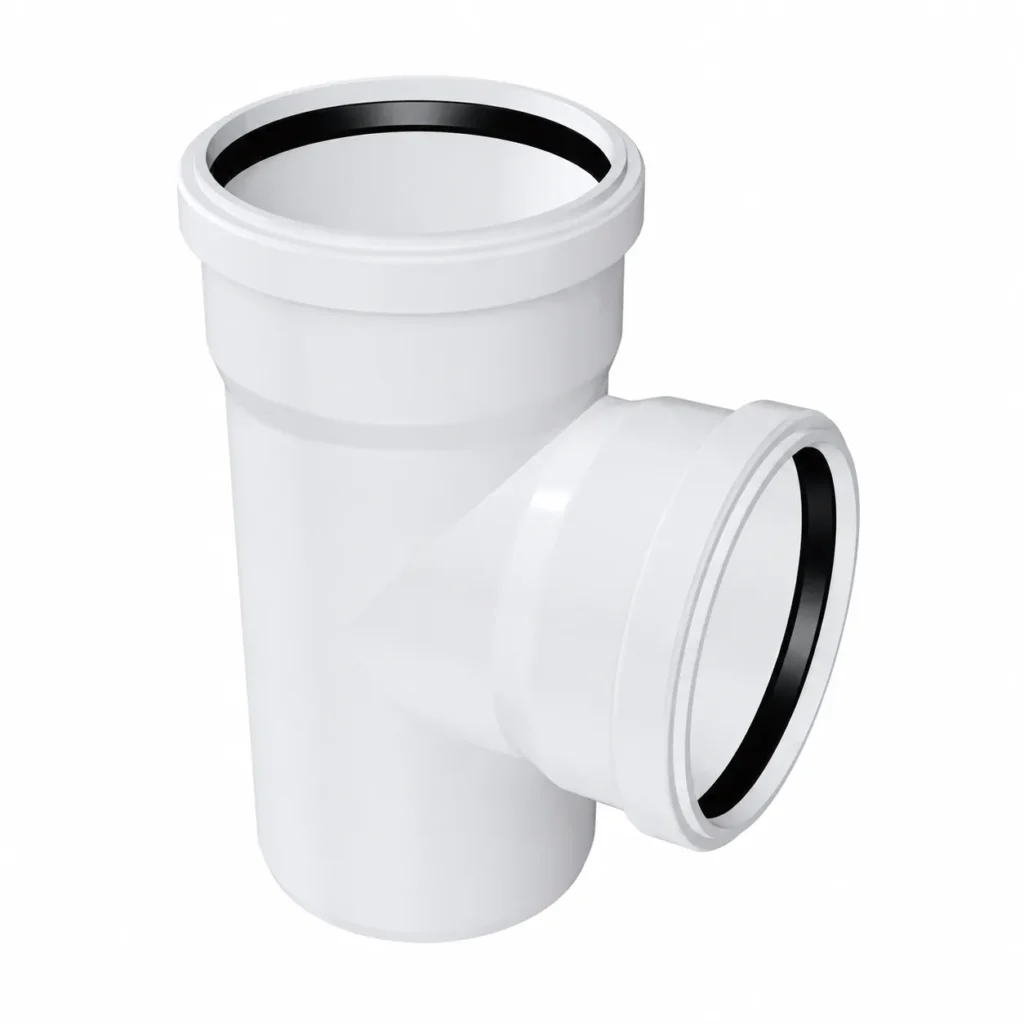
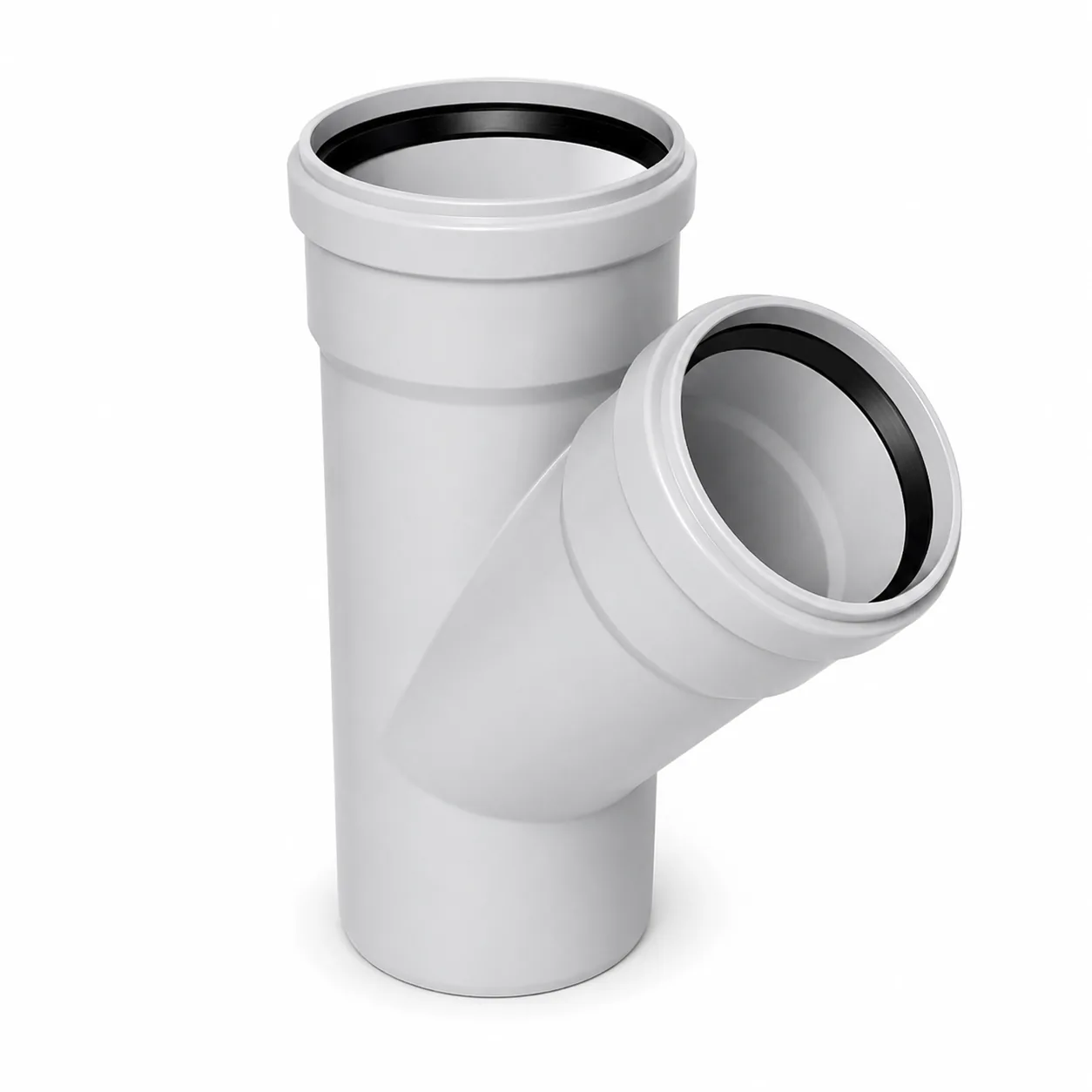
A surprising number of tender queries begin with someone asking which joint type “meets the standard”. Both do. EN 1329-1 — the product standard for PVC-U soil and waste discharge inside the building structure — covers jointing by solvent-cement socket or by elastomeric ring-seal type. EN 1401-1, the buried non-pressure drainage and sewerage standard, applies to pipes and fittings with or without an integral socket, with ring seal joints as well as adhesive and welded joints.
That kills the quality-hierarchy framing before it starts. Ring seal is not the amateur option and solvent weld is not the professional one. They are two engineered answers to two different problems, and a well-built system usually contains both.
Two edition changes landed this year. EN 1329-1:2026 was published on 5 May 2026 and supersedes EN 1329-1:2020, with the matching conformity-assessment document CEN/TS 1329-2:2026 published the same day. On the buried side, the unamended EN 1401-1:2019 shows status withdrawn effective 10 February 2026, having been merged into EN 1401-1:2019+A1:2023. A datasheet still citing EN 1329-1:2020 is citing a superseded edition. Ask which edition the declaration of performance was drawn against — the answer tells you how current your supplier’s paperwork is.
There is also a marking on the pipe itself. Above-ground PVC-U carries an application area code: B for above ground inside buildings or fixed to the external wall, BD for both indoor use and burial within the building structure, with BD limited to nominal outside diameters of 75 mm and above. Buried pipe uses U outside building structures and UD for both. If someone offers B-marked pipe for a run under a slab, the marking has already answered the question.
The number that drives the whole decision: 0,06 mm per metre per °C
PVC-U has a coefficient of thermal expansion of approximately 0,06 mm/m/°C. Brett Martin’s soil and waste technical guide works it through: a 2 m length of soil or waste pipe will expand by 2,4 mm for a 20 °C rise in temperature. Run the same arithmetic up a four-storey external stack and you are managing tens of millimetres of movement over a summer afternoon.
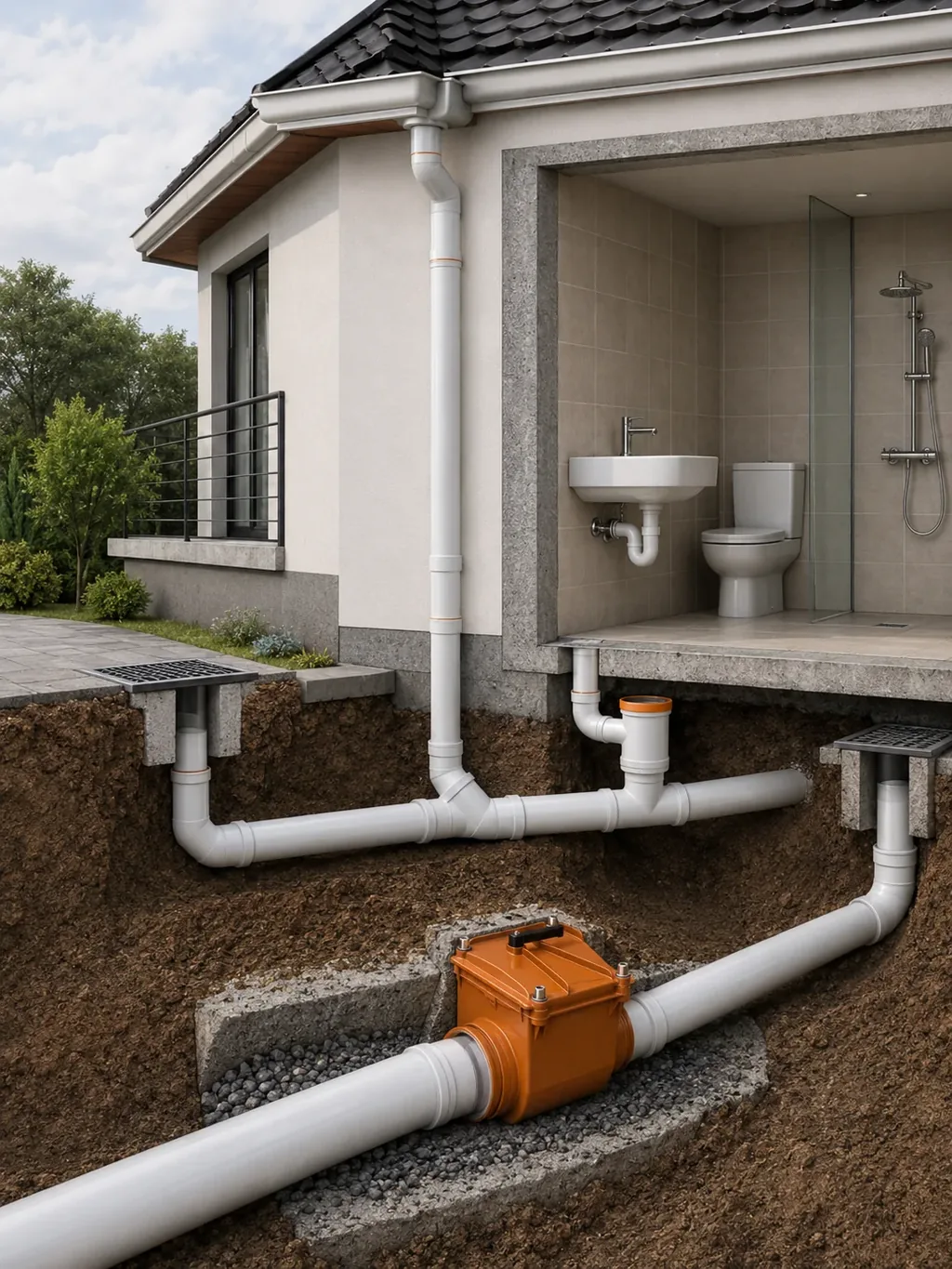
That movement has to go somewhere. In a ring-seal system it goes into the socket, which is why Wavin describes its buried sockets as fitted with ring seals that act as both a sealing and an expansion joint. One component, two jobs. Push the spigot fully home and you have quietly converted an expansion joint into a rigid one, transferring load that used to be absorbed into the socket wall.
Here is the point most comparison pages get wrong. Solvent weld does not make the movement disappear. Brett Martin is explicit: all plastic soil and waste systems move with temperature, and an expansion allowance is also necessary in solvent weld systems — which is why solvent weld runs often carry ring-seal fittings placed deliberately as the expansion device. Once you see that, the either/or question dissolves. The real question is where each joint belongs.
10 mm above ground, minimum 12 mm buried — and why the difference is real
This is the single most useful thing on this page, and I have not found it stated side by side anywhere else.
For above-ground soil and waste, Brett Martin’s push-fit sequence is: push the pipe end or fitting spigot fully into the ring seal socket, mark the pipe at the socket face — then withdraw until the mark is 10 mm away from the face. That gap is the thermal movement allowance inside the socket.
For buried drainage, Wavin’s OsmaDrain manual says something different: push the spigot fully home, mark it at the socket face, then withdraw by a minimum of 12 mm. Where the fitting carries a moulded depth-of-entry mark, that mark is set so the pipe can expand into the socket by a minimum of 12 mm — insert until the mark is just visible.
Two applications, two manufacturer instructions, two numbers. Do not average them and do not carry one across the slab. An installer who learned 10 mm on soil stacks and applies it in a trench is working outside the buried manufacturer’s instruction — and has taken 2 mm of allowance out of a joint that also has to survive backfill settlement. Follow the manual for the system you actually bought; these two are cited because they are published and checkable.
The allowance is easy to lose after you have made it
Brett Martin adds a warning that reads like it was written after a site visit: as installation progresses, a continuous check should be made to ensure the expansion allowance has not been lost. It goes by ordinary means. Someone lifts a length to get a bracket in and the joint below closes up. A branch gets pulled to meet an appliance and takes the gap out of two joints upstream. Nobody notices, because the joint still looks made. Walk the run before sign-off and confirm the marks are still visible. It costs ten minutes.
Install speed, expressed only in numbers you can check
You will see claims that push-fit is two or three times faster. No authoritative published figure exists for joints per hour or labour cost per joint, so there is no multiplier in this article. What there is, is a set of published time constraints — and they make the speed argument on their own.
A ring-seal joint is finished when the spigot is pushed home and withdrawn to the mark. No waiting stage. A solvent-weld joint imposes a schedule, and Brett Martin gives it precisely: insert the coated spigot into the coated socket immediately with a slight twisting motion to spread the adhesive and remove air bubbles — and if cemented surfaces are left unjoined for longer than 90 seconds, bonding will not be totally effective. Then hold still for 30 seconds, wipe off excess cement, leave a further 2 hours to gain strength, and do not test for at least 24 hours.
That 90-second window bites hardest on large diameters. On a 110 mm or 160 mm socket there is a lot of surface to cover with cleaner and cement, and one person in awkward access can burn ninety seconds without hurrying. This is where solvent joints go wrong, and the failure is invisible: the joint looks made, holds water at low head, and lets go later.
| Stage | Ring seal (push-fit) | Solvent weld |
|---|---|---|
| Preparation | Cut square, chamfer to about half the wall thickness at about 15°, remove swarf, lubricate the spigot | Cut square, deburr, clean both surfaces free from dirt, grease and water, apply solvent cleaner |
| Assembly window | None | 90 seconds from cement application to joining |
| Hold | None | 30 seconds |
| Movement allowance | Built into the joint: 10 mm above ground, min 12 mm buried | Must be provided elsewhere in the run — an allowance is still necessary |
| Ready for strength | Immediate | 2 hours |
| Ready for testing | Immediate | Not before 24 hours |
| Wet or damp conditions | Tolerant — surfaces must be clean and free from grit, and the lubricant is water-based | Surfaces must be free from water |
| Reversible | Yes — can be pulled apart for alteration | No — cut out and replace |
Time figures from the Brett Martin Soil & Waste Technical Guide; withdrawal figures from Brett Martin (above ground) and the Wavin OsmaDrain Product & Installation Manual (buried). Always work to the manual for the system you have bought.
Temperature: the one place where the ring seal genuinely has a ceiling
If you take one specification decision from this article, take this one. EN 681-1 — the material standard for vulcanized rubber seals — covers drainage, sewerage and rainwater systems at continuous flow temperatures up to 45 °C and intermittent flow up to 95 °C. (The same standard covers cold potable water to 50 °C and hot water supply to 110 °C, which is why quoting a single “seal temperature” number without saying which duty is meaningless.)
Read the two drainage numbers as a duty cycle, not a limit and a bonus. A domestic bathroom stack sees hot water in bursts — a bath emptying, a shower — with long cold intervals. That is intermittent duty and 95 °C gives plenty of headroom. A commercial kitchen pot-wash branch, a laundry, or a run collecting several dishwashers on a short cycle is a different animal: the pipe is warm most of the shift. That is where continuous flow approaches 45 °C, and that is the defensible reason to specify solvent weld on those branches rather than a vague preference for “something more permanent”.
The pipe material is matched to the same duty. PVC-U has a softening point in excess of 70 °C and PVC-U soil stacks cope with short intermittent discharges up to 90 °C; PVC-C softens above 90 °C and polypropylene above 140 °C, which is why traps are usually PP. Pipe, seal and fitting are all designed around bursts of hot water, not a continuous hot stream. If the application is genuinely continuous high temperature, changing the joint is not enough — look at the material and consider a polypropylene drainage system.
Cold weather flips the economics the other way
Ring seals do not care much about the weather. Solvent cement cares a great deal, and the penalty is quantified — though not in a European gravity-drainage document.
The clearest published schedule is the one Spears issues with its solvent weld instructions, stated as based on the guidelines of ASTM D2855. That is a US pressure-pipe schedule, so do not treat the hours as an EN 1329 or EN 1401 requirement. What it shows is the shape of the curve. Minimum set time runs 30 minutes at 15–40 °C, 1 hour at 5–15 °C, 2 hours at −5 to 5 °C and 4 hours at −20 to −5 °C. On the cure side, a 1½ to 3 in. joint needs 2 hours at 60–100 °F but 12 hours at 20–40 °F; a 6 to 8 in. joint needs 8 hours at 60–100 °F and 3 days at 20–40 °F. Relative humidity above 50% increases those times further.
Translate that into a programme. In warm weather the 24-hour rule is an inconvenience. On a January job with large-diameter solvent joints, the cure schedule moves from hours into days and sits on the critical path in front of your test and your handover. Push-fit has no equivalent exposure.
There is a floor as well. Oatey advises against solvent welding below 0 °F unless you use a specialty product rated for it, because pipe brittleness increases and cure times rise sharply; its All Weather Medium PVC Cement is formulated from −15 °F up to 110 °F. Brand-specific figures, but the transferable point is not: solvent cement has a temperature rating on the tin, and a rubber ring does not need one. Use your own cement maker’s chart for the product in the van — EN 14680 tests adhesives against the specific system standard, so a cement qualified for one material family is not automatically right for another.
Why ring-seal joints leak — five documented mechanisms
No anecdotes here. Every one of these is written down in a published manual.
1. The lubricant goes on the spigot, never in the socket. Wavin is explicit — lubricate evenly around the spigot, not the socket. Brett Martin says the same: apply lubricant around the pipe end or spigot end of fittings, not around the ring seals. Two independent manufacturers, one instruction. Lubricant swimming in the socket floats the seal out of its housing, and a gasket that is not seated cannot seal.
2. The chamfer is missing or wrong. Brett Martin: cut pipe ends square, chamfer to about half the wall thickness at about 15° with a file or rasp, remove all swarf. Chamfers are already moulded on fitting spigots — it is the site-cut pipe that bites, because a square-cut edge presents a scraping face to the rubber.
3. The joint gets deflected before it is assembled. Generic push-on-joint physics, documented in the ductile iron world: in a tight trench, deflecting the pipe before assembly lets the spigot edge catch the gasket and roll or tear it. Assemble straight, then deflect. The same rolled-gasket failure comes from lubricating the bell before the gasket is seated, or fitting it backwards.
4. Grit. Both manuals ask for spigot and socket to be dry, clean and free from grit or dust. One stone dragged into the seal face gives a leak path that passes a quick visual and fails a proper test.
5. The expansion allowance was made and then lost. Covered above — a joint that was correct at assembly and is not correct at handover.
And why solvent-weld joints fail
Shorter list, harder to detect. Exceeding the 90-second open time. Cementing surfaces not free from dirt, grease and water. Skipping the cleaner stage, or brushing cement around the surface instead of along it. Testing before 24 hours. Running a long rigid welded length with no movement provision anywhere in it.
One more that catches people on timber-framed work: PVC-U and PP resist most commonly occurring chemicals, but the notable exceptions are solvents — including those in most timber preservatives. Wet preservative can attack and embrittle plastic, so treated timber must be dried thoroughly before you fix pipe to it.
Ring seals are tested for things solvent joints never face
The idea that push-fit is the less serious option does not survive contact with the test standards.
EN 1277 exists specifically for elastomeric sealing ring type joints in buried non-pressure thermoplastics systems. It defines four test conditions: A with no deflection, B diametric only, C angular only, and D combined angular and diametric. The sequence applies a negative pressure — a vacuum — stage first, then hydrostatic stages. So the joint is squashed out of round, bent at an angle, both at once, and then asked to hold against suction as well as pressure. The exact deflections are set by the standard against pipe diameter; I have not reproduced them because I could not corroborate the vendor summary listing them against primary text.
Alongside it sit EN ISO 13254 for watertightness of non-pressure systems including joints, and EN ISO 13255 for airtightness of joints in soil and waste discharge inside buildings — the joint-specific one for a stack. EN 1055 covers resistance to elevated temperature cycling, specifying a method for 1500 cycles for application areas B and BD/UD. Fifteen hundred hot-cold cycles is a fair proxy for years of real discharges.
One procurement consequence worth acting on: the seal and the cement each have their own material standard, separate from the pipe — EN 681-1 and EN 681-2 for seals, EN 14680 for adhesives. The joint is only as good as the consumable, so ask for a declaration against the consumable standard as well as the system one. Most buyers never do.
Buried work has its own rules, and the trench decides the outcome
A buried ring-seal joint can be made perfectly and still fail, because what happens after you make it matters more than how you made it.
Wavin’s requirements are concrete. Trench widths as narrow as practicable but not less than 300 mm wider than the pipe diameter — 150 mm clear each side — so the sidefill can actually be compacted. Small depressions dug to accommodate the sockets, then filled carefully after laying so no voids remain under or around them. Where a granular bed is used, 50 mm depth of nominal 10 mm single-sized aggregate with no sharp edges, and the first 300 mm of backfill free from stones exceeding 40 mm. Trench sides deeper than 1,2 m need support.
The socket depression rule is the buried counterpart of the 12 mm withdrawal. A socket bearing directly on undug trench bottom is point-loaded — the run hangs off the fitting shoulders instead of resting on the barrel, and backfill compaction then applies load in the worst possible place. That failure has nothing to do with jointing technique, and it is invisible once the trench is closed.
Where a buried run meets something rigid, differential settlement will try to shear the joint. The published detail is a rocker pipe, and Wavin sets its length at no more than 0,6 m. There is a dedicated component too — the OsmaDrain settlement socket, a PVC-U expansion joint installed vertically to absorb differential settlement. Movement in buried drainage is designed for with hardware, not left to hope.
On the pipe itself, buried PVC-U is specified by ring stiffness: EN 1401-1 gives SN 2 at SDR 51, SN 4 at SDR 41, SN 8 at SDR 34 and SN 16 at SDR 27,6, with SN 16 introduced in the 2019 revision. Quote both the SN class and the SDR when you enquire — a supplier who can only give one of them is reading a sales sheet rather than a datasheet.
Fixing and testing: the two checks that catch a bad joint
Brackets are where good jointing gets undone. The rule is that all soil and waste pipes must be securely fixed, but not so rigidly as to prevent thermal movements. Clamp a PVC-U stack hard at every bracket and the 2,4 mm of movement per 2 m has nowhere to go except into the joints and the pipe wall.
| Material and size | Vertical (m) | Low gradient (m) |
|---|---|---|
| PVC-U 110 mm | 2,0 | 1,0 |
| PVC-U 160 mm | 2,0 | 1,2 |
| PVC-C 32 mm / 40 mm | 1,2 | 0,5 |
| PVC-C 50 mm | 1,2 | 0,6 |
| PP 32 mm / 40 mm | 1,2 | 0,5 |
| PP 50 mm | 1,2 | 0,6 |
Support spacing per the Brett Martin Soil & Waste Technical Guide. This is that manufacturer’s guidance for their system — check it against your own supplier’s manual and against local building regulations.
Above ground, the acceptance test is an air test: the pipes, fittings and joints should be capable of withstanding a positive pressure of at least 38 mm water gauge for at least 3 minutes, and during that time every trap should maintain a water seal of at least 25 mm. One warning worth carrying to site — smoke test cartridges are unsuitable, because the chemicals released adversely affect plastics materials, particularly PVC-U. If a testing subcontractor turns up with smoke cartridges for a plastic stack, stop them.
Buried, you are into EN 1610, Construction and testing of drains and sewers, which covers materials, embedment, connections and inspection as well as testing. It gives two leaktightness routes. Method W uses water: test pressure equivalent to filling the section to ground level at the appropriate manhole, maximum 50 kPa and minimum 10 kPa measured at the pipe invert, testing time (30 ± 1) min, allowable water loss 0,15 l/m². Method L uses air in four grades designated by initial test pressure — LA 10 mbar, LB 50 mbar, LC 100 mbar, LD 200 mbar — each run as a build-up to 1,1 × test pressure, a 5-minute settling phase, a reduction to test pressure, then the main test.
Permissible pressure drop and main-test duration vary by grade, diameter and material. Read them off Table 3 of the standard rather than a summary online — circulating figures could not be corroborated against primary text, so they are not printed here. Agree the grade with the client before anyone opens a trench: LA and LD are very different tests to pass.
Best for / not for
| Best for | Not for | |
|---|---|---|
| Ring seal | External stacks exposed to solar gain; cold-weather programmes where cure time is a schedule risk; long buried runs where the socket doubles as an expansion and settlement joint; refurbishment that may need altering later | Branches with genuinely continuous hot discharge near the EN 681-1 45 °C ceiling; concealed runs you cannot inspect; sites where assembly quality cannot be controlled |
| Solvent weld | Internal concealed work in ducts, chases and voids; high-temperature branches; anywhere joint security outweighs reversibility; warm-weather programmes with a high fitting count | Winter external work; damp conditions where surfaces cannot be got free from water; jobs where a 24-hour wait before testing breaks the programme; long rigid runs with no movement provision |
The honest summary of the two “not for” columns: a push-fit joint is easy to make and easy to make badly, and a solvent joint is unforgiving of time and moisture. Neither weakness is a reason to avoid the method — both are reasons to match it to the conditions.
And yes, you can mix them on the same soil system. There is no difference in diameter or material between the two, adapters exist for the transition, and solvent weld systems often carry ring-seal fittings placed deliberately to allow for expansion. Push-fit externally and solvent weld internally on the same building is not a compromise — it is the right answer to two different sets of conditions.
One building, both joints — how the decision plays out end to end
A four-storey apartment block with a ground-floor restaurant. Where each joint lands:
External stack, south elevation: ring seal. Full daily temperature swing, so every socket earns its keep as an expansion joint. Withdraw to the 10 mm mark, bracket at 2,0 m vertical for 110 mm PVC-U, and walk the run before sign-off to confirm the marks still show.
Apartment branches in the duct: solvent weld. Concealed, stable temperature, no future access — and the programme has dry internal work either side, so the 24-hour wait costs nothing.
Restaurant pot-wash branch: solvent weld, and check the material. This is the run where continuous flow approaches the EN 681-1 45 °C limit. If the kitchen schedule shows sustained hot discharge rather than bursts, move the branch to polypropylene instead of only changing the joint.
Buried drain to the boundary: ring seal at minimum 12 mm withdrawal — not 10 mm. Socket depressions backfilled with no voids, 150 mm clear each side, 50 mm granular bed, and a rocker pipe of no more than 0,6 m into the manhole.
Testing: above ground, 38 mm water gauge for 3 minutes with 25 mm trap seals held, and no smoke cartridges near the PVC-U. Buried, EN 1610 with method and grade agreed in writing beforehand. Any solvent joint made in the last 24 hours does not get tested today.
What we check before a drainage order ships
Bekaatherm manufactures UPVC drainage and sewage pipe and fittings to EN 1329 and EN 1401, from a 120,000 m² facility with 1000+ staff and 10,000 moulds, exporting to 118+ countries across 30 years of manufacturing. Company credentials are SKZ (Germany), ISO, CE and WRAS — noting that our ISO 15874 certification covers the PPR pressure system, not the UPVC gravity drainage range, so it should not be quoted as drainage evidence. Our quality control process covers the socket geometry and seal seating this article turns on.
On a drainage enquiry, this is the sequence we work through before anything is confirmed:
- Application area first, not diameter. Above ground (B or BD) or buried (U or UD) decides which standard governs, which withdrawal instruction applies and which acceptance test you face. BD is limited to 75 mm outside diameter and above.
- Joint type per section, not per project. Which runs are concealed, which are external, and whether any branch carries sustained hot discharge. A mixed bill of materials with both socket types on one order is normal, and we quote it that way.
- Ring stiffness for anything buried. SN class and SDR together — SN 2/SDR 51, SN 4/SDR 41, SN 8/SDR 34 or SN 16/SDR 27,6 — matched to cover depth and traffic loading on your side.
- Standard edition confirmed in writing, which matters now that EN 1329-1:2026 has superseded the 2020 edition and the unamended EN 1401-1:2019 has been withdrawn.
- Origin confirmed on the proforma. We supply from Türkiye and from a partner plant, allocated by market, confirmed in writing per order, with certificate of origin, packing list and bill of lading kept consistent.
- Loading plan built before pricing is final. A 20GP gives roughly 33 m³ usable against a ~28 tonne payload; a 40HQ gives roughly 76 m³. A mixed load runs about 60% pipe, 30% fittings and 10% valves by volume.
If you are specifying or importing UPVC drainage and need the joint type fixed before you commit: send us the run-by-run breakdown — external stacks, concealed branches, hot-discharge branches, buried lengths with cover depth. We will come back with the ring-seal and solvent-weld split, the SN class for the buried sections, and a quotation covering FOB unit price, a container loading plan and the certificate pack. This is for buyers with a live project or a stocking programme; if you are still comparing materials, the UPVC pipe and fittings range page is the better starting point.
Paperwork changes that hit importers this year
Regulation (EU) 2024/3110, the new Construction Products Regulation, entered into force on 7 January 2025 and becomes applicable in stages from 8 January 2026, repealing Regulation (EU) No 305/2011. It introduces the Digital Product Passport, while the declaration of performance and CE marking remain central to market access. Obligations phase in as product-family measures land, so drainage pipe is not subject to a DPP requirement today — but it is a fair question to put to any supplier you are onboarding for a multi-year programme. Confirm current obligations for your product and your role with the relevant authority or your compliance adviser.
For Great Britain the position eased: CE marking will be recognised indefinitely for construction products placed on the GB market, announced September 2024, which removed the planned move to UKCA. Note the asymmetry — GB accepts CE, but UKCA is not accepted in the EU.
Frequently asked questions
Is ring seal or solvent weld better for drainage pipe?
Neither is better as a general rule, and both are permitted by the product standards. EN 1329-1 covers jointing by solvent-cement socket or elastomeric ring-seal type, and EN 1401-1 applies to ring seal, adhesive and welded joints. Choose ring seal where thermal movement, cold weather or future access matter, and solvent weld where the run is concealed, the discharge is hot, or joint security outweighs reversibility.
How big should the expansion gap be on a push-fit drainage joint?
It depends on the application, and the two published figures differ. For above-ground soil and waste, Brett Martin’s instruction is to push the spigot fully home, mark it at the socket face, then withdraw until the mark is 10 mm from the face. For buried drainage, Wavin’s OsmaDrain manual requires withdrawal by a minimum of 12 mm. Work to the installation manual for the system you have bought.
How long does solvent weld take to cure before you can test it?
Brett Martin’s sequence is a 30-second hold for initial bonding, a further 2 hours to gain strength, and no testing for at least 24 hours. The joint must also be assembled within 90 seconds of the cement being applied, or bonding will not be totally effective. Cold weather extends cure times substantially — check the chart from your cement manufacturer.
What is the maximum temperature a rubber ring seal can handle?
EN 681-1 covers seals for drainage, sewerage and rainwater systems at continuous flow temperatures up to 45 °C and intermittent flow up to 95 °C. Domestic bathroom discharges are intermittent and sit well inside that. A commercial kitchen or laundry branch that runs hot for most of a shift approaches the 45 °C continuous limit, which is a sound reason to specify solvent weld or a polypropylene system on that branch.
Can you mix push-fit and solvent weld on the same soil system?
Yes. For soil pipe there is no difference in diameter or material between the two systems, and socket and spigot adapters are available for the transition. On solvent weld systems you will often find ring-seal fittings included deliberately to allow for expansion, since a solvent weld system still needs an expansion allowance somewhere in the run.
Why do ring-seal drainage joints leak?
The documented causes are: lubricant applied into the socket instead of on the spigot, which floats the seal out of its housing; a missing or incorrect chamfer on a site-cut pipe end, which cuts or rolls the seal; deflecting the pipe before the joint is assembled, so the spigot edge catches the gasket; grit or dust on the seal face; a gasket fitted backwards; and the expansion allowance being made correctly and then lost as work progresses.
Which standard edition should a UPVC drainage supplier declare in 2026?
For above ground, EN 1329-1:2026, published on 5 May 2026, which supersedes EN 1329-1:2020; the matching conformity-assessment document CEN/TS 1329-2:2026 was published the same day. For buried, EN 1401-1:2019+A1:2023 — the unamended EN 1401-1:2019 was withdrawn effective 10 February 2026.
How is a finished drainage system tested?
Above ground, an air test: at least 38 mm water gauge for at least 3 minutes, with every trap maintaining a water seal of at least 25 mm. Smoke cartridges should not be used on plastics. Buried, EN 1610 applies, with method W using water at 10 to 50 kPa for (30 ± 1) min and allowable loss of 0,15 l/m², or method L using air at grades LA 10 mbar, LB 50 mbar, LC 100 mbar or LD 200 mbar. Agree the method and grade with the client beforehand.