EN 1451 is usually presented as a dimensions table. That framing is what gets specifications rejected on site, because the part of the standard deciding whether a pipe is legal in a given position is not a dimension at all — it is a letter. EN 1451-1:2017 states its scope in two halves and closes with the sentence that should govern the whole specification: “The intended use is reflected in the marking of products by ‘B’ or ‘BD’.”
Read that literally. A pipe marked “B” can be dimensionally perfect, correctly pigmented, made from the right polymer — and non-conforming the moment somebody drops it into a trench under the slab. No test report rescues it. What follows is how to read the code, what the standard permits around it, and the one document you should never ask a PP drainage supplier for.
Key Takeaways
- The application area code is the specification. EN 1451-1:2017 Clause 1: the intended use is reflected in the marking by “B” or “BD”. Dimensions do not override the letter.
- “BD” alone does not authorise burial. Clause 1 Note 1 restricts buried use to components marked BD and at least 75 mm and of nominal ring stiffness at least SN4. A 50 mm BD branch cannot go under the slab.
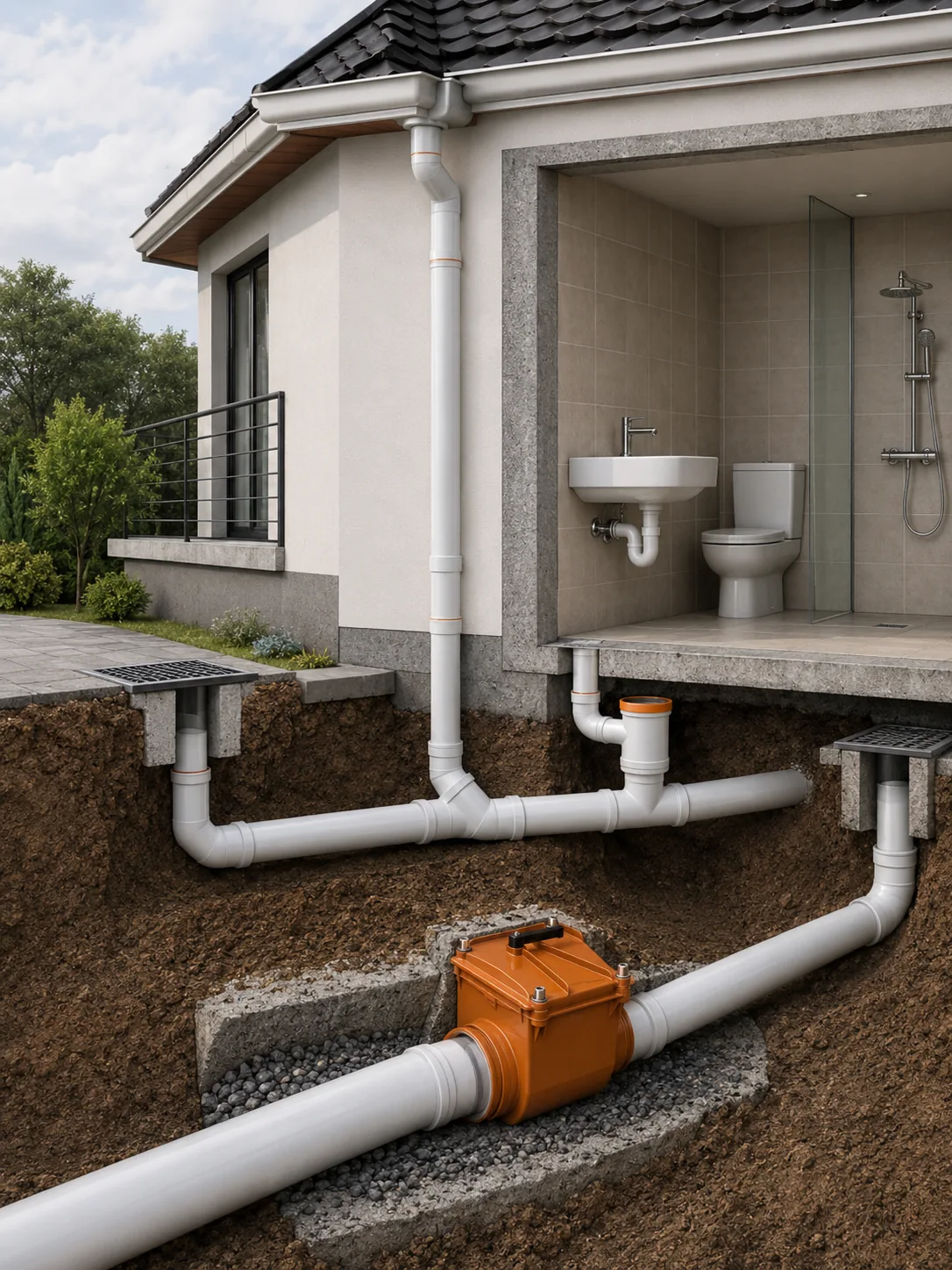
- Code D has a measured boundary: 1 m. The standard defines D as the area under and within 1 m from the building where pipes are buried and connect to the underground drainage system.
- Do not ask for a CE mark on EN 1451 pipe. TEPPFA’s position statement of 21 October 2025 says it is “not possible and not legal” to CE mark plastic piping systems, expressly including non-pressure soil and waste discharge.
- The new CPR applies from 8 January 2026. Regulation (EU) 2024/3110 Article 96. It changed the legal frame, not the availability of a harmonised specification for plastic pipe.
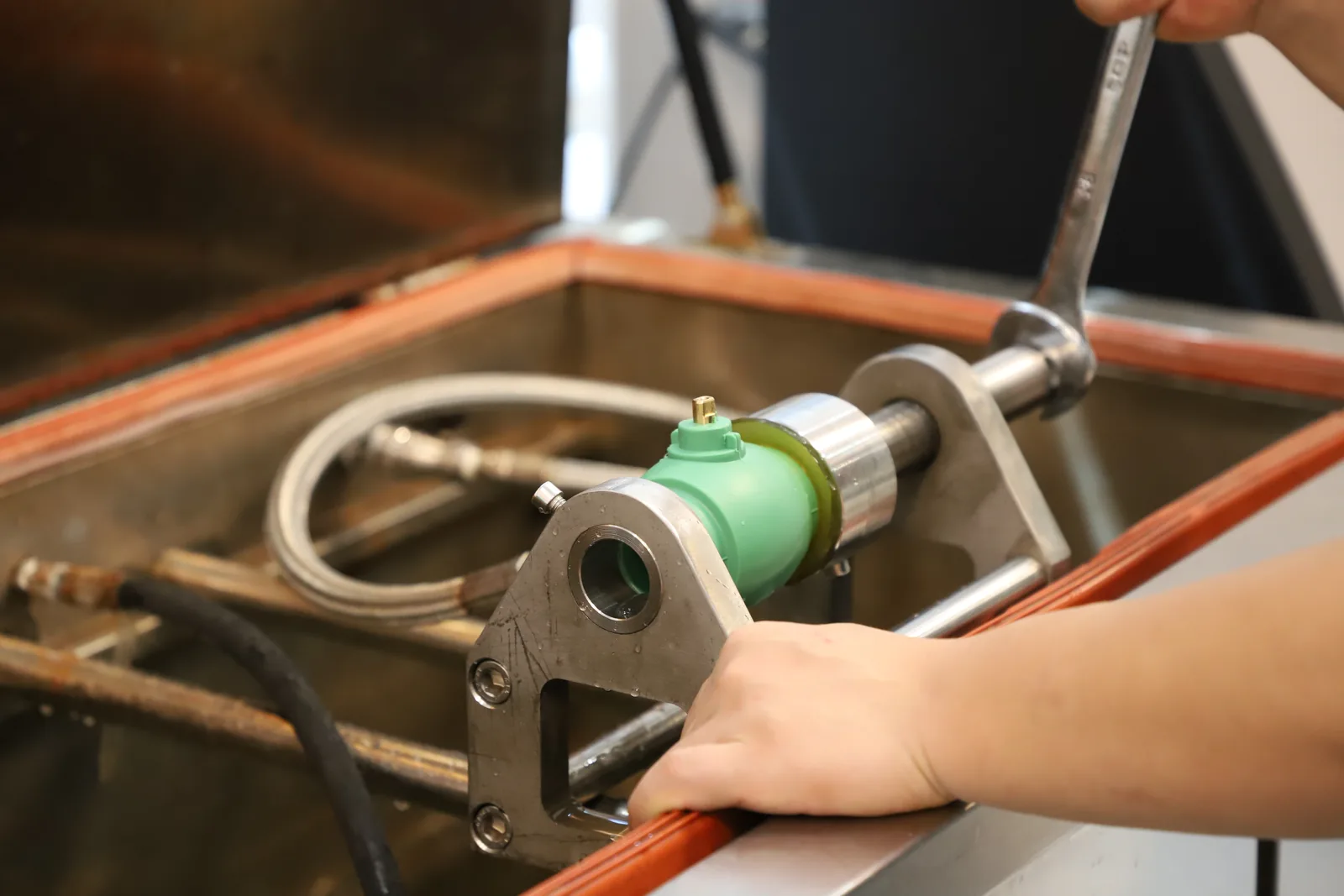
- BD material faces an extra pressure test. Clause 5.2 and Table 1: PP-H at 6,0 MPa hoop stress, 140 h at 80 °C; PP-B at 4,2 MPa under the same conditions. Ask for the EN ISO 1167 report.
- Recycled content is permitted, not prohibited. The 2017 edition added normative Annex A covering non-virgin PP material — so “contains recyclate” is not by itself a defect claim.
- Grey is a preference, not a rule. Clause 6.2 requires colouring through the wall; the colour itself is only “should be preferably grey, black or white”.
What EN 1451 actually covers
The full title is the fastest way in: plastics piping systems for soil and waste discharge, low and high temperature, within the building structure, polypropylene (PP). Two phrases do real work. “Low and high temperature” means the standard expects dishwasher and washing-machine discharge, not just cold greywater. “Within the building structure” is the outer limit of the whole document — this is not a standard for the site drain running out to the sewer connection. Clause 1 also extends it to the ventilating part of the pipework and to rainwater pipework within the building structure, so the vent stack and internal downpipe need no separate standard. External rainwater goods are somewhere else.
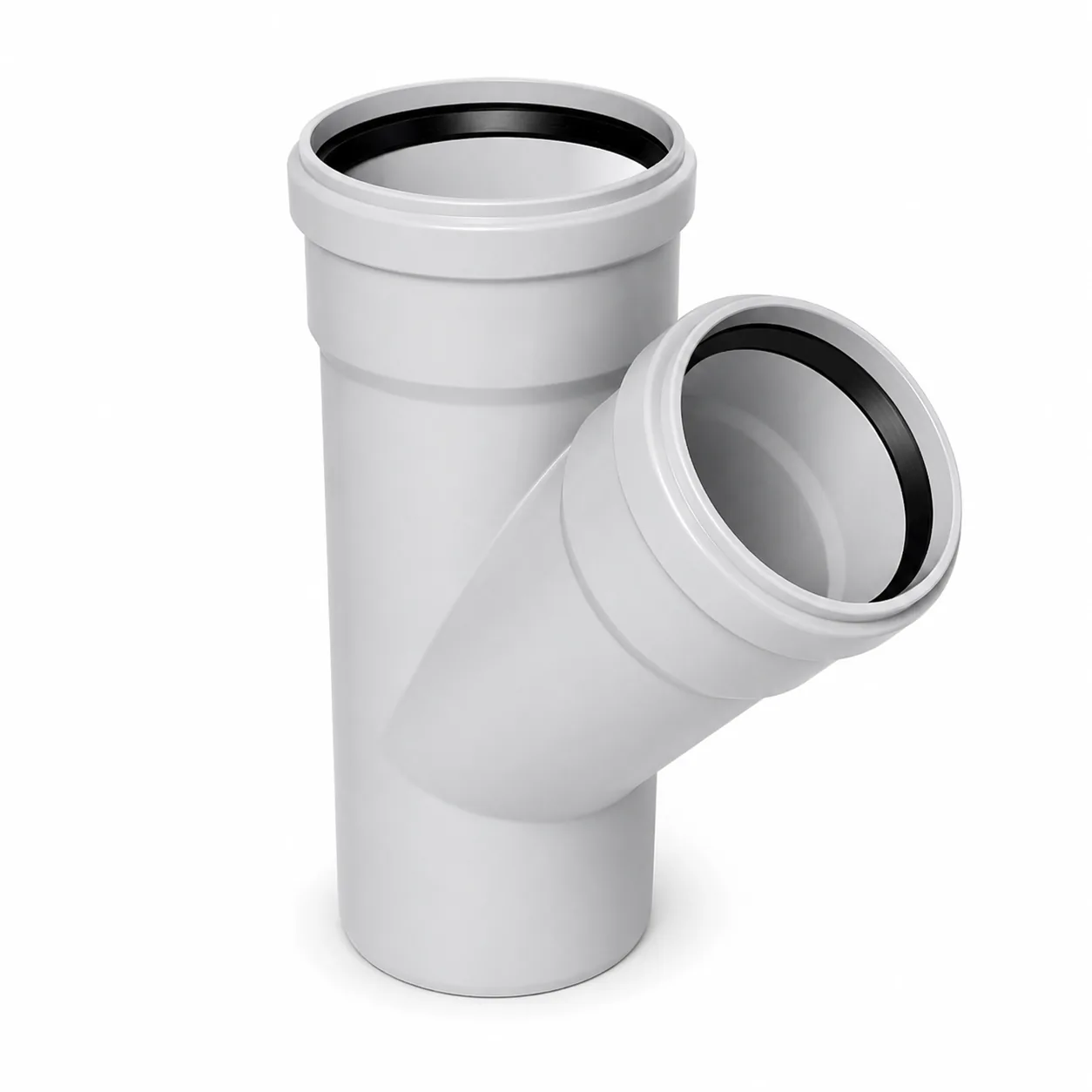
On joint types, the standard covers three: plain-ended, integral elastomeric ring seal socket, and butt fusion. Fittings may be injection-moulded or fabricated from pipes and/or injection-moulded fittings. That second route matters commercially, because buyers often treat a fabricated fitting as a bodge welded up from offcuts. The standard defines it at 3.13 as a fitting produced from pipe and/or injection-moulded fittings by thermoforming or welding, and treats it as legitimate. In large diameters where a mould costs more than the entire order, fabricated is often the only sane answer.
One scope fact carries strategic weight. The European foreword names 34 countries whose national standards bodies are bound to implement EN 1451-1:2017, Turkey among them. For a Turkish plant this is not a foreign export hurdle; it is the domestic standard, adopted nationally. Same document, different cover page.
B, D and BD: the three codes and the 1 m boundary
Most pages that mention the codes give you “B is above ground, BD is buried” and stop. The standard defines three, and the one it defines but does not itself sell carries the number you need.
| Code | Definition in EN 1451-1:2017 | What it means on the drawing |
|---|---|---|
| B | Components intended for use above ground inside the building, or for components outside buildings fixed onto the wall | Stacks, branches, vents, wall-mounted external runs. Never in a trench. |
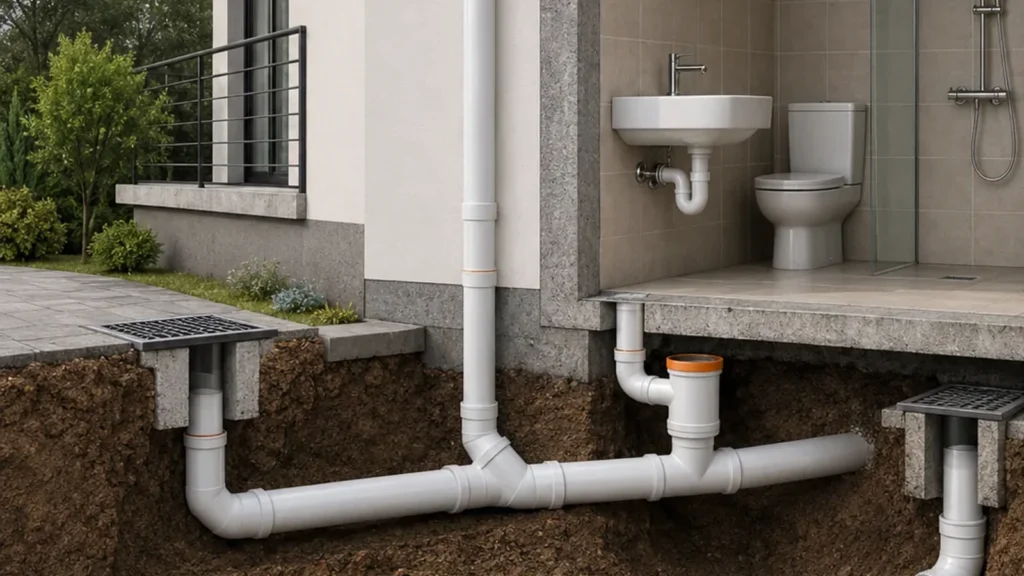
| D | The area under and within 1 m from the building where the pipes and fittings are buried in ground and are connected to the underground drainage and sewerage system | A zone, not a product you buy on its own under this standard. |
| BD | Components intended for use for both code B and code D application areas | The only EN 1451 marking that may go under the slab — subject to the size and stiffness condition below. |
The D definition gives you a checkable dimension: one metre from the building. Inside that band, buried and connected to the underground system, a B-marked component is out of scope. Past it you have left EN 1451 entirely — the standard notes that codes U and UD are not covered here and are defined elsewhere. So a supplier quoting U or UD against a soil and waste enquiry is quoting a different standard’s territory, most likely EN 1852-1.
Now the condition almost every free source omits, and the single most useful line in this article. Clause 1, Note 1: “For use buried in the ground within the building structure are intended only those components marked with ‘BD’, with dimensions equal to or greater than 75 mm and nominal ring stiffness of at least SN4.”
Three conditions, all of which must hold at once. Marked BD. At least 75 mm. At least SN4. A 50 mm BD-marked branch fails on size alone, which is why a PP drainage system serving both positions has to be specified size by size rather than under one blanket code. SN4 is not a marketing tier either: nominal ring stiffness is defined at 3.12 as a numerical designation relative to the determined stiffness in kN/m², measured by test to EN ISO 9969 — a number in a lab report, which means you can ask for it.
Why the extra demands? The standard explains itself in a note under the D definition: in D application areas, external forces from the surroundings in addition to the hot water discharge are usual. Soil load outside, 90-plus degree discharge inside, at the same time — the load case a B-marked pipe was never designed for.
The CE marking trap, and what changed on 8 January 2026
Here is the line that appears in specification after specification: “PP soil and waste pipework shall be CE marked to EN 1451.” It sounds rigorous, and it asks for a document that cannot lawfully be issued.
TEPPFA — the European Plastic Pipes and Fittings Association — published a position statement on 21 October 2025 addressing CE marking under the Construction Products Regulation. Its wording is unambiguous: “As the necessary harmonised technical specifications are not available for plastic piping products, it is currently not possible and not legal to apply a CE marking and issue a DoPC for plastic piping systems under CPR-2024 or CPR-2011 based on harmonised standards. Plastic piping systems continue to be governed by national or European recognised product standards.” The applications it lists expressly include non-pressure soil and waste discharge.
Read the second sentence as carefully as the first. Nothing is unregulated here — EN 1451 is precisely the “European recognised product standard” doing the governing. So the instinct most buyers carry is backwards. A supplier who cannot produce a CE mark for EN 1451 pipe is behaving correctly; one who cheerfully produces such a mark is the one to question, because either it covers something else entirely, such as a pressure-pipe line under a different standard, or it is not what it appears to be. Read the scope statement before the logo.
The regulation behind this moved recently, which is why older pages get it wrong. Regulation (EU) 2024/3110, the new Construction Products Regulation, states at Article 96 that it applies from 8 January 2026, with certain listed articles applying from 7 January 2025 and Article 92 from 8 January 2027.
Why did nothing break on that date? The repeal is staged. Article 94 repeals Regulation (EU) No 305/2011 from 8 January 2026 but excepts a long list of articles — including Articles 4 to 9 and 11 to 18, which carry CE marking and the Declaration of Performance — until 8 January 2040. The legal frame changed; the position for plastic pipe did not. Something is coming, though: CE marking, a Declaration of Performance and Conformity and a Digital Product Passport all become applicable once a product is covered by a harmonised technical specification. Confirm current status with the relevant authority before this enters a binding document.
Spec-wording fix
Instead of “CE marked to EN 1451”, write: “PP soil and waste components shall conform to EN 1451-1, marked BD, minimum DN 75 and minimum SN4 where laid buried within the building structure; conformity assessed in line with CEN/TS 1451-2, evidenced by a certificate from a certification body accredited to EN ISO/IEC 17065 or by test reports to the methods named in EN 1451-1.” That asks for documents that exist.
Material, colour and the extra test BD components must pass
Clause 5.1 is generous on polymer grade: the compound shall be PP-base material — homopolymer or copolymer — with the additives needed to make conforming components. So the recurring procurement argument about whether PP-H or PP-B is “the right one” has no answer at the level of conformity, because both are inside the standard. The grade does change the pass mark, though. Clause 5.2 carries an additional requirement for material for application area BD, tested for resistance to internal pressure to EN ISO 1167-1 and EN ISO 1167-2, with the material tested in the form of a pipe.
| Material | Test condition | Hoop stress | Test pieces |
|---|---|---|---|
| PP-H | 140 h at 80 °C, water-in-water, 1 h conditioning | 6,0 MPa | 3 |
| PP-H | 1 000 h at 95 °C, water-in-water, 1 h conditioning | 3,5 MPa | 3 |
| PP-B | 140 h at 80 °C, water-in-water, 1 h conditioning | 4,2 MPa | 3 |
Compare the first and third rows. Same duration, same temperature, same method — and PP-H is held to 6,0 MPa where PP-B is held to 4,2 MPa. That gives you a checkable request: for anything going under the slab, ask for the EN ISO 1167 report at the stated condition and confirm the stress on it matches the grade on the datasheet. A report at 4,2 MPa attached to a product sold as PP-H does not add up.
Colour trips people up because the two halves of Clause 6.2 have different force. “The pipes and fittings shall be coloured through the wall. The colours of pipes and fittings should be preferably grey, black or white. Other colours may be used.” The first sentence is mandatory and rules out anything pigmented only at the surface. The colour itself is a preference, so a non-grey EN 1451 pipe is not automatically non-conforming — worth knowing before someone rejects a delivery over the wrong shade.
On recycled content, the 2017 edition settled an argument that still runs in tender queries. Annex A is normative — binding, not advisory — and titled “Utilization of non-virgin PP material”. It separates own reprocessed material from pipes and fittings (A.1) from external reprocessed and recycled materials with an agreed specification (A.2), and within A.2 distinguishes material from PP pipes and fittings from material from other PP products. So “contains recycled content” is not by itself a defect claim. The category to interrogate is that last one, and the phrase to hold a supplier to is “an agreed specification” — agreed means agreed with you.
Dimensions, tolerances and the 2017 edition changes
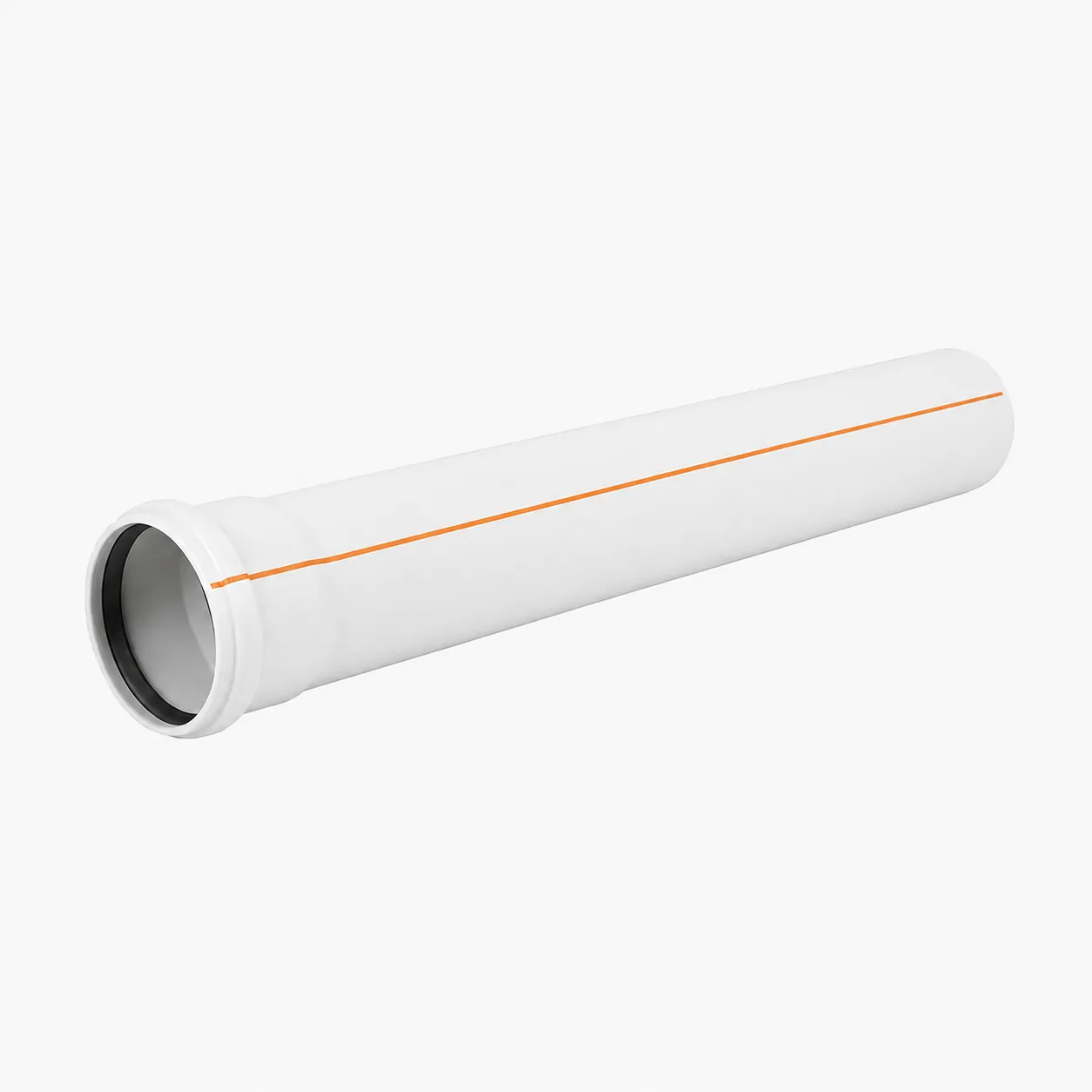
Dimensions shall be measured in accordance with EN ISO 3126, per Clause 7.1. The mean outside diameter tolerance in Table 2 is one-sided, which is the detail to notice: the nominal value is the minimum, and the pipe is never allowed below it.
| DN/OD | dem min (mm) | dem max (mm) |
|---|---|---|
| 32 | 32,0 | 32,3 |
| 40 | 40,0 | 40,3 |
| 50 | 50,0 | 50,3 |
| 63 | 63,0 | 63,3 |
| 75 | 75,0 | 75,3 |
| 80 | 80,0 | 80,4 |
| 90 | 90,0 | 90,4 |
| 100 | 100,0 | 100,4 |
| 110 | 110,0 | 110,4 |
Rows above DN 110 exist — the range now runs to DN 315 — but are not reproduced here because they were not readable in the publicly available extract used to compile this page. That the band widens from 0,3 mm to 0,4 mm at DN 80 is exactly the detail secondary tables flatten. Wall thickness is deliberately absent too: the standard expresses it through pipe series S, defined by reference to ISO 4065, and SDR, defined at 3.11 as the nominal ratio of outside diameter to minimum wall thickness. Ask which series your quoted pipe is rather than accepting a bare millimetre figure — a wall thickness with no series attached is unmoored from the specification.
The 2017 edition’s own change list doubles as a supplier-currency test. The foreword records the main changes: updated template and normative references; the thermal stability (OIT) requirement made valid in general; two new nominal sizes at 250 mm and 315 mm; impact resistance for BD applications aligned with UD applications in EN 1852-1; non-virgin PP material described in the new Annex A; and a new Annex B “Product standards”. Run that against the datasheet in front of you — if it cites EN 1451-1:2000, stops at DN 200, or treats recyclate as forbidden, it predates the revision. One further check: EN 1451-1:2017/AC:2018 was published on 5 June 2018 and modifies Table 2 itself, and BSI’s listing for the British adoption records corrigenda from June 2018 and December 2019. Ask for conformity against the current consolidated text, not the original 2017 print run.
What to demand from a supplier claiming EN 1451
“Complies with EN 1451” is a sentence, not evidence. The standard splits conformity assessment out of Part 1 entirely — the foreword records Part 1 as specifications for pipes, fittings and the system, and Part 2 as guidance for the assessment of conformity, published as a CEN Technical Specification. So the document describing how conformity is demonstrated is CEN/TS 1451-2, a separate purchase most people arguing about EN 1451 have never opened.
Part 2 covers conformity assessment for materials, products, joints and assemblies, written for the manufacturer’s quality plan and for third-party certification. Two expectations are worth carrying into a supplier conversation: a quality management system no less stringent than EN ISO 9001, and — where third-party certification is involved — a certification body accredited to EN ISO/IEC 17065 or EN ISO/IEC 17021 as applicable. That accreditation is the practical filter, because anyone can produce a certificate with a seal on it.
Here is the document set worth asking for, in the order that actually filters suppliers.
- The marking, photographed on delivered goods. Clause 12 sets minimum required marking for pipes (12.2) and fittings (12.3), plus additional marking (12.4), and Clause 1 confirms the application area code sits in it. Ask for a photograph of an actual production pipe, not a rendering.
- The EN ISO 9969 ring stiffness result for anything going under the slab. SN4 is a measured floor, so the number exists or it does not.
- The EN ISO 1167 internal pressure report at the Table 1 condition matching the declared grade — 6,0 MPa for PP-H or 4,2 MPa for PP-B at 140 h and 80 °C.
- Confirmation of elevated-temperature cycling to EN ISO 13257, the test standing behind the “high temperature” half of the standard’s title.
- The certificate, with its scope statement read first. A certificate whose scope names a pressure-pipe standard says nothing about soil and waste product.
- The edition cited. EN 1451-1:2017 as corrected, not the 2000 edition.
A closing note on mixing systems, since it comes up on every refurbishment. Clause 1, Note 3 permits components conforming to the plastics product standards listed in Annex B to be used with EN 1451 pipes and fittings — provided they conform to the requirements for joint dimensions given in Clause 6 and to the requirements of Table 18. Connecting PP to an existing PVC-U stack is allowed; doing it with whatever adaptor was on the van is not the same thing.
One stack, end to end: how the codes land on a real drawing
Take a six-storey residential block. The main discharge stack runs at DN 110 with branches at DN 50 and DN 75, and turns at the foot below the ground-floor slab to run about 4 m before meeting the site drainage. The vent through the roof and everything above the slab is code B, including a wall-mounted external section if the design has one. Under the slab, that pipe sits in a D application area, so it must be BD-marked, at least 75 mm and at least SN4 — the DN 110 line clears the size test easily, but ring stiffness is a separate question a BD marking alone does not answer, and this is the one point on the drawing where you demand the EN ISO 9969 result in writing.
Then the 1 m boundary bites. Of that 4 m buried run, only the first metre is D where EN 1451 BD product belongs; beyond it you are in U or UD territory. Specifying EN 1451 for the whole 4 m over-reaches, and specifying it for none of it leaves the D zone unspecified. The transition point is a design decision that belongs on the drawing, not in the installer’s judgement in a trench. One trap worth naming because it costs real money: a DN 50 branch cannot be buried even when BD-marked, because it fails the 75 mm condition — which on plant room layouts where small-bore runs dive under the slab to reach a gully becomes a redesign if it surfaces at inspection.
The standard has the last word on why the drawing still needs a designer. Clause 1, Note 2: “It is the responsibility of the purchaser or specifier to make the appropriate selections from these aspects, taking into account their particular requirements and any relevant national regulations and installation practices or codes, e.g. CEN/TR 13801.” Conformity is a floor, not a selection.
EN 1451 in the UK, and how it sits next to EN 1329
For anyone specifying into England and Wales, EN 1451 is the standard a building control officer will look for against polypropylene. Approved Document H, Table 4 “Materials for sanitary pipework”, lists BS EN 1451 against PP, alongside BS EN 1329 for PVC-U, BS EN 1455 for ABS, BS EN 1519 for polyethylene and BS EN 1566 for PVC-C. That also settles the material question: EN 1451 versus EN 1329 is not a quality contest but PP versus PVC-U, two rows in the same list, both acceptable. PP earns its place on the high-temperature half of its own title, which is why the standard carries an OIT thermal stability requirement and cycling to EN ISO 13257. If your scheme is mostly cold greywater on a tight budget, PVC-U to EN 1329 is the honest answer and we would say so — the case for PP strengthens as hot discharge and service temperature climb, and the UPVC drainage pipe and fittings range sits on the other side of that comparison.
Table 4 carries a footnote worth quoting to anyone specifying a commercial kitchen or a modern boiler installation: “Some of these materials may not be suitable for carrying trade effluent or condensate from boilers.” Condensate is acidic and runs continuously — a discharge chemistry question, not a diameter question. Building regulations are amended periodically and vary across UK jurisdictions; confirm the edition in force with the building control body for the site.
Best for / not for
EN 1451 PP is the right specification for: soil and waste discharge inside the building envelope where high-temperature appliance discharge is expected; vent pipework associated with those discharge stacks; rainwater pipework running within the building structure; and the buried run under and within 1 m of the building — provided the component is BD-marked, DN 75 or larger, and at least SN4.
It is not the right specification for: buried drainage and sewerage beyond the building structure, where U and UD codes under a different standard apply; external rainwater goods outside the building structure; pressure applications of any kind — this is a non-pressure discharge standard; or any situation where somebody has asked you to produce a CE mark against it.
Conclusion
If you take one line from this page into your next specification, take the one the standard puts in its own scope: the intended use is reflected in the marking by “B” or “BD”. Get the letter wrong and the tolerance bands, hoop stress figures and accreditation numbers are all decoration. Then check the three conditions together before anything goes in a trench — BD, 75 mm or larger, SN4 or better — and delete “CE marked” from the clause. Ask instead for the marking photograph, the ring stiffness result to EN ISO 9969, the pressure report to EN ISO 1167 at the stress matching the declared grade, and a certificate whose issuing body is accredited to EN ISO/IEC 17065. Those documents exist, which is precisely why asking for them separates suppliers.
Behind this page is a manufacturer with 30 years in pipe, a 120,000 m² plant, 1000+ staff and 10,000 moulds, shipping 98 items across 4 systems to 118 countries from Türkiye — one of the 34 countries bound to implement EN 1451-1:2017. Commercial terms on a PP drainage enquiry run to one 20GP mixed container for a trial or 500 kg per size and colour, at 15–25 days for regular in-production sizes and 30–45 days for private label. Because EN 1451 treats colour as a preference, a house colour is a commercial conversation, not a conformity one.
One caveat. The clauses come from EN 1451-1:2017 as published, the regulatory dates from Regulation (EU) 2024/3110 in the Official Journal, and the CE marking position from TEPPFA’s statement of 21 October 2025. Standards are revised and corrigenda issued — this one has been corrected at least twice since 2017 — and regulatory positions move. Treat this as the basis for a check against the edition and legal position in force at your destination market, confirmed with the relevant authority. It is not a compliance certificate for any particular product or installation.
Frequently Asked Questions
What is EN 1451 and what does it cover?
EN 1451-1:2017 specifies requirements for solid-wall polypropylene pipes, fittings and systems for soil and waste discharge, low and high temperature, within the building structure. It covers two application areas: code B for inside buildings, and code BD for inside buildings plus buried in the ground within the building structure. It also applies to the ventilating part of discharge pipework and to rainwater pipework within the building structure.
What is the difference between B and BD marking on PP drainage pipe?
B covers components intended for use above ground inside the building, or outside buildings fixed onto the wall. BD covers components intended for both code B and code D application areas. Code D is the area under and within 1 m from the building where pipes are buried and connected to the underground drainage and sewerage system. A B-marked component must not be buried.
Can I bury any BD-marked pipe?
No. EN 1451-1:2017 Clause 1 Note 1 states that only components marked BD, with dimensions equal to or greater than 75 mm and nominal ring stiffness of at least SN4, are intended for use buried in the ground within the building structure. All three conditions apply together, so a 50 mm BD-marked branch cannot be buried. Ring stiffness is determined by test to EN ISO 9969.
Is EN 1451 pipe CE marked?
According to TEPPFA’s position statement of 21 October 2025, it is currently not possible and not legal to apply a CE marking or issue a Declaration of Performance and Conformity for plastic piping systems, including non-pressure soil and waste discharge, because the necessary harmonised technical specifications are not available. Plastic piping systems continue to be governed by national or European recognised product standards such as EN 1451. Confirm the current position with the relevant authority before writing it into a binding specification.
What changed under the new EU Construction Products Regulation in 2026?
Regulation (EU) 2024/3110 applies from 8 January 2026 under its Article 96, with some articles and annexes applying from 7 January 2025 and Article 92 from 8 January 2027. Article 94 repeals Regulation (EU) No 305/2011 from 8 January 2026 but excepts a list of articles that remain in force until 8 January 2040. For plastic piping the practical position is unchanged, since no harmonised technical specification is available.
Does EN 1451 allow recycled PP?
Yes. The 2017 edition added normative Annex A, “Utilization of non-virgin PP material”, covering own reprocessed material from pipes and fittings, and external reprocessed and recycled materials with an agreed specification — including material from PP products other than pipes and fittings. Because Annex A is normative, recycled content is permitted under stated conditions rather than prohibited.
Does EN 1451 pipe have to be grey?
No. Clause 6.2 requires that pipes and fittings shall be coloured through the wall, which is mandatory. On the colour itself it says only that colours should be preferably grey, black or white, and that other colours may be used. So colour is not a conformity criterion, but surface-only pigmentation is not acceptable.
Can I connect EN 1451 PP to fittings made to another plastics standard?
Clause 1 Note 3 permits components conforming to any of the plastics product standards listed in Annex B to be used with EN 1451 pipes and fittings, provided they conform to the requirements for joint dimensions given in Clause 6 and to the requirements of Table 18. The permission is conditional, so the joint dimensions have to be verified rather than assumed.
Is EN 1451 recognised for UK Building Regulations?
Approved Document H, Table 4 “Materials for sanitary pipework” lists BS EN 1451 against polypropylene, alongside BS EN 1329 for PVC-U and BS EN 1455 for ABS. The table carries a footnote that some of these materials may not be suitable for carrying trade effluent or condensate from boilers. Confirm the edition in force with the building control body for the specific site.
How is conformity to EN 1451 assessed and certified?
EN 1451 Part 2 is a CEN Technical Specification giving guidance for the assessment of conformity, intended for the manufacturer’s quality plan and for third-party certification procedures. It expects a quality management system conforming to, or no less stringent than, EN ISO 9001, and where third-party certification is involved, a certification body accredited to EN ISO/IEC 17065 or EN ISO/IEC 17021 as applicable.