Most people build a pipe distributor catalogue backwards. They ask the factory what it can print, get told “any colour, any logo, low minimums,” and start choosing artwork. The harder question arrives six months later, when a third of the branded stock has not moved and the range still cannot cover a normal apartment job. Catalogue depth is a cash question and a legal question long before it is a design one.
Here is the number that reframes it. ISO 15874-2:2013 Table 5 lists 17 nominal sizes in pipe dimension class A alone — DN/OD 12 through 160 — across seven pipe series (S8, S6.3, S5, S4, S3.2, S2.5 and S2). That is one axis of one product family, before a second colour, before fittings, and before the three other dimension classes the same standard defines. And under Regulation (EU) 2024/3110, which applies from 8 January 2026, printing your own trademark on that pipe makes you its legal manufacturer.
Key takeaways
- Branding is a legal transfer, not a print job. Under Regulation (EU) 2024/3110 Article 26, an importer or distributor “shall be considered a manufacturer” where it places a product on the market under its own name or trademark — with the Article 22 duties that come with it.
- The date matters. Regulation (EU) 2024/3110 applies from 8 January 2026 and repeals Regulation (EU) No 305/2011 from the same date, with a set of articles surviving until 8 January 2040.
- You cannot inherit a WRAS approval. WRAS states that once a product is re-branded, WRAS Approval cannot be claimed and a secondary product approval must be applied for separately.
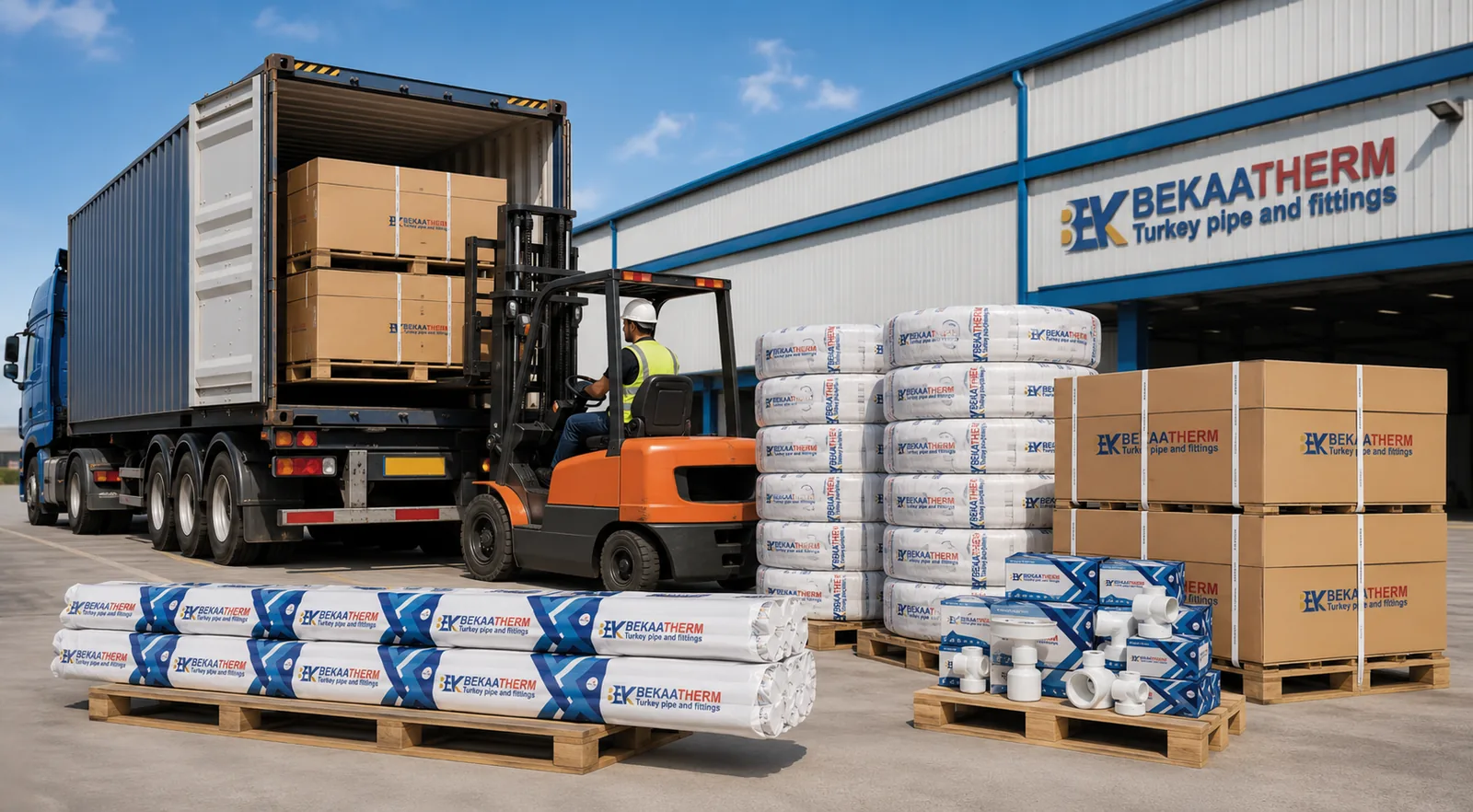
- The order threshold sets the cash floor. A first branded run at Bekaatherm is one 40HQ, or 3 tonnes per colour — against 500 kg per size and colour for unbranded stock. Colour is where a catalogue quietly doubles.
- Branded lead time is 30–45 days versus 15–25 days for regular in-production sizes, with 7–10 days added for a first colour match or a new mould.
- Your logo is not the only thing on the pipe. ISO 15874-2 Table 12 requires the standard number, manufacturer name or mark, size and wall thickness, dimension class, material, application class with operating pressure, and a traceable production period and site code — printed at least once per metre.
- Start narrow. Rank your own last 12 months of line-item sales, cut at 80% of cumulative volume, brand that set, and leave the tail unbranded.
The SKU maths nobody shows you
Supplier landing pages talk about range in adjectives. The standard talks about it in tables. ISO 15874-2 organises PP-R pipe by dimension class — a grouping of outside diameters — and by pipe series S, the wall-thickness class that determines how much pressure the pipe holds at temperature. Class A follows the ISO 4065 size list; classes B1, B2 and C sit alongside it, B1 built on copper pipe sizes, each with its own dimension table.
So the size axis is not 17 values. It is 17 values in one class, repeated across four classes, crossed with up to seven series. Not every intersection is manufactured — series S8, S6.3 and S4 are footnoted as valid only for PP-RCT, the raised-temperature grade — but the shape of the problem is clear. Wall thickness is not decoration either: in class A, 20 mm at S3.2 is 2.8 mm wall, and 110 mm at S5 is 10.0 mm. Each is a separate item to buy, print, store, count and eventually write off.
| Catalogue axis | What the standard or supplier defines | Effect on a branded range |
|---|---|---|
| Nominal size, class A | 17 sizes, DN/OD 12 to 160 (ISO 15874-2 Table 5) | Base multiplier. Most markets move 20–63 mm. |
| Dimension class | Classes A, B1, B2, C — four separate tables | Pick one. The class must be marked on the pipe. |
| Pipe series S | S8, S6.3, S5, S4, S3.2, S2.5, S2 | Wall thickness and pressure class. Two is usually enough. |
| Colour | Market convention, not a standard requirement | Doubles the branded minimum: 3 tonnes per colour. |
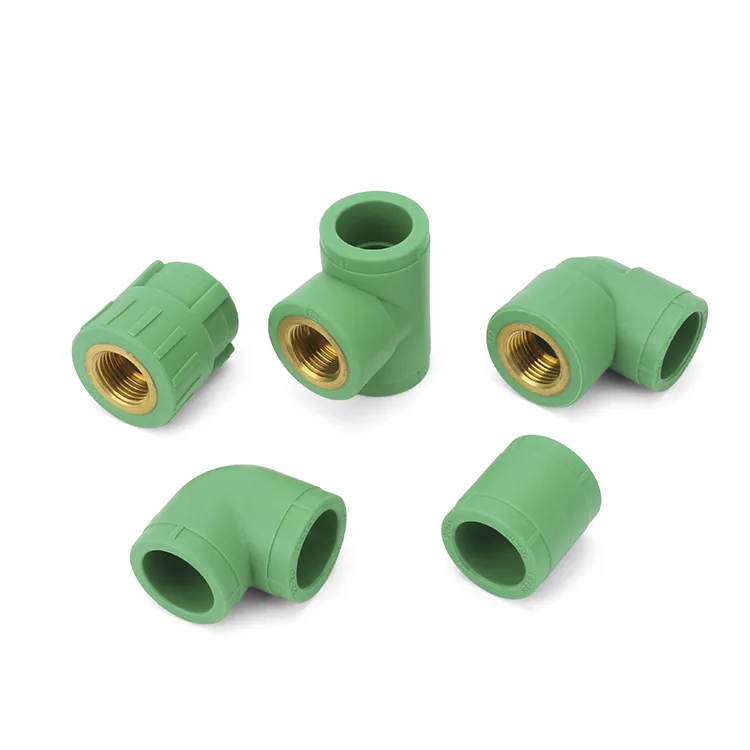
| Fittings and valves | 98 items across 4 systems at Bekaatherm | Where the long tail of dead stock actually lives. |
One point worth stating plainly, because supplier blogs get it wrong constantly: colour carries no performance meaning in ISO 15874-2. The standard asks for opacity to be marked only where the manufacturer declares it, and sets no colour-to-service mapping at all. Green-for-cold and white-for-hot are market habits that differ by country. Treat colour as a stocking decision you confirm with your buyers, never as a technical specification you inherit.
The same caution applies to UV. PP-R is a polyolefin subject to photo-oxidative degradation, so exposed runs need a UV-stabilised grade or physical protection. The confident survival timelines you will find online come from marketing pages, disagree with each other, and cite no test basis. Ask for the specific compound’s UV data instead of accepting a colour as proof.
Put your logo on it and you become the manufacturer
This is the part the OEM landing pages leave out, and for buyers selling into the EU it is the most consequential fact on this page. Regulation (EU) 2024/3110, the new Construction Products Regulation, has an article headed “Cases in which obligations of manufacturers apply to importers and distributors.” Article 26(1) reads: “An importer or distributor shall be considered a manufacturer for the purposes of this Regulation and shall be subject to the obligations of a manufacturer pursuant to Article 22, where: (a) it places a product on the market under its own name or trademark.”
There is no threshold in that sentence. No minimum volume, no exemption for small importers, no carve-out for “we only print the logo, the factory does everything else.” The same article also catches you if you claim characteristics deviating from what the actual manufacturer declared, or if you simply opt to assume the manufacturer’s role. The timing sharpens it: the Regulation applies from 8 January 2026, and Article 94 repeals Regulation (EU) No 305/2011 from the same date, with a list of its articles and Annexes III and V surviving until 8 January 2040.
What Article 22 actually asks of you
Once you are the legal manufacturer, three duties land on your desk. You draw up a declaration of performance and conformity — the DoPC, which replaces the old declaration of performance — in accordance with Articles 13 to 15. You affix the CE marking under Articles 17 and 18. And you draw up technical documentation stating the declared use and every element needed to demonstrate performance and conformity.
Traceability follows. Article 22(5) requires that products “bear a manufacturer-specific unique identification code of the product type and, where available, a batch or serial number which is easily visible and legible for users.” That code is yours now, not the factory’s, and it has to map back to something you can produce on request.
Article 18(2) then constrains your artwork more than most brand owners expect. Next to the CE marking must appear the last two digits of the year it was first affixed, your name and registered address, the unique identification code of the product type, the declaration code of the DoPC, and a notified body number where one applies. Where the manufacturer has no place of business in the Union, the authorised representative’s details go there too — exactly the position a non-EU factory is in.
Your own brand mark is legally subordinate on top of that. Article 19 permits other markings, “including private ones,” only if they do not suggest performance was assessed differently from the way the Regulation lays down, and only if they do not impair the visibility, legibility or meaning of the CE marking. Your logo can be beautiful. It cannot bury the compliance block.
If you import and resell under the factory’s brand, you are an importer — you add your name and contact details per the importer article, and the factory keeps the manufacturer’s duties. Rebrand it and the duties move to you. That is the whole trade.
Requirements vary by product family, market and the role you take in the chain, and the wording above is the Regulation’s, not legal advice. Confirm your obligations with a competent authority or compliance consultant before committing to artwork. But do not let a supplier tell you the question does not exist.
The certificates do not come with your brand
Every OEM page implies the factory’s certificate wall transfers to your label. Two of the four common marks in PP-R do not work that way, and getting it wrong costs tenders rather than money.
WRAS: rebranding breaks the claim
WRAS is explicit on this. Once products are re-branded — meaning the product name and identification markings change — WRAS Approval cannot be claimed on the rebranded item, and use of the WRAS Certification Mark is not permitted on it. A re-branded product must be applied for separately, as a secondary product approval. So if you sell into the UK water sector and your tender depends on a WRAS listing, budget that application before you print, not after. Confirm the current process directly with WRAS, since scheme rules change.
SKZ: tied to an audited site, not a name
SKZ in Germany is accredited as a certification body to DIN EN ISO/IEC 17065 and has awarded more than 800 certificates in the pipe sector. Its model is the point: certification involves inspection of the production facility by an SKZ auditor plus a monitoring contract providing for semi-annual or annual monitoring, with inspectors carrying out product monitoring under DIN EN ISO/IEC 17020 in over 30 countries. That certificate describes a plant under surveillance, not a name.
So the workable framing is a sourcing statement rather than an ownership one. “Manufactured in an SKZ-certified facility to ISO 15874” is defensible and checkable. “SKZ certified” printed next to your own logo, with no producer named, invites the one question you cannot answer in a tender room.
| Mark | What it is attached to | What you can say on your own label |
|---|---|---|
| WRAS | The approved product under its original name and markings | Nothing, until a secondary product approval is granted for the rebranded item. |
| SKZ | An audited production facility under a monitoring contract | “Produced in an SKZ-certified facility,” naming the producer. |
| CE / DoPC | The legal manufacturer — which becomes you on rebranding | Your own declaration, with the Article 18(2) block alongside the mark. |
| ISO 15874 | The product’s conformity to the standard’s requirements | The standard number, required on the pipe by Table 12 anyway. |
What must be printed on the pipe besides your logo
Brand owners usually arrive with a print line in mind: logo, maybe a website, maybe a slogan. Then the artwork comes back from the factory covered in text they did not ask for. That text is mandatory, and knowing the list in advance saves a revision cycle and 7–10 days.
ISO 15874-2 Table 12 sets the minimum required marking for PP-R pipe: the number of the standard; the manufacturer’s name or trade mark, as a name or a code; nominal outside diameter and nominal wall thickness, written like 16 x 2,2; the pipe dimension class, such as A; the material, such as PP-R; the application class combined with the operating pressure, such as Class 1/10 bar; opacity where the manufacturer declares it; and traceability information — the production period as year and month, plus a name or code for the production site where the manufacturer produces at different sites.
Clause 10.1 governs how it goes on. Marking “shall be printed or formed directly on the pipe not less than once per metre” in a way that keeps legibility after storage, handling and installation, must not initiate cracks, and must be legible without magnification. The print colour has to differ from the pipe’s base colour — which is why a white print line on a white pipe is a non-starter, however good it looks in the brand deck.
Note that production-site clause. A brand supplied from two plants carries two distinguishable site codes on the print line, by design — the traceability requirement doing its job, and it connects directly to the origin paperwork below.
For distributors who already know which sizes they sell and now need the marking block, dimension class and colour fixed before artwork. Our team returns a marked-up print-line layout with the ISO 15874-2 Table 12 fields filled in for your sizes.
How much cash a branded range actually freezes
Depth costs money in three places at once: the order minimum, the lead time, and the payment schedule. Read them together and the catalogue decision makes itself.
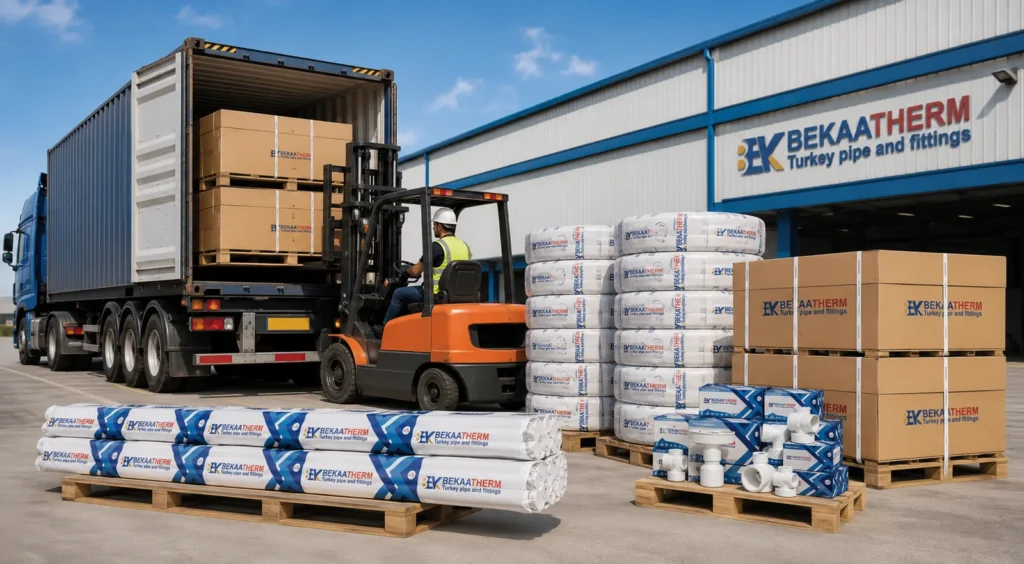
Start with the minimum. At Bekaatherm, a first branded run is one 40HQ, or 3 tonnes per colour — against 500 kg per size and colour for ordinary stock, or a single 20GP mixed container of pipe, fittings and valves for a trial. That step from 500 kg to 3 tonnes per colour is the whole argument against launching in two colours “to cover both markets.” A second colour is not a design choice; it is another 3 tonnes of committed inventory before a single metre sells.
Then the clock. Branded production runs 30–45 days against 15–25 days for regular in-production sizes, and a first colour match or a new mould adds 7–10 days on top. So a first branded run with a bespoke colour can sit at 40–55 days of production before it reaches the port, with transit stacked on after that under FOB İstanbul or Mersin — the default terms, with CFR and CIF on request.
Finally the money. Terms are 30% T/T deposit with 70% against copy bill of lading, and an irrevocable L/C at sight is accepted from USD 50,000. The deposit goes out at order placement, so it is frozen across the entire production window, and the balance falls due when the B/L copy issues — meaning you fund the full container while it is still on the water.
| Stage | Branded run | Unbranded stock order |
|---|---|---|
| Minimum commitment | One 40HQ, or 3 tonnes per colour | 500 kg per size and colour |
| Samples first | Branded samples in 7–10 days, cost credited against the first bulk order | Standard samples free up to 3 items, freight collect |
| Production | 30–45 days, plus 7–10 for a first colour or new mould | 15–25 days on in-production sizes |
| Payment | 30% T/T deposit, 70% against copy B/L; L/C at sight from USD 50,000 | Same terms, smaller absolute exposure |
| Resale flexibility | Locked to your market; regional exclusivity available, agreed in writing per market | Sellable anywhere, including back into trade |
That last row is the one distributors underweight. Unbranded stock that fails to move can be sold sideways to another trader. Branded stock with your logo on it can only be sold by you, in your market, at whatever price clears it. Branding converts inventory risk from recoverable to terminal — the strongest reason to brand the fast movers and leave the slow tail in the factory’s colours.
On margin: you will see confident percentage upsides quoted for private label in distribution. Do not plan on someone else’s number. Take your landed cost per metre on the sizes you actually sell, add the branded minimum’s carrying cost across your real turn rate, and compare against the trade price you buy at today. If the answer only works at a turn rate you have never achieved, the range is too deep.
Choosing depth: the 80% cut and the colour decision
There is no universal starting SKU count, and anyone who gives you one has not seen your sales history. What works is a method you run on your own data, in an afternoon.
The 80% cut
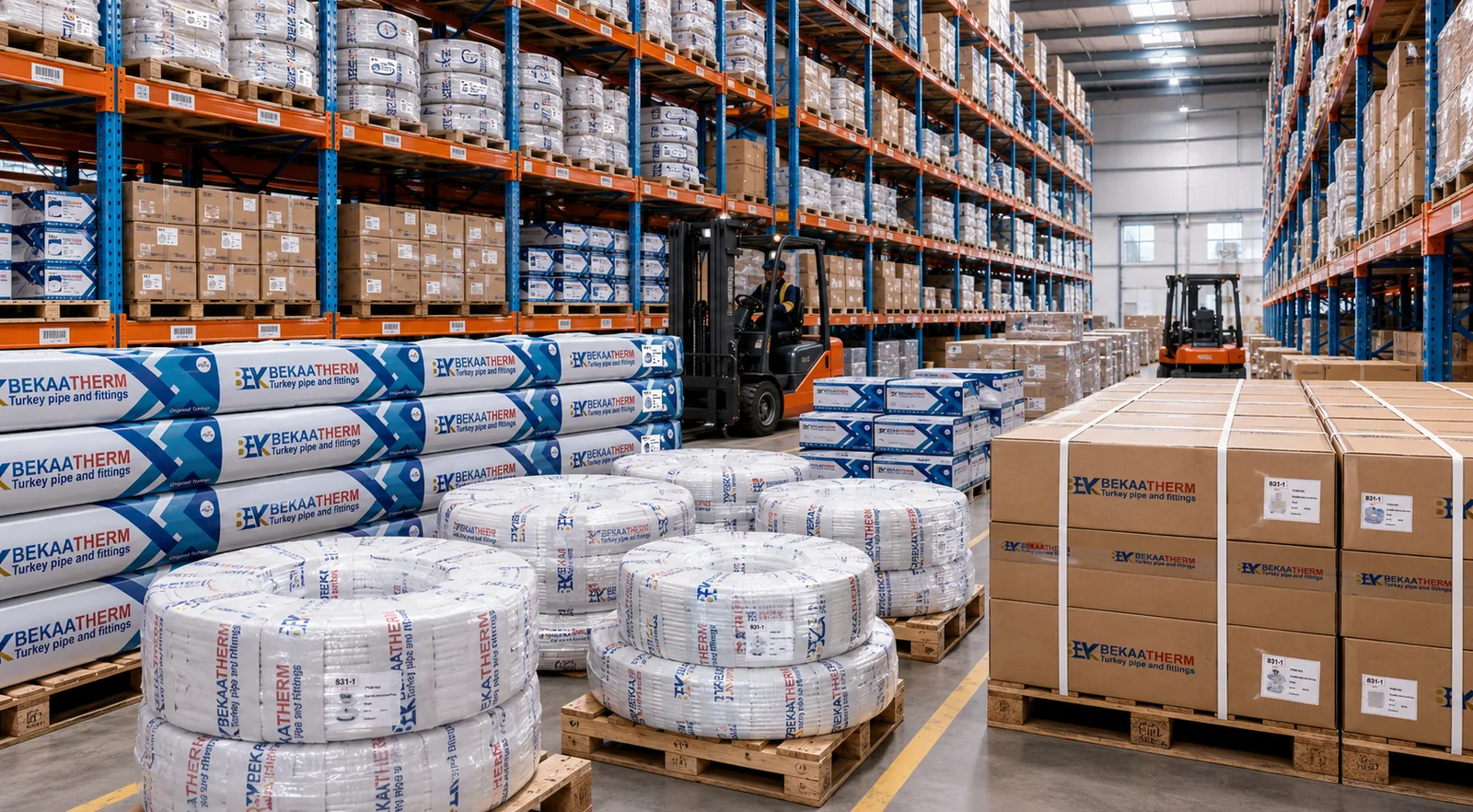
Export the last 12 months of line items from your own system — not the factory’s catalogue, yours. Rank every item by volume sold, in metres for pipe and pieces for fittings, run a cumulative total down the list, and draw a line at 80% of volume. Everything above the line is your branding candidate list. Everything below stays unbranded for now, bought as needed against the 500 kg per size and colour minimum.
Two adjustments before you commit. Strip anything above the line that you sold once as a project one-off, since a single large order distorts a 12-month rank badly. Then check the list against a normal job in your market — if branding the 80% set leaves a hole that forces the installer to buy a competitor’s fitting mid-job, pull that item up regardless of rank. A range that cannot finish a job sends the whole job elsewhere.
Colour, and how to weight pipe against fittings
Colour is where good SKU discipline goes to die. Since 3 tonnes per colour applies to a first branded run, every extra colour is a separate inventory commitment with its own turn rate and write-off risk. Launch one colour — whichever your installers already ask for — and prove the turn rate before adding a second. If two are genuinely non-negotiable, split them by system rather than by size, so you are not carrying the same 25 mm pipe twice.
For the mix itself, a mixed container at Bekaatherm typically runs about 60% pipe, 30% fittings and 10% valves by volume. Start there, then correct against your own line-item data — retrofit-heavy markets skew toward fittings, new-build markets toward pipe. Starting from the typical split matters for a practical reason: it is what actually fits in a container without leaving void space you paid freight on.
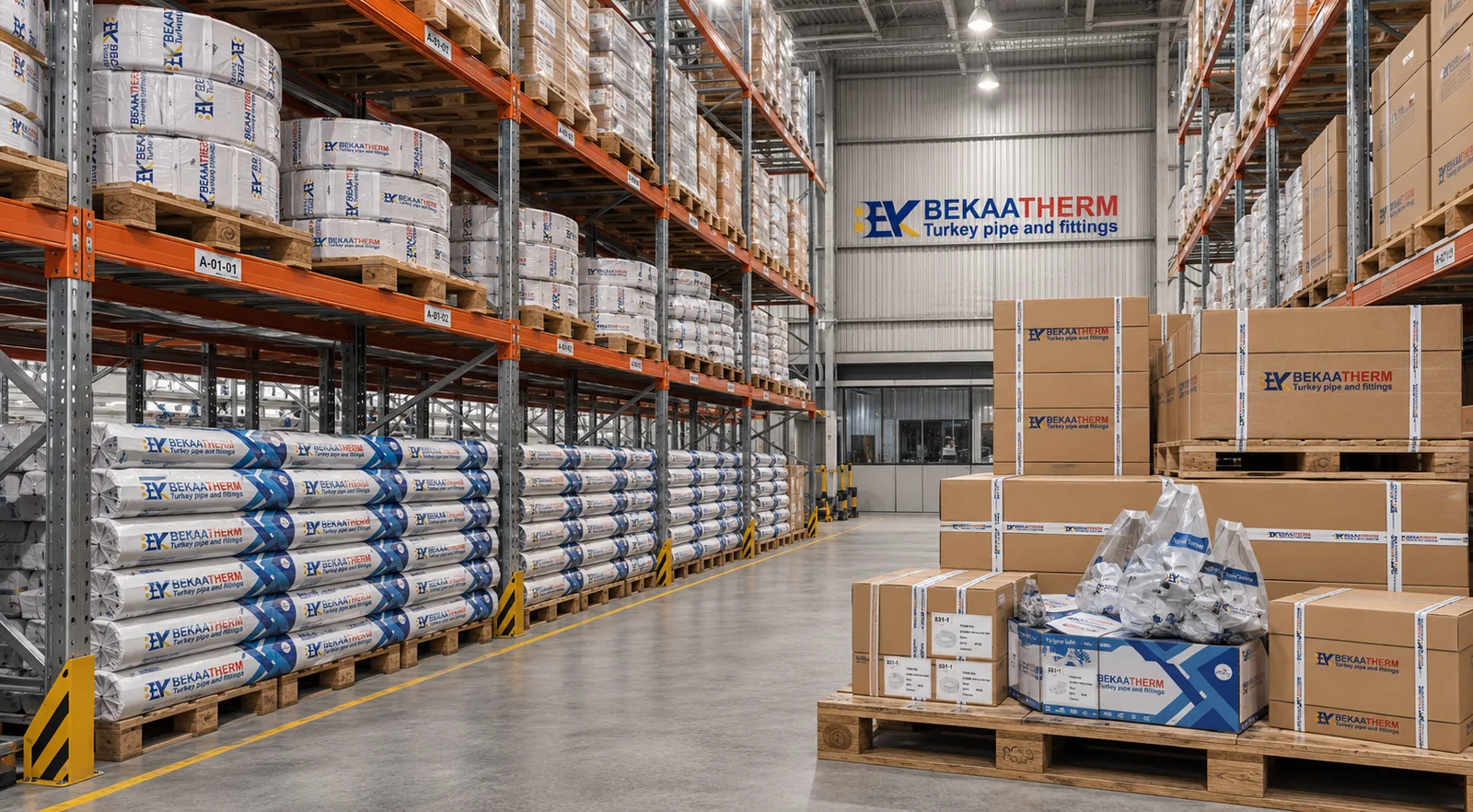
A worked first container, end to end
Take a distributor who sells roughly 60% of volume in 20 mm and 25 mm pipe, wants one colour, and has settled on a 40HQ first branded run. A 40HQ gives roughly 76 m³, against a 20GP’s roughly 33 m³ usable and a payload around 28 tonnes; a 20GP takes roughly 8,000–9,000 m of 20 mm PN20 pipe when bundles are telescoped. Telescoping is not optional here. Void space is freight paid on air, and unlike a mixed trade order you cannot backfill it with something you would happily sell to anyone.
Then the sequence, and the dates that matter:
- Week 0 — artwork and marking block. Fix the print line: your trade mark plus the Table 12 mandatory fields, in a print colour that differs from the pipe’s base colour. Settle the dimension class here, because it must appear on the pipe.
- Weeks 1–2 — branded samples. Branded samples arrive in 7–10 days, and the sample cost is credited against the first bulk order. Check legibility on the sample after handling, not on a PDF proof.
- Week 2 — proforma invoice. This is where origin is confirmed in writing for the order, and where the regional exclusivity terms are agreed per market if you want them.
- Week 2 — 30% deposit. Cash leaves. The production clock starts.
- Weeks 3–9 — production. 30–45 days for the branded run, plus 7–10 days if this is a first colour match or a new mould.
- Week 9–10 — loading and B/L. Telescoped bundles, FOB İstanbul or Mersin by default. The 70% balance falls due against the copy B/L.
- On arrival — document check. Certificate of origin, packing list and bill of lading must agree with each other and with the proforma. Any mismatch is a clearing problem, not a paperwork nuisance.
One judgment call inside that timeline: do not compress the sample step to save 7–10 days. A print line that becomes illegible after a bundle has been strapped, shipped and dragged across a site is a container that fails an inspection you cannot appeal. Ten days of sampling against 45 days of production and a full container’s cash is cheap insurance.
Price is always on request, but a serious private-label quotation contains three things — the FOB unit price, the container loading plan showing how your mix actually fits, and the certificate pack for the producing facility. If a quote arrives with only a unit price, you cannot check whether the mix loads or whether the certificates cover the plant that will make your pipe.
For distributors with a shortlist of sizes and a target container. Send your size-and-quantity list and you get back an FOB unit price, a container loading plan for your mix, and the certificate pack for the producing facility.
Origin paperwork when your supplier has two plants
Bekaatherm supplies from Türkiye and from a partner plant in China, with origin allocated by market. Origin is confirmed in writing on the proforma invoice for each order, and the certificate of origin, packing list and bill of lading all have to agree. That is not a formality. Your customs entry, duty treatment and in some markets your tender eligibility all key off origin — and the production-site code printed on the pipe under Table 12 is visible evidence of which plant made it. Paperwork that says one thing while the print line says another is the kind of discrepancy an inspector notices immediately.
A.TR proves free circulation, not origin
This trips up buyers importing Turkish-origin goods into the EU. Under the EU–Türkiye Customs Union, established by Decision No 1/95 of the EC–Turkey Association Council, goods move on an A.TR movement certificate — and A.TR establishes the customs status of goods in free circulation, not their origin. A separate certificate of origin answers “where was this pipe made.” For a dual-origin arrangement that is exactly why the allocation has to be fixed on the proforma before production, not discovered at the port. Confirm current requirements with your broker for your specific entry.
One classification trap while you are there: a mixed branded container is not one HS code. Rigid polypropylene pipe classifies at HS 3917.22, while plastic pipe fittings classify at HS 3917.40 regardless of polymer — so your sockets, elbows and tees do not follow the pipe’s subheading. Get the split right on the packing list from the first shipment, or you will be amending entries for every container after it.
Best for / not for: is private label right for you?
Private label is oversold as a universal upgrade. It suits a specific shape of business and actively hurts others.
Best for
- Distributors with 12+ months of clean line-item history. You need the data to run the 80% cut.
- Businesses that own the customer relationship. If installers buy from you for your counter, credit terms and stock position, a brand consolidates that. If they buy on price alone, it does not.
- Markets where you can hold territory. Regional exclusivity is agreed in writing per market — negotiate it before the first order.
- Buyers who can carry a 40HQ across a 30–45 day build plus transit. The cash cycle is the real entry requirement.
Not for
- Tenders that depend on a WRAS listing you cannot wait for. Sell the approved product under its original branding until your own secondary approval is granted.
- Traders who resell sideways. Branding kills that channel and turns slow stock into a write-off.
- EU importers unwilling to take on manufacturer duties. The DoPC, technical documentation and CE marking are a standing obligation, not a one-time form.
- Buyers testing a market for the first time. Start with one 20GP mixed container under the factory’s brand. Learn what moves, then brand it.
What backs the range once your name is on it
Whatever you brand, you are standing behind it in your market. The Bekaatherm range carries a 50-year warranty against material and manufacturing defects, matched to the 50-year design life at rated pressure and 20°C under ISO 15874. The catalogue runs to 98 items across 4 systems, supported by 10,000 moulds — which is what makes a size or colour variant a scheduling question rather than a tooling project. Manufacturing follows ISO 15874-1, -2, -3 and -5, with dimensions to DIN 8077. If you are still comparing suppliers, our page for importers and distributors sets out the stocking programme, and the certifications page lists what the producing facility holds.
Conclusion
Catalogue depth looks like a marketing decision and behaves like a balance-sheet one. The 3 tonnes per colour, the 30–45 day build, the 30/70 payment split and the fact that branded stock cannot be sold sideways all point the same direction: start narrow, prove the turn rate, then widen. The legal layer points the same way — under Regulation (EU) 2024/3110, every item you brand is an item whose declaration and technical documentation are yours to maintain.
If you are weighing this now, run the 80% cut on your own last 12 months before you talk to anyone about artwork. That single list tells you what your first branded container should contain, and it is the only version of the answer that reflects your market rather than someone else’s.
For distributors who have run the 80% cut and want a second opinion on the size list, colour count and container fit before committing. Message our export desk directly, or email sales18-ifan@ifangroup.com.
Frequently Asked Questions
What is the minimum order for private-label PPR pipe, and is it per size or per colour?
A first branded run is one 40HQ, or 3 tonnes per colour. That threshold is per colour, which is why adding a second colour is a far bigger commitment than adding another size. Unbranded stock orders work on 500 kg per size and colour.
Do I become legally responsible for the pipe if I put my brand on it?
In the EU, yes. Regulation (EU) 2024/3110 Article 26 states that an importer or distributor is considered a manufacturer where it places a product on the market under its own name or trademark, and is then subject to the Article 22 manufacturer obligations. Confirm your position with a compliance adviser for your market.
Can I keep the factory’s WRAS approval if I rebrand the product?
No. WRAS states that once a product is re-branded, WRAS Approval cannot be claimed and the Certification Mark may not be used on it. A rebranded product must be applied for separately as a secondary product approval. Check the current process with WRAS before you print artwork.
How long does a branded order take compared with standard stock?
Branded production runs 30–45 days against 15–25 days for regular in-production sizes. A first colour match or a new mould adds 7–10 days. Branded samples come in 7–10 days and the sample cost is credited against the first bulk order.
Can I print only my logo on the pipe?
No. ISO 15874-2 Table 12 requires the standard number, manufacturer name or mark, size and wall thickness, dimension class, material, application class with operating pressure, and traceability data including production period and site code. Clause 10.1 requires this at least once per metre, in a colour different from the pipe.
Does an A.TR certificate prove my pipe is Turkish origin?
No. The A.TR movement certificate establishes the customs status of goods in free circulation under the EU–Türkiye Customs Union, not their origin. Origin is evidenced by a separate certificate of origin, which is why origin is fixed in writing on the proforma invoice for each order.
How many SKUs should I launch my brand with?
There is no universal number — use your own data. Rank your last 12 months of line items by volume, cut at 80% of the cumulative total, and brand that set. Then add back any item needed to complete a normal job in your market, even if it ranks below the line.
What should a private-label quotation actually contain?
Three things: the FOB unit price, a container loading plan showing how your specific mix fits, and the certificate pack for the producing facility. Trade terms are FOB İstanbul or Mersin by default, with CFR and CIF on request. Payment is 30% T/T deposit and 70% against copy B/L.