A buyer asks for SKZ certification, gets sent a PDF with a German logo on it, and books the container. Six weeks later the goods sit at the port because the utility that has to sign off the installation wanted a different mark entirely — or because the certificate covers a product family that is not the one in the boxes. The mark was real. It just was not the mark that market asked for.
Three things changed in the eighteen months to August 2026 that make this worth re-checking rather than assuming. Most provisions of the new EU Construction Products Regulation (EU) 2024/3110 began applying on 8 January 2026. The EU’s rules for materials in contact with drinking water generally apply from 31 December 2026, with a transition to 31 December 2032 for products already holding a valid national attestation. And Germany’s KTW-BWGL deadline for elastomers — the O-rings and seals inside valves, not the pipe — landed on 1 July 2026. Any certification advice written before 2025 is now describing a different world.
Key Takeaways
- SKZ is voluntary, not mandatory. No certification body or regulator lists SKZ as a legal requirement. SKZ’s own material describes certification as a voluntary commitment to continuous quality assurance and regular inspections. Supplier blogs claiming it is “mandatory for commercial drinking water projects” are wrong.
- A CE marking for PPR pipe does not currently exist. TEPPFA, the European Plastic Pipes and Fittings Association, stated on 21 October 2025 that because harmonised technical specifications are not available for plastic piping products, it is “currently not possible and not legal to apply a CE marking and issue a DoPC for plastic piping systems.”
- That does not block EU market access. TEPPFA’s same statement confirms plastic piping systems continue to be governed by national or European recognised product standards, and can be marketed and used across the EU under existing frameworks.
- Certificates are product-specific and site-specific. DVGW’s ZP 8141 programme, for example, covers polyethylene systems to DIN EN 12201 up to 25 bar PFA — a DVGW certificate under that programme says nothing about a PPR pipe.
- Both SKZ and DVGW certificates run a 5-year term. SKZ audits the production facility and tests certified products normally twice a year; DVGW combines type testing, manufacturer self-surveillance and external surveillance audits.
- ISO 15874-2 Table 12 gives you an eight-item goods-in check printed on the pipe itself, including a production-site code — the fastest way to confirm which plant actually filled your container. Marking must appear at least once per metre.
- WRAS approval is not the UK legal requirement. The legal minimum is compliance with Regulation 4 of the Water Supply (Water Fittings) Regulations. WRAS is one voluntary route to demonstrating it.
What SKZ certification actually proves
SKZ is a German plastics institute that tests, certifies and inspects. The reason its mark carries weight is structural: SKZ holds three separate accreditations — as a certification body to DIN EN ISO/IEC 17065, as a testing laboratory to DIN EN ISO/IEC 17025, and for product monitoring and inspection to DIN EN ISO/IEC 17020. One organisation can run the type test, issue the certificate, and keep auditing the factory that makes the goods.
That last part separates a certificate from a test report, and it is the distinction most buyers miss. An SKZ certificate is valid for 5 years, with normally semi-annual auditing of the production facility and testing of the certified products. A test report says a sample passed on a Tuesday. A certificate with twice-yearly surveillance says somebody keeps coming back to check the line still makes that sample.
SKZ certifies more than 150 customers according to more than 100 different standards and guidelines in the piping sector, and has awarded more than 800 certificates there. Its certified product groups include domestic drinking water installations in PP-H, PP-B, PP-R, PE-X, PB, PVC-C and PE-RT — so PP-R sits squarely inside its scope.
The mandatory myth, corrected
Several supplier guides state that SKZ is mandatory for commercial drinking water projects. It is not. No certification body or regulator we could find lists SKZ as a legal requirement in any market, and SKZ describes its own scheme as a voluntary commitment. That cuts both ways commercially: you cannot use “SKZ is required” to justify a price premium to your customer, and you should not reject a supplier who lacks it if your market never asked for it.
A voluntary mark that nobody in your market recognises is a cost. A voluntary mark your customer’s specifier writes into the tender is a moat. The mark is the same; the market decides which one you bought.
SKZ vs DVGW vs TSE, side by side
These three get compared as if they were competing grades of the same thing. They are not. SKZ is a certification body. DVGW is a technical-rule-setting association whose certification arm runs product-specific programmes. TSE is a national standards institution that also performs state-delegated import inspections. Reading them as three tiers of quality is the mistake; reading them as three answers to “who is asking, and why” is the fix.
| SKZ (Germany) | DVGW (Germany) | TSE (Türkiye) | |
|---|---|---|---|
| What it is | Third-party certification body, test lab and inspection body | Certification against DVGW’s own product programmes, e.g. ZP 8141 | National standards institution issuing the TSE conformity mark |
| Legal status | Voluntary | Voluntary as a mark, but widely specified by German utilities | Voluntary as a mark; separate mandatory import control runs through TAREKS |
| Accreditation | DIN EN ISO/IEC 17065, 17025 and 17020 | DAkkS accreditation No. D-ZE-16028-01 for the ZP 8141 procedure | National scheme of the Turkish Standards Institution |
| Certificate term | 5 years | 5 years (type examination certificate) | Term set per certificate; check the issued document |
| Ongoing surveillance | Normally semi-annual factory audit plus product testing | Type testing + manufacturer self-surveillance (BRT and PVT) + external surveillance audit, after an initial factory inspection | Testing plus inspection of the factory, covering production processes and quality control |
| Public register | List of valid certificates, filterable by number, owner and product guideline | DIN-DVGW certification marks directory for water | Certified company inquiry and test certificate inquiry on the TSE portal |
| Ask for it when | Your specifier or main contractor wants German third-party surveillance on PP-R | You are selling into German water-utility work | You are trading into or out of Türkiye and need the domestic mark |
The scope trap, in one example
DVGW’s certification programme ZP 8141 applies to plastic piping systems made of polyethylene in accordance with DIN EN 12201 for water supply — pipes, fittings and valves — with a permissible component operating pressure (PFA) of up to 25 bar. Read that again with a buyer’s eye. It is a polyethylene programme. If a supplier of PPR pipe hands you a DVGW certificate issued under ZP 8141, they are showing you a genuine certificate for a different material. That is not necessarily dishonesty; it is often a sales team grabbing the most impressive PDF in the folder. But you are the one who eats the rejection.
The general rule holds across all three schemes: certificates are granted for a defined product range, made to a defined standard, at a defined production site. Ask which of the three your document actually names before you treat it as cover for the whole order.
The CE marking problem nobody wants to explain
Here is the fact that reorganises this whole topic, and you will not find it on a competing supplier page. On 21 October 2025 TEPPFA — the European Plastic Pipes and Fittings Association, the industry’s own body — issued a position statement saying that as the necessary harmonised technical specifications are not available for plastic piping products, it is “currently not possible and not legal to apply a CE marking and issue a DoPC for plastic piping systems” under either CPR-2024 or CPR-2011 based on harmonised standards.
The applications TEPPFA names as governed by national or European recognised product standards instead include hot and cold water distribution, buried and above-ground conveyance of liquids under pressure, non-pressure soil and waste discharge, and underground non-pressure drainage and sewerage — covering PPR, HDPE and UPVC drainage, effectively the entire plastic piping trade.
Read the reassuring half too, because the first half alarms people unnecessarily. Until new harmonised standards are adopted under CPR 2024, TEPPFA confirms these products can be marketed and used across the EU under existing regulatory and performance frameworks. Nothing about the absence of a CE marking blocks your container.
So why is a “CE certificate” in every supplier’s folder?
Three reasons, and none of them require anyone to be lying. First, ISO 15874-2 itself hedges the point — the note under its marking table reads “Attention is drawn to the possible need to include CE marking when required for legislative purposes.” The 2013 standard anticipated CE marking conditionally, and the condition never materialised for piping. Second, what gets shown as a “CE certificate” is usually a voluntary laboratory test report or a self-declaration — a real document proving real test results, simply not a CPR CE marking. Third, buyers keep asking, so sales teams keep producing something that answers the question.
The useful move is to stop asking “is it CE certified” and start asking “which standard was it type-tested to, by whom, and is the certificate current.” That question has a checkable answer. The CE question, for plastic pipe in 2026, does not.
Context on the regulation itself: Regulation (EU) 2024/3110 lays down harmonised rules for marketing construction products and repeals Regulation (EU) No 305/2011. It entered into force on 7 January 2025, most provisions began applying from 8 January 2026, and the full transition runs to 8 January 2040. Under CPR 2024, CE marking, a Declaration of Performance and Conformity and a Digital Product Passport apply when a product is covered by a harmonised technical specification or a European Technical Assessment. Where those do not exist — the situation for plastic piping — CE marking and the related declarations are not applicable.
Which mark does your market actually want?
This is the question every incumbent page skips, because answering it means committing to a position. Below is ours, market by market. Treat it as a starting framework for your own due diligence rather than a legal opinion — requirements shift by product type, channel and the importer’s role.
Germany and German-specified projects
German requirements are the most layered of the four. Technical requirements for PP pipe sit in DIN 8077 (dimensions) and DIN 8078 (general quality requirements and testing), covering PP-H, PP-B, PP-R and PP-RCT. Hygiene is a separate track, running through the KTW-BWGL assessment basis plus microbial growth testing under DVGW W 270 or EN 16421, and routing back to the German Federal Environment Agency (UBA) recommendation. W 270 assesses microbial growth on non-metallic materials in contact with drinking water — approval certifies the product does not support harmful growth. Where materials fall outside the UBA assessment basis, suitability must be verified by test reports from an accredited laboratory.
Best for: a distributor supplying German installers or utility work, where a specifier will name DVGW or SKZ in writing. Not for: a buyer chasing German marks purely as a marketing badge in a market that never checks them — you will pay for surveillance audits your customer does not value.
Türkiye, in both directions
The TSE Mark is voluntary, certifying compliance with the relevant Turkish standard through testing plus inspection of the factory’s production processes and quality control. Turkish PPR conformity certificates are issued against TS EN ISO 15874-2 for pipes.
Keep that separate from import control, which is where buyers get caught. TAREKS, the Risk-Based Trade Control System, was launched at the end of 2010 by the Ministry of Trade to run safety and quality checks electronically on a risk basis. Without a TAREKS reference number, customs clearance cannot be completed. TSE performs import inspections under certain communiqués; low-risk consignments receive automatic approval, flagged consignments undergo physical inspection. Conflating the voluntary mark with the mandatory clearance process is the commonest error in competing content. Whether plastic pipe under your specific HS heading appears on the current mandatory-inspection communiqué changes over time — confirm your heading with your broker against this year’s list.
United Kingdom
The myth to kill here is that WRAS approval is the law. It is not. WRAS is voluntary, and the minimum legal requirement is compliance with Regulation 4 of the Water Supply (Water Fittings) Regulations. Kiwa, which operates a competing scheme, states its KUKreg4 mark demonstrates full compliance with the UK Water Supply (Water Fittings) Regulations 1999 exactly as WRAS does and can be universally accepted as equal — a competitor’s claim rather than a neutral fact, though the Regulation 4 point is not in dispute.
A WRAS-type approval tests water quality performance to BS 6920, covering non-metallic materials in contact with drinking water — rubbers, plastics, coatings, greases, gaskets, O-rings and pipe materials — verifying they do not support microbial growth, leach harmful substances, or affect taste, odour or appearance. That is the UK analogue of Germany’s KTW-BWGL plus W 270 pairing. Same job, different paperwork.
Gulf, MENA and markets without a national scheme
Where no national piping scheme dominates, the specification falls back to the international standard plus whatever the consultant trusts. ISO 15874 compliance plus a third-party certificate with live surveillance is the practical combination, and which mark matters less than whether it is current and names your product and site.
One standard, three jackets. ISO 15874, EN ISO 15874 and TS EN ISO 15874 are not three competing standards. ISO 15874-2 was prepared by CEN/TC 155 in collaboration with ISO/TC 138/SC 2 under the Vienna Agreement on technical cooperation between ISO and CEN — which is why the European and Turkish adoptions carry the same technical content. A buyer holding three differently-branded certificates is often holding one standard.
The regulatory clocks running right now
31 December 2026 — the EU drinking-water materials regime
If you are planning 2027 stock, one date belongs in your calendar above all others. The EU requirements for materials and products in contact with drinking water under Article 11 of Directive (EU) 2020/2184 generally apply from 31 December 2026. Products holding a valid national attestation of conformity on that date benefit from a transitional period until 31 December 2032. In commercial terms: a supplier whose hygiene approval is valid and current on 31 December 2026 gets six more years of runway, and one who has not started may not.
The regime is built from six legal acts — implementing decisions (EU) 2024/365, 2024/367 and 2024/368 covering test methodologies, the European positive lists and procedures for testing final materials, plus delegated regulations (EU) 2024/369, 2024/370 and 2024/371 covering positive-list changes, conformity assessment and marking. You do not need to read them. You need your supplier’s answer, in writing, on which approvals will be valid on 31 December 2026 — while there is still time to act on it.
1 July 2026 — KTW-BWGL for elastomers
The KTW-BWGL became legally binding for plastics, organic coatings and lubricants on 21 March 2021. Elastomers and TPE were added in March 2022 with a transitional period to 1 March 2025, extended in February 2025 to 1 July 2026. That deadline has now passed. It does not touch the PPR pipe itself — it touches the O-rings and seals inside ball valves, unions and compression fittings. If you buy valves and pipe as one order and only ever asked about the pipe, this is the gap.
A third clock, quieter: ISO 15874 is being revised
ISO 15874-2:2013 is the second edition, dated 2013-02-15, last reviewed and confirmed in 2023 — so it remains current. It carries amendments Amd 1:2018 and Amd 2:2022, the latter adding an impact test; the matching general-part amendment is ISO 15874-1:2013/Amd 1:2022. Revision projects for Parts 1, 2 and 5 are open at ISO/AWI stage, which is early drafting, not replacement.
A question worth putting to any supplier: does your type test cover the 2022 impact amendment, or only the 2013 base text? That tells you whether their certification is maintained or merely old, and no generic certification page will prepare them for it.
How to verify a certificate in fifteen minutes
A PDF proves nothing. Every one of the three schemes publishes a register you can search without asking the supplier’s permission, and that asymmetry is your best tool as a buyer.
- SKZ: publishes a list of currently valid SKZ certificates, filterable by certificate number, certificate owner and product guideline. Search the owner name, not just the number — a wrong company name on a right number is the tell.
- DVGW: the DIN-DVGW certification marks directory for water lists company name and location, registration number, product name and model. It held roughly 2,600 entries when we checked in August 2026. Note the directory’s own warning: due to a technical malfunction not all certified companies are currently displayed, and DVGW asks you to contact them about a certificate that is not shown. Do not conclude a supplier is uncertified from an empty search alone.
- TSE: operates public online inquiries including a certified company search and a test certificate inquiry, reachable from the TSE application portal.
Reading a DVGW registration number
DVGW’s scheme document sets out its registration number format, and once you know it you can read the issue year off any certificate without asking anyone. The documented example format is DW-8141DQ0001 or NW-8141DQ0001, where DW is the DVGW certification mark for water, NW is the DIN-DVGW certification mark for water, 8141 is the product code, DQ is the year 2025, and 0001 is the serial number. That is an illustrative format from the scheme’s own text, not anyone’s actual number. The practical payoff: a product code tells you which programme the certificate belongs to, which is how you catch a polyethylene certificate being used to cover a polypropylene order.
DVGW CERT’s procedure itself carries accreditation No. D-ZE-16028-01 from DAkkS, the German accreditation body in Berlin. If you want to check the checker, that is where you start.
Read the pipe: the goods-in check that needs no lab
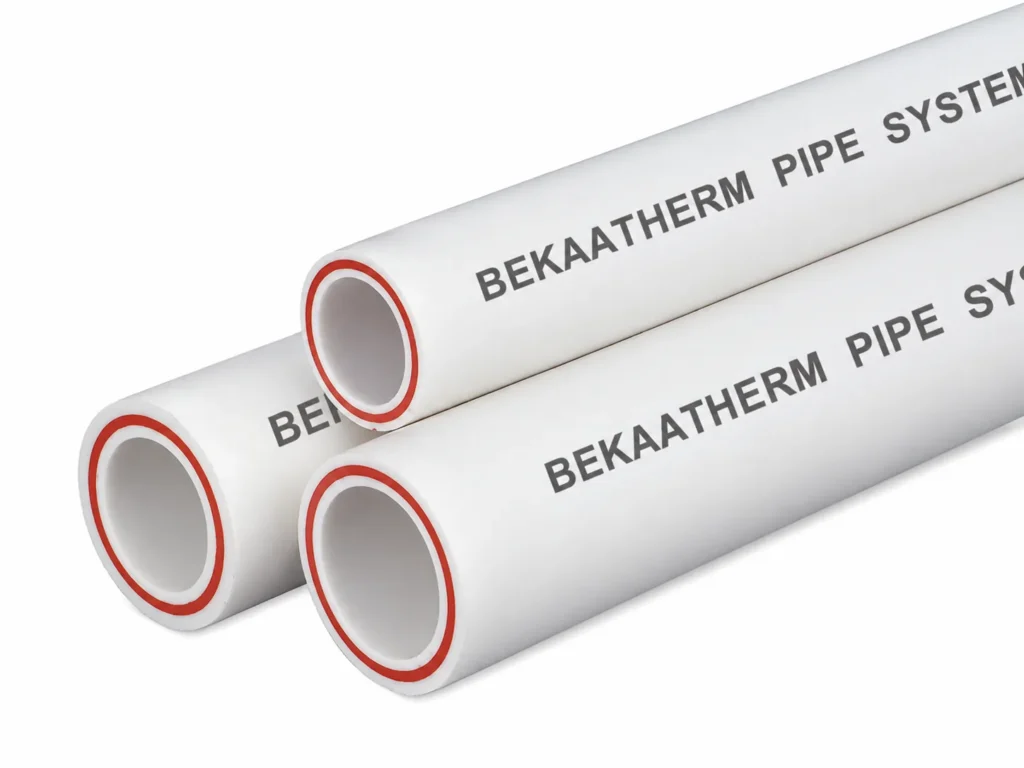
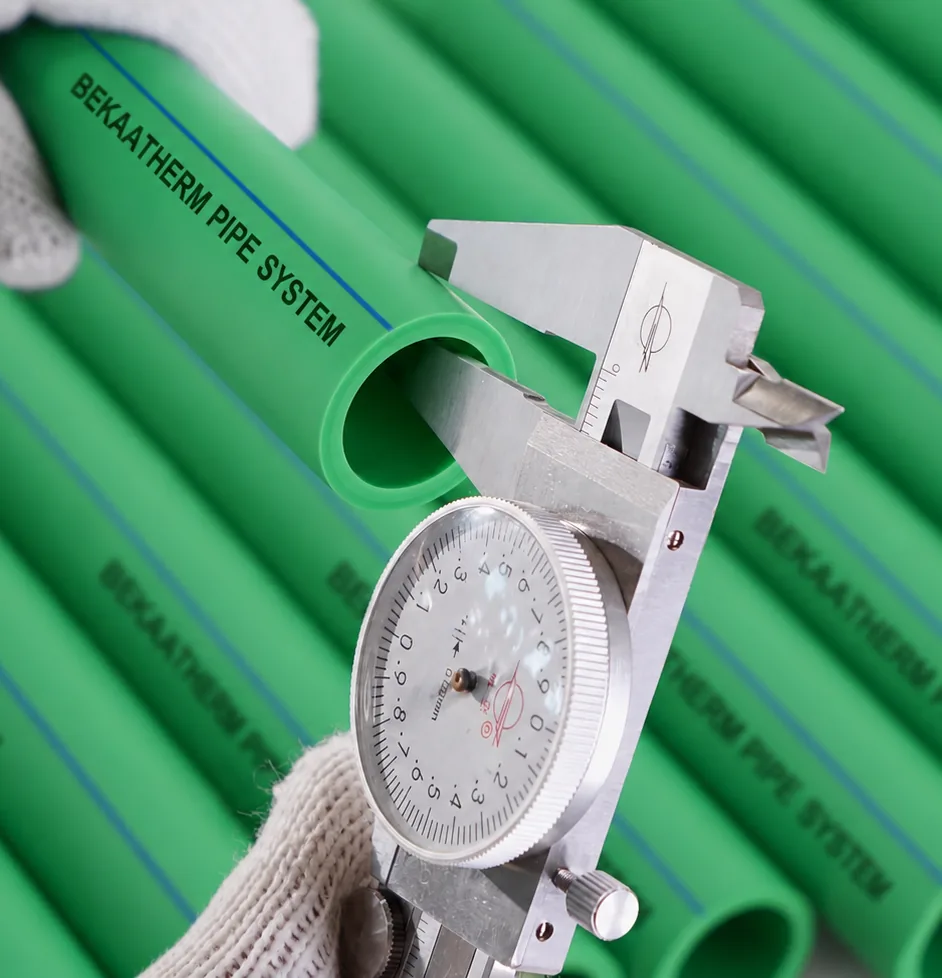
This is the most useful thing on this page. ISO 15874-2 Table 12 specifies the minimum required marking that must appear on the pipe itself. You can walk to a container with this list, pull one length, and check every item in under a minute. No lab, no sample dispatch, no waiting.
| Marking required on the pipe | Example given in the standard | What it tells a buyer |
|---|---|---|
| Number of the International Standard | ISO 15874 | The pipe claims conformity to the standard your certificate names |
| Manufacturer’s name and/or trade mark | Name or code | Must match the certificate owner in the public register |
| Nominal outside diameter and wall thickness | 16 × 2.2 | Check it with a caliper; this is where thin-wall substitution shows |
| Pipe dimension class | A | Confirms the tolerance class you ordered |
| Material | PP-R | Catches a different polypropylene grade arriving as PP-R |
| Application class with operating pressure | Class 1/10 bar | Must match your service condition, not just your pressure |
| Opacity, if declared | Opaque | Declared by the manufacturer where relevant |
| Manufacturer’s information for traceability | Production period (year and month, figures or code) plus a name or code for the production site where the manufacturer produces at different sites | The single most useful item: it tells you which plant made the goods |
Two enforcement details make the list checkable rather than theoretical. Marking must be printed or formed directly on the pipe not less than once per metre, in a way that keeps legibility after storage, handling and installation. Where printing is used, the colour must differ from the base colour of the pipe, and the marking must be legible without magnification. So “the print rubbed off” is not an acceptable answer at goods-in — that is a marking failure against the standard, and you can say so with the clause behind you.
The production-site code deserves its own sentence, because it is the item buyers never check and the one that answers the most awkward question in this trade: where was this actually made? Where a manufacturer produces at different sites, the standard requires a name or code identifying which one. Match it against the certificate scope and the certificate of origin. Three documents agreeing is a supply chain; two agreeing and one silent is a conversation to have before the balance payment.
On application class, a deliberate gap
You will see design temperatures for ISO 15874 application classes quoted confidently across the web. We are not printing them, because that class table lives in ISO 15874-1:2013 Table 1 and we have not verified those figures against the standard’s own text. What is verified is the mechanism: the pipe must be marked with its application class combined with operating pressure, in the form “Class 1/10 bar”. Match the marked class to your service condition and ask your supplier for the ISO 15874-1 class definition in writing — executable today, without anyone quoting a temperature they read on a blog.
What we hold, and what we do not claim
An article telling you to verify certificates has an obligation to be precise about its own. Bekaatherm’s certification set is SKZ, ISO 15874, CE and WRAS — and by the reasoning above, treat any CE document in this trade, ours included, as a voluntary test or declaration rather than a CPR CE marking. We are not going to sell you a badge we have just spent a section explaining does not exist.
We do not claim DVGW certification, a TSE mark, KTW-BWGL approval or DVGW W 270 approval. Those appear here because your market may ask for them, not because we are quietly implying we have them. If your specification requires one, ask us directly and we will tell you yes or no before you commit to a container.
How we handle the site question
This connects back to the production-site code in Table 12. We supply from Türkiye and from a Chinese partner factory, with origin allocated by market and confirmed in writing on the proforma invoice, and the certificate of origin, packing list and bill of lading kept consistent. We put it in writing because certificate scope is site-specific: a mark held by one production site does not automatically cover another. Ask which site your order ships from — it is a normal question with a written answer.
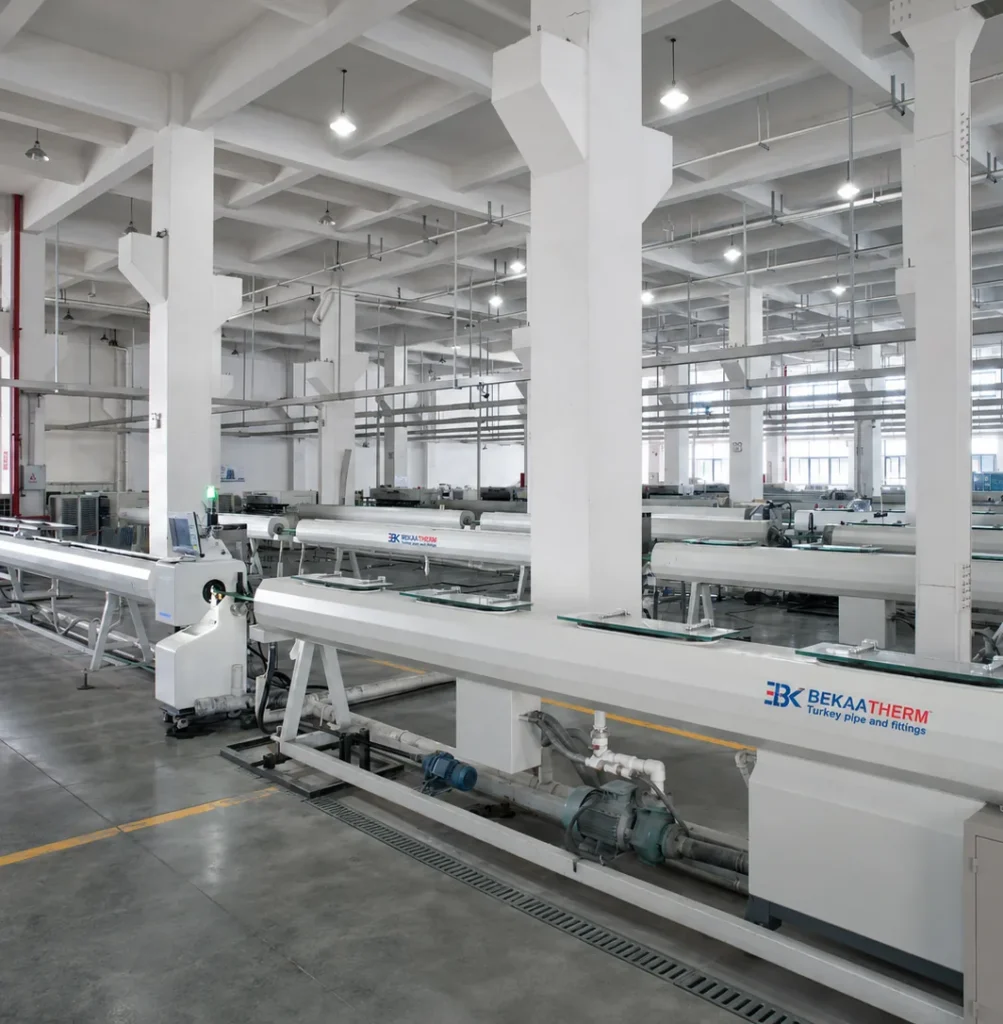
Behind the paperwork sits a 50-year warranty against material and manufacturing defects, matched to the 50-year design life at rated pressure and 20°C under ISO 15874. A warranty that long only means something from a manufacturer still around to honour it — the practical argument for checking the certification and the factory rather than the brochure. Bekaatherm has 30 years behind it, a 120,000 m² plant, 1000+ staff, 10,000 moulds, and ships 98 items across 4 systems to 118+ countries.
The document pack to ask for before a first order
This is what we send, and what you should require from anyone you are comparing us against:
- The certificate with scope visible: product range, standard and production site named on the document — not a logo on a letterhead.
- The register entry: the certificate number as it appears in the issuing body’s public list, so you can search it yourself.
- Type test scope: which standard edition and amendments, specifically whether the 2022 impact amendment is covered.
- Hygiene approval status for your market and whether it will be valid on 31 December 2026, given the transition to 31 December 2032.
- A marking sample: a photograph of the actual print on the pipe you are buying, checked against ISO 15874-2 Table 12.
- Origin documents: certificate of origin, packing list and bill of lading, consistent with each other and with the production-site code on the pipe.
If a supplier produces the first two in a day, they are used to being checked. If the last item causes friction, you have learned something valuable for the price of an email.
Conclusion
SKZ, DVGW and TSE are not a ranking. They are three answers to the question of who your market trusts to keep checking a factory, and the right one is whichever your specifier, utility or main contractor names in writing. What travels across all three is the discipline underneath: a certificate with a live scope, an entry in a public register, and marking on the pipe that agrees with both.
If you are pricing a container now, start with the destination market rather than the mark. Work out who signs off the installation, ask them what they require, then check a candidate supplier’s certificate against the register and the print on the pipe before the deposit goes out. Our certifications page lists what we hold and the standards behind each item, and the quality control process shows what happens between audits. If you want the market-by-market read for your specific range, ask — the answer is more useful to you than a badge.
Frequently Asked Questions
Is SKZ certification mandatory for PPR pipe?
No. SKZ is a voluntary third-party certification scheme, and no certification body or regulator lists it as a legal requirement. SKZ describes certification as a voluntary commitment to continuous quality assurance and regular inspections. Claims on supplier blogs that SKZ is mandatory for commercial drinking water projects are not supported by SKZ’s own material. It can still be commercially decisive if your specifier names it.
Is PPR pipe CE marked?
Not under the Construction Products Regulation. TEPPFA’s position statement of 21 October 2025 says that because harmonised technical specifications are not available for plastic piping products, it is currently not possible and not legal to apply a CE marking and issue a DoPC for plastic piping systems. A “CE certificate” for PPR pipe is usually a voluntary lab test report or a self-declaration. This does not block EU sales: plastic piping systems continue to be governed by national or European recognised product standards.
What is the difference between SKZ and DVGW certification?
SKZ is a certification body, test laboratory and inspection body accredited to DIN EN ISO/IEC 17065, 17025 and 17020, certifying a wide range of piping products including PP-R for domestic drinking water. DVGW certifies against its own product-specific programmes — ZP 8141, for example, covers polyethylene systems to DIN EN 12201 up to 25 bar PFA. Both carry a 5-year certificate term. The practical difference for a buyer is scope: check which material and product range the certificate in front of you actually names.
Is TSE certification required to import pipe into Türkiye?
The TSE Mark itself is voluntary. What is mandatory is the import control process: TAREKS, the Risk-Based Trade Control System run by the Ministry of Trade, must issue a reference number or customs clearance cannot be completed. TSE performs import inspections under certain communiqués, with low-risk consignments approved automatically and flagged consignments physically inspected. Whether plastic pipe under your HS heading appears on the current mandatory-inspection communiqué changes over time — confirm your heading with a customs broker against this year’s list.
Is WRAS approval a legal requirement in the UK?
No. WRAS is a voluntary scheme. The minimum legal requirement is compliance with Regulation 4 of the Water Supply (Water Fittings) Regulations, and WRAS approval is one route to demonstrating it. Kiwa states its KUKreg4 mark demonstrates the same compliance and can be accepted as equal, though that is a competing scheme’s claim. WRAS-type water quality testing is carried out to BS 6920, covering non-metallic materials in contact with drinking water.
What changes for drinking water materials on 31 December 2026?
The EU requirements for materials and products in contact with drinking water under Article 11 of Directive (EU) 2020/2184 generally apply from 31 December 2026. Products holding a valid national attestation of conformity on that date get a transitional period until 31 December 2032. Ask any supplier which of their hygiene approvals will be valid on 31 December 2026, and get it in writing. Confirm current requirements for your specific product and market with the relevant authority.
Are ISO 15874, EN ISO 15874 and TS EN ISO 15874 different standards?
They carry the same technical content. ISO 15874-2 was prepared by CEN/TC 155 in collaboration with ISO/TC 138/SC 2 under the Vienna Agreement between ISO and CEN, which is why the European and Turkish adoptions match. ISO 15874-2:2013 is the current second edition, last reviewed and confirmed in 2023, with amendments Amd 1:2018 and Amd 2:2022. Revisions to Parts 1, 2 and 5 are open at early ISO/AWI stage but the 2013 editions remain in force.
What must be printed on PPR pipe?
ISO 15874-2 Table 12 requires the standard number, manufacturer’s name or trade mark, nominal outside diameter and wall thickness, pipe dimension class, material, application class with operating pressure, opacity if declared, and manufacturer’s traceability information including production period and a production-site code where the manufacturer produces at different sites. Marking must appear not less than once per metre, in a colour different from the pipe, legible without magnification after storage, handling and installation.