Search for a torque figure for a PE compression fitting valve and you will find plenty of numbers. None of them come from a standard. No published specification for polyethylene mechanical compression fittings contains a tightening torque clause in newton-metres — the trade works in turns past hand-tight, and the joint is proven by pull-out and leaktightness tests instead. That is the honest answer, and it changes how you should be vetting suppliers.
Key Takeaways
- No standard publishes a torque table. The clause list of ISO 14236:2000 runs from Scope through to Marking with no torque clause anywhere. Any Nm figure you are given is a manufacturer’s own product data, not a specification.
- ISO 14236 has been withdrawn. It was replaced by ISO 17885, now in its 2021 edition. A catalogue still citing ISO 14236 as current is working from a stale reference — including, at the time of writing, parts of this site.
- For valves specifically, the standard is EN 12201-4:2024, published 14 March 2024, covering PE valves up to dn 400 mm at PFA up to 25 bar. Almost no competing guide names it.
- Tighten by turns, then stop. Typical trade practice is hand-tight plus roughly a quarter to half turn. Over-tightening crushes the grip ring and cracks the cap nut — it causes the leak it was meant to cure.
- PN10 means 10 bar at 20 °C, not at any temperature. Both EN 12201-3:2024 and EN 12201-4:2024 use 20 °C as the reference.
- A “WRAS approved” claim expires. Approvals are valid for a maximum of five years. Ask for the certificate number and check it is still in date.
Why there is no torque number, and what to use instead
Start with the document everyone cites. ISO 14236:2000 — Plastics pipes and fittings — Mechanical-joint compression fittings for use with polyethylene pressure pipes in water supply systems — was prepared by ISO/TC 138/SC 2 and issued on 15 March 2000. Its table of contents is short enough to read in one breath: Scope, Normative references, Terms and definitions, Classification, Material, Workmanship and appearance, Geometrical characteristics, Mechanical and hydraulic characteristics, Pressure losses, Marking, and an annex on long-term leaktightness pressure calculation.
There is no torque clause in that list. This is not a gap in my reading — the full clause structure is visible, and assembly tightening simply is not something the standard legislates. It never was. The standard tells you what the finished joint must survive; how hard you pull on the nut to get there is left to the manufacturer’s assembly instructions.
So if a supplier hands you a neat Nm table by size, treat it as useful product-specific data rather than a compliance requirement. It applies to their body geometry, their ring stack, their nut thread. Carry it across to another brand’s valve and you are guessing.
What the trade actually does is count turns. Common practice is to hand-tighten the nut fully, until it stops turning under finger pressure, then add roughly a quarter to a half turn with a wrench. Some sources go as far as one to one-and-a-half turns past hand-tight depending on diameter and brand — and that disagreement is the point. The ranges do not converge, which is exactly why you defer to the instruction sheet that came in the box.
If a joint weeps at test pressure, resist the instinct to lean on it. Retighten in small increments of about an eighth of a turn and re-test between each one. A joint that will seal, seals within a couple of those increments. A joint that will not seal after that has a different problem — a burr on the pipe end, a ring that never seated, or a pipe that was not pushed fully home — and more force will not fix any of them.
The failure mode nobody budgets for. Excess force on a plastic compression nut distorts the fitting body, damages the O-ring, crushes or deforms the split grip ring, or cracks the cap nut outright. Every one of those outcomes produces the leak the installer was trying to stop. Over-torquing is widely described as a leading cause of compression joint failure — and unlike a loose nut, you cannot undo it on site. The part is scrap.
The standards that actually apply in 2026
This is where most buying decisions go wrong, because the reference everyone quotes is dead. ISO 14236:2000 has been withdrawn. It was revised into ISO 17885:2015, which was itself superseded by ISO 17885:2021, the currently valid edition. If your specification pack, your tender document, or your supplier’s product page still names ISO 14236 as the governing standard, it is citing a withdrawn document.
I will be blunt about this, because it would be dishonest not to: the Bekaatherm HDPE fittings page cites ISO 14236 as well. That reference is being corrected. It is a good illustration of how deep the stale citation runs in this industry — it is on manufacturer sites, distributor catalogues, and the top-ranking guides for this exact search term, all at once.
| Standard | Status & scope | What it means for your order |
|---|---|---|
| ISO 14236:2000 | Withdrawn. Covered PE mechanical compression fittings to dn 160 mm, water to 40 °C, usually PN 6 / PN 10 / PN 16. | Legacy reference only. Do not accept it as proof of current conformity. |
| ISO 17885:2021 | Current. Mechanical fittings for plastic pressure piping, including transition fittings to metal pipe. | This is the replacement to name in a spec. Excludes flanges, in-building hot/cold water and district heating. |
| EN 12201-3:2024 | Published 30 January 2024; supersedes EN 12201-3:2011+A1:2012. PE fusion and mechanical fittings. MOP up to 25 bar, reference 20 °C. | Routes mechanical fittings to ISO 17885:2021. If a spec pack names the 2011+A1:2012 edition, it is three editions behind reality. |
| EN 12201-4:2024 | Published 14 March 2024. PE valves and valve bodies, dn ≤ 400 mm, PFA up to 25 bar, reference 20 °C. | The valve-specific part. Name this one when you are buying valves rather than couplers. |
| DIN 8076:2013-09 | Live German standard. Metal and plastic compression fittings for PE pipe to 110 mm OD, ≤ 40 °C. Replaced DIN 8076:2008-11. | The 110 mm ceiling matches the practical top end of the compression format. |
Scope and publication data read from the ISO and CEN catalogue entries and the DIN register.
Two exclusions in ISO 17885:2021 deserve a specifier’s attention, because they quietly delete a lot of misapplication. Mechanical fittings for hot and cold water inside buildings are outside its scope, and so are fittings for district heating. Compression is a buried and above-ground water-network format. It is not an in-wall plumbing solution, whatever a general catalogue implies by listing everything on one page.
What is actually inside the joint
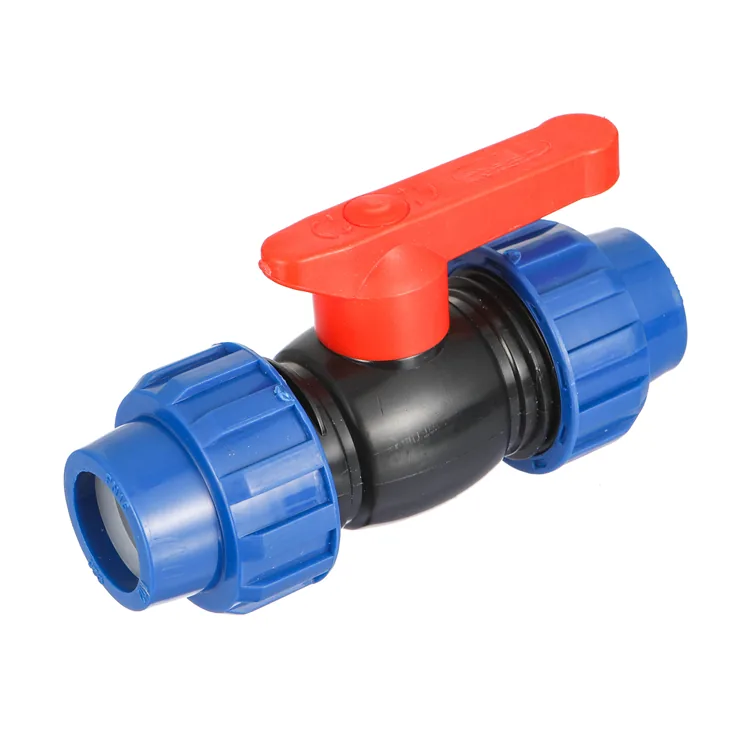
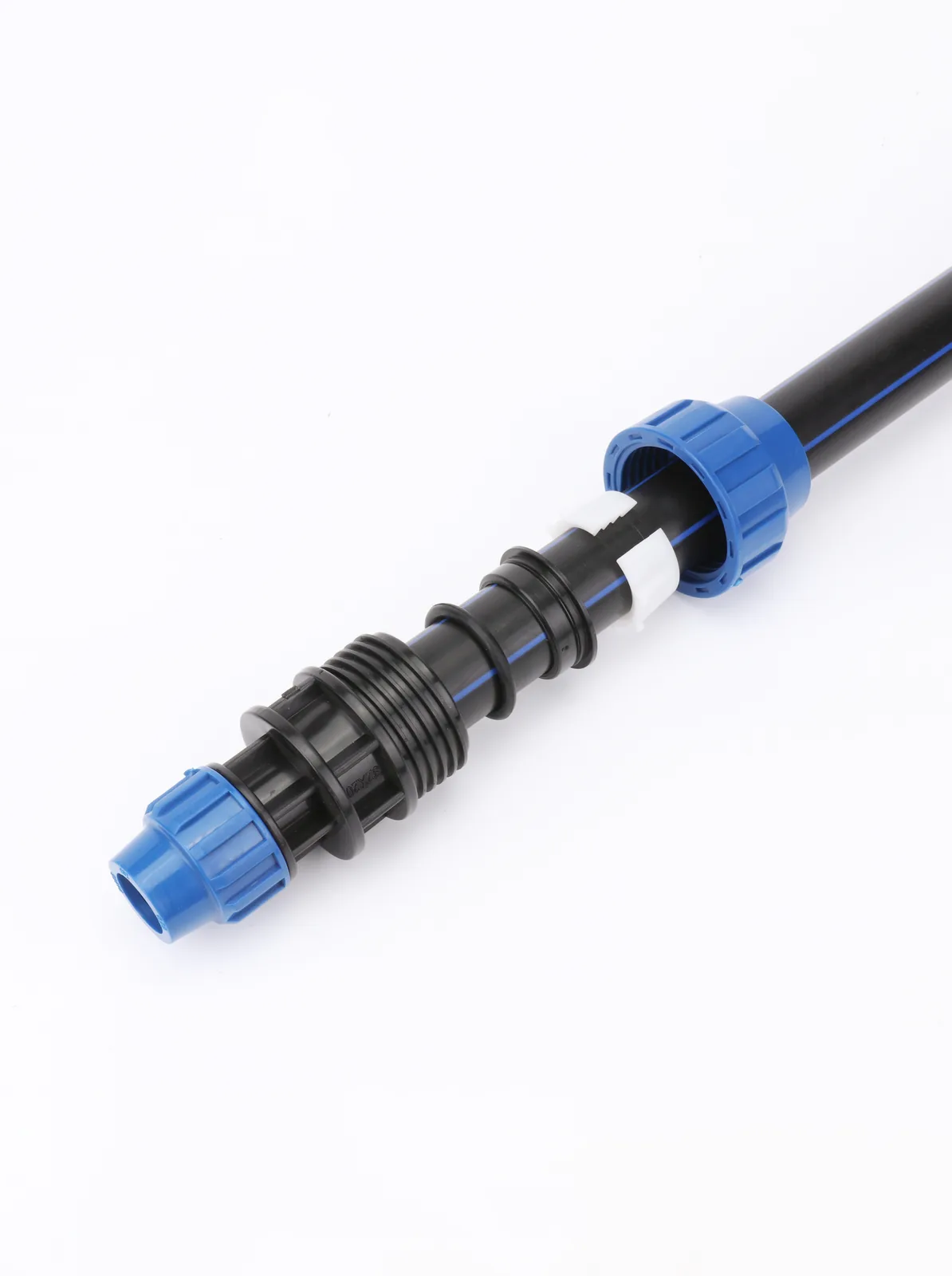
A typical PN10 polypropylene compression valve stacks five parts: the body, the cap nut, a sealing O-ring, a thrust or spacer ring, and a split grip ring. Designs vary — some manufacturers combine the thrust and grip functions, some add a support liner — so check the exploded view on the sheet for the specific product you are buying rather than assuming this order.
The mechanics matter because they explain the turns. As you tighten the nut, the grip ring is driven down a taper and closes onto the pipe wall, holding it against pull-out. The O-ring is compressed separately and does the sealing. Those two jobs finish at slightly different points in the travel, which is why “hand-tight plus a fraction” works and why continuing past it does damage: once the O-ring is fully compressed, extra turns only load the plastic.
Three preparation steps decide whether any of this works. Cut the pipe square — an angled cut leaves the O-ring sealing against an ellipse. De-burr the cut end, because a burr drags a sliver of the O-ring with it as the pipe goes in. Then push the pipe fully home to the internal stop before you tighten anything, so the rings sit where the designer put them. A pipe that stops half an inch short can pass a pressure test and pull out under thermal cycling six months later.
Ball valve or female valve: which one, and when
The compression fitting and valve range splits into two valve types, and they are not interchangeable despite looking similar in a catalogue thumbnail. Both are supplied at PN10 across 20–110 mm, so the choice is about what the joint has to do, not about pressure class.
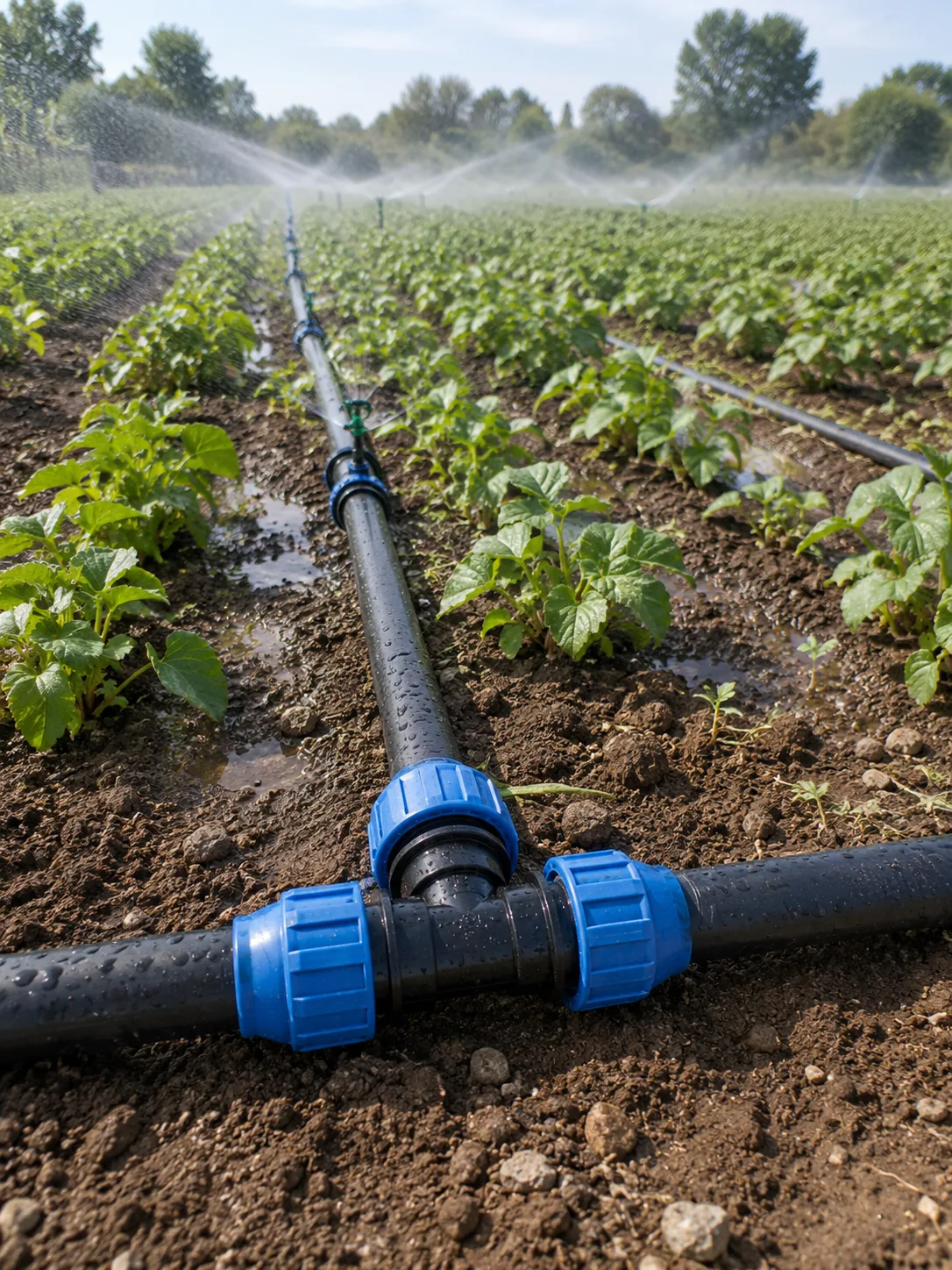
The compression ball valve takes pipe on both ends. It is an in-line isolation device — you cut into a run, put a valve in it, and you can now shut that branch. Quarter-turn operation, full bore, obvious handle position. This is the one you want on irrigation sub-mains, on branch takeoffs from a distribution line, and anywhere a maintenance crew needs to see at a glance whether a leg is open.
The compression female valve takes pipe on one end and a BSP female thread on the other. It is a transition device — the point where a PE network hands off to threaded metalwork, a meter set, a pump, a hydrant riser, or a filter assembly. Use it where the run leaves plastic. Do not use it in-line just because you have one on the shelf, because you have then introduced a threaded joint that needs its own sealing method and its own inspection.
Best for / not for
Compression valves are the right call for: buried and above-ground cold water networks; agricultural and landscape irrigation; site and temporary water; mains branch isolation at 20–110 mm; anywhere the crew has no fusion equipment or no power; and repair work where a joint has to be made in a wet trench.
They are the wrong call for: anything above 110 mm, where the format runs out and flanged or fused valves take over; hot water and in-building hot and cold services, which ISO 17885:2021 explicitly excludes; district heating, also excluded; and any buried joint that will be permanently inaccessible under a structure — a fully fused network has no mechanical joint to fail, and that is worth the equipment hire.
PN10 is a temperature statement, not just a pressure one
A PN class is the maximum continuous working pressure at a reference temperature, and that reference is normally 20 °C. EN 12201-3:2024 and EN 12201-4:2024 both use 20 °C. A PN10 valve is a 10 bar valve at 20 °C — it does not hold 10 bar at 40 °C, and it certainly does not hold it at 60 °C.
I am not going to give you a derating table, and you should be suspicious of anyone who publishes one without naming its source. The coefficients live in the annexes of the system standards and in the manufacturer’s own data sheet for the specific product, and they differ by material and by design. Take them from the data sheet for the item you are buying. If the supplier cannot produce derating data for their own valve, that tells you something about how well they know it.
This matters more than it sounds in hot climates. Above-ground irrigation pipe in a Gulf or North African summer runs well above 20 °C by mid-afternoon, and a network specified at the nameplate figure has less margin than the drawing suggests. The Bekaatherm compression range is PN10 across all sizes, which is the honest number to design against — not a PN16 headline borrowed from a different product family.
The tests that prove a joint, and the one buyers forget
Since no standard tells you how hard to tighten, the proof sits in the joint tests. These are the test method numbers to demand reports against, and they have all been revised recently enough that an old report is a warning sign in itself.
ISO 3501:2021 is the pull-out test: resistance of a mechanical joint to a constant longitudinal force. Third edition, published December 2021, replacing ISO 3501:2015. This is the one that proves the grip ring does its job — that the pipe does not walk out of the fitting under load.
ISO 3459:2022 is the test almost nobody asks for: leaktightness under negative pressure, published April 2022, replacing the 2015 edition, covering assembled joints up to and including 63 mm. It proves the joint holds when the line goes to vacuum rather than pressure. That is the condition on drain-down, on pump shutdown, and on any buried irrigation line that empties on a slope — and a joint can pass a pressure test and still suck in through the O-ring under vacuum. Ask for this one.
ISO 3503 covers leakproofness under internal pressure when the joint is subjected to bending, which is the realistic buried condition — a trench settles, the pipe takes a bend, and the joint has to stay sealed while it is loaded off-axis. Worth noting that ISO 14236:2000 referenced the 1976 editions of these test methods. That alone should tell you how far the old citation has drifted from current practice.
How we check a compression valve before it ships
Bekaatherm manufactures in Türkiye across a 120,000 m² site, with 1000+ staff, 10,000 moulds and 30 years of production behind the tooling, exporting to 118+ countries. Here is the documentation logic we apply, and the same logic works as a checklist against any supplier including us.
- Name the current standard, not the comfortable one. ISO 17885:2021 and EN 12201-4:2024 are the live references for mechanical fittings and PE valves. We are not claiming certification to ISO 17885 for this range — we are telling you it is the benchmark to ask every supplier about, and you should hold us to the same question.
- Check the certificate is in date. We hold SKZ (Germany), ISO, CE and WRAS. WRAS Fitting and Material Approvals are each valid for a maximum of five years and the product must be retested to keep them, so a logo on a catalogue proves nothing on its own. Ask for the number and look it up in the WRAS directory. A real holder will hand it over without hesitating.
- Match the pipe standard to the fitting standard. The pipe a compression valve clamps onto is made to ISO 4427, EN 12201, and DIN 8074 / DIN 8075. Dimensional conformity of the pipe is half of whether the joint seals — a fitting cannot compensate for out-of-round pipe.
- Confirm PN and its reference temperature together. PN10 at 20 °C. Both halves of that statement, in writing, on the invoice specification.
- Ask which plant. We supply from Türkiye and from a partner plant in China, allocated by market. The origin is confirmed in writing on the proforma invoice for each order, and the certificate of origin, packing list and bill of lading are issued to match. If a supplier will not tell you which plant made your goods, that is the answer.
Details of the test and inspection regime sit on the quality control page, and the certificate set is on the certifications page. Conformity requirements vary by market and by application, so confirm what your own local water authority or building control will accept before you commit a specification.
If you are specifying a PE network and need to see the compression range against the standards above — sizes, valve types, saddle clamps and the PN10 declaration — the full range sits on the HDPE pipe and fittings page.
For specifiers and contractors comparing formats. Not a quote request — no commitment involved.
A worked order: irrigation sub-main, 63 mm, first container
Take a distributor supplying agricultural contractors who needs 63 mm PN10 sub-main with isolation at each field branch, and wants to trial the range before committing to a full programme.
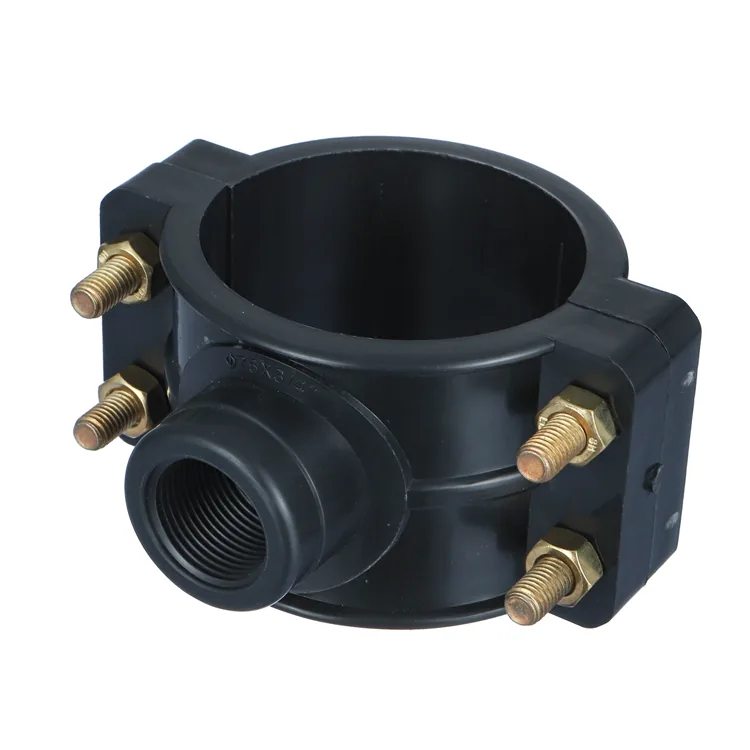
The specification is straightforward: black HDPE pipe to ISO 4427 / EN 12201, blue PP compression couplers and equal tees at the branches, compression ball valves for isolation, compression female valves where the line meets the pump manifold, and saddle clamps for the drip laterals. Every item PN10 at 20 °C, 20–110 mm range, so the whole build sits inside one pressure class with no mixed-rating confusion in the van.
Commercially, the entry point is one 20GP mixed container of pipe, fittings and valves. A mixed container runs at about 60% pipe, 30% fittings and 10% valves by volume — worth knowing before you plan the assortment, because valves are the smallest slice by volume and the largest by unit value, and first-time buyers routinely over-order them relative to the pipe they will actually sell. If you would rather order by line item, the single-size minimum is 500 kg per size and colour.
Lead time on regular in-production sizes is 15–25 days; a private-label run is 30–45 days. Payment is 30% T/T deposit with 70% against copy B/L. Trade terms are FOB İstanbul or Mersin by default, with CFR and CIF on request. Product carries a 50-year warranty against material and manufacturing defects.
Before any of that, get a valve in your hand. Standard samples are free for up to three items, freight collect. Fit one to a length of the pipe you actually intend to sell, hand-tighten it, add your quarter turn, and pressure-test it. Twenty minutes on a bench answers more questions than a fortnight of catalogue comparison.
The document list to send your supplier
Copy this into an email. The replies you get will sort suppliers faster than any spec sheet, because each item is something a real manufacturer has on file and a trading company has to go and ask for.
- Your written assembly instruction for these valves, including the tightening method you specify — stated in turns, in Nm, or both.
- Which standard you declare conformity to for the valve body, and the edition year.
- ISO 3501 pull-out test report for the joint, with the report date.
- ISO 3459 negative-pressure leaktightness report — expect a pause on this one; it is the test that separates the prepared from the improvising.
- Declared PN class and the reference temperature it applies at, plus derating data for the temperatures in my market.
- WRAS certificate number and expiry date, if WRAS is claimed.
- Which plant will produce this order, confirmed on the proforma invoice.
Send that list to us first. If you are pricing a PE network and want the compression range quoted against your sizes with the documentation attached, put the list in the enquiry form or message +86 198 8450 3412 on WhatsApp. Replies go out within 24 hours.
For distributors and contractors with a defined project or assortment. If you are still at the comparison stage, read the product page first — you will get a better answer from us once you know your sizes.
Frequently asked questions
What torque should I use on a PE compression fitting valve?
No published standard for PE mechanical compression fittings specifies a tightening torque in newton-metres — ISO 14236:2000 had no torque clause, and current references govern joint performance rather than assembly force. Typical trade practice is to hand-tighten the nut fully, then add roughly a quarter to a half turn with a wrench. Always follow the assembly instruction supplied with the specific product.
Is ISO 14236 still valid?
No. ISO 14236:2000 has been withdrawn. It was revised into ISO 17885:2015, which was superseded by ISO 17885:2021 — the current edition for mechanical fittings in plastic pressure piping systems.
Which standard covers PE valves specifically?
EN 12201-4:2024, published 14 March 2024, covers valves and valve bodies made from polyethylene for buried and above-ground water applications, at nominal outside diameters up to 400 mm and allowable operating pressure up to 25 bar at a 20 °C reference temperature.
What happens if I over-tighten a plastic compression nut?
Excess force can distort the fitting body, damage the O-ring, crush or deform the grip ring, or crack the cap nut. Each of those causes the leak the installer was trying to prevent, and none can be reversed on site — the part has to be replaced.
Does PN10 mean 10 bar at any temperature?
No. A PN class is the maximum continuous working pressure at a reference temperature, normally 20 °C, and both EN 12201-3:2024 and EN 12201-4:2024 use that reference. The permissible pressure falls as temperature rises, and the derating factors must be taken from the manufacturer’s data sheet for the specific product.
What size range do PE compression valves cover?
The Bekaatherm compression range covers 20–110 mm, with 1/2″–4″ BSP threads, at PN10 across the range. Saddle clamps run from 25×1/2″ up to 315×6″. DIN 8076:2013-09 sets a 110 mm outside-diameter ceiling for compression fittings, which matches the practical limit of the format.
How do I verify a supplier’s WRAS approval?
WRAS Fitting Approvals and WRAS Material Approvals are each valid for a maximum of five years, and products must be retested every five years to maintain approval. Ask the supplier for the certificate number and check it is still in date in the WRAS products and materials directory. Non-metallic materials in contact with drinking water are tested to BS 6920.
Can I use compression valves instead of electrofusion?
Within 20–110 mm on cold water networks, yes — compression needs no power, no fusion equipment and no dry trench, which is why it dominates irrigation and repair work. Above 110 mm the format runs out. For hot and cold water inside buildings and for district heating, ISO 17885:2021 excludes mechanical fittings from its scope, so a fused or purpose-designed system applies instead.