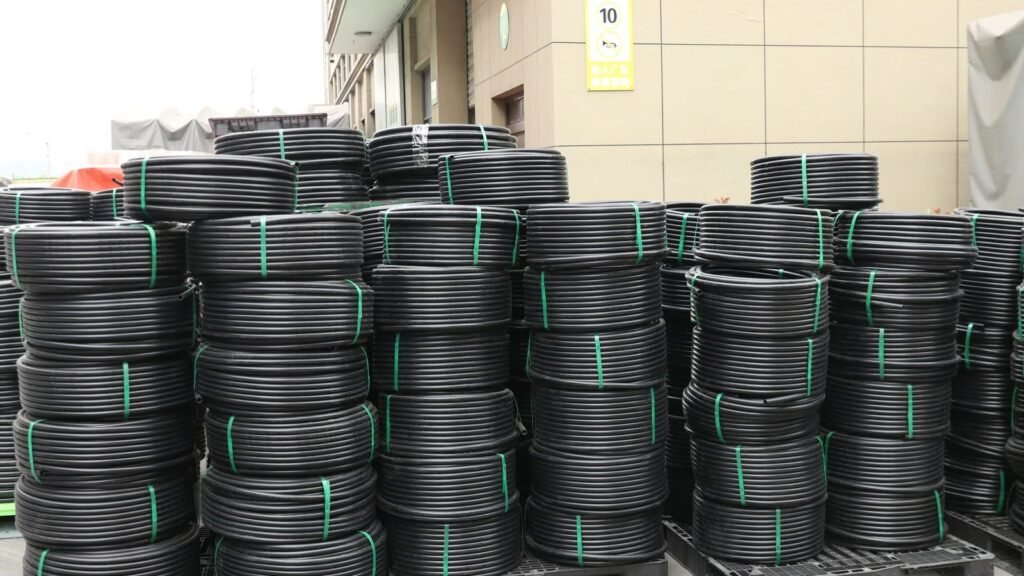
Double-wall corrugated HDPE pipe and solid-wall HDPE pipe are not two grades of the same product. They are answers to two different load questions, and they are written into two different standards families. DWC lives under EN 13476, whose title contains the word non-pressure. Solid-wall PE pressure pipe lives under EN 12201, which is written for allowable operating pressures up to 25 bar. Once you see that split, most of the “which is better” content on this topic stops making sense.
Two things changed recently that most pages on this keyword have not caught up with. EN 13476-2:2025 and EN 13476-3:2025 were both published on 7 October 2025, superseding the 2018+A1:2020 editions that nearly every corrugated pipe datasheet still cites. And the 2025 Type B edition specifically lists “ring stiffness classes (SN) better described” among its changes — which matters if your standing spec text was copied from a 2018-era document.
Key Takeaways
- DWC is a non-pressure product, by standard. EN 13476 governs “non-pressure underground drains and sewers”. If the line carries pressure, DWC is the wrong family — not a cheaper version of the right one.
- The number that settles the argument is 0,5 kPa. EN 1610:2015, the construction and testing standard for drains and sewers, applies to pipelines “usually operating under gravity but up to 0,5 kPa when surcharged”. That is the ceiling for the whole gravity family.
- Type B is the standards word for “corrugated”. Type A = smooth inside and outside. Type B = smooth internal surface, profiled external surface. DWC is Type B, covered by EN 13476-3:2025.
- Cite the 2025 editions. EN 13476-2:2025 and EN 13476-3:2025 were both published 7 October 2025 and supersede the 2018+A1:2020 editions. A spec quoting 2018 is now out of date.
- SN is a measured value, not a marketing badge. Ring stiffness is determined to EN ISO 9969:2016 by compressing a sample between two parallel plates and reading the force at 3 % diametric deflection. EN 13476 uses SN2, SN4, SN8 and SN16, in kN/m².
- Initial stiffness is a short-term number. EN 13476-3:2025 normatively references EN ISO 9967, creep ratio. Long-term deformation is governed there — not by the SN figure on the brochure.
- On the pressure side the equivalent lever is SDR. MOP = 20 × MRS / [C × (SDR − 1)]. For PE100 (MRS 10 MPa, C = 1.25): SDR11 → 16 bar, SDR17 → 10 bar. You can reproduce that arithmetic yourself.
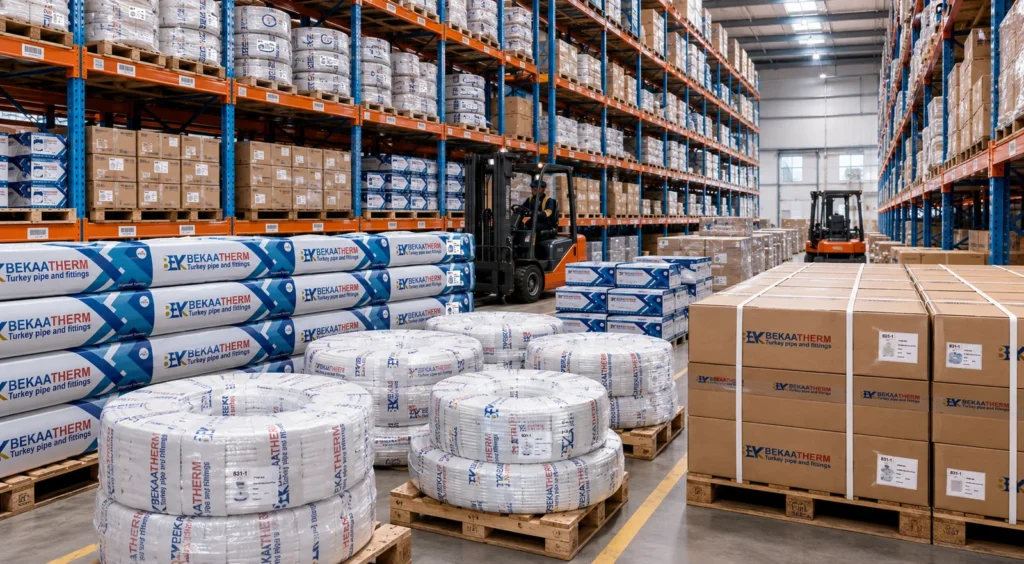
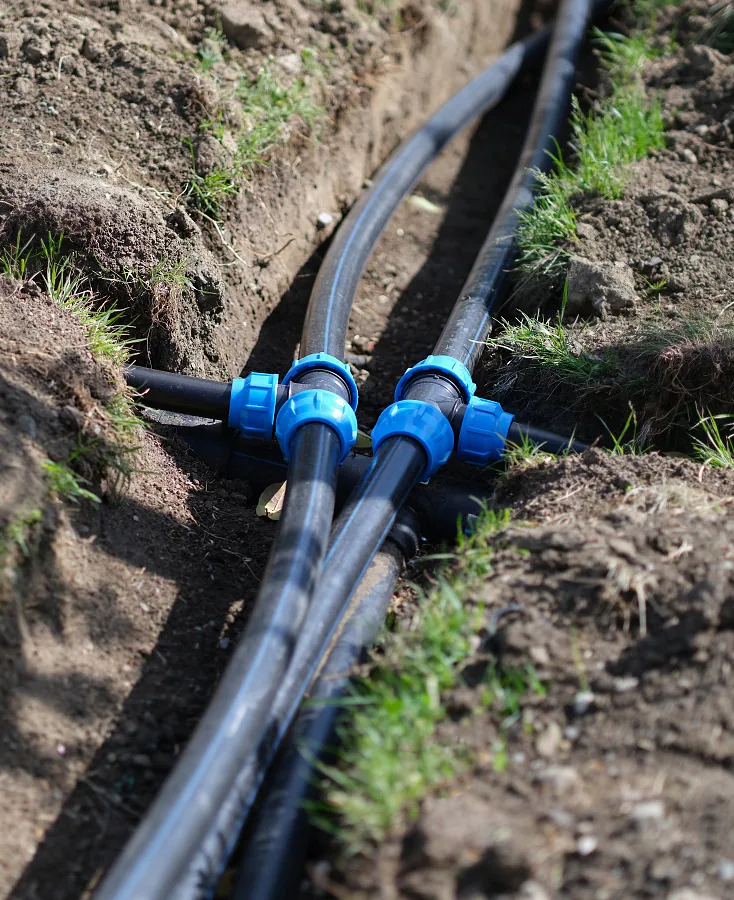
- Bekaatherm does not manufacture DWC. Our HDPE line is solid-wall pressure pipe with blue PP mechanical compression fittings, PN10, fittings 20–110 mm and saddle clamps to 315 mm. This page is here to get the boundary right, not to sell you corrugated pipe.
What the second wall actually does
A DWC pipe is one smooth inner liner bonded to a corrugated outer profile, with air between the ribs. In standards language that is Type B: smooth internal surface, profiled external surface. Type A, by contrast, is smooth on both faces. That single distinction decides which part of EN 13476 your product is declared against.
The reason the profile exists is geometry, not chemistry. Resistance to being squashed by soil and traffic is a bending problem in the pipe wall, and bending stiffness rises sharply as you move material away from the neutral axis. A corrugation does exactly that: it pushes plastic outward into ribs instead of spreading it evenly through a thick wall. So you buy external load resistance cheaply.
Now flip the load. Internal pressure produces hoop tension, and hoop tension does not care where the material sits — it cares how much continuous cross-section is there to be pulled. The air gaps between ribs carry nothing. That is the entire physical reason DWC wins on burial depth per kilogram and loses on pressure, and it is why the two products sit in separate standards rather than competing on a price list.
You will find pages claiming DWC saves a specific percentage of material against solid wall at equal stiffness. Ignore the number unless the source states the comparison geometry, the SN class and the test basis. Most of those figures trace back to marketing copy with no stated method, and “equal stiffness” is meaningless until someone says stiffness against which load.
The decision boundary, in one table
The honest comparison is not feature-by-feature. It is a single question asked before anything else: does the line hold pressure, or does it flow downhill? Answer that and the standard, the rating system, the test method and the jointing method all follow automatically.
| Question | DWC / structured wall | Solid-wall PE pressure pipe |
|---|---|---|
| Governing standard | EN 13476-3:2025 (Type B); ISO 21138-3:2020 internationally | EN 12201-2:2024; also ISO 4427, DIN 8074/8075 |
| Load it is designed against | External: soil column, traffic, groundwater | Internal: hoop stress from operating pressure |
| Rating system | SN2 / SN4 / SN8 / SN16, in kN/m² | SDR and PN, derived from MRS by formula |
| Pressure ceiling | Gravity; EN 1610 covers up to 0,5 kPa when surcharged | EN 12201 applies up to 25 bar allowable operating pressure |
| Key test method | EN ISO 9969:2016 ring stiffness; EN ISO 9967 creep ratio | Long-term hydrostatic strength behind the MRS classification |
| Typical service | Foul sewer, stormwater, highway drainage | Potable mains, irrigation, pressurised sewer, vacuum sewer |
Read the pressure-ceiling row again, because it is the one that ends most arguments. EN 1610:2015 covers construction and testing of drains and sewers “usually operating under gravity but up to 0,5 kPa when surcharged”. Half a kilopascal is about five centimetres of water head. Anyone offering you corrugated pipe for a rising main is either confused about the product or hoping you are.
“Can DWC handle pressure?” — the question behind the question
This gets asked constantly, and usually the asker does not mean “can it hold 10 bar”. They mean something narrower: a gravity line that occasionally surcharges in a storm, or a short section that sits below a pumping station, or a drain that backs up when the outfall is tide-locked. Those are real conditions and they deserve a real answer.
The answer is that the gravity system standard already accounts for surcharge — up to 0,5 kPa — and beyond that you have left the family. There is no SN class that converts a Type B pipe into a pressure pipe, because SN describes resistance to being flattened from outside, not resistance to being burst from inside. Two different failure modes, two different tests, two different standards.
Here is the practical trap. A pumped section is often only twenty or thirty metres of a scheme that is otherwise gravity. It is tempting to keep one material through the whole run for jointing simplicity. Do not. Specify the pumped section to EN 12201 with an SDR that suits the pump’s shut-off head, transition at a chamber, and note the change explicitly on the drawing so the site team does not “helpfully” continue the corrugated pipe through it.
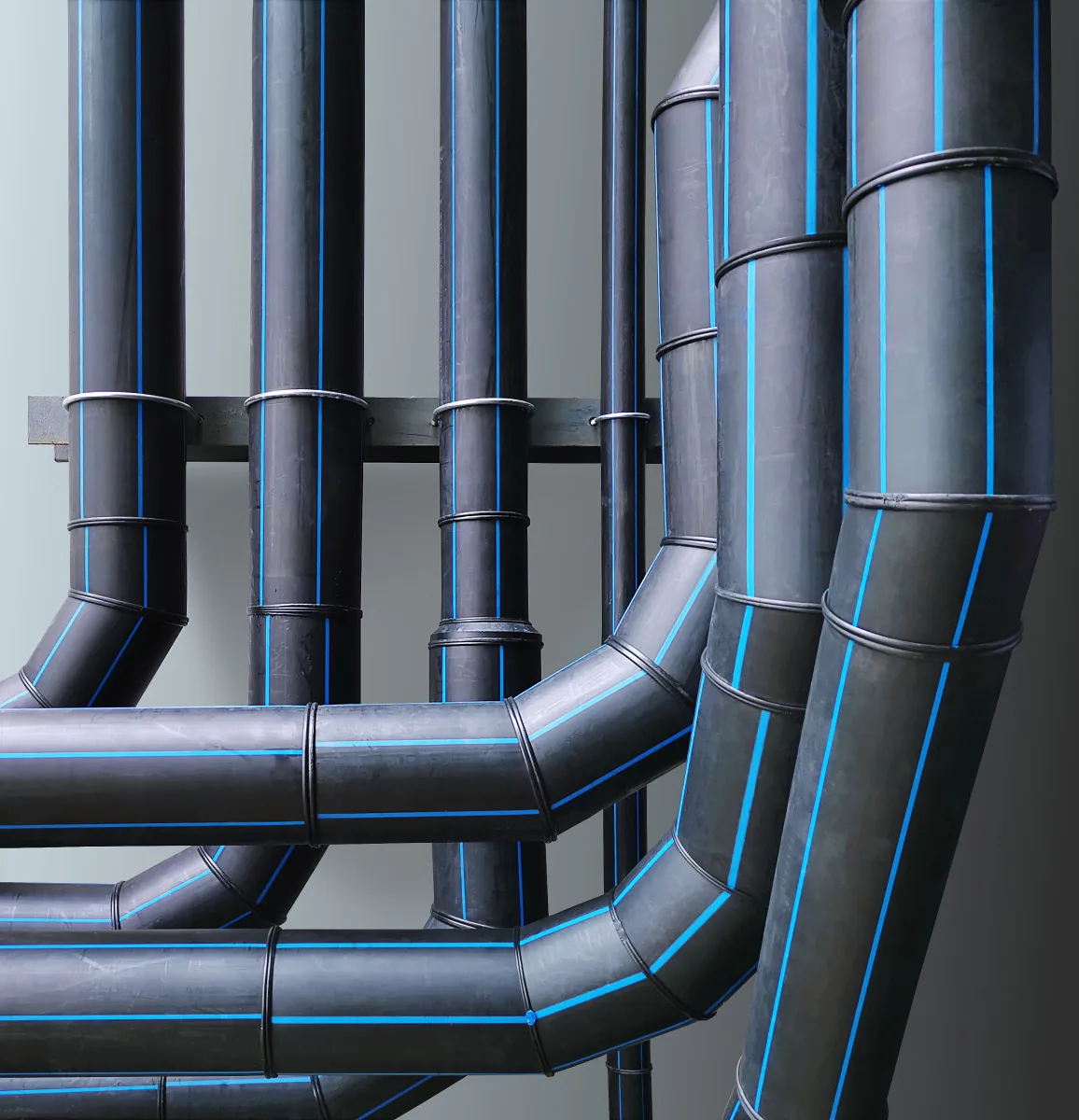
How SN is actually measured, and what it does not tell you
Ring stiffness (SN — the class number describing how hard the pipe resists being squashed) is determined to EN ISO 9969:2016. The method is blunt and repeatable: take a pipe sample, compress it between two parallel plates at a constant deflection speed, record force against deflection, and calculate stiffness from the force needed to produce 3 % diametric deflection. The 2016 third edition supersedes EN ISO 9969:2007.
Two consequences follow, and both are worth putting in a spec. First, SN is a laboratory value from a short-duration plate test on a bare sample. It says nothing about how the pipe behaves once it is surrounded by soil that either supports it or does not. Second, it is a short-term number. EN 13476-3:2025 normatively references EN ISO 9967, creep ratio, precisely because deformation continues under sustained load long after the plate test has ended.
Competitor product pages quote SN8 and stop there. Ask for the creep ratio data as well. A supplier who can produce EN ISO 9967 results has run the long-duration testing; a supplier who only has the plate-test certificate has run the cheap one. That single request separates the two faster than any factory audit question.
SN4, SN8 or SN16: what really decides it
You will see a tidy mapping repeated everywhere: SN4 for footpaths, SN8 for light traffic, SN16 for heavy roads. That mapping is trade shorthand. It is not in EN 13476, and treating it as a rule is how specifiers end up defending a class selection they cannot show the working for.
What is real: SN2, SN4, SN8 and SN16 are the classes used in the EN 13476 series, expressed in kN/m². SN4 and SN8 are the classes traditionally recommended in the UK for water company adopted sewers, on the condition that the system is installed in accordance with BS EN 752:2017 or BS EN 1610:2015 to achieve the intended resistance to long-term deformation. Note the condition attached to that recommendation — it is doing real work, and the next section is about why.
One warning on class numbers you may be quoted: SN12.5 turns up in some product literature written to Chinese GB standards. It is not an EN 13476 class. If a quotation offers SN12.5 against a European specification, the supplier is mixing standards families and you should ask which one the declaration of performance is actually written against.
The inputs you genuinely need before choosing a class are unglamorous: burial depth to crown, surface loading including construction traffic during the build (often worse than the finished condition), native soil modulus, groundwater level, trench width and support, and the embedment material you can realistically get compacted on that site. Gather those, then let the class fall out of the calculation.
Does solid-wall PE pipe have an SN class?
No. EN 12201-2:2024 declares solid-wall PE pipe by SDR and PN, not by SN; its ring stiffness is a consequence of wall thickness and can be estimated from the SDR, but it is never a marked class. The two tables below put the two rating systems side by side so a specifier can compare like with like.
EN 13476 assigns four nominal classes. The BSI foreword to BS EN 13476-3 sets them out by size: SN4, SN8 and SN16 for DN ≤ 500, with SN2 added for DN > 500. Solid-wall pipe has no such ladder, so the useful move is to work its stiffness out from geometry. Ring stiffness as defined in EN ISO 9969:2016 is S = E·I / Dm3; for a plain wall that collapses to S = E / [12 × (SDR − 1)3]. Using the 1 000 MPa short-term flexural modulus that the PE100+ Association publishes for PE100, the arithmetic looks like this.
| Pipe | How stiffness is stated | Short-term ring stiffness (kN/m²) | Basis |
|---|---|---|---|
| DWC Type B, SN4 | Declared class, EN 13476-3:2025 | ≥ 4 | Plate test to EN ISO 9969:2016 at 3 % deflection |
| DWC Type B, SN8 | Declared class, EN 13476-3:2025 | ≥ 8 | Plate test to EN ISO 9969:2016 at 3 % deflection |
| DWC Type B, SN16 | Declared class, EN 13476-3:2025 | ≥ 16 | Plate test to EN ISO 9969:2016 at 3 % deflection |
| Solid-wall PE100, SDR 33 | Not declared; follows from SDR | ≈ 2.5 | E / [12 × (SDR − 1)3], E = 1 000 MPa |
| Solid-wall PE100, SDR 26 | Not declared; follows from SDR | ≈ 5.3 | Same formula |
| Solid-wall PE100, SDR 21 | Not declared; follows from SDR | ≈ 10.4 | Same formula |
| Solid-wall PE100, SDR 17 (PN10) | Not declared; follows from SDR | ≈ 20 | Same formula |
| Solid-wall PE100, SDR 11 (PN16) | Not declared; follows from SDR | ≈ 83 | Same formula |
| Sources: EN 13476-3:2025 and the BSI national foreword to BS EN 13476-3 (class-by-size split); EN ISO 9969:2016 (definition of ring stiffness, 3 % deflection); EN 12201-2:2024 (SDR/PN declaration); PE100 flexural modulus 1 000 MPa from the PE100+ Association, pe100plus.com (PE100 & PE100-RC pipe properties page). Solid-wall values are arithmetic from that modulus, rounded; substitute the resin’s declared modulus for a design check. | |||
Read the middle column with the pressure rating in mind. A PN10 PE100 main at SDR 17 is already stiffer than an SN16 corrugated pipe, and at SDR 11 it is roughly four times stiffer again. That is why nobody specifies solid-wall pressure pipe by stiffness: once the wall is thick enough to hold pressure, external load almost never governs. The reverse is the whole DWC argument — at SDR 26 to 33, where a pressure pipe would be thin and floppy, corrugation buys the SN4 to SN8 range for a fraction of the material. A long-term check still needs the creep ratio to EN ISO 9967 for either family; the short-term number in the table is a like-for-like comparison, not a design value.
Burial depth and load: which lever to check first
The table below is a sequencing aid, not a class-selection lookup. On the gravity side the class comes out of a soil-structure calculation to EN 1295-1:2019; on the pressure side the SDR comes out of the operating pressure and the stiffness is then confirmed rather than chosen. The bedding rules are the same for both and sit in EN 1610:2015 — our trench and bedding guide walks through them zone by zone.
| Site condition (cover to crown, m) | DWC to EN 13476: what governs | Solid-wall PE to EN 12201: what governs | Check it against |
|---|---|---|---|
| < 0.6, landscape or garden, no vehicles | Embedment quality; SN4 is the usual starting class | Operating pressure only; stiffness is not the constraint | EN 1610:2015 embedment; national minimum-cover rule |
| < 1.0 under a carriageway, or < 0.9 under a footway | Construction traffic, not the finished road; SN8 or a concrete surround | Protection detail; confirm deflection at SDR 21 and above | EN 1295-1:2019; UK highway standard details (City of Edinburgh detail 5003-1 calls for a concrete surround below those covers) |
| 1.0 to 3.0, native soil with reasonable modulus | Soil modulus and trench width; SN4 to SN8 falls out of the calculation | Pressure class; SDR 17 to 26 typical, stiffness confirmed, not chosen | EN 1295-1:2019 structural design |
| > 3.0, soft ground or high water table | Long-term deformation; SN8 to SN16 plus creep ratio data | Buckling under external water pressure when empty; SDR 17 or thicker | EN 1295-1:2019; EN ISO 9967 creep ratio |
| Any internal pressure, any depth | Out of scope — change family | SDR from MOP = 20 × MRS / [C × (SDR − 1)] | EN 12201-2:2024; ISO 4427-2:2019; DIN 8074/8075 from DIN |
| Sources: EN 1610:2015 (construction and testing of drains and sewers); EN 1295-1:2019 (structural design of buried pipelines); EN 13476-3:2025; EN 12201-2:2024; ISO 4427-2:2019. Cover thresholds in row 2 are the UK highway convention, not a CEN requirement — confirm the local rule. | |||
For the pressure side, the SDR-to-PN arithmetic and the wall thicknesses behind it are tabulated in our HDPE SDR, PN and wall thickness guide; the stiffness column above is the one figure that guide does not need, because on that side the wall is already thicker than any external load requires.
The pressure side: SDR arithmetic you can check yourself
If SN is the structural lever on the gravity side, SDR is its counterpart on the pressure side. SDR (standard dimension ratio) is simply outside diameter divided by wall thickness. Higher SDR means a thinner wall relative to diameter, which means a lower pressure rating. The relationship is a published formula, not a vendor claim:
MOP = 20 × MRS / [C × (SDR − 1)]
MRS in MPa, MOP in bar. For PE100, MRS = 10 MPa. For water applications the minimum recommended service design coefficient C is 1.25.
PE100 SDR11: (20 × 10) / (1.25 × 10) = 16 bar → PN16
PE100 SDR17: (20 × 10) / (1.25 × 16) = 10 bar → PN10
Work through those two lines once and the pressure side stops being mysterious. It also gives you a check on any supplier: if a quoted SDR and PN pair do not reconcile through that formula at the stated material grade, something in the offer is wrong — usually the material grade, occasionally the design coefficient, sometimes the whole datasheet.
EN 12201 covers PE 100, PE 80 and PE 40 for buried and above-ground use: water for human consumption, raw water before treatment, drainage and sewerage under pressure, and vacuum sewer systems. Note that third item. Pressurised sewerage is explicitly in the pressure standard, which is the cleanest possible confirmation that “it’s sewage” never by itself justifies a corrugated product.
Why bedding decides whether your SN class does anything
A flexible pipe does not resist soil load on its own. It deflects slightly, pushes outward into the surrounding embedment, and the soil pushes back. The pipe and the soil form one structure. Which means the SN class you paid for is only realised if the embedment is placed and compacted the way the design assumed.
EN 1610:2015, published 01 September 2015, is the standard that covers this: pipelines in trenches, under embankments or above ground, including bedding, embedment, backfilling, manholes and final leak-tightness testing. It defines air test method “L” and water test method “W” for gravity pipelines. The specific test pressures and hold durations sit in the standard’s own tables — buy the document rather than trusting a figure copied off a forum.
The failure that follows from ignoring this is predictable. Someone specifies SN8 to be safe, the gang backfills with as-dug clay because the imported granular material did not arrive, nobody compacts the haunch zone under the pipe springline, and the line deflects past tolerance within a season. The pipe met its standard. The installation did not. Upgrading the SN class is the expensive way to fix a problem that costs far less to solve in the bedding specification.
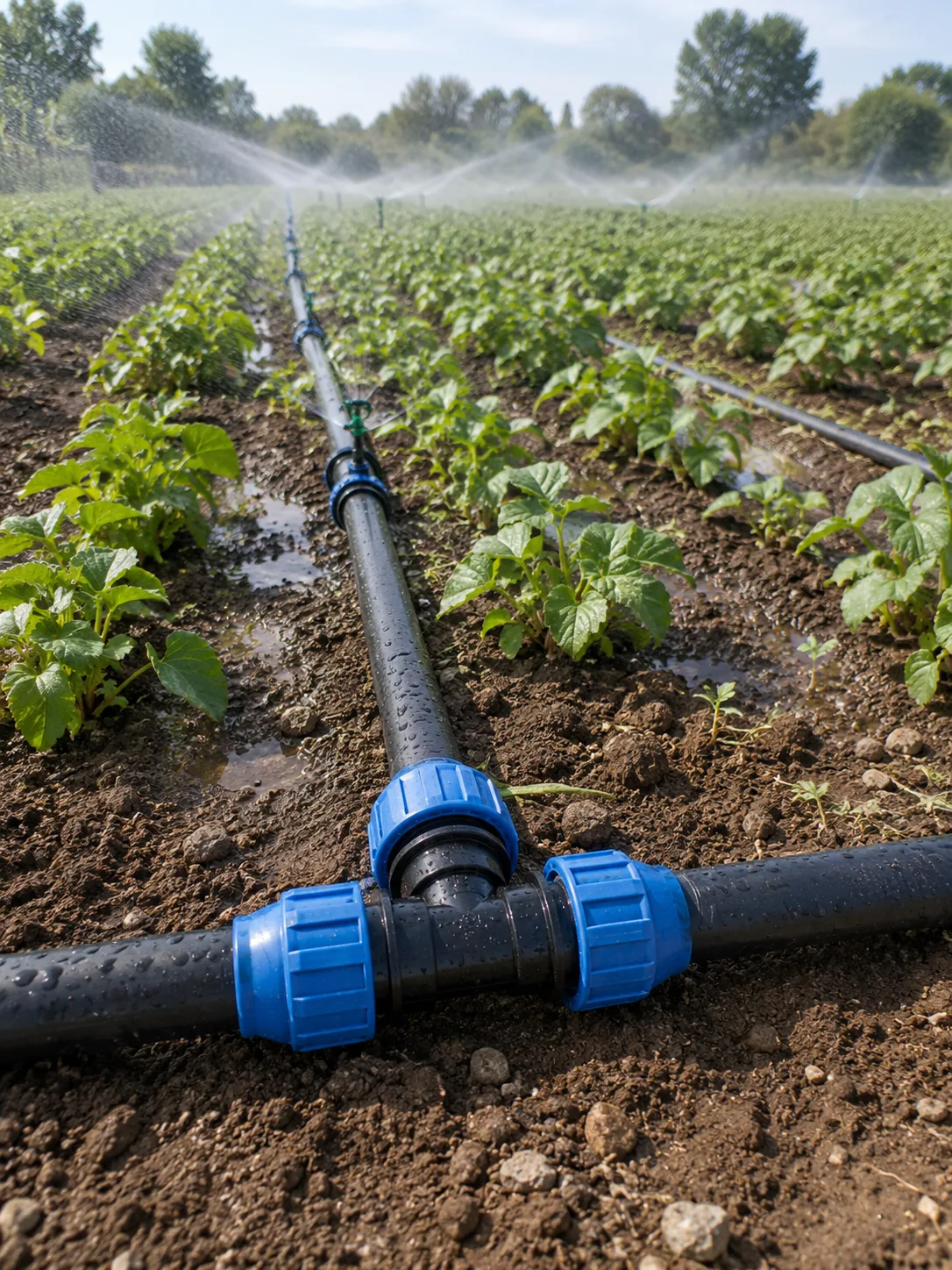
Best for, and definitely not for
DWC is best for gravity foul sewers and stormwater where the governing problem is depth of cover and surface loading; highway and rail drainage where trench conditions vary along the route; large-diameter culverting where a solid-wall equivalent would be heavy enough to need lifting plant on every length; and any scheme where budget is dominated by material cost per metre in a purely gravity network. EN 13476-3:2025 covers foul wastewater and is also suitable for surface water, with application marked “U” for burial outside the building structure and “UD” for both outside and within it. Check which marking your specification requires.
DWC is not for any line under sustained internal pressure; potable water distribution; pumped or rising mains, including short pumped sections inside an otherwise gravity scheme; vacuum sewer systems, which EN 12201 explicitly covers on the pressure side; or applications where you need a butt-fused, fully end-load-resistant joint. In the Turkish and European market corrugated pipe to TS EN 13476-3 is typically offered from DN 100 to DN 1000 with steel-reinforced variants between 800 mm and 2400 mm, in ring stiffness classes SN 4 to SN 16 — that is a commercial range, not a range the standard mandates.
Two administrative points that catch importers. Türkiye is a CEN member and adopts EN 13476 directly as TS EN 13476, so a Turkish-issued spec and a European one are the same technical document — useful when a client questions whether Turkish material meets “European standard”. And both DWC and solid-wall rigid PE pipe fall under the same customs heading, HS 3917.21, “tubes, pipes and hoses, rigid, of polymers of ethylene”. Customs does not distinguish them, so your commercial invoice and packing list have to. Duty is destination-specific; check it against your own national tariff rather than any figure quoted on a supplier page, including this one.
What to put in writing before you order
The most expensive ambiguity on a corrugated pipe order is the diameter basis. Structured-wall pipe is commonly sold on an internal diameter reference while pressure pipe is sold on outside diameter, and a DN 400 of one basis is not the same pipe as a DN 400 of the other. EN 13476 carries two nominal-size series, DN/OD and DN/ID, and a product is declared in one or the other; the BSI national foreword to BS EN 13476-3 strongly advises specifying the bore series, DN/ID, so a UK-written spec and a Turkish quotation may be using different series for the same “DN 400”. Ask which series the DN on the quotation belongs to, and write the answer on the drawing.
Put five things in the purchase document, in writing, before deposit:
- Which diameter the DN refers to — internal or external — stated numerically on the drawing, not just as a DN label.
- The standard and edition, dated. “EN 13476-3:2025”, not “EN 13476”. A 2018 citation now points at a superseded document.
- The SN class with the test report reference to EN ISO 9969:2016, plus creep ratio data to EN ISO 9967 if the line is deep or long-life.
- The application marking, U or UD, matched to where the pipe is actually buried.
- The bedding and embedment specification referenced to EN 1610:2015, with the leak-tightness test method — L or W — named for the handover.
On our own side of the boundary, the checks we run before a solid-wall order ships are the same shape: the dated standard on the declaration, dimensional verification against the drawing rather than the catalogue, and the origin document set — certificate of origin, packing list and bill of lading — reconciled to each other before the documents leave. Documents that disagree with one another are the single most common reason a compliant container still gets held.
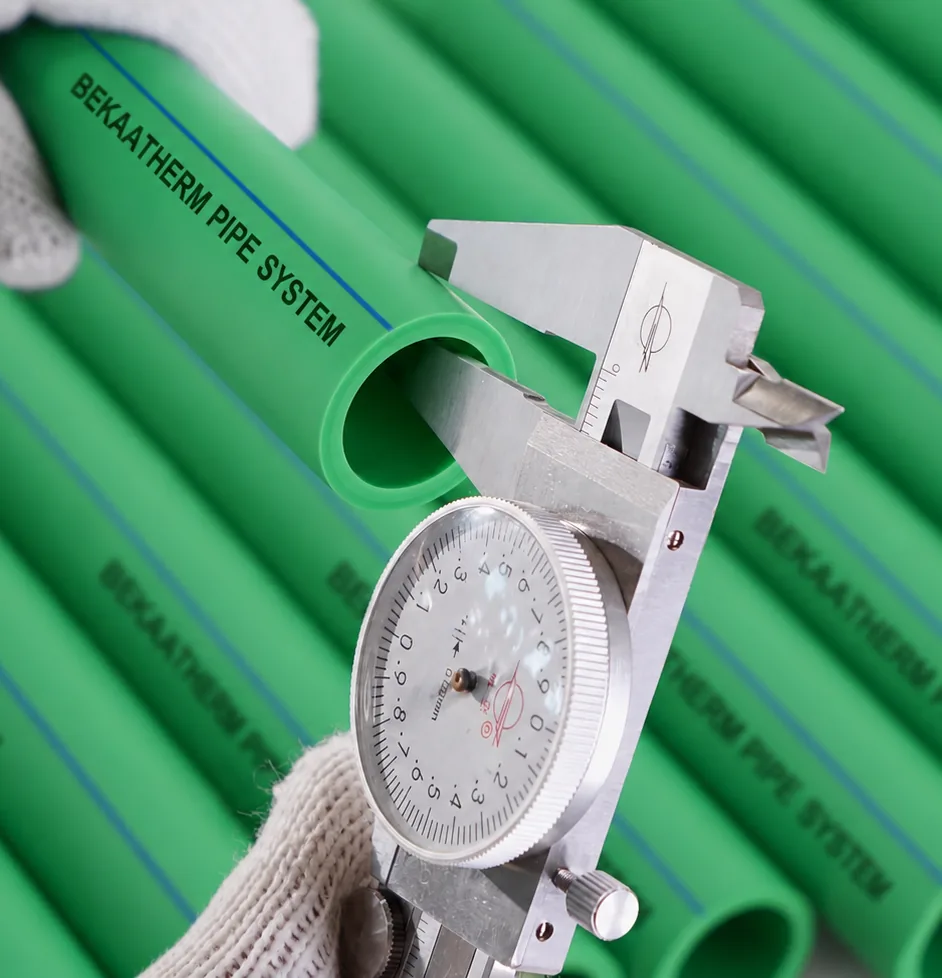
Where we sit on this boundary
Straight answer: Bekaatherm does not make double-wall corrugated pipe. If your project is a gravity sewer needing DWC, you want a structured-wall specialist, and nothing on this page is trying to talk you out of that.
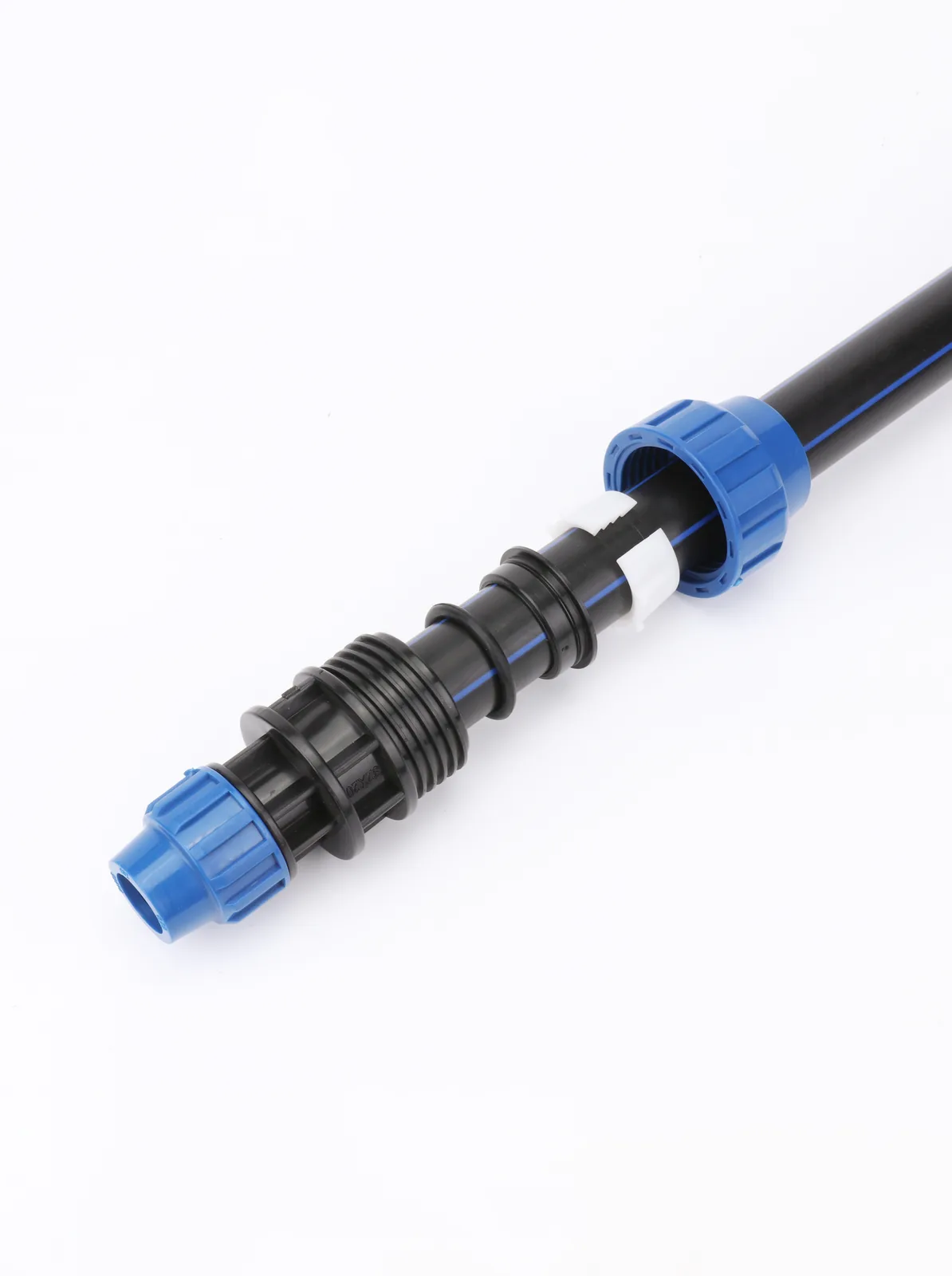
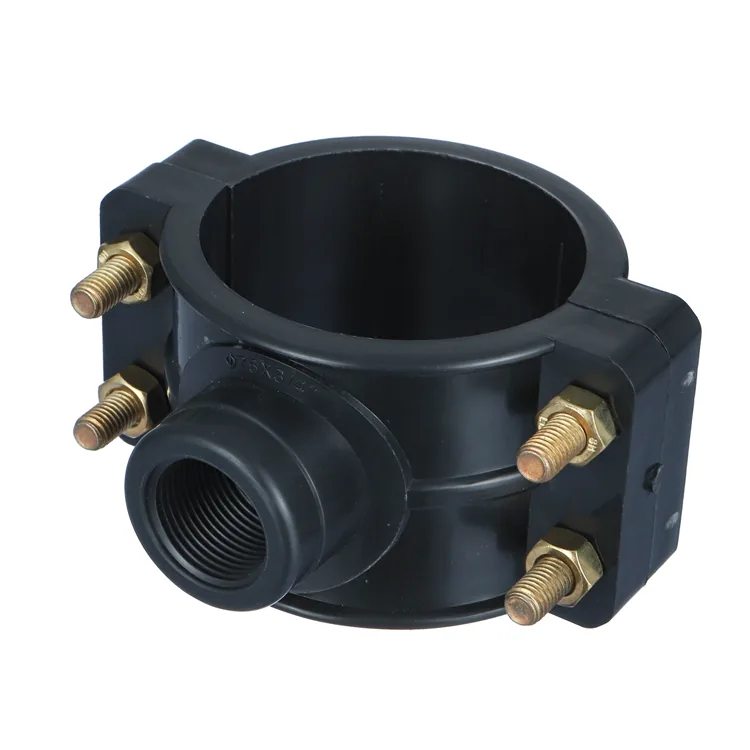
What we mould is the pressure side. Our solid-wall HDPE pipe and compression fitting range is black PE pipe with blue PP mechanical compression fittings — sockets, elbows, tees and caps from 20 to 110 mm; compression ball valves 20 to 110 mm; threaded transitions from 20×1/2 inch to 110×4 inch; saddle clamps from 25×1/2 inch to 315×6 inch. All PN10, all mechanical joints, so no butt-fusion or electrofusion plant is needed on site. The product line runs to article numbers BK-387 through BK-669. Our declared standards on that range are ISO 4427, EN 12201 and DIN 8074/8075 — all pressure standards, which is the other way of saying the same thing about scope.
The company behind it: 30 years of manufacturing, a 120,000 m² plant, 1000+ staff, 10,000 moulds, exports to 118+ countries across 98 items and 4 systems, made in Türkiye. Certification is SKZ, ISO 15874, CE and WRAS — and those certify the pressure range, not any corrugated product. We hold no EN 13476 certificate, because we make nothing that would need one. Our 50-year warranty against material and manufacturing defects is matched to the 50-year design life at rated pressure and 20°C under ISO 15874.
Frequently asked questions
Can DWC HDPE pipe be used for pressure applications?
No. EN 13476 is titled for “non-pressure underground drains and sewers”. The relevant construction and testing standard, EN 1610:2015, applies to pipelines usually operating under gravity but only up to 0,5 kPa when surcharged. Pressure applications belong to EN 12201, which is written for allowable operating pressures up to 25 bar.
Which edition of EN 13476 should I cite in 2026?
EN 13476-3:2025 for Type B (corrugated) and EN 13476-2:2025 for Type A. Both were published on 7 October 2025 and supersede the 2018+A1:2020 editions. Part 1 remains the general requirements and performance characteristics document.
What is the difference between Type A and Type B structured-wall pipe?
Type A has smooth internal and external surfaces. Type B has a smooth internal surface and a profiled — corrugated or ribbed — external surface. Double-wall corrugated pipe is a Type B product, so it is declared against EN 13476-3.
How is ring stiffness measured?
To EN ISO 9969:2016. A pipe sample is compressed between two parallel plates at a constant deflection speed while force and deflection are recorded, and stiffness is calculated from the force required to produce 3 % diametric deflection. The 2016 third edition supersedes EN ISO 9969:2007.
Is SN8 always better than SN4?
Higher is stiffer, but the class only performs if the installation matches the design assumption. SN4 and SN8 are the classes traditionally recommended in the UK for water company adopted sewers, conditional on installation in accordance with BS EN 752:2017 or BS EN 1610:2015. Class selection is a burial-depth, soil-modulus, trench-support and traffic-load calculation, not a lookup.
Does the SN number cover long-term deformation?
Not on its own. Ring stiffness to EN ISO 9969 is a short-term plate-test value. EN 13476-3:2025 normatively references EN ISO 9967 for creep ratio, which is what governs deformation under sustained load. Ask for both sets of data.
How do SDR and PN relate for solid-wall PE pipe?
By the formula MOP = 20 × MRS / [C × (SDR − 1)], with MRS in MPa and MOP in bar. For PE100, MRS is 10 MPa and the minimum recommended service design coefficient for water is C = 1.25. That gives SDR11 a maximum operating pressure of 16 bar and SDR17 a maximum of 10 bar.
Does Bekaatherm manufacture DWC corrugated pipe?
No. Bekaatherm manufactures solid-wall HDPE pressure pipe with PP mechanical compression fittings at PN10, with fittings from 20 to 110 mm and saddle clamps to 315 mm, declared against ISO 4427, EN 12201 and DIN 8074/8075. We hold no EN 13476 certification and offer no SN-classed product.
What HS code do these pipes ship under?
Both fall under HS 3917.21, “tubes, pipes and hoses, rigid, of polymers of ethylene”. The heading does not distinguish corrugated from solid wall, so the product description on the invoice and packing list has to. Duty rates are destination-specific and should be confirmed against your own national tariff and, where the value is material, with a customs broker.
Standards references were checked against publicly available catalogue entries at the time of writing. Standards are revised; confirm the current edition and the full clause text against the published document before issuing a specification. Class selection, bedding design and pressure rating for a specific project remain the responsibility of the design engineer.