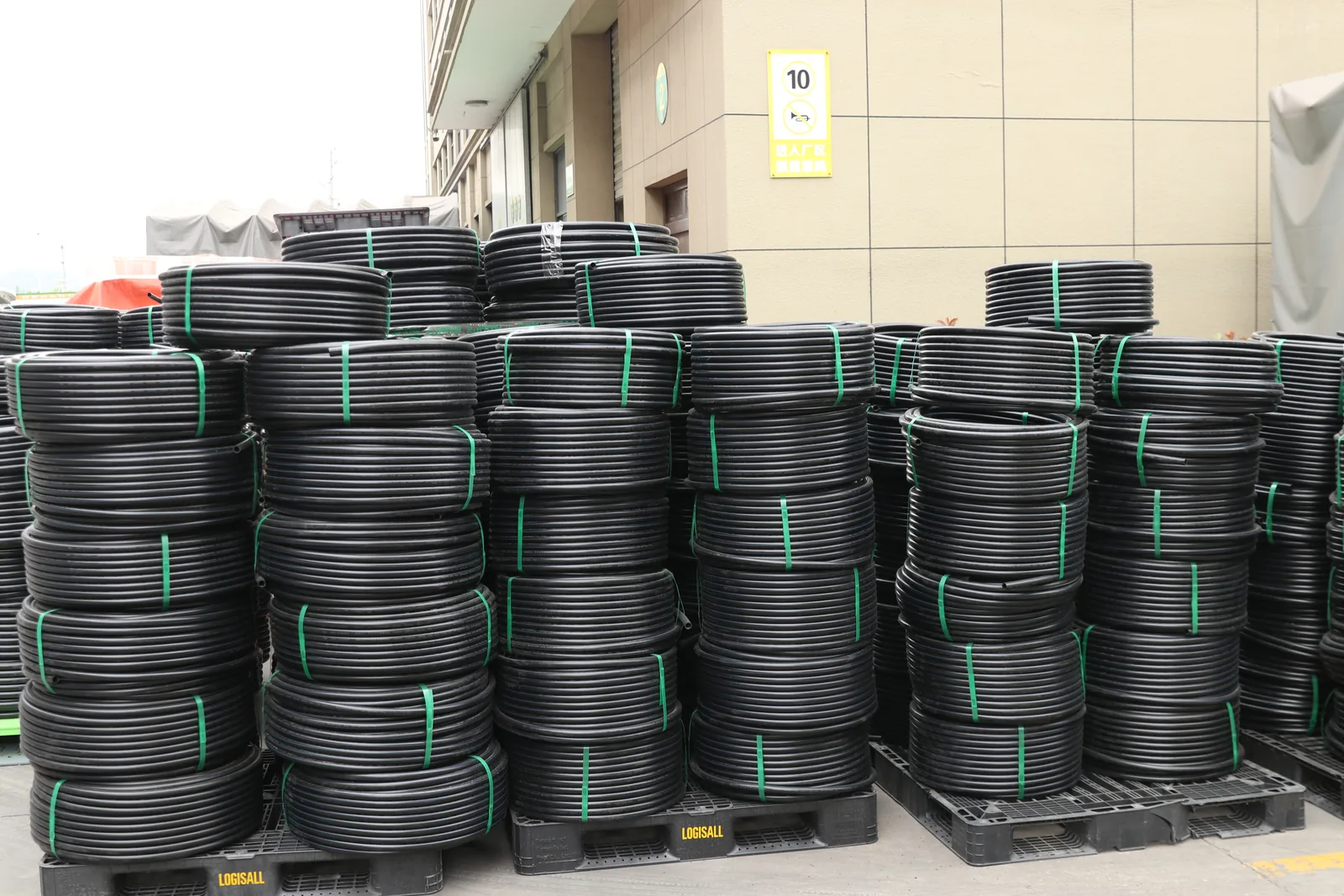
Two coils of black pipe sit on the same pallet. Both measure 63 mm across the outside. One is rated 16 bar, the other 10 bar, and the only physical difference is a couple of millimetres of wall. Order HDPE pipe by diameter alone and you have specified half of what matters — the half you left out decides whether the line holds pressure for fifty years or splits in year three.
The missing half is SDR: outside diameter divided by wall thickness. That one ratio drives the pressure class, the weight per metre, and the freight cost. This guide covers the HDPE pipe specifications a buyer has to pin down — SDR, PN class, wall thickness, and the standard edition behind them — including which standards are current in 2026 and which one your supplier is probably still quoting after it was withdrawn.
Key Takeaways
- SDR = dn / en — nominal outside diameter divided by nominal wall thickness. A lower SDR means a thicker wall and a higher pressure rating.
- Pressure class comes from one formula: MOP = 20 × MRS / [C × (SDR − 1)]. For PE100 at SDR11 that gives 200 / 12.5 = 16 bar, i.e. PN16.
- There is no diameter term in that formula. A 63 mm SDR11 pipe and a 315 mm SDR11 pipe in the same PE grade carry the same working pressure.
- Cite editions, not bare numbers. Current as of 2026: EN 12201-2:2024 (superseding 2011+A1:2013), ISO 4427-2:2019, and DIN 8074:2023-10.
- ISO 14236 is withdrawn. Compression fittings are now specified to ISO 17885:2021. Suppliers across this industry still print the dead number on datasheets — including, until this article, our own product page.
- Per TEPPFA’s 21 October 2025 position statement, CE marking a plastic piping system is currently “not possible and not legal” — no harmonised technical specification exists. Treat any CE claim on PE pipe with caution.
- Inspection leverage lives in ISO 11922-1:2018, which sets out-of-roundness grades K, L, M and N with formulas you can measure against on arrival.
What SDR actually measures
SDR stands for Standard Dimension Ratio. It is defined as dn / en, where dn is the nominal outside diameter of the pipe and en is the nominal minimum wall thickness. Divide one by the other and you get a bare number: 11, 17, 26. That number is the pipe’s structural signature.
Work an example. A 110 mm pipe with a 10 mm wall gives 110 / 10 = SDR11. The same 110 mm outside diameter with a 6.6 mm wall gives roughly SDR17 — the standards round to commercial wall thicknesses rather than exact quotients. Both fit the same 110 mm compression fitting, because the outside diameter is identical. Only one survives the pressure your design calls for.
This is what confuses buyers first time out: a lower SDR number means a thicker wall. SDR7.4 is heavy-walled and high-pressure; SDR41 is thin-walled and low-pressure. Invert it once on a purchase order and you receive the opposite of what the engineer specified. The commercially available series runs 7.4, 9, 11, 13.6, 17, 17.6, 21, 26, 33 and 41.
From SDR to PN: the formula that connects them
PN is the nominal pressure class in bar — PN10 means 10 bar of continuous internal pressure at 20 °C. Buyers order in PN, engineers design in SDR, and one equation links them:
MOP = 20 × MRS / [C × (SDR − 1)] — with MRS in MPa, the result in bar. MOP is the maximum operating pressure, MRS the minimum required strength of the material, and C the design coefficient.
Take PE100, MRS 10 MPa, at SDR11, with C set to 1.25: (20 × 10) / [1.25 × (11 − 1)] = 200 / 12.5 = 16 bar. PE100 SDR11 is PN16. At SDR17, 200 / [1.25 × 16] = 10 bar, which is PN10. Two lines of division replace a lookup chart, and let you check any supplier’s claim in ten seconds.
Why the design coefficient C matters more than buyers realise
C is a safety factor, and 1.25 is the minimum recommended value for water. It converts a laboratory strength into a pressure you can run for a fifty-year design life. Raise C and permitted pressure falls. So a supplier quoting a higher PN at the same SDR and PE grade has quietly used a smaller design coefficient — not a bargain, a thinner margin on a buried asset you cannot easily replace.
Why a 63 mm and a 315 mm pipe share a pressure class
Notice what is absent from the formula: any diameter term. A 63 mm SDR11 pipe and a 315 mm SDR11 pipe in the same PE grade carry the same working pressure. The big pipe has a much thicker wall in millimetres, but proportionally more hoop stress to resist, and the two cancel.
PE80 vs PE100: why the material changes the answer
MRS is a property of the resin, and it is where the grade names come from. PE100 has an MRS of 10 MPa; PE80 has an MRS of 8.0 MPa. The grade number is the MRS in bar. Feed PE80 into the same SDR11 calculation and you get (20 × 8) / 12.5 = 12.8 bar, against 16 bar for PE100 at identical wall thickness.
That has a direct commercial consequence. PN10 in PE100 needs SDR17; the same PN10 in PE80 needs a thicker wall — more resin per metre, fewer metres per container. Chase a cheaper resin price and the freight penalty can eat the saving before the pipe leaves port. One material limit worth knowing: ISO 4427-2:2019 states that pipe from PE 40 materials shall be limited to diameters up to and including 63 mm. If someone offers PE 40 in 90 mm, they are outside the standard’s scope.
Watch one newer designation. EN 12201-2:2024 treats PE 100-RC as a distinct crack-resistant class, and the rule is strict: a pipe can only be designated PE 100-RC if produced from PE 100-RC materials declared as such by the raw material producer. The same clause closes a loophole — a co-extruded pipe combining PE 100 and PE 100-RC layers is regarded as PE 100 and marked accordingly. If a quote says “PE 100-RC” on a multi-layer construction, ask for the producer’s declaration.
| SDR | PE100 (MRS 10) | PE80 (MRS 8.0) | Typical use |
|---|---|---|---|
| SDR9 | 20 bar | 16 bar | High-head pumping mains |
| SDR11 | 16 bar | 12.8 bar | Distribution mains, service connections |
| SDR13.6 | 12.5 bar | 10 bar | Mid-pressure distribution |
| SDR17 | 10 bar | 8 bar | Gravity-fed and low-head networks |
| SDR26 | 6.4 bar | 5.1 bar | Irrigation, low-pressure transfer |
Every figure above is calculated from the formula with C = 1.25, not lifted from a supplier’s chart. Rounded commercial designations vary slightly between standards, so treat these as the engineering basis and confirm the marked PN against the product standard on your order.
SDR11 vs SDR17: what the extra wall costs you
This is the decision most buyers actually face, since SDR11 and SDR17 in PE100 cover the bulk of water distribution. Wall thickness scales as dn / SDR, so at 110 mm you compare a nominal 10 mm wall against roughly 6.5 mm. The cross-sectional area of plastic — and with it the kilograms per metre and the resin cost — rises by more than half. HDPE prices and ships by weight, so a container of SDR11 holds materially fewer metres. That is why over-specifying pressure class is an expensive habit rather than a safe one.
Best for SDR11
- Pumped mains and high static head: where working pressure plus surge could approach 10 bar.
- Trenchless installation: pipe bursting, directional drilling and slip-lining load the wall in ways a pressure calculation misses.
- Shallow cover or heavy traffic: external load resistance improves with a thicker wall, independent of internal pressure.
Not for SDR11
- Gravity-fed rural supply at fixed modest head — you pay for capacity physics never calls on.
- Field irrigation laterals at a few bar, where the weight penalty multiplies across long runs.
- Freight-constrained orders where metres landed per container decide the economics.
The honest position: pick SDR from the hydraulic calculation plus surge allowance, then check the installation method separately. Buying SDR11 “to be safe” on a gravity irrigation scheme spends money on capacity nobody will use. Buying SDR17 because it was cheaper per metre, on a line that will later be pipe-burst into place, is a decision you find out about during installation.
Which standard governs, and which edition is current
Three standards get quoted on HDPE water pipe, and they are regional siblings rather than alternatives. ISO 4427 is the international series, EN 12201 the European one, and DIN 8074 gives dimensions in the German system alongside DIN 8075 for general quality requirements. Most suppliers list all three and stop. Almost none give the edition year — the part that decides whether a submittal gets accepted.
| Standard | Current edition | What it covers |
|---|---|---|
| EN 12201-2 | 2024 (January), supersedes 2011+A1:2013 | European PE water pipe; PFA up to 25 bar at 20 °C reference |
| ISO 4427-2 | 2019, second edition; replaced 2007 + Amd 1:2014 | International PE water pipe; same 25 bar / 20 °C envelope |
| DIN 8074 | 2023-10, replaced 2011-12 | PE 80 / PE 100 pipe dimensions |
| ISO 11922-1 | 2018 | Dimensions and tolerances, metric series |
| ISO 17885 | 2021, second edition | Mechanical fittings — replaces the withdrawn ISO 14236 |
Both product standards define the same operating envelope, which helps when a project spec names one and your supplier quotes the other. EN 12201-2:2024 covers an allowable operating pressure, PFA, up to 25 bar at a 20 °C reference temperature; ISO 4427-2:2019 states the same 25 bar maximum at the same reference. Run hotter and the rating drops — EN 12201-2:2024 directs you to EN 12201-1:2024 Annex A for constant temperatures above 20 °C up to and including 50 °C. Never carry a 20 °C PN number into a warm-climate buried main without checking that derating.
ISO 4427-2:2019 also lists what the pipe is intended to convey: water for human consumption, raw water prior to treatment, drainage and sewerage under pressure, vacuum sewer systems, and water for other purposes. An application outside that list is outside the standard.
One forward-looking note. ISO/CD 4427-1 and ISO/CD 4427-2 sit at Committee Draft stage, intended to replace the 2019 editions. Draft stage is not published stage, so the 2019 editions remain the ones to cite today. On long-term supply agreements, referencing “the current published edition” rather than a frozen year saves a renegotiation later. Texts come from ISO and DIN.
The withdrawn-standard problem: ISO 14236 to ISO 17885
Here is a two-minute check that occasionally saves a rejected submittal. Take every standard number on your supplier’s datasheet and look up its status. Not its content — its status. A meaningful share of the PE fittings market still quotes a standard that no longer exists.
ISO 14236:2000, the old specification for plastic compression fittings, is withdrawn. ISO 17885:2015 cancelled and replaced it, along with the ISO 10838 series. The current text is ISO 17885:2021, second edition, “Plastics piping systems — Mechanical fittings for pressure piping systems — Specifications”, which replaced the 2015 first edition and incorporated Amendment ISO 17885:2015/Amd 1:2016.
We found this on our own product page while researching this article. It cited “PP compression fittings to ISO 14236”. The correct current reference is ISO 17885:2021, and we are fixing it. If a supplier’s page still says ISO 14236, that is a documentation lag, not necessarily a product defect — but ask.
Commercially it matters because a consulting engineer who does check can bounce the submittal. The product may be identical, but the paperwork points at a document dead since 2015. On a municipal tender with a compliance review, that is an unbudgeted delay.
The 2021 edition brought a technical change worth knowing. The diameter for the “resistance of plastic pipe/pipe or pipe/fitting assemblies to tensile loading at 23 °C” test was increased from 63 mm to 250 mm, and the standard clarified the relationship between nominal pressure and the manufacturer-declared MOP.
Check the scope before citing ISO 17885 for everything. It covers application areas coded GAS, W, P, I and IS — gaseous fuels, water for human consumption and general purposes, irrigation, and industrial applications. It explicitly excludes flanges, plus mechanical fittings for hot and cold water inside buildings and district heating. Indoor hot and cold water is a different standard family, which is where our PPR pipe systems and ISO 15874 come in.
CE marking, CPR 2024/3110 and what changes in 2026
This section is the one most likely to contradict something a supplier has told you, including us. Verify it against your own market, because construction product regulation is jurisdiction-specific and the position is moving.
Regulation (EU) 2024/3110 lays down harmonised rules for marketing construction products and repeals Regulation (EU) No 305/2011. It entered into force on 7 January 2025, most provisions apply from 8 January 2026, and a transition period runs to 8 January 2040. Under it, CE marking, a Declaration of Performance and Conformity, and a Digital Product Passport apply when a product is covered by a harmonised technical specification or a European Technical Assessment.
That conditional clause is where plastic pipe sits. Per a position statement from TEPPFA, the European plastic pipes and fittings association, dated 21 October 2025, the necessary harmonised technical specifications are not available for plastic piping products — so it is currently “not possible and not legal to apply a CE marking and issue a DoPC for plastic piping systems” under either CPR 2024 or CPR 2011 on the basis of harmonised standards.
This does not mean PE pipe cannot be sold in the EU. TEPPFA is explicit that plastic piping systems remain governed by national or European recognised product standards, and can be marketed across the EU under existing frameworks until new harmonised standards are adopted. The route to market is conformity with EN 12201 or ISO 4427, plus whatever national approval your market requires.
For a buyer, that shifts what you ask for. A “CE marked” claim on a plastic piping system should prompt a question rather than reassurance: marked against which harmonised specification? Ask instead for product standard conformity, the certification behind it, and the potable-water approval your market recognises. Check scopes in our certification documentation rather than taking a badge at face value; SKZ in Germany and WRAS in the UK both publish verifiable listings. Requirements differ by market and by the importer’s role, so confirm the position for your destination country with your certification body before relying on it for a tender.
Checking a certification scope before you commit to a tender? If you are an importer or project buyer who needs to confirm which approvals cover which product line and market, the certification page lists what we hold and the scope behind each one.
Review certification scopesWhat you can hold the factory to on inspection
A specification you cannot measure is a wish. The dimensional tolerances referenced by EN 12201-2:2024 live in ISO 11922-1:2018, and this is the document that makes a purchase order enforceable on arrival.
Out-of-roundness grades you can specify by letter
Ovality matters because a pipe that has gone oval in transit will not seat correctly in a compression fitting or fusion clamp. ISO 11922-1:2018 sets lettered grades with explicit formulas, so you can name a grade in a contract instead of arguing about “roundness” after the container is open.
| Grade | Tolerance formula | Notes |
|---|---|---|
| K | 0.06 dn, min 1.0 mm | dn ≤ 160 only; recommended for coiled pipe |
| L | 0.05 dn, min 1.0 mm | Looser general grade |
| M | 0.024 dn, min 1.0 mm | Tighter; suits straight lengths |
| N | dn ≤ 75: (0.008 dn + 1) mm, min 1.2 mm; dn 75–250: 0.02 dn; dn > 250: 0.035 dn | Banded by diameter |
A detail that catches people out: grade K applies only up to dn 160 and is the grade recommended for coiled pipe, because coiling deforms the section. Writing grade M into a contract for coiled 110 mm pipe sets up a dispute you will probably lose. The 2018 edition also deleted diameter tolerance grade E — an older spec calling for grade E is referencing a superseded edition.
How the measurement is defined
Arguments about acceptance are usually arguments about method. ISO 11922-1:2018 fixes both: wall thickness is measured at any point around the circumference and rounded to the nearest 0.1 mm, while mean outside diameter is the measured outer circumference divided by pi, rounded up to the nearest 0.1 mm. A pi tape, not a caliper, is the correct instrument for mean outside diameter.
ISO 4427-2:2019 Table 1 gives the permitted diameter band. At dn 16 the mean outside diameter runs 16.0 to 16.3 mm; at dn 20, 20.0 to 20.3; at dn 25, 25.0 to 25.3, with a maximum out-of-roundness of 1.2 mm at the small end. It is a tight positive-only tolerance — pipe may run slightly oversize, never undersize. One caveat the standard states directly: for coiled pipes, maximum out-of-roundness shall be agreed between manufacturer and end-user. Buy in coils without agreeing that figure in writing and you have no number to reject against.
Reading the pipe itself
Before any instrument comes out, read the print line. PE pressure pipe carries a repeated marking identifying material grade, dimensions, pressure or SDR class, the standard, and traceability data. Check it against the invoice and packing list on more than one coil, from more than one pallet. A mismatch there is the fastest quality signal available at the port, and it needs no equipment at all.
Where fittings enter the sizing decision
A pipe specification is half a system. The joint has its own pressure rating, and the system runs at the lower of the two. Specify PE100 SDR11 at PN16, connect it with PN10 fittings, and you have built a PN10 network with expensive pipe in it.
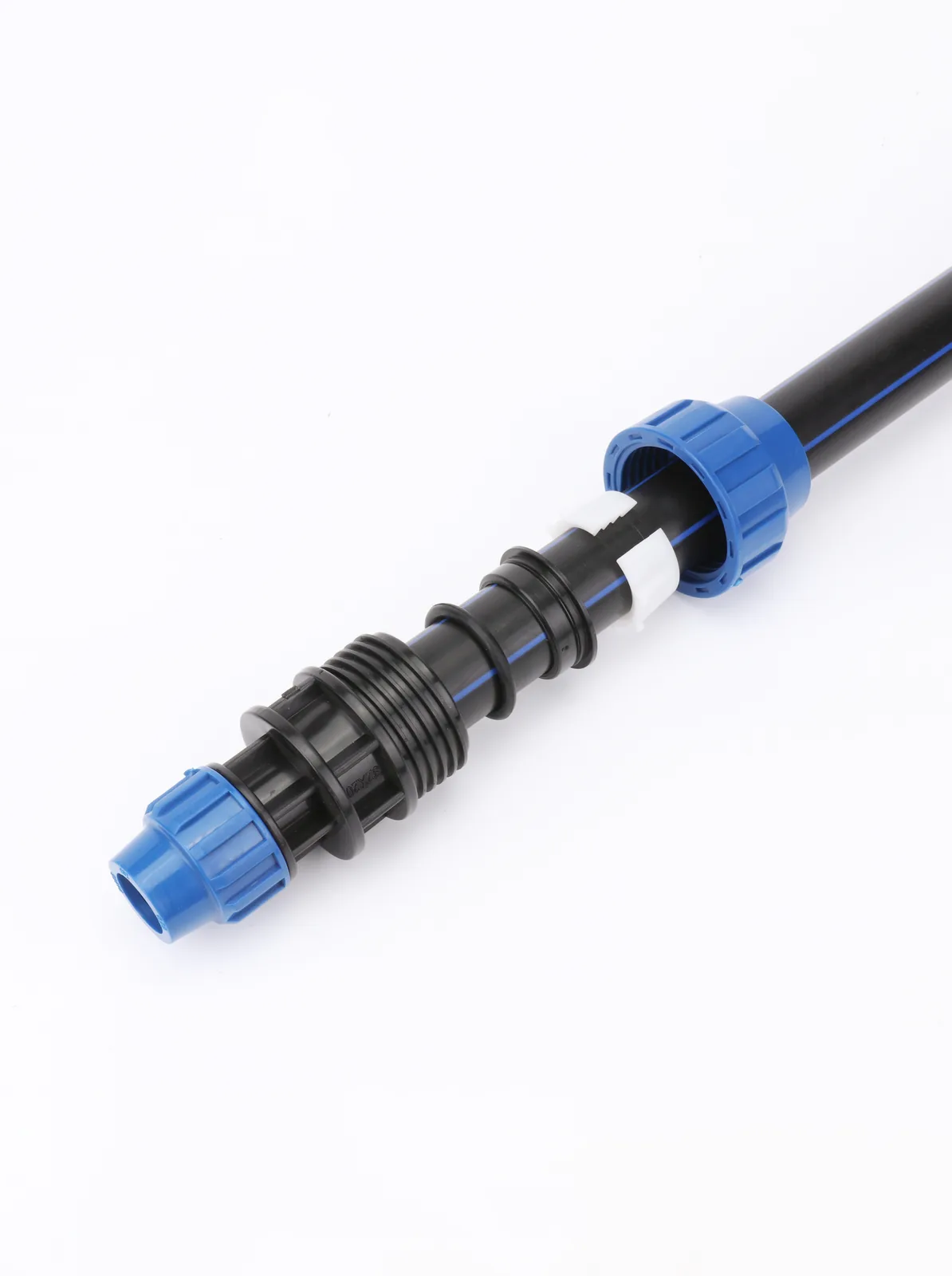
Two joining methods dominate. Fusion — butt or electrofusion — makes a monolithic joint as strong as the pipe, but needs a machine, trained operators, and power in the trench. Mechanical compression fittings seal by tightening a nut so a gripping ring bites the pipe wall: no machine, no flame. Compression wins on sites without guaranteed power or a trained welder, which is most rural and agricultural work. Fusion wins where pressure is high, diameter is large, or the asset must be joint-free by specification.
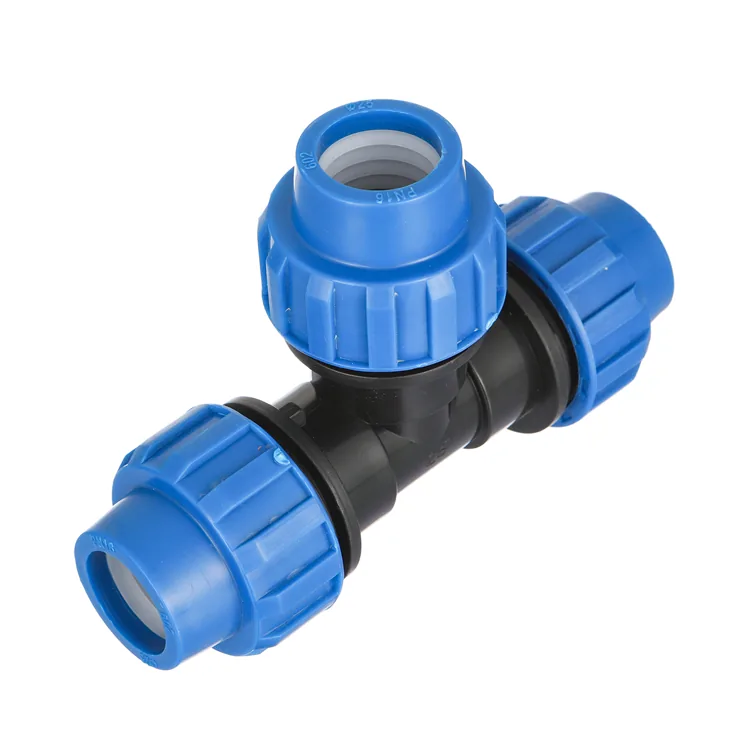
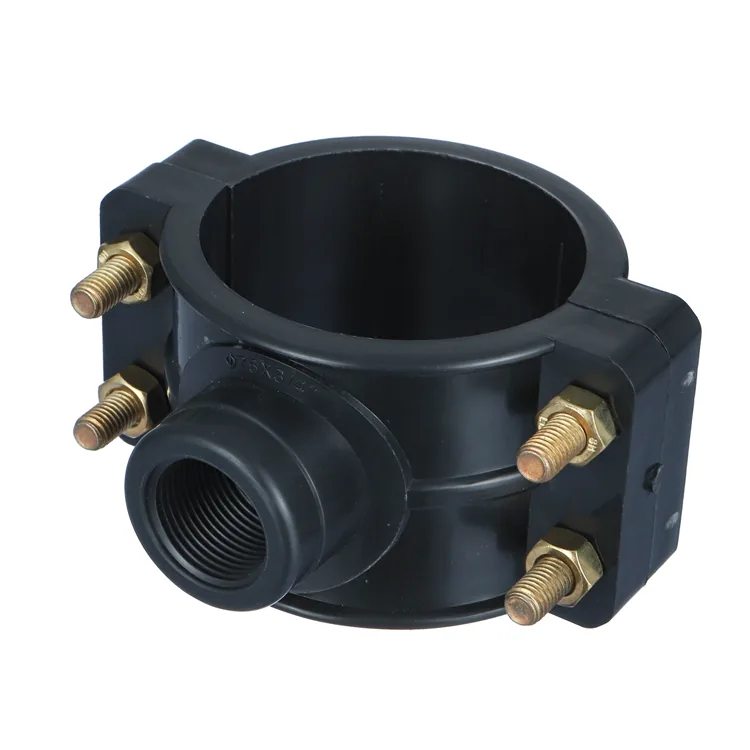
Our range is built around the mechanical route. The HDPE pipe and compression fittings system is PN10 across the whole range, with fittings from 20 mm to 110 mm, saddle clamps to 315 mm, threaded transitions from 1/2″ to 4″ BSP, and article numbers spanning BK-387 to BK-669. Because everything is PN10, the sizing conversation is short: if your design needs more than 10 bar at the joint, specify fusion instead. One scope point — the mechanical fittings standard historically capped compression fittings at 160 mm outside diameter, so call the 315 mm parts saddle clamps in your documentation, not compression fittings. They clamp onto a main to create a branch rather than joining two pipe ends.
Writing the specification into a purchase order
Everything above collapses into a few lines on a document. An unambiguous HDPE pipe line item names six things: material grade, outside diameter, SDR, pressure class, the standard with its edition year, and the delivery form. “PE100, dn 110 mm, SDR17, PN10, to EN 12201-2:2024, in 12 m straight lengths” leaves a factory nothing to guess at. “110 mm HDPE pipe, PN10” leaves wall thickness, resin grade and standard edition — three decisions you just delegated to whoever quotes most aggressively.
A worked order, end to end
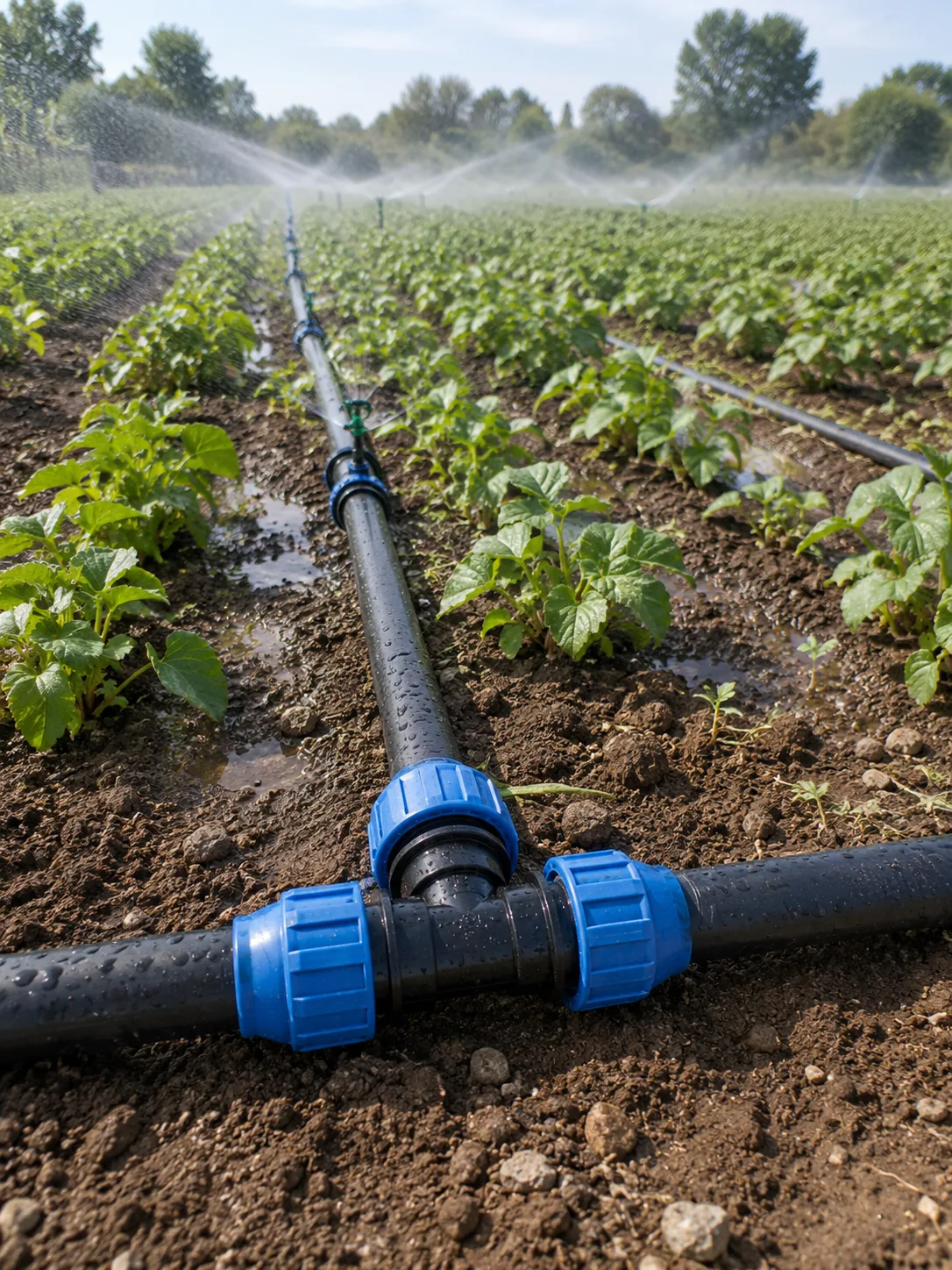
Take a distributor supplying an agricultural irrigation scheme: 4 bar working pressure, hand-made joints, no power and no fusion crew on site. Run the formula backwards and 4 bar in PE100 sits comfortably inside SDR26. The buyer picks SDR17 at PN10 anyway, for surge headroom and to match the PN10 fitting range — one class across the job, no risk of a crew mixing pipe in the trench.
Then the commercial layer. Minimum for a single item is 500 kg per size and colour, so a spread of fitting references consolidates into a mixed load rather than ordering line by line. A trial order goes as one 20GP mixed container (pipe + fittings + valves) — roughly 33 m³ usable against a ~28 tonne payload. With HDPE, a heavy SDR11 order hits that weight ceiling well before it fills the cube, which is one more reason not to over-specify wall. Regular in-production sizes run 15–25 days, terms are 30% T/T deposit, 70% against copy B/L, and shipment is FOB İstanbul or Mersin by default, CFR and CIF on request.
What we check before a specification goes into production
An HDPE enquiry gets four things confirmed in writing first. Pressure class against joining method — anything above 10 bar at the joint is not a compression job. Fitting size band against the pipe schedule, because a 160 mm main with a takeoff needs a saddle clamp, not a coupler. Standard and edition as the destination market’s approval body expects them, since a submittal citing a superseded edition gets bounced. And production origin, confirmed on the proforma invoice per order, with certificate of origin, packing list and bill of lading kept consistent. That last one is documentation discipline rather than engineering, but it is where shipments actually get held.
Conclusion
SDR is a division, PN is what that division buys you, and the standard edition makes both claims checkable by someone else. The buyers who get burned are rarely the ones who misunderstand the physics — they are the ones who wrote “PN10” on a purchase order, left the resin grade and wall class open, and accepted a datasheet citing a standard withdrawn in 2015.
Before your next order, run the two-minute check on your supplier’s datasheet: look up the status of every standard number, and confirm the edition years. To see how a PN10 compression system maps onto a real size band, the HDPE range page lists the part numbers by size.
Have a pipe schedule and need it matched to a PN10 fitting list? If you are an importer, distributor or project buyer working at container volume, send the sizes and quantities and we will return the matching article numbers, the consolidation plan for a mixed load, and lead time. Standard lead time on in-production sizes is 15–25 days.
Send your pipe schedule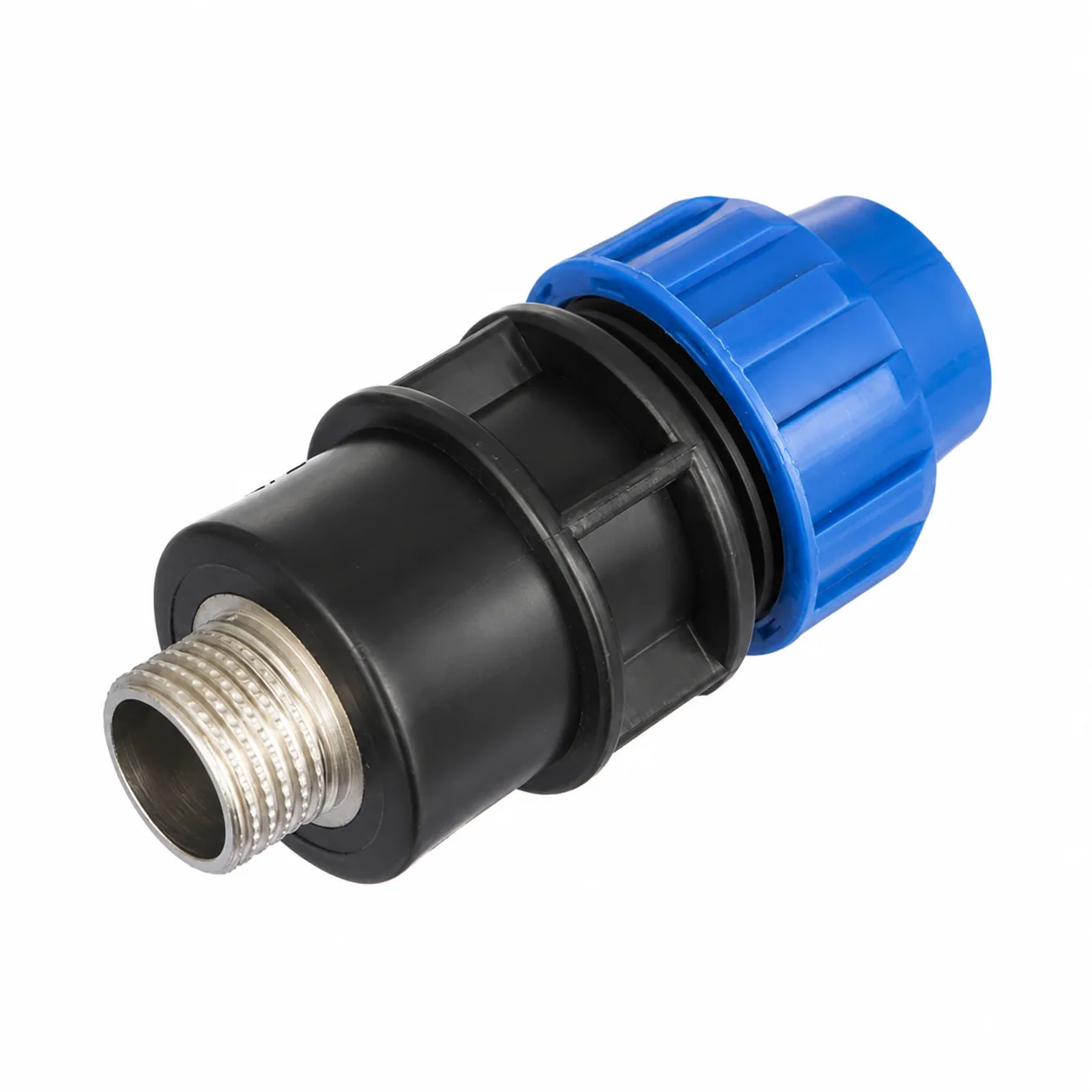
Frequently Asked Questions
How do I calculate SDR from a pipe’s dimensions?
Divide the nominal outside diameter by the nominal wall thickness: SDR = dn / en. A 110 mm pipe with a 10 mm wall is SDR11. A lower SDR number means a thicker wall and a higher pressure rating.
What PN class is PE100 SDR11?
PN16. Using MOP = 20 × MRS / [C × (SDR − 1)] with PE100’s MRS of 10 MPa and a design coefficient of 1.25, the result is 200 / 12.5 = 16 bar at 20 °C. The same calculation at SDR17 gives PN10.
Do larger diameter pipes need a lower SDR for the same pressure?
No. The pressure formula contains no diameter term, so a 63 mm SDR11 pipe and a 315 mm SDR11 pipe in the same PE grade carry the same working pressure. The larger pipe has a thicker wall in millimetres, but proportionally more stress to resist.
Is ISO 14236 still a valid standard for compression fittings?
No. ISO 14236:2000 is withdrawn. It was replaced by ISO 17885:2015, and the current edition is ISO 17885:2021. Any datasheet still citing ISO 14236 as a live conformity claim needs updating before it goes into a submittal.
Can HDPE pipe be CE marked in the EU?
Per TEPPFA’s position statement of 21 October 2025, no harmonised technical specification currently exists for plastic piping systems, so CE marking and a DoPC are not possible or legal for them. These products are instead governed by national or European recognised product standards such as EN 12201. Confirm the position for your market with your certification body.
Which edition of EN 12201 and ISO 4427 should I cite in 2026?
EN 12201-2:2024, published January 2024, which supersedes EN 12201-2:2011+A1:2013. For the international series, cite ISO 4427-2:2019, the second edition. ISO/CD 4427-1 and -2 are at draft stage and do not replace the 2019 editions yet.
What ovality can I reject a delivery for?
Whatever grade you specified from ISO 11922-1:2018 — grade K is 0.06 dn (dn ≤ 160, recommended for coils), L is 0.05 dn, M is 0.024 dn. For coiled pipe, ISO 4427-2:2019 requires the maximum out-of-roundness to be agreed between manufacturer and end-user, so agree it in writing before shipment.
Does a fitting’s PN have to match the pipe’s PN?
The system runs at the lower of the two ratings, so a PN16 pipe on PN10 fittings gives you a PN10 network. Our compression range is PN10 throughout, which means designs needing more than 10 bar at the joint should use fusion rather than mechanical fittings.