Compare PP-R pipe Environmental Product Declarations only after the documents describe a defensible common basis. Check the covered product, declared unit, conversion evidence, environmental indicator, life-cycle modules and assessment rules before comparing results. When those fields differ or remain unknown, reject the proposed ranking or restrict the comparison to the part that is genuinely aligned.
A lower number on a declaration does not by itself identify the lower-impact pipe for your project. The denominator and the assessment boundary travel with that number. This guide provides a document-comparison matrix and completed purchasing examples. It uses a published Fırat declaration as a named illustration. The second supplier situations are hypothetical, and no Bekaatherm environmental declaration or comparative footprint is established here.
Key Takeaways
- Record the exact declaration and covered product before extracting an impact result.
- Keep mass-based and length-based results separate until the conversion is supported.
- Match the named indicator and life-cycle modules on both sides.
- Check the programme record alongside the supplied PDF.
- Use a limited comparison when only a limited boundary is aligned.
- Environmental document acceptance and technical pipe selection remain separate decisions.

What an EPD describes
Play EPD International explainer
General programme-operator context. Manual playback is unverified. This video supplies no Bekaatherm endorsement or product comparison approval. Watch on YouTube.
Identify the document and product
Start with the declaration number, owner, publication or version date, stated validity and the product scope. Save those details beside the actual file used in the comparison. A supplier can send a genuine document that covers a different product family, plant or production period. Authenticity and applicability therefore deserve their own entries in the purchasing record.
The Fırat example carries S-P-06756 and describes PP-R pipe on a mass basis. Its PDF identifies its own owner, assessment rules and boundaries. Those particulars belong to that declaration. A purchaser should preserve them even when a sales comparison groups several polypropylene products together. Shared material terminology is too broad to establish that an individual ordered specification is represented.
On the programme page checked for this guide, the corresponding registration appears as EPD-IES-0006756:001, with status Valid and a validity date of 1 December 2027. The registry and the saved PDF display different PCR version details. Keep that discrepancy visible and reconcile the applicable file and rules before making a formal comparative claim. A valid registry status answers the registration question while leaving document-version consistency to be resolved. Fırat programme record.
This is a practical reason to retain the downloaded file rather than copying a registration number into a spreadsheet and discarding the document. If a reviewer later asks which assessment rules were used, the comparison needs a recoverable answer. A current link and an older attachment can both look authoritative while describing different points in a document’s history.
Resolve units before numbers
A mass-based declaration and a length-based quotation answer different immediate questions. A value attached to a kilogram of pipe describes that declared mass. A purchase schedule often specifies metres at a stated outside diameter and wall series. Moving between them requires a defensible relationship between mass and the actual ordered product.
The important decision is whether that relationship is available and applicable. A nearby catalogue row, another manufacturer’s weight or an unlabelled average can make the spreadsheet calculate without making the comparison valid. Preserve the exact pipe designation behind any conversion, including the construction and wall specification represented by the mass-per-length information.
Changing the pipe wall changes how much material belongs to the purchased length. Consequently, two suppliers can have similar results per kilogram and different material requirements for the application. Conversely, a lower mass-based result can lose its apparent advantage when the compared products do not provide the same required function. The buyer needs the service specification alongside the environmental record to interpret either result.
For the worked matrix below, the second submission is deliberately hypothetical and gives a result per metre without its mass conversion. The completed decision is to withhold a numerical ranking. The missing conversion is material to the task, so guessing it would defeat the purpose of the comparison. The reader still obtains a usable outcome immediately by identifying which proposal cannot yet be supported.
Keep indicators and modules aligned
Read the full indicator label. The Fırat document includes separate climate-change indicators, including fossil and total results. Copying a number while shortening its label to “carbon” removes information needed by the next person using the worksheet. Select the intended indicator first, then keep the same named quantity on both sides of the comparison.
The declared life-cycle stages need equal attention. In this example, the PDF declares production stages and selected later stages, while use-stage modules are not declared. A blank or undeclared stage supplies no measured result for that stage. Treating it as zero would quietly turn a boundary limitation into an environmental advantage. Fırat PP-R declaration.
A production-stage comparison may be useful to a project team whose question is limited to production. Keep the conclusion attached to that question. It cannot establish an entire installed system’s lifetime outcome when installation, use, replacement or other relevant stages have not been aligned. The same discipline applies to later-stage benefits reported separately in the declaration.
Separate material selection from numerical convenience. It would be easy to choose whichever module set happens to produce the neatest result. Instead, state the decision the project needs and examine whether both submissions support it. Where they support only part of that decision, report the supported part with its boundary and leave the wider ranking unresolved.
Complete the comparison matrix
The following matrix is completed against one real document and one hypothetical incomplete submission. It is an editorial demonstration of acceptance logic. It contains no second manufacturer’s measured performance and makes no comparison between Bekaatherm and Fırat.
| Check | Fırat example | Hypothetical submission B | Completed decision |
|---|---|---|---|
| Identity | Named declaration and programme record | Unidentified attachment | Hold B’s document identity |
| Product scope | Published PP-R pipe scope | Sales description only | Ordered product coverage unresolved |
| Declared unit | One kilogram | One metre, conversion absent | No numerical ranking |
| Indicator | Several named GWP indicators | Unqualified carbon number | Indicator match unresolved |
| Modules | Declared module set visible | Boundary unstated | No whole-life conclusion |
| Rules and version | PDF and registry require reconciliation | PCR version absent | Resolve both document bases |
The outcome is specific. Neither a valid registration nor an attractive number completes this comparison. Submission B lacks several essential fields, and the reference example has a version discrepancy to close. The buyer can return a precise document query while declining the proposed environmental ranking. This avoids treating every missing field as equally important or endlessly collecting unrelated certificates.
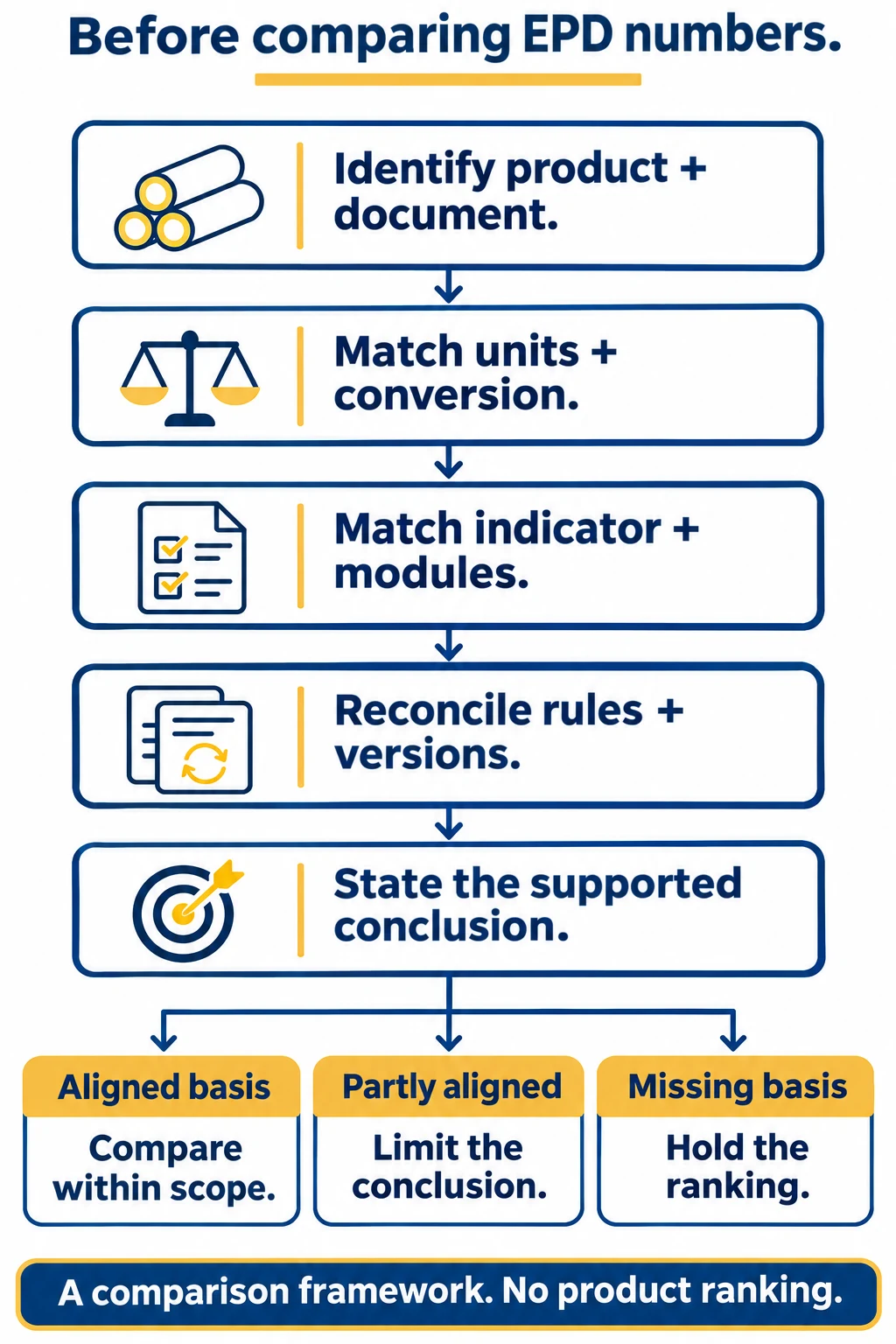
- Identify product + document.
- Match units + conversion.
- Match indicator + modules.
- Reconcile rules + versions.
- State the supported conclusion.
Resolve three purchasing cases
Consider a first hypothetical case where two complete submissions cover the required products, use the same declared unit, identify the same indicator and align their assessment rules and production-stage boundary. The purchaser can advance a production-stage comparison after confirming those conditions. The result should still be described at that boundary, with the exact declarations identified, rather than presented as a universal preference for one polymer or brand.
Now change one condition. The second supplier provides a per-metre figure for an unspecified wall series. The first declaration remains mass-based. This changes the decision to hold the numerical comparison until the actual conversion basis is established. Adding more decimal places to either result would not reduce that uncertainty. The obstacle is product identity and denominator, which arithmetic alone cannot supply.
In a third case, both documents support a common production-stage comparison but only one declares later use or end-of-life stages relevant to the requested whole-life assessment. Report the supported production-stage finding separately and decline the wider ranking. A partial result can remain useful when its scope is explicit. Combining mismatched boundaries would make the conclusion harder to defend than leaving part of the question open.
These cases explain why a completed worksheet can legitimately end with a restricted conclusion. The output is the permitted comparison, including what cannot yet be ranked. It is more informative than a single green tick against “EPD supplied”, because it tells the project team exactly which environmental statement the evidence can carry.
Keep the comparison result separate from the purchasing preference. A procurement team may prefer a supplier for availability or the fit of its technical range while the environmental ranking remains unresolved. Recording those decisions independently avoids making the environmental worksheet carry a commercial conclusion that its evidence never established. It also lets a later document revision improve the comparison without changing the history of the original purchase decision.
Record a revision trigger beside every limited conclusion. If the missing conversion arrives, reassess the unit match. If the declared module set changes, reassess the boundary. If a new PDF replaces the reviewed file, preserve the earlier matrix and identify the new input. This makes the record reproducible across a purchasing team and a project assessor, rather than dependent on one person remembering which attachment was used.
| Changed condition | Supported conclusion | Held conclusion |
|---|---|---|
| All comparison bases align | Compare within stated production boundary | Universal material preference |
| Mass conversion absent | Identify the missing conversion | Numerical ranking |
| Only production modules align | Limited production-stage finding | Whole-life ranking |
Carry the result into the pipe enquiry
Keep environmental evidence linked to the proposed pipe specification. The service, dimensions, application requirements and product identity still need their own technical review. An environmental declaration does not fill an absent pressure, temperature or potable-water suitability statement. Our PP-R catalogue guide addresses the separate task of reading the product schedule.
For an availability and documentation enquiry, state the destination, intended service, outside diameter, wall designation and exact product family under consideration. Describe the environmental document requirement separately, including the project boundary and the indicator the assessor needs. This lets the supplier establish which evidence, if any, applies to the proposed item without promising a document for the entire catalogue.
Submit a pipe specification for an availability and documentation check. Product availability and applicable documents require confirmation. No Bekaatherm EPD or comparative environmental performance has been verified in this guide.
Conclusion
Retain document identity, product coverage, units, indicators, modules and assessment rules together. Complete the matrix before ranking the numbers. When a condition changes, change the permitted conclusion with it. The outcome may be an aligned production-stage comparison, a restricted partial result or a documented refusal to rank incomplete submissions.
Frequently Asked Questions
Does a valid EPD automatically cover the pipe on my order?
Confirm the declaration’s scope against the exact proposed product. Registration and product applicability are separate checks.
Can I compare kilograms with metres?
Only after establishing an applicable conversion and a defensible common comparison basis. A guessed catalogue weight leaves the result unresolved.
Can an undeclared module be entered as zero?
No. It leaves that stage outside the supported numerical comparison.
Does this example establish a Bekaatherm footprint?
No. The named declaration belongs to Fırat. The hypothetical cases illustrate document decisions.