Search for a PPR pipe price list and you will get quote forms. Dozens of them. The listing promises a price list, the page delivers a field asking for your email, and after the third one you start to wonder whether anyone in this trade will just tell you what a container costs. That reaction is fair, and this page is not going to insult it by adding a fourth form.
What follows is the part nobody publishes: what a first container actually commits, expressed as dates and percentages of your order value, because those are the figures a manufacturer can state honestly and a unit price printed in June is not.
Here is the number that makes the point. On UK commodity code 3917 22 90 90 — rigid tubes of polymers of propylene, which is what PPR pipe is — the third-country duty rate is 6.00%, while goods of Turkish origin carry a tariff preference of 0.00%. That is six percentage points of the whole invoice, decided before anyone negotiates a cent on the unit price. Most buyers spend their energy on the per-metre number and never check the line that moves more money.
Key takeaways
- The trial minimum is one 20GP mixed container of pipe, fittings and valves — but the binding constraint on your SKU list is the separate 500 kg per size and colour rule.
- Your cash leaves in two tranches, not one: 30% T/T deposit up front, then 70% against copy B/L — paid while the goods are at sea, before you have seen them.
- Origin can outweigh unit price. UK duty on PP pipe is 6.00% third-country against 0.00% for Turkish origin; the US general rate on HTS 3917.22.00.00 is 3.1%.
- Duty and VAT are payable at clearance — before a single metre is sold. Budget them as capital, not as cost of sales.
- No published unit price exists here, deliberately. Prices are quoted on request and dated; this page gives you the structure so you can read any quote you receive, from us or anyone else.
Why No PPR Manufacturer Publishes a Real Price List
A PPR price is a derivative of three things that all move independently: polypropylene random copolymer resin, the currency your quote is denominated in, and the mix you order. A list printed in one month describes none of them accurately by the next. That is why serious factories quote on request and date the quote — and why a page claiming to publish standing PPR prices is either quoting a single SKU at a single volume, or quoting a number it will not honour when you place the order.
Freight makes the same point from outside the factory gate. Drewry’s World Container Index composite sat at USD 4,297 per 40ft container on 6 August 2026, up 1% week on week after three consecutive weekly declines. Note what that figure is and is not: it is a composite across mainly Asian and transpacific lanes, measured on a 40ft box — not a Türkiye-lane rate and not a 20GP rate. It is here only to show the shape of the thing.
A cost line that moves several percent in a week is not a line you can print in a brochure.
What a dated quote gives you that a list cannot
A dated quote locks a basis. It fixes the Incoterm, the validity window, the MOQ and the exact specification behind each line, which means the number you costed your resale against is the number you will be invoiced. A published list protects nobody — when resin moves, the supplier simply tells you the list is out of date, and you discover it after you have already promised a price to your own customer.
A quote from this factory is issued FOB İstanbul or Mersin by default, with CFR and CIF available on request, and it contains three things rather than one: the FOB unit price per line, the container load plan behind it, and the list of certificates that ship with the goods. If a quote you receive from anyone contains only the first of those three, you have a price, not an offer you can act on.
The honest answer to a price-list query from a manufacturer is the structure of the number plus a route to the live one. This page is the structure. It contains no invented unit price.
The Minimum That Actually Opens an Account
Most first-time buyers ask one MOQ question and get one answer, then discover at proforma stage that there were two rules operating. The container-level minimum tells you how big the order is. The size-level minimum tells you how many different products you are allowed to put inside it. The second one is what actually reshapes your first order, and almost nobody warns you about it in advance.
| Order type | Minimum | What it constrains |
|---|---|---|
| Trial order, own brand of the factory | One 20GP mixed container (pipe + fittings + valves) | Total order size |
| Any single specification within that container | 500 kg per size and colour | How many SKUs fit — the binding constraint |
| OEM / private label, first branded run | One 40HQ, or 3 tonnes per colour | Whether branding is viable on order one |
| Reference capacity, 20GP | Roughly 33 m³ usable against a ~28 tonne payload | Volume, which fills long before weight does |
| Reference capacity, 40HQ | Roughly 76 m³ | The step-up point for branded runs |
Why the 500 kg rule is the one that bites
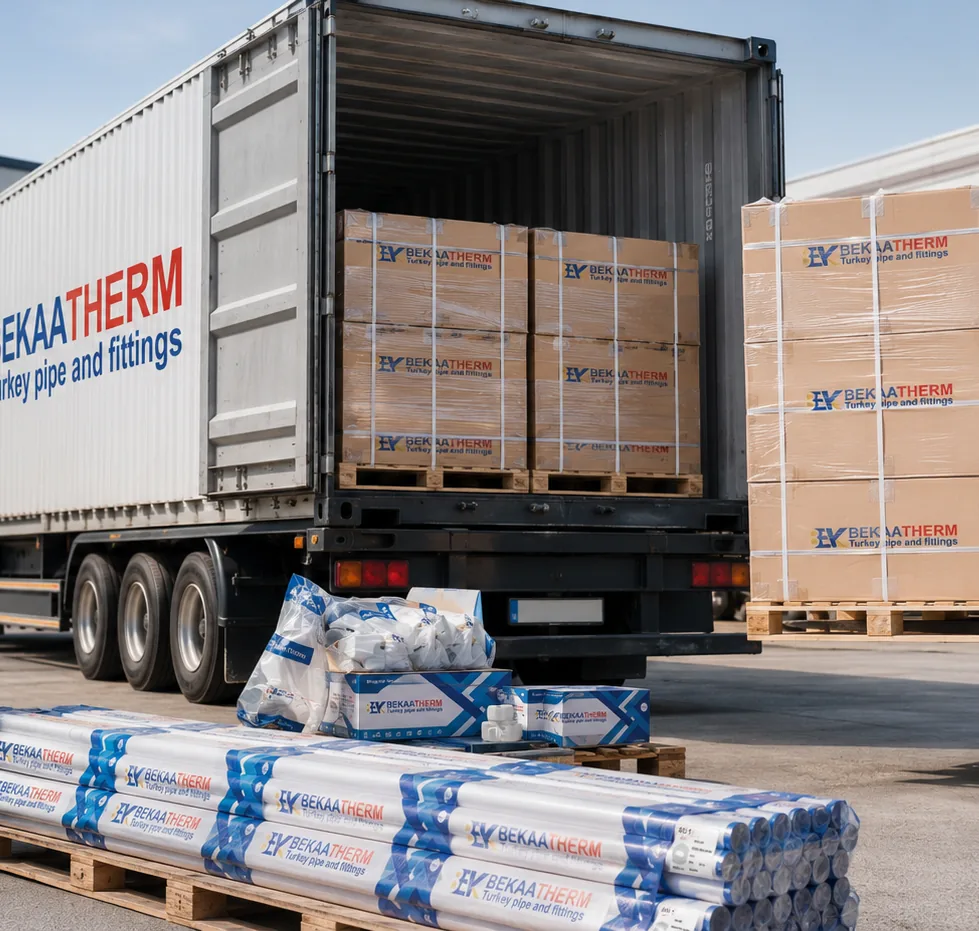
Run the arithmetic against your own catalogue ambitions. A 20GP takes roughly 8,000–9,000 m of 20mm PN20 pipe when the bundles are telescoped, and the usable volume is roughly 33 m³ against a payload of about 28 tonnes — which means a pipe container cubes out long before it weighs out. Now apply the 500 kg floor per size and colour. Every additional diameter, every additional pressure class, and every colour variant you want to stock consumes another 500 kg block of that container whether your market absorbs it or not.
The practical consequence: a first container is not the place to launch a twelve-size range in two colours. It is the place to take the four or five sizes that turn fastest in your market, in one colour, and let the fittings and valves carry the breadth.
A typical mixed container runs about 60% pipe, 30% fittings and 10% valves by volume — the fittings side is where you can afford variety, because a fitting weighs a fraction of what a metre of pipe does. If you want the full geometry of how those proportions get planned across systems, that argument is worked through in detail in our guide to mixed-container planning for a 20GP; here it matters only as the input that shapes your SKU list.
Best for, and not for
- Best for: importers and distributors ready to commit one full 20GP, who already have a market for four to six fast-moving sizes and want the range depth to sit in fittings rather than pipe diameters.
- Best for: private-label buyers who can reach one 40HQ, or 3 tonnes in a single colour, on the first branded run.
- Not for: buyers wanting an LCL trial of a few hundred kilos across many sizes — the 500 kg per size and colour floor makes that order impossible to build, and no amount of negotiating on price changes it.
- Not for: anyone wanting branded product on a first small order. Branding starts at 40HQ or 3 tonnes per colour, so order one under own label is the realistic route in.
Where Your Money Goes, and On What Date
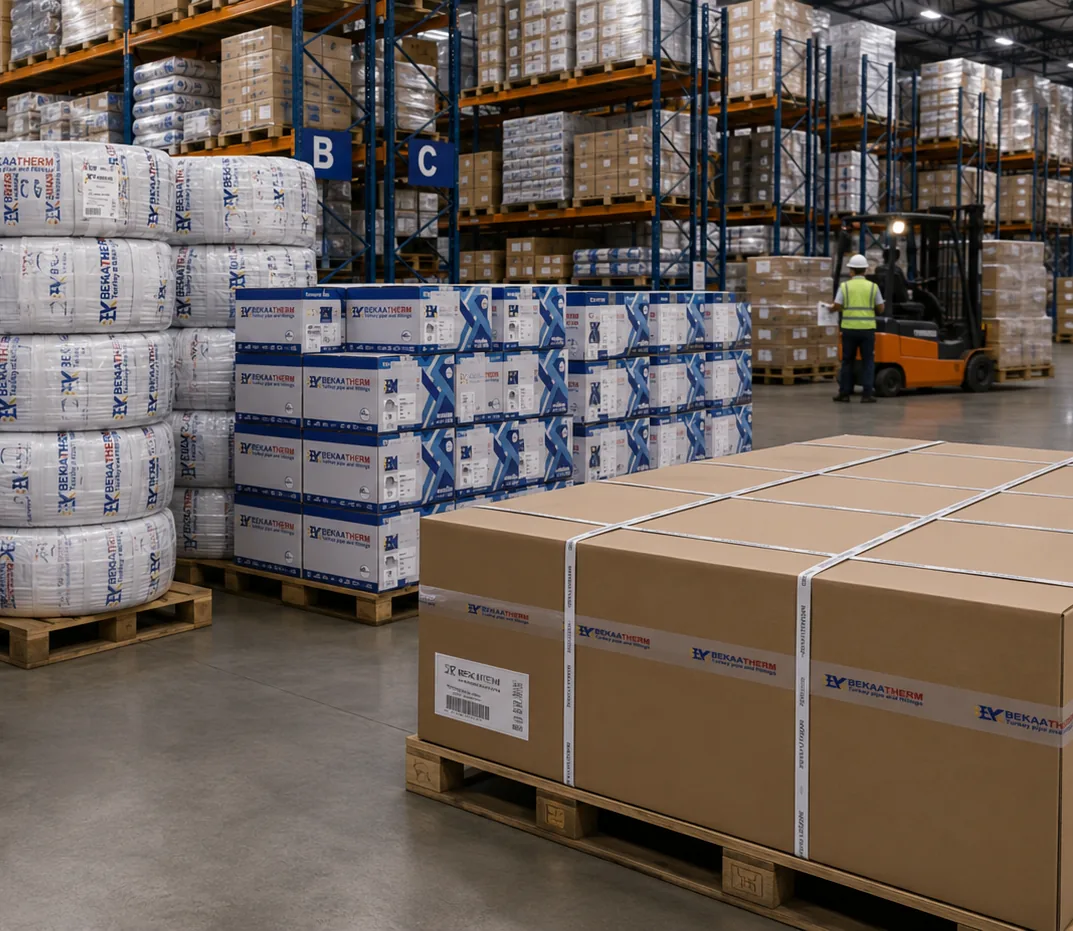
This is the section the price-per-metre pages never write. Your exposure on a first container is not a single number on an invoice — it is a sequence of payments on different dates to different parties, and the gap between the first and last of them is the period your working capital is committed with nothing to show for it. Below is that sequence for one 20GP on standard terms, expressed as a share of order value so it holds regardless of what your quoted unit price turns out to be.
| Stage | When | Leaves your account | Paid to |
|---|---|---|---|
| Deposit, against signed proforma | Day 0 | 30% of goods value (T/T) | Factory |
| Production, regular in-stock sizes | Day 0 to day 15–25 | Nothing further | — |
| Balance, against copy bill of lading | Shortly after sailing | 70% of goods value (T/T) | Factory |
| Ocean freight and insurance, if not FOB | Per your forwarder’s terms | Varies by lane and week | Carrier / forwarder |
| Duty and import VAT | At clearance, before release | Duty per your market’s rate, plus VAT on the duty-inclusive value | Customs |
| Terminal handling and inland delivery | At and after clearance | Port and haulage tariff | Terminal / hauliers |
| First resale revenue | After stock is in your warehouse | Money starts coming back | — |
Read the fourth and fifth rows together, because that is where first-time importers get caught. Duty and VAT fall due at clearance, before the container is released — before a single metre is sold. On a market with a 6.00% duty rate and standard VAT, the cash you must have available at the port is materially more than the goods value alone, and it is due on a date you do not control. Treat those lines as capital you must have liquid on arrival day, not as a cost you will settle out of trading income.
Converting all of this into a comparable cost per metre is a separate exercise, and we work it through step by step in our guide to FOB pricing and container loading for PPR imports.
Want the FOB unit prices that sit behind this timeline? The PPR pipe price list and catalogue carries the full pipe table by OD, wall and PN plus the fittings and valves part-number map — the document you would price this timeline against. Useful for an importer or distributor costing a first 20GP who needs line-item numbers rather than structure.
When the timeline stretches
The 15–25 day production window applies to regular in-production specifications. Two things extend it, and both are worth knowing before you sign rather than after. An OEM or private-label order runs 30–45 days rather than 15–25. A first colour match or a new mould adds a further 7–10 days on top of whichever band you are in. Stack the worst case — branded goods in a new colour — and production alone can approach eight weeks before the vessel is even booked.
The letter of credit alternative
If wiring 30% to a factory you have not yet met is the part you cannot get comfortable with, there is a documented alternative: an irrevocable L/C at sight is accepted from USD 50,000 upward. That changes your risk profile rather than your total cost. Your bank pays against compliant documents instead of you paying against trust, which is worth the bank charges on a first transaction with an unfamiliar counterparty.
Below that threshold the T/T route is the practical one, which is another reason a first order tends to be a full container rather than a part load. The trade-offs between the two routes are set out in our note on payment terms in piping trade and who carries the risk.
The Duty Line That Moves More Money Than Your Unit Price
Buyers negotiate hard on unit price and accept the duty line as weather. That is backwards, because the duty rate is knowable before you order, applies to the entire customs value, and in several markets swings further than any discount a factory will give you on a first container.
| Market | Code | Rate on PP pipe | Source, checked 10 Aug 2026 |
|---|---|---|---|
| United Kingdom, general | 3917 22 90 90 | 6.00% third-country duty | UK Trade Tariff |
| United Kingdom, Turkish origin | 3917 22 90 90 | 0.00% tariff preference | UK Trade Tariff, area TR |
| United States, general (column 1) | 3917.22.00.00 | 3.1% | USITC Harmonized Tariff Schedule |
| United States, column 2 | 3917.22.00.00 | 25% | USITC Harmonized Tariff Schedule |
Put the first two rows against each other. Six percentage points of the entire customs value, decided purely by where the goods were made and whether the paperwork proves it. To beat that with negotiation you would have to extract a 6% discount on the whole order — which no factory gives a first-time buyer on a single 20GP. The origin question is settled before you start bargaining, and it is worth more than the bargaining.
What A.TR proves, and what it does not
For EU-bound shipments the document that carries this benefit is the A.TR movement certificate, and it is routinely misunderstood. Under Decision No 1/2006 of the EC–Turkey Customs Cooperation Committee, an A.TR is documentary evidence that the conditions for free circulation are met (Article 5), and it may be endorsed only where it serves that purpose (Article 7(2)). It establishes customs status, not preferential origin — the same Decision routes proof of Turkish or Community origin down a separate track, the EUR.1 and EUR-MED certificates, at Article 17.
What that means in practice: industrial goods such as PPR piping move under A.TR at 0% duty, while agricultural, coal and steel products fall outside the Customs Union and cannot use it. If your customs broker or your buyer asks you to prove Turkish origin specifically, A.TR is the wrong document for that question and you need a certificate of origin alongside it.
How to check your own market before you commit
- Start from the right heading: PPR pipe classifies under HS 3917.22 — rigid tubes and pipes of polymers of propylene. Fittings and valves sit under different codes, so a mixed container is not a single-rate shipment.
- Query your national tariff, not a blog: every customs administration publishes a searchable tariff. Enter the eight or ten digit code your market uses and read the measure list for your origin country.
- Look for a preference row specifically: the headline rate and the rate that applies to your supplier’s country are often different lines, as the UK example above shows.
- Confirm the paperwork the rate depends on: a preferential rate you cannot document is the general rate. Ask which certificate your market requires before the goods ship, not while they sit at the terminal.
A market-by-market breakdown of the relevant codes and duty treatment is set out in the reference on HS codes and duty for PPR, HDPE and UPVC by market, and the certificates themselves are covered in the import document pack customs will ask for.
Sorting out territory before the first container, not after
If you are a distributor planning to build a market position on this range rather than trade one container, regional exclusivity is available to private-label partners and is agreed in writing per market. It is far easier to settle before your first order than after you have created demand someone else can service.
See the importer and distributor terms — for distributors and wholesale buyers who want territory agreed before the goods ship, not after.
The Costs That Appear After the Quote Is Signed
Every experienced importer has a story about a charge that was nobody’s fault and still came out of their margin. These are the ones that recur on first containers, and the reason they recur is that none of them appears on a factory quotation — they arise from the shipping and clearance side, where a first-time buyer has no baseline for what is normal.
Demurrage and detention
These are the charges that apply once you exceed the free time agreed between carrier and merchant — demurrage on the container sitting at the terminal, detention on the equipment once you have taken it away.
Here is the part that matters for budgeting, and it is an honest non-answer: there is no universal number of free days. Maersk states plainly that free time differs between ports and carriers, so the figure is shipment-specific. Anyone who tells you “you get fourteen days” without looking at your booking is guessing. Read the free time off your own booking confirmation and count backwards to work out when your broker needs the documents.
The VGM declaration
Verified Gross Mass is not optional paperwork and it is not the carrier’s job. Under SOLAS regulation VI/2, adopted as Resolution MSC.380(94) and in force since 1 July 2016, the shipper named on the bill of lading is responsible for providing the verified weight, and a container without one is not loaded.
Two methods are permitted: weighing the packed container, or weighing all packages and cargo items including pallets, dunnage and securing material and adding the container tare, using a certified method approved by the competent authority of the state where packing took place. On an FOB shipment this sits on the factory side, but the consequence of a missing or late VGM — a rolled booking and a container that misses its vessel — lands on your delivery programme.
What to fix in writing before the deposit leaves
- The Incoterm and the named port: FOB İstanbul and FOB Mersin are not interchangeable for your freight quote. Get the specific port on the proforma.
- Quote validity: the window during which the price holds. Without it, a delay in your own approval process can reprice the order.
- The certification, itemised: which certificates ship with the goods, naming the standards. For PPR that means the ISO 15874 family rather than a vague reference to “international standards”.
- The load plan per SKU: quantities by size and colour, so that what arrives matches what you costed and you can check the 500 kg blocks add up.
- Who books the vessel: on FOB it is you or your forwarder, and the handover point needs to be unambiguous before production finishes.
How Long Your Capital Stays Out
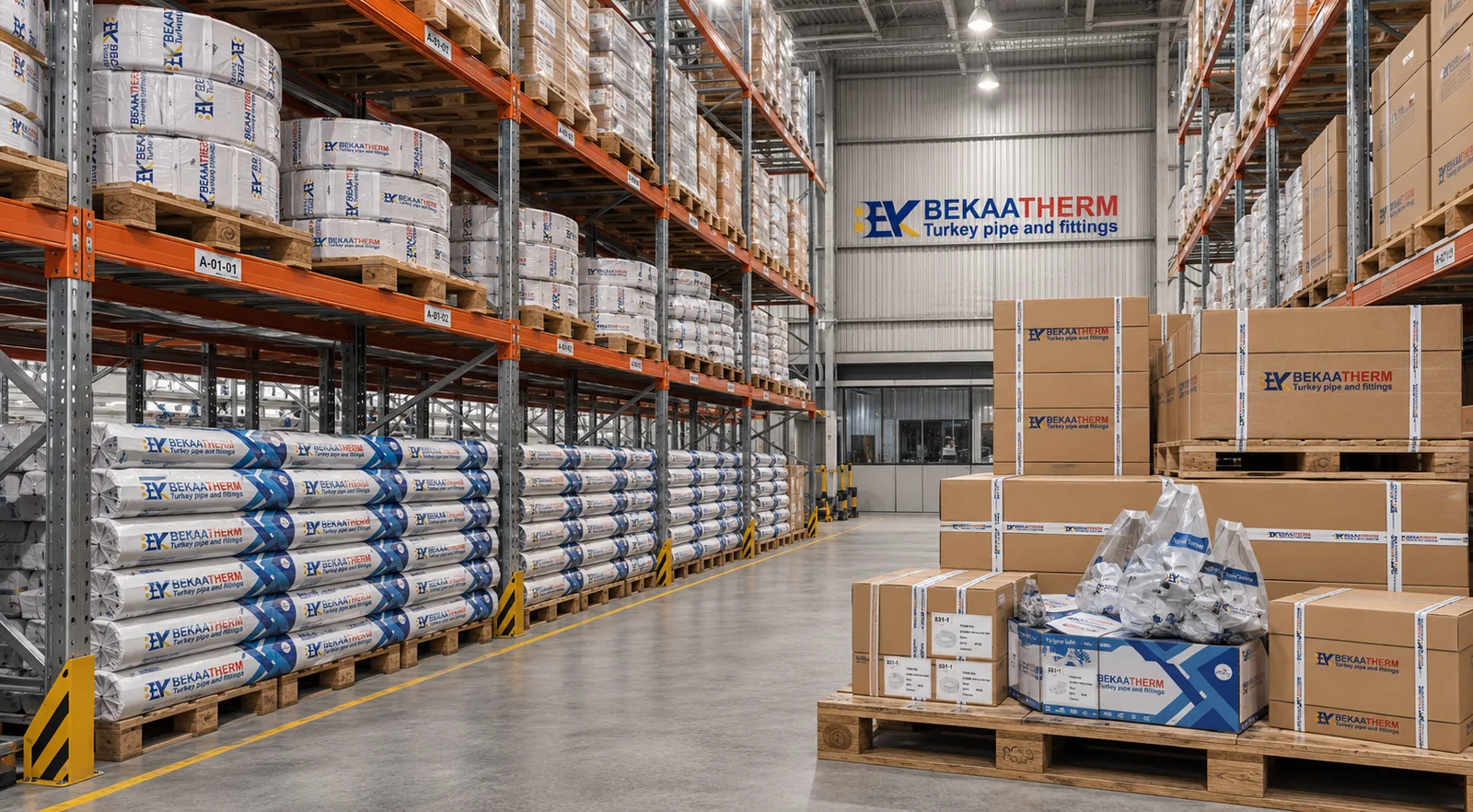
Add up the intervals from the timeline above and a realistic first-container cycle looks like this: 30% goes out on day zero, production runs 15–25 days for regular specifications, the balance of 70% follows shortly after sailing, transit takes whatever your lane takes, and then duty and VAT fall due at clearance before you can move a single metre. Only after that does the first invoice go out to your own customer.
The variable we cannot give you
How quickly your market absorbs the stock is the figure that decides whether a first container was a good decision, and it is the one number in this article that no supplier can honestly supply. It depends on your customer base, your season and your pricing, none of which we can see.
Plan on a sell-through period rather than assuming one — and be aware that this is an estimate you are making, not a fact you have been given. What can be stated grounded is everything on the supply side: the 15–25 day production window, the 30/70 payment split, and a duty line you can look up today at 6.00% or 0.00% depending on origin.
Why a 50-year warranty is a cash argument
Slow sell-through is a cash-flow problem, not a write-off, and that distinction depends entirely on the product. PPR is not perishable, not seasonal in the way finished goods are, and not subject to model changes.
These systems carry a 50-year warranty against material and manufacturing defects, matched to a 50-year design life at rated pressure and 20°C under ISO 15874. Stock that moves slower than you forecast is capital sitting still, which hurts — but it is not stock that expires, and it is still worth its full value in month nine. That is a materially different risk from importing something with a shelf life.
The second container decision
The trap on order two is ordering it against optimism rather than against the first container’s actual turn. If your first box is 40% sold and you have already recovered the deposit, ordering again keeps continuity of supply and holds your lead time advantage. If it is 40% sold because the range was wrong rather than because time has been short, a second container multiplies the error.
The information you need is which sizes moved, and it is worth waiting for that data before committing another 30% deposit — with production at 15–25 days, the cost of waiting a few weeks is far smaller than the cost of doubling down on a mix your market did not want.
Testing the Supplier Before You Commit a Container
Everything above assumes the factory is worth the deposit. Verifying that costs almost nothing and most first-time buyers skip it, then spend the whole production window anxious. There is a documented order of checks that carries no capital commitment at all.
Samples, and what they cost
The published terms are these: standard items up to three of them carry no goods cost, on a freight-collect basis, so you pay the courier rather than the factory. That is enough to put real pipe and real fittings in front of your technical people, or your customer’s, without capital moving.
For branded product the terms differ — branded items take 7–10 days and their cost is credited against your first bulk order, so the expense converts into order value rather than disappearing. There is no self-serve portal for this on the site; the terms are applied per enquiry, so the route is to state your size list and market when you make contact.
The certification to ask for
Ask for certification against named standards rather than a general assurance of quality. For PPR systems the relevant family is ISO 15874-1 for general requirements and ISO 15874-2 for pipes, with ISO 15874-3 covering fittings and ISO 15874-5 covering fitness for purpose of the system; dimensions and general quality requirements follow DIN 8077 and DIN 8078. Where potable water approval matters in your market, WRAS and testing through bodies such as SKZ in Germany are the recognisable marks. Requirements vary by destination market, so confirm what your own regulator accepts rather than assuming a certificate travels.
Do this before you send a size list, not after. The full range — 98 items across 4 systems, set out on the PPR pipe and fittings page — is what your list has to map onto, and the sizes you assume are standard may sit outside it or fall below the 500 kg per size and colour floor once split across colours. Matching your list against the actual range first is what stops a quote round from being spent discovering which lines cannot be made economically at your volume.
What gets checked before a quote goes out, and where it stops
Quoting a first container is a documented procedure rather than a price lookup, and it is worth knowing what it does and does not settle for you. Four things are established before a number is issued: which of the 98 items across the 4 systems your size list actually maps to, whether each line clears the 500 kg per size and colour floor, how the resulting mix loads against roughly 33 m³ of usable 20GP volume, and which certificates your destination market requires.
Two things it does not settle, and no supplier’s quote can. It cannot tell you your own duty position — that depends on your market’s tariff and your ability to document origin, which is why the checking step above is yours rather than ours.
Nor can it tell you how fast your market will absorb the stock. A quote fixes the supply side precisely and leaves the demand side entirely with you; anyone claiming otherwise is selling you a forecast, not a price.
What sits behind the terms
The commercial terms in this article are underwritten by a manufacturer with 30 years of production, a 120,000 m² plant, 1000+ staff and 10,000 moulds, supplying 98 items across 4 systems and exporting to 118+ countries, working to a 24-hour response on enquiries. Those are capability figures rather than a promise about your order — the promise about your order is the dated quote, which is where the checking should end.
Have a size list already? Get it costed as a loaded container
If you know roughly which sizes and quantities your market needs, that list is all a factory needs to come back with FOB pricing and a load plan showing how it fills a 20GP. This is for buyers ready to cost a real order — not for general price browsing, where the price list above is the better starting point.
Send your list on WhatsApp — or email sales18-ifan@ifangroup.com with the same details.
Conclusion
A first container is a cash decision wearing the costume of a purchasing decision. The unit price matters, but it is bounded — the things that genuinely decide whether the order works are the two minimums that shape your SKU list, the dates on which 30% and then 70% leave your account, the duty rate your origin qualifies for, and how long the stock sits before it turns. Those you can settle now, before anyone quotes you anything.
If you are early in this, start by looking up your own market’s duty rate on HS 3917.22 and asking for standard samples — neither costs you capital. When you are ready to see real numbers, ask for a dated quote with the load plan and the certificates itemised, and check that the sizes on it match the ones your customers actually buy.
Frequently Asked Questions
What is the minimum order for PPR pipe from a Turkish manufacturer?
One 20GP mixed container of pipe, fittings and valves for a trial order, with a separate floor of 500 kg per size and colour. Private label starts at one 40HQ, or 3 tonnes per colour on a first branded run.
Why will nobody give me a PPR pipe price list?
Because PPR pricing tracks resin costs, currency and your specific mix, a printed list goes stale quickly. A dated quote locks the basis you costed against, which a standing list cannot do.
What duty will I pay importing PPR pipe?
It depends on your market and the origin. On UK code 3917 22 90 90 the third-country rate is 6.00% while Turkish origin carries a 0.00% preference; the US general rate on 3917.22.00.00 is 3.1%. Check your own tariff for your origin.
When do I pay for a first container?
Standard terms are 30% T/T deposit against the signed proforma and 70% against copy bill of lading, so the balance falls due while goods are at sea. Duty and VAT come later, at clearance.
How long does production take?
15–25 days for regular in-production sizes and 30–45 days for OEM or private-label orders. A first colour match or a new mould adds 7–10 days on top.
Can I get samples before ordering a container?
Yes. Standard samples are free for up to three items on a freight-collect basis. Branded samples take 7–10 days and the cost is credited against your first bulk order.
How many free days do I get before demurrage starts?
There is no universal figure. Free time is agreed between carrier and merchant and differs by port and by carrier, so read it off your own booking confirmation rather than relying on a rule of thumb.
Does an A.TR certificate prove the goods were made in Türkiye?
No. A.TR proves free circulation within the EU–Türkiye Customs Union, which is what allows 0% duty on industrial goods. If you need to evidence origin itself, you need a certificate of origin as well.