Key Takeaways
- Delayed leaks are not slow versions of early leaks. ISO 9080 describes a “knee” in the stress-rupture curve where the line changes slope — and a change of slope means a change of failure mode, not just a longer wait.
- A 50-year rating is an extrapolation to 438,000 hours at 20 °C. Raise the temperature and you leave the curve the rating was drawn on — PPI states that higher temperatures shorten both time to failure and time to the ductile-brittle transition.
- Chemical ageing has an induction period. In accelerated lab work on PP-R, measurable properties held for hundreds of hours and then collapsed — molar mass fell from 742 kg/mol to roughly 45 kg/mol in one grade. Nothing shows, then everything does.
- PPI’s 2025 guidance puts a number on the copper question: dissolved copper below 0.1 ppm will not adversely affect PP-R, while levels above 0.5 ppm may have a significant effect.
- On a 20 mm socket fusion joint the change-over window is a maximum of 4 seconds. A joint that misses it still passes the commissioning pressure test, then behaves like a defect for years.
- The one document that actually probes long-term stability — the ISO 15874-2 thermal stability test, 8,760 hours at 110 °C — needs only one test piece and rarely appears on a routine certificate. Ask for it by name.
A leak in week one is an argument you can win. Somebody hit the pipe with a grinder, a joint was never welded, a fitting arrived cracked — the evidence is fresh and the invoice is recent. A leak in year three is a different problem entirely. The installer has moved on, the warranty conversation gets tense, and nobody can say whether the pipe failed or the building did something to it.
The delay is not random. Polypropylene pressure pipe fails along a curve with distinct branches, and the standards that rate these pipes describe those branches explicitly: a mechanical branch, a slow-crack branch, and a chemical branch, each with its own clock. Knowing which clock is running tells you what to put in a purchase order. One caveat up front, though: “year three” is a way of talking about delayed failure, not a statistic. No credible dataset says pipes fail on average in year three, and this article does not claim one.
The knee: why a pipe can change how it fails without changing anything else
Pressure pipe gets rated by hanging a stress on it and waiting. Plot the results — stress against time to failure, both logarithmic — and you get a line sloping down. The complication is that the line often has a bend in it, and ISO 9080:2012 gives that bend a name. A branch is a “line of constant slope in the log10 (stress) versus log10 (time) plot representing the same failure mode.” The knee is the “point of intersection of two branches at the same temperature,” with the data before it designated type A and the data after it type B. The important part sits inside the word branch: each straight segment represents the same failure mode. Cross the knee and the pipe is not failing more slowly — it is failing differently.
What changes? The Plastics Pipe Institute puts it plainly in Technical Note TN-7: “the knee in the regression curve typically, but not always, corresponds to a change between ductile failure and brittle (slit) failure modes in polyolefin materials.” Keep that hedge — it is PPI’s own, and not every knee is a ductile-brittle transition. Ductile failure is the one everyone pictures: the pipe balloons, thins and bursts, at high stress in short times. Brittle failure is a slit opening along the pipe with no visible deformation at all, at a stress the pipe carried for years without complaint. Nothing measurable would have warned you last month. The pipe simply arrived at the other branch.
Where the 50-year number actually comes from
PPI TN-7 sets out the arithmetic: ISO 9080 extrapolation characterises a possible knee before the 438,000-hour intercept, and 438,000 hours is 50 years, measured at the 20 °C ISO 9080 specifies. The number is also more conservative than people assume. ISO 9080 defines the lower prediction limit σLPL as the “97,5 % lower confidence limit of the predicted hydrostatic strength” — a statistical floor, not a middle — and ISO 15874-2:2013 adds a design coefficient on top, C being 1,5 for PP-R at the operating design temperature. The result is a 50-year design stress at 20 °C of 6,93 MPa, against 8,25 MPa for PP-RCT.
What to do with this in a purchase order
Stop accepting “PPR” as a specification. PP-R and PP-RCT are different materials with different curves. Per PPI, PP-R material shall have an MRS value of 8.0 MPa or 10.0 MPa, while PP-RCT carries a minimum MRS of 11.2 MPa, both classified from ISO 9080 testing under ISO 12162. Write the MRS class on the order, not the trade name. A supplier who cannot name the MRS class of the compound they extrude has told you something useful.
Heat is the accelerator, and it explains why the hot leg goes first
One pattern shows up again and again in delayed failures: the cold water lines are fine, and the hot water recirculation loop is on its second repair. Same pipe, same installer, same week of work. The difference is temperature, and PPI TN-7 states the mechanism directly — higher temperatures shorten the time to failure and the time to the ductile-brittle transition, following an Arrhenius relationship.
That second half is the part that gets missed. Heat does not simply move you down the same curve faster; it moves the knee itself closer in time. A hot line can reach the brittle branch inside a service life that a cold line spends entirely on the ductile branch. That is how two pipes from the same bundle end up behaving like two different products.
Read the Bekatherm design-life line with that in mind: 50-year design life at rated pressure and 20 °C under ISO 15874. Every qualifier is load-bearing. Change the temperature and you have left the curve the number was calculated on — not a caveat manufacturers hide, but the definition of how the rating was produced.
The commissioning compromise that shows up years later
PPI TN-57, published in August 2025, describes how buildings end up running hotter than designed. Many field issues, it says, come from improper balancing of piping legs, “whereby some piping legs receive excessive flow rates while others are often underserved with inadequate flow.” The response is predictable: “this situation can encourage building owners or operators to increase hot-water temperatures throughout the system for the apparent benefit of delivering more hot-water to the portions of the building being underserved.”
Follow that through. A balancing problem nobody had budget to fix in month two gets solved by turning up the boiler, the complaints stop, and every metre of pipe in the building now runs above its design temperature permanently. The clock on the ductile-brittle transition speeds up everywhere at once. Two years later a riser leaks and the pipe gets blamed. PPI recommends the recirculation loop temperature not exceed 140 °F (60 °C).
The third branch: pipes can die chemically, and the standards say so
Most discussion of pipe life stops at two branches, ductile and brittle. ISO 9080 has a third, and it is the one that explains why delayed failure feels so abrupt.
Clause 5.2 of ISO 9080:2012 describes extrapolation time factors for polyolefins built on “an Arrhenius equation for the temperature dependence using the apparent activation energy calculated from the third (degraded) branch of the curve for stabilized polyolefins (which is 110 kJ/mol, i.e. a conservative value for the activation energy from the third branch).” That is an admission written into the standard: there is a regime where the polymer is not torn apart mechanically but oxidised, and the standard assigns it an activation energy. Pipe compounds resist it with an antioxidant package — additives that are consumed rather than permanent. The shape of that consumption is the whole story.
Nothing, nothing, nothing, then everything
Fischer and colleagues aged pipe-grade PP-R in chlorinated water and published the results in Polymers in 2019. Conditions were deliberately harsh: 5 mg/L free chlorine at 60 °C, pH 7, up to 2,000 hours. These are accelerated laboratory hours, not service years, and they cannot be converted into one — what they show is the shape of the curve.
Oxidation induction time in one grade dropped roughly 80 °C within the first 500 hours, from 263 °C to about 185 °C. Total stabiliser loss came at 250 hours for that grade and at 1,000 to 1,250 hours for the other, with embrittlement following at 1,500 and 2,000 hours respectively. Molar mass fell from 742 kg/mol to about 45 kg/mol in the first grade, and quasi-brittle fracture appeared below a threshold of roughly 300 kg/mol.
The order of events is what matters. The antioxidant depletes first, and throughout that phase the pipe holds pressure and looks exactly like new pipe to anyone inspecting it. Only once the package is gone does the backbone break down — and then properties fall off a cliff. There is no gradual weakening to catch, because the thing being consumed was never visible from outside. One further detail: the beta-nucleated grade outlasted the alpha grade under identical conditions, which argues for specifying material class rather than trusting a colour.
Copper upstream, PP-R downstream
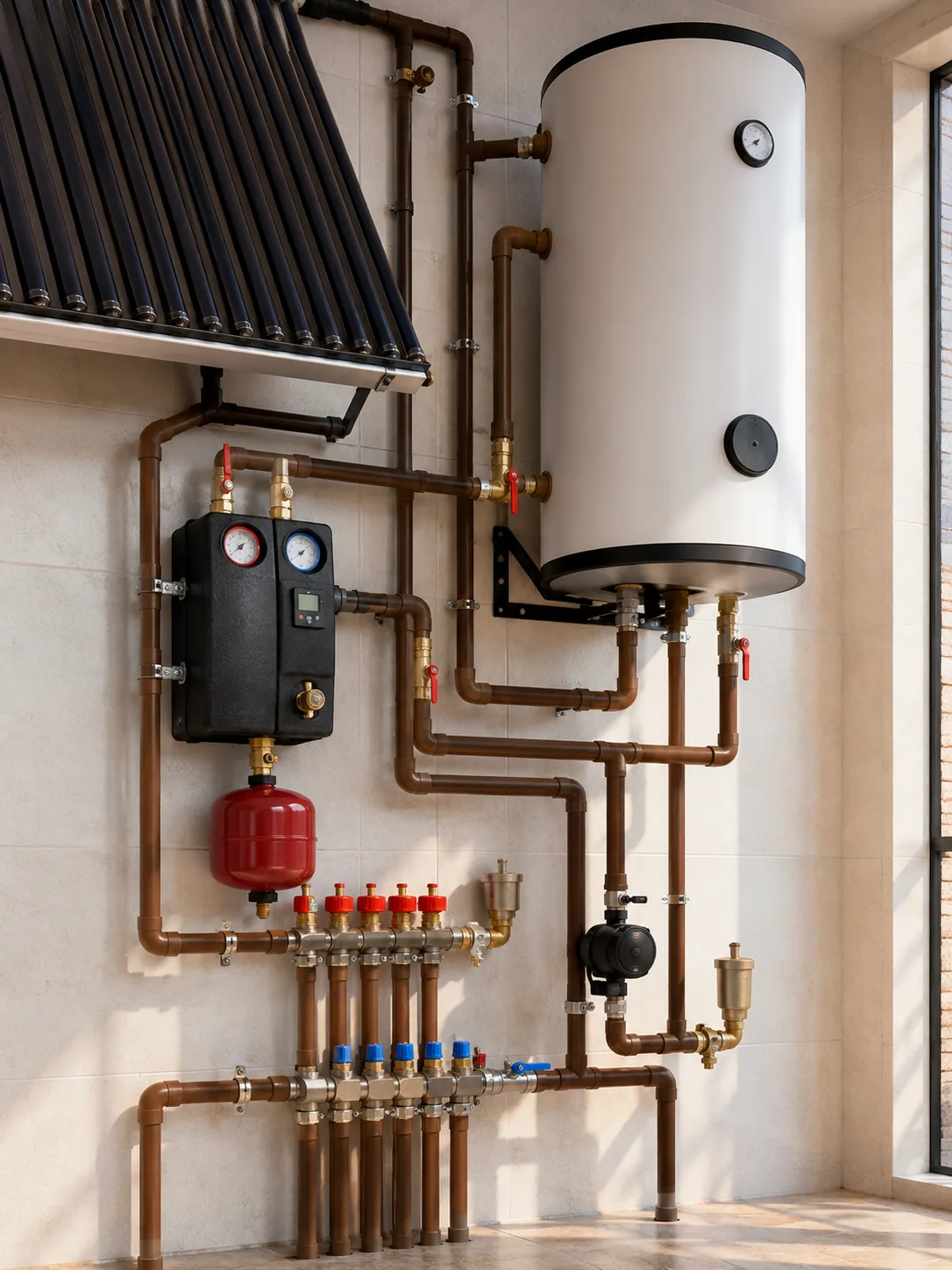
Dissolved copper accelerates oxidation of polypropylene. PPI TN-57 gives the working threshold: “limited experience has shown that dissolved copper levels below 0.1 ppm will not adversely affect PP-R piping materials but that levels above 0.5 ppm may have a significant effect,” with the range between those figures depending on water temperature, total chlorine, pH, ORP and dissolved oxygen. Before adding PP-R to an existing copper system, PPI advises testing dissolved copper in the hot water, and states the level “should not exceed 0.1 ppm (mg/L).” That is a cheap commissioning test on exactly the job where delayed failure is likeliest and costliest to argue about later.
Now the qualifiers, because this mechanism gets exaggerated in sales conversations. PPI describes it as rare and says it does not occur in cold-water plumbing, hydronic, closed-loop geothermal or industrial systems. It needs four conditions at once: constant replenishment of chlorine and oxygen; circulation temperatures in excess of 140 °F; excessive flow rates in the copper tubing or components; and water chemistry specifically aggressive to copper. Every one is controlled by the designer, not by the pipe.
The velocity limits matter because they apply to the copper, not to the plastic. PPI states that flow velocity in plumbing and domestic hot water recirculation systems should not exceed 5 ft/sec (1.5 m/s) at temperatures up to 140 °F, and that above 140 °F the Copper Tube Handbook limits plumbing velocity to 2 to 3 ft/sec (0.6 to 0.9 m/s). Some commercial designers hold tighter still, at 1.5 ft/sec (0.5 m/s).
Was it the pipe or the joint? Usually you can tell
A delayed leak at a fitting is the most disputed failure in the trade, because a bad fusion joint and a bad batch of pipe produce the same wet ceiling. Commercially the distinction is everything: one is a supplier problem and the other is not. Working from the DVS 2207-11 parameters tabulated by SIMONA in its 2023 welding guidance, the heated tool runs at 260 ± 10 °C and every diameter carries three timings.
| Pipe OD (SDR 11) | Warming time | Change-over, max | Fixed cooling | Total cooling |
|---|---|---|---|---|
| 20 mm | 5 s | 4 s | 6 s | 2 min |
| 25 mm | 7 s | 4 s | 10 s | 2 min |
| 32 mm | 8 s | 6 s | 10 s | 4 min |
| 40 mm | 12 s | 6 s | 20 s | 4 min |
| 50 mm | 18 s | 6 s | 20 s | 4 min |
| 63 mm | 24 s | 8 s | 30 s | 6 min |
Heated-tool socket welding figures for PP to DVS 2207-11, as tabulated by SIMONA (work.info Welding, October 2023). Values assume 20 °C ambient with moderate air movement. A welding jig is required for PP at diameters of 63 mm and above.
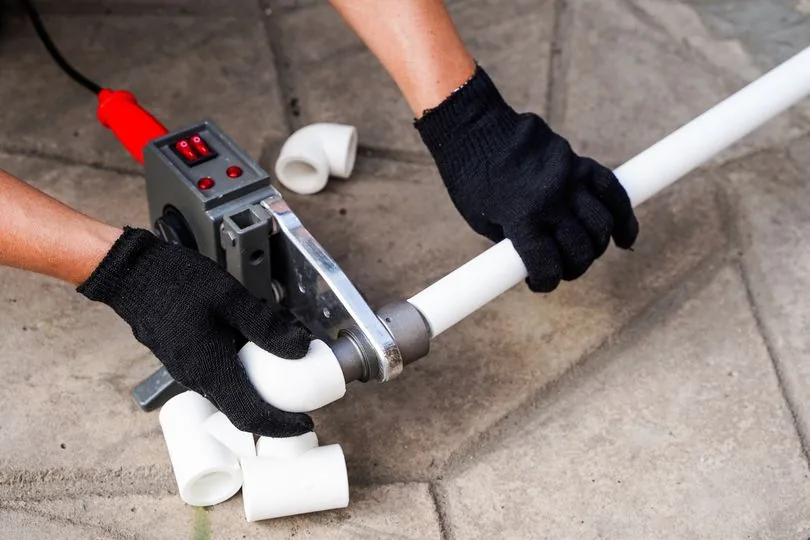
The change-over column is the one that ruins buildings. On a 20 mm joint, the installer has a maximum of four seconds between lifting the pipe and fitting off the heater and seating them together. Fumble the grip, reach for a dropped fitting, get interrupted — the melt surfaces cool below fusion temperature and the parts stick together without fusing. The joint looks correct. It has a bead. It holds.
That is a cold joint, and it is the classic year-three leak. It survives commissioning because a short hydrostatic test at ambient temperature asks almost nothing of it, then spends years absorbing thermal cycling, pressure pulses and expansion movement until the unfused interface opens. Preparation errors behave identically. SIMONA’s guidance requires that “the connecting surface of the pipe has to be machined with a peeling tool,” that the fitting is cleaned with lint-free paper, and that parts are seated to the insertion mark “without twisting or tilting.” A twisted joint tears the melt as it forms — and holds pressure on day one.
Best for / not for: what a passed pressure test proves
A commissioning pressure test is best for catching gross errors — unwelded joints, missed connections, damaged pipe, fittings left loose behind a wall. It does that job well and it is not optional.
It is not for predicting service life. It cannot detect a partially fused interface, a depleted stabiliser package, or a system that will run 15 °C hotter than designed. Treating a signed-off pressure test as evidence the material was sound is the most common reasoning error in delayed-failure disputes. For the joint procedure itself, our guide to PPR heat fusion welding covers it step by step.
The one test report almost nobody asks for
Most factory certificates show the hydrostatic acceptance tests from ISO 15874-2:2013 Table 10. For PP-R those are four rows: 16,0 MPa hoop stress at 20 °C for 1 hour; 4,3 MPa at 95 °C for 22 hours; 3,8 MPa at 95 °C for 165 hours; and 3,5 MPa at 95 °C for 1,000 hours, three test pieces each, requirement no failure during the test period. The 1,000-hour row is the one to look for — longest, and most often missing from a routine certificate of analysis.
None of those four say much about the stabiliser package, though, and the stabiliser package governs the chemical branch. The test that does sits in Table 11 of the same standard: thermal stability by hydrostatic pressure testing. For PP-R the conditions are 1,9 MPa hoop stress, 110 °C, for 8,760 hours, water-in-air, with the requirement of no bursting during the test period. That is 365 days at 110 °C, run in air rather than immersed — deliberately the harsher configuration for oxidative attack.
So it is the closest thing on a datasheet to a real answer about long-term chemical durability — and it is easy to skip, because the standard requires only one test piece. Ask for it by name. A supplier who has type-tested to ISO 15874-2 already has the report; one who cannot produce it either has not completed the type test, or has not run it on the compound currently in the extruder.
How our own line is checked before shipment
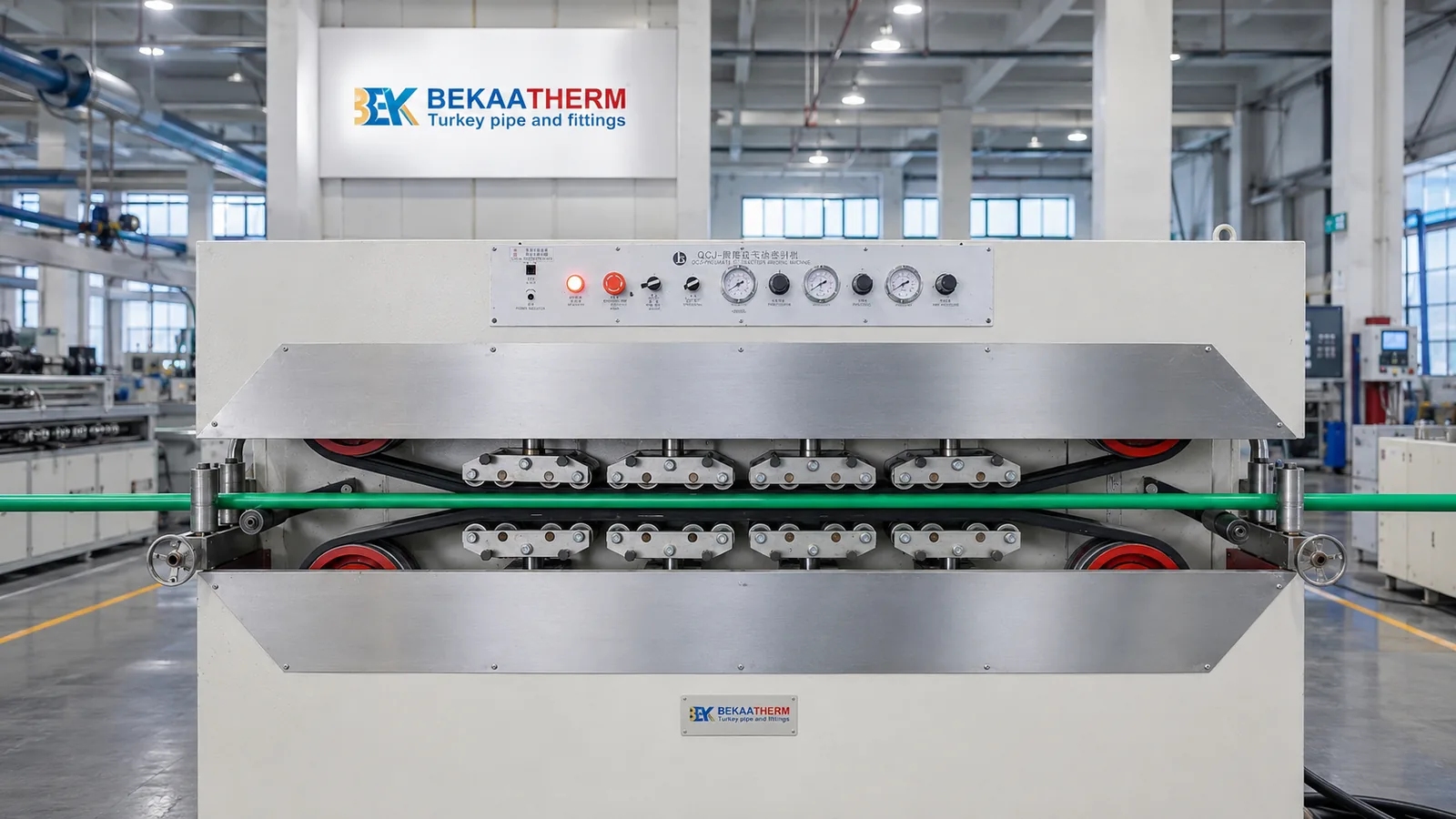
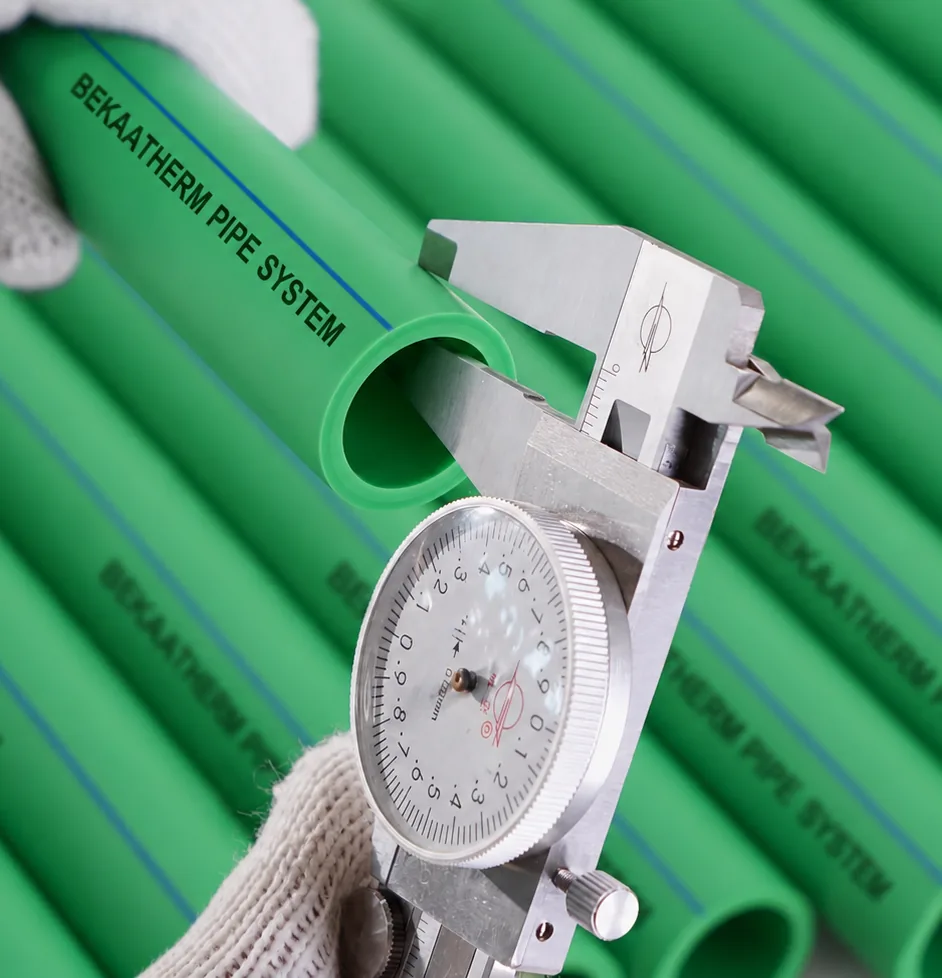
Bekatherm runs five sequential control points, and they map onto the failure modes above rather than sitting there as a quality slogan. Resin intake verification confirms virgin material with no regrind — regrind is stabiliser of unknown history, the chemical branch. In-line extrusion control and dimensional measurement catch wall thickness and frozen-in stress from an over-fast line, the mechanical branch. Pressure and temperature testing covers the hydrostatic rows above, and pre-shipment sampling closes it with a documented factory test report. The targets that report is written against are on our quality control page: PN20 at 20 bar and PN25 at 25 bar at 20 °C, outside diameters 20 mm to 63 mm, 20 mm PN20 at 2.8 mm wall and 20 mm PN25 at 3.4 mm, to DIN 8077 series S3.2 and S2.5.
Those wall figures are what to check on arrival with a caliper. A 20 mm PN25 pipe measuring 2.8 mm is a PN20 pipe with the wrong print on it, and no certificate fixes that once it is inside a wall.
End to end: a hot water retrofit that fails in year three
Put the mechanisms together and the delay stops looking mysterious. Here is the sequence in a mid-rise building where PP-R replaces part of an ageing copper hot water system.
Month 0. Risers are replaced in PP-R while the copper distribution and old circulation pump stay. Nobody tests dissolved copper, because nobody knows there is a 0.1 ppm figure to test against. Joints are welded quickly on a cold winter site — the DVS timings assume 20 °C ambient — and a handful of 20 mm joints miss the four-second change-over. The system is pressure tested, passes, and gets signed off. All of that is true at the same time.
Month 4. Tenants at the far end complain about lukewarm water, because the loop was never properly balanced. The cheap fix is the boiler setpoint, so up it goes. Complaints stop, everyone considers it closed, and the loop now runs above 60 °C — the ceiling PPI names for recirculation, and one of the four conditions its copper-oxidation mechanism requires.
Year 1 to 2. Visibly, nothing happens. This is the induction period: the antioxidant package in the hot leg depletes faster than it would at design temperature, and the ductile-brittle transition moves closer in time. Cold lines are unaffected. Every inspection passes because there is nothing to see — the accelerated lab work found no measurable warning in the equivalent phase either.
Year 3. A cold joint on a hot riser opens. Then a second, on a different floor. Both on the hot leg, both at fittings, neither anywhere near pipe midspan. The building manager concludes the pipe was defective and files a warranty claim.
That claim will be difficult. Bekatherm’s 50-year warranty covers material and manufacturing defects, matched to the 50-year design life at rated pressure and 20 °C under ISO 15874. It does not cover a joint that missed its change-over window, an unbalanced loop run above design temperature, or water chemistry nobody tested. Warranty terms vary by contract and market, so confirm the wording before it becomes an argument. Note what would have settled this in an afternoon: a commissioning record of loop temperature, a dissolved copper reading, and the fusion joint log. None cost anything to collect, and none can be created retroactively.
The certificate check that takes five minutes
One last trap, specific to importers and distributors: certificates expire, and a PDF in a supplier’s shared folder does not. WRAS Approvals are valid for a maximum of five years, and the approval number is based on the date of the test report. Intertek noted in February 2026 that BS 6920 testing can take up to nine weeks, advising manufacturers to start at least three months before expiry — so a lapse is easy to fall into and easy to miss.
The check takes two steps: read the date on the certificate, then verify the product in the WRAS Approvals directory rather than trusting the PDF you were sent. Do the same across the set — SKZ in Germany, plus ISO and CE. Our certifications page lists what we hold, and the breakdown of what SKZ, CE and WRAS each cover explains why they are not interchangeable. While you are there, check the standards references: ISO 15874-1:2013 and ISO 15874-2:2013 both remain current. If a supplier’s paperwork still cites EN 713 or EN 712 for Part 5 test methods, which Amendment 1:2018 replaced with ISO 3503 and ISO 3501, you have just learned when that paperwork was last updated.
If you are a distributor building an incoming-inspection routine rather than buying today, the dimensional targets each batch is measured against — pressure class, outside diameter and wall thickness, with the DIN 8077 series behind them — are published in full on our quality control page. Take the numbers and use them against any supplier, including ours.
Frequently asked questions
Why did my pipe pass the pressure test and still leak two years later?
A commissioning pressure test applies a short-duration load at ambient temperature. It detects gross defects such as unwelded or missing joints, but it cannot detect a partially fused interface, a depleted antioxidant package, or a system that will later be operated above its design temperature. Under ISO 9080 the stress-rupture curve has separate branches for different failure modes, so passing a short test says nothing about which branch the pipe will eventually reach.
What is the “knee” in a pipe regression curve?
ISO 9080:2012 defines the knee as the point of intersection of two branches at the same temperature, where a branch is a line of constant slope in the log stress versus log time plot representing the same failure mode. PPI TN-7 states the knee typically, but not always, corresponds to a change between ductile and brittle (slit) failure modes in polyolefins. Crossing it means the pipe fails by a different mechanism, not simply more slowly.
Why do hot water lines fail before cold water lines?
PPI TN-7 states that higher temperatures shorten both the time to failure and the time to the ductile-brittle transition, following an Arrhenius relationship. Heat moves the knee closer in time as well as moving the pipe along the curve faster. A 50-year design life stated at 20 °C under ISO 15874 is calculated on the 20 °C curve; operating hotter means operating on a different curve.
At what copper concentration is PP-R at risk?
PPI TN-57 (2025) states that dissolved copper levels below 0.1 ppm will not adversely affect PP-R piping materials, while levels above 0.5 ppm may have a significant effect, with the range between depending on temperature, total chlorine, pH, ORP and dissolved oxygen. Before adding PP-R to an existing copper system, PPI advises testing dissolved copper in the hot water, and states the level should not exceed 0.1 ppm.
Is copper-induced damage to PP-R common?
No. PPI TN-57 describes it as rare and states it does not occur in cold-water plumbing, hydronic systems, closed-loop geothermal systems, or industrial piping systems. Four conditions must be present together: constant replenishment of chlorine and oxygen, circulation temperatures in excess of 140 °F, excessive flow rates in the copper tubing or components, and water chemistry specifically aggressive to copper.
How long is the change-over window on a socket fusion joint?
For SDR 11 PP pipe to DVS 2207-11 as tabulated by SIMONA, change-over is a maximum of 4 seconds on 20 mm and 25 mm, 6 seconds on 32 mm to 50 mm, and 8 seconds on 63 mm, with the heated tool at 260 ± 10 °C. Exceeding it lets the melt surfaces cool below fusion temperature, producing a joint that holds pressure initially without being properly fused.
Which test report should I ask a PP-R supplier for?
Ask for the ISO 15874-2 Table 11 thermal stability result: 1,9 MPa hoop stress at 110 °C for 8,760 hours, water-in-air, with no bursting during the test period. It is the test that probes the stabiliser package, it takes a year to run, and it requires only one test piece — so it is commonly omitted from routine certificates even by suppliers who have done it.
What is the difference between PP-R and PP-RCT?
They are different material classes with different rated strengths. Per PPI, PP-R has an MRS value of 8.0 MPa or 10.0 MPa, while PP-RCT has a minimum MRS of 11.2 MPa, both classified under ISO 9080 testing and ISO 12162. In ISO 15874-2, the 50-year design stress at 20 °C is 6,93 MPa for PP-R against 8,25 MPa for PP-RCT. Specify the class on the order, since “PPR” alone does not identify either.
Does a 50-year warranty cover a leak in year three?
Bekatherm’s 50-year warranty covers material and manufacturing defects, matched to the 50-year design life at rated pressure and 20 °C under ISO 15874. It is not a guarantee against installation error, operation above design temperature, or water chemistry outside the assumed conditions. Warranty scope and its application vary by contract and market, so confirm the specific terms in writing before an order.
How do I check a supplier’s WRAS certificate is still valid?
WRAS Approvals are valid for a maximum of five years, and the approval number is based on the date of the test report. Check the date on the certificate, then confirm the product still appears in the WRAS Approvals online directory rather than relying on a PDF supplied to you. Intertek advises manufacturers to begin re-approval at least three months before expiry, since BS 6920 testing can take up to nine weeks.