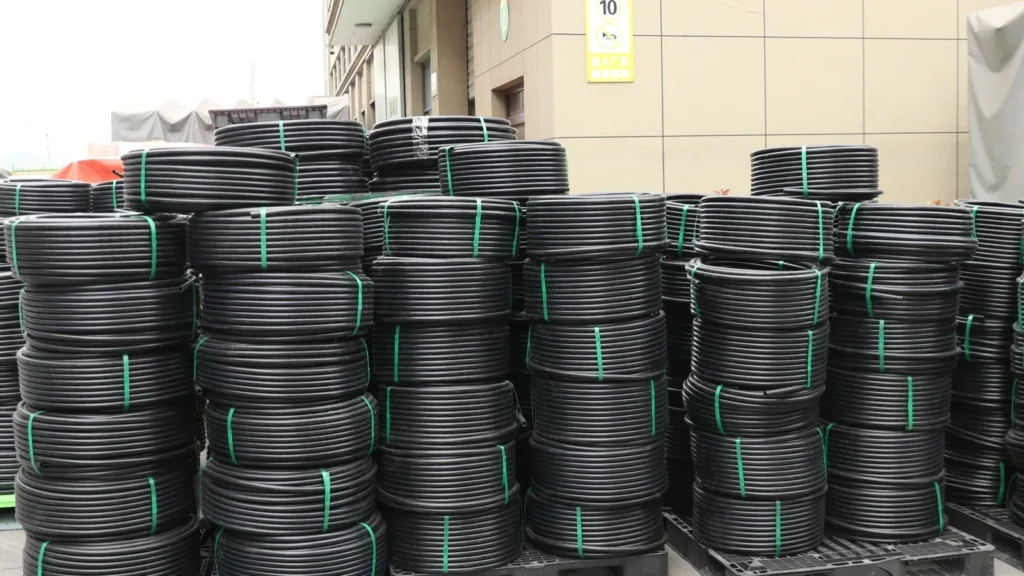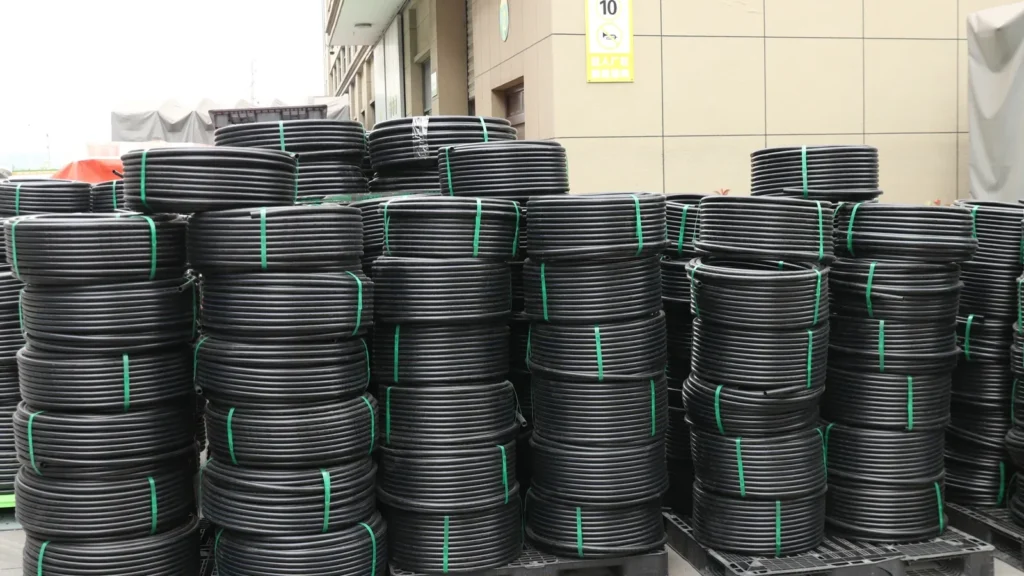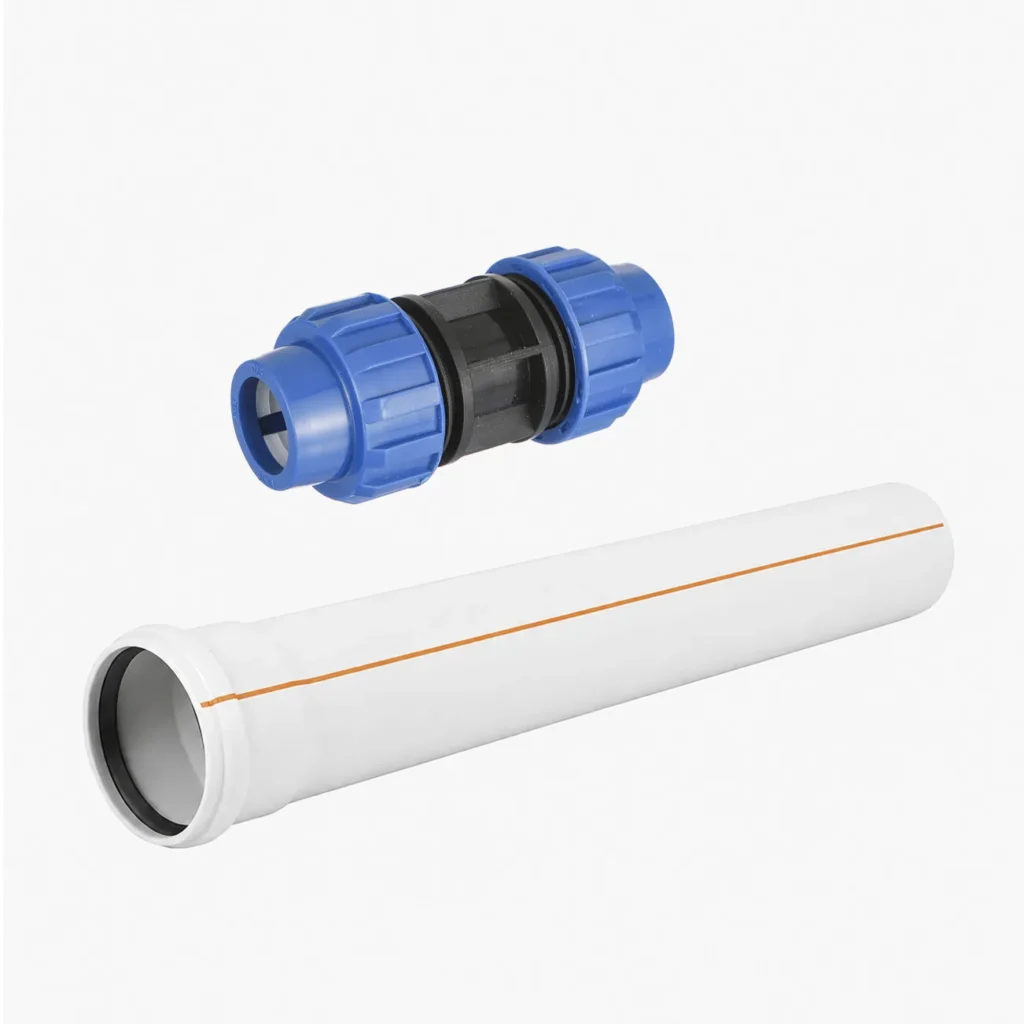
There are three polyethylene pipe grades a water or pressure-sewer buyer meets in practice: PE 80, PE 100 and PE 100-RC. The number is not a rating invented by the seller. It is the material’s minimum required strength in megapascals, multiplied by ten, fixed by the ISO 12162 classification rules — so PE 100 means MRS 10.0 MPa and PE 80 means MRS 8.0 MPa. PE 100-RC is the one that trips people up: it carries exactly the same MRS 10.0 as ordinary PE 100 and rates to exactly the same pressure class. It is not a stronger pipe. It is a pipe with a much harder crack-resistance qualification behind it.
Key Takeaways
- The grade number is MRS × 10. PE 80 = MRS 8.0 MPa, PE 100 = MRS 10.0 MPa, and MRS itself comes from an ISO 9080 regression on long-term pressure tests extrapolated to 20 °C and 50 years.
- Design stress is MRS divided by the overall service coefficient C = 1,25. ISO 4427-1 Table 3 tabulates 8,0 MPa for PE 100 and 6,3 MPa for PE 80 — not the 6,4 you get by dividing it yourself.
- Same duty, different pipe: PN 10 needs SDR 13,6 in PE 80 but only SDR 17 in PE 100. At 110 mm that is an 8,1 mm wall against a 6,6 mm wall.
- PE 100-RC is not a higher pressure class. Identical MRS, identical PN at identical SDR. What changes is slow-crack-growth performance.
- The notched pipe test tells the story: conventional PE 100 must reach 500 hours, PE 100-RC must reach 8 760 hours — a full year, and a grade has to pass all four crack tests, not one.
- PAS 1075, the German specification most online RC guidance still quotes, was withdrawn in February 2020. PE 100-RC now sits inside EN 12201 and ISO 4427 themselves.
- PE 80 is not obsolete. It remains a listed grade in the current dimension tables, alongside PE 63 and PE 40.
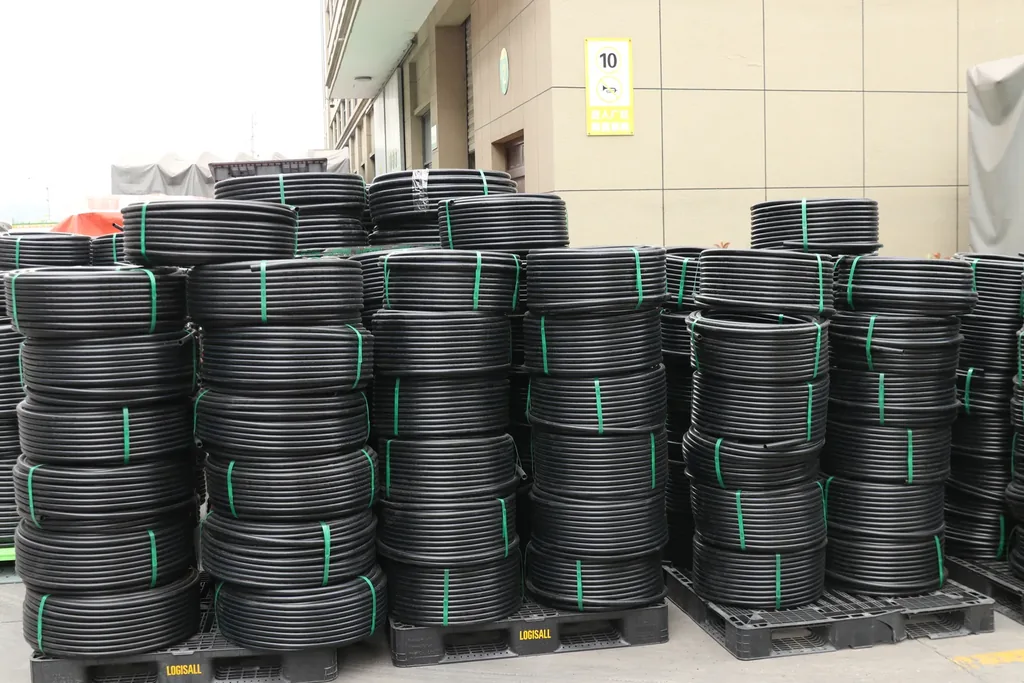
What the number in PE 80, PE 100 and PE 100-RC actually means
The naming convention is arithmetic, and it is the whole story. Take the material’s minimum required strength (MRS) in megapascals and multiply by ten. MRS 8.0 becomes PE 80. MRS 10.0 becomes PE 100. There is no marketing in the number and no room for a supplier to interpret it generously.
MRS itself is not a figure someone estimated in a meeting. It comes out of long-term hydrostatic pressure testing analysed by regression under ISO 9080, then extrapolated to predict the minimum strength the material still holds at 20 °C after 50 years of service. That extrapolated value is rounded down onto a standard series and classified under ISO 12162. So when a data sheet says PE 100, it is making a 50-year claim that a laboratory regression has to support.
The grades you will actually be quoted
Most pressure work today lands on PE 100. PE 80 still appears, particularly in gas distribution and in markets where existing network specifications were written years ago and never revised. PE 63 and PE 40 remain in the standard’s dimension tables as well, though for new pressure mains you will rarely see them offered.
- PE 100 — MRS 10.0 MPa. The default for potable water mains and pressure sewers.
- PE 100-RC — MRS 10.0 MPa, identical to PE 100, plus a much harder slow-crack-growth qualification.
- PE 80 — MRS 8.0 MPa. Still current, still legal, still specified.
- PE 63 and PE 40 — MRS 6.3 and 4.0 MPa. Listed in the tables, narrow in practical use.
Grade is one axis of three — keep them separate
A large share of buyer confusion comes from collapsing three independent things into one. Grade is the material. SDR (the ratio of outside diameter to wall thickness) is the geometry. Colour and stripe coding is the application convention, and it varies by market. A pipe can be PE 100 and thin-walled, or PE 100 and thick-walled, and those are completely different products at completely different prices. If you want the geometry side in depth, our guide to HDPE pipe specifications, SDR, PN and wall thickness covers it properly; this page stays on the material.
From MRS to design stress: the number that decides your wall thickness
MRS is the laboratory number. It is not the number an engineer designs to. Between the two sits a safety margin called the overall service (design) coefficient, written as C, and for water applications ISO 4427-1 sets it at C = 1,25. Divide MRS by C and you get design stress, written σs. That is the figure that actually drives wall thickness. Wall thickness drives mass, and mass drives price per metre.
| Designation | MRS (MPa) | Design stress σs (MPa) |
|---|---|---|
| PE 100 | 10,0 | 8,0 |
| PE 80 | 8,0 | 6,3 |
| PE 63 | 6,3 | 5,0 |
| PE 40 | 4,0 | 3,2 |
Why it is 6,3 and not 6,4
Do the division for PE 80 and you get 6.4. The standard tabulates 6,3. This catches out people who reverse-engineer the number rather than reading the table, and you will find 6.4 asserted on plenty of supplier blogs. The reason for the gap is that classification rounds the measured strength down onto a standard series before the grade is assigned, so the arithmetic runs on the rounded value rather than the raw one. If a specification on your desk says 6,3 MPa and a supplier’s sheet says 6.4, the standard is right and the sheet is showing you that nobody checked it.
The equation behind every pressure class
Maximum operating pressure follows directly: MOP = 20 × MRS ÷ (C × (SDR − 1)). Two consequences matter commercially. Raise the grade and you raise MOP at unchanged geometry. Raise C and you lower it — the standard’s own worked example notes that taking C = 1,6 instead of 1,25 drops PE 80’s design stress to 5,0 MPa. Some network owners do exactly that for critical mains, which is why an identical pipe can be rated differently in two tenders.
The same pressure class, two different pipes
Here is where the grade stops being a technical footnote and starts being money. Because PE 100 carries a higher design stress, it reaches a given pressure class on a thinner wall than PE 80 does. Two quotes can both say PN 10 and describe genuinely different pipes.
| Pipe series | PE 80 gives | PE 100 gives | Wall at 110 mm (emin) |
|---|---|---|---|
| SDR 9 | PN 16 | PN 20 | 12,3 mm |
| SDR 11 | PN 12,5 | PN 16 | 10,0 mm |
| SDR 13,6 | PN 10 | PN 12,5 | 8,1 mm |
| SDR 17 | PN 8 | PN 10 | 6,6 mm |
A worked example you can rerun on your own size
Say you are buying 110 mm pipe at PN 10. In PE 100 that is SDR 17, and the minimum wall is 6,6 mm. In PE 80 the same PN 10 requires SDR 13,6, and the minimum wall is 8,1 mm. Identical outside diameter, identical pressure class on paper, and a wall 18.5% thicker. Since PE pipe is bought and shipped by weight, that extra wall is roughly 21% more polyethylene in every metre — an approximation, because the exact kilogram figure depends on the resin density your supplier actually runs, but the wall thicknesses themselves are tabulated values, not estimates.
Run the same check at 63 mm and the pattern holds: 3,8 mm at SDR 17 against 4,7 mm at SDR 13,6. The rule generalises. Whenever a supplier substitutes PE 80 for PE 100 while keeping your stated pressure class, they must go thicker, and your cost per metre goes up rather than down.
The trap this creates in a quote comparison
The dangerous version runs the other way. A quote states PN 10 and SDR 17 but the material is PE 80 rather than PE 100. Read the table again: PE 80 at SDR 17 is PN 8, not PN 10. The pipe is a full pressure class below what the paperwork claims, and the only visible difference is a lighter delivery. This is why a quote that names a pressure class without naming the grade is not a quote you can compare — and why price per kilogram, not price per metre, is the honest basis for comparison.
Checking a compression-fitting spec against your pipe class
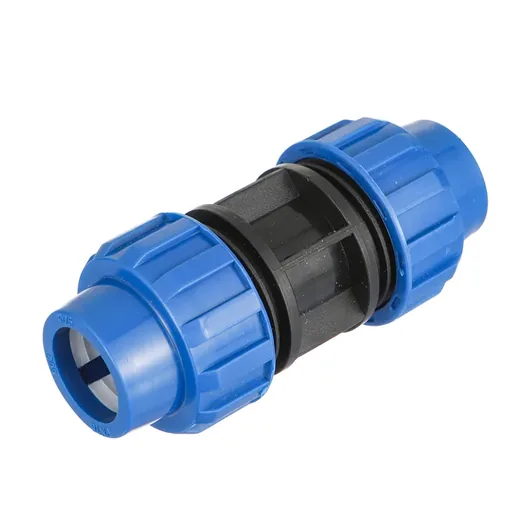
For distributors and procurement buyers comparing quotes by the container: the fitting has its own pressure ceiling, and it is often lower than the pipe it joins. Our HDPE and PE compression range lists its PN class and size coverage on the product page — compression fittings across 20–110 mm and saddle clamps to 315 mm, rated PN10 — so you can check the fitting rating against the pipe class before you commit to a size mix.
PE 100-RC is not a higher pressure class — here is what you are buying
RC stands for resistance to cracking. It does not stand for a higher rating, and this is the single most common misunderstanding in PE procurement. PE 100-RC has an MRS of 10.0 MPa, exactly like conventional PE 100. At the same SDR it gives the same PN. If you specify PE 100-RC expecting more pressure capacity, you have paid a premium for nothing.
What you are actually buying is resistance to slow crack growth — the failure mode where a scratch, a notch from a stone, or a point load on the pipe wall propagates quietly over years until the pipe fails. Every requirement that applies to PE 100 still applies to PE 100-RC; the RC grade simply has to clear a far higher bar on the crack tests.
The four tests, and the thresholds that separate the grades
The headline number is the notched pipe test under ISO 13479, where a pipe is deliberately notched along its length and held under hydrostatic pressure at 80 °C. Conventional PE 100 must survive 500 hours. PE 100-RC must survive 8 760 hours — one full year, seventeen and a half times the requirement, at an identical MRS.
- Notched pipe test (ISO 13479) — PE 100 ≥ 500 h; PE 100-RC ≥ 8 760 h, water at 80 °C.
- Full notch creep test (ISO 16770) — PE 100 ≥ 300 h; PE 100-RC > 8 760 h.
- Strain hardening test — PE 100 ≥ 40 MPa; PE 100-RC ≥ 53 MPa for the resin and ≥ 50 MPa for pipe and fittings.
- Cracked round bar — PE 100 > 0,9 × 10⁶ cycles; PE 100-RC > 1,5 × 10⁶ cycles.
These thresholds are summarised by TEPPFA, the European trade association for plastic pipes and fittings, in its 2024 paper on PE 100-RC certification. One detail in that paper is worth carrying into a specification: a qualifying RC grade has to pass all four methods, so a resin cannot be tuned to win on one test and scrape through the rest.
When the premium is worth paying — and when it is not
RC exists for a commercial reason, not a theoretical one. Standard installation guidance in many markets calls for sand bedding around a PE pipe so that stones in the ground cannot press into the wall. Sand costs money, takes time and often has to be trucked in. A pipe qualified to resist point loading can be laid using the excavated soil as backfill instead, and it opens up trenchless methods — directional drilling, pipe bursting, close-fit relining — where the pipe is dragged through ground you cannot inspect.
So the test is not the pipe, it is the trench. Open-cut work into a properly sand-bedded trench at moderate pressure rarely justifies the RC premium. Directional drilling, rocky ground, sand-free backfill, or a network owner who has already been burned by point-load failures — that is where the arithmetic changes. Ask what the installation method is before you ask what the grade costs.
Why half the PE 100-RC guidance online is out of date
Search PE 100-RC and most of what comes back explains it through PAS 1075, a German specification published by DIN in April 2009 that sorted RC pipes into Type 1, Type 2 and Type 3. That framework is still repeated widely, still quoted in tender documents, and still presented as current. It was withdrawn in February 2020.
What replaced it is better news for buyers. Instead of a national specification sitting beside the product standards, PE 100-RC was written into the product standards themselves — the EN 12201 and EN 1555 series for water and gas in Europe, with ISO 4427 and ISO 4437 alongside them. The requirements travel with the standard you were already specifying, so an RC grade can be demanded without invoking a separate document.
The current edition, and what changed in it
EN 12201-1:2024 was published on 30 January 2024 and supersedes the 2011 edition. Beyond adding the PE 100-RC designation, it extends the covered diameter range to 3 000 mm and carries an Annex C covering installation of PE 100-RC systems for both conventional and non-conventional methods. The scope sits at allowable operating pressures up to 25 bar with 20 °C as the reference temperature.
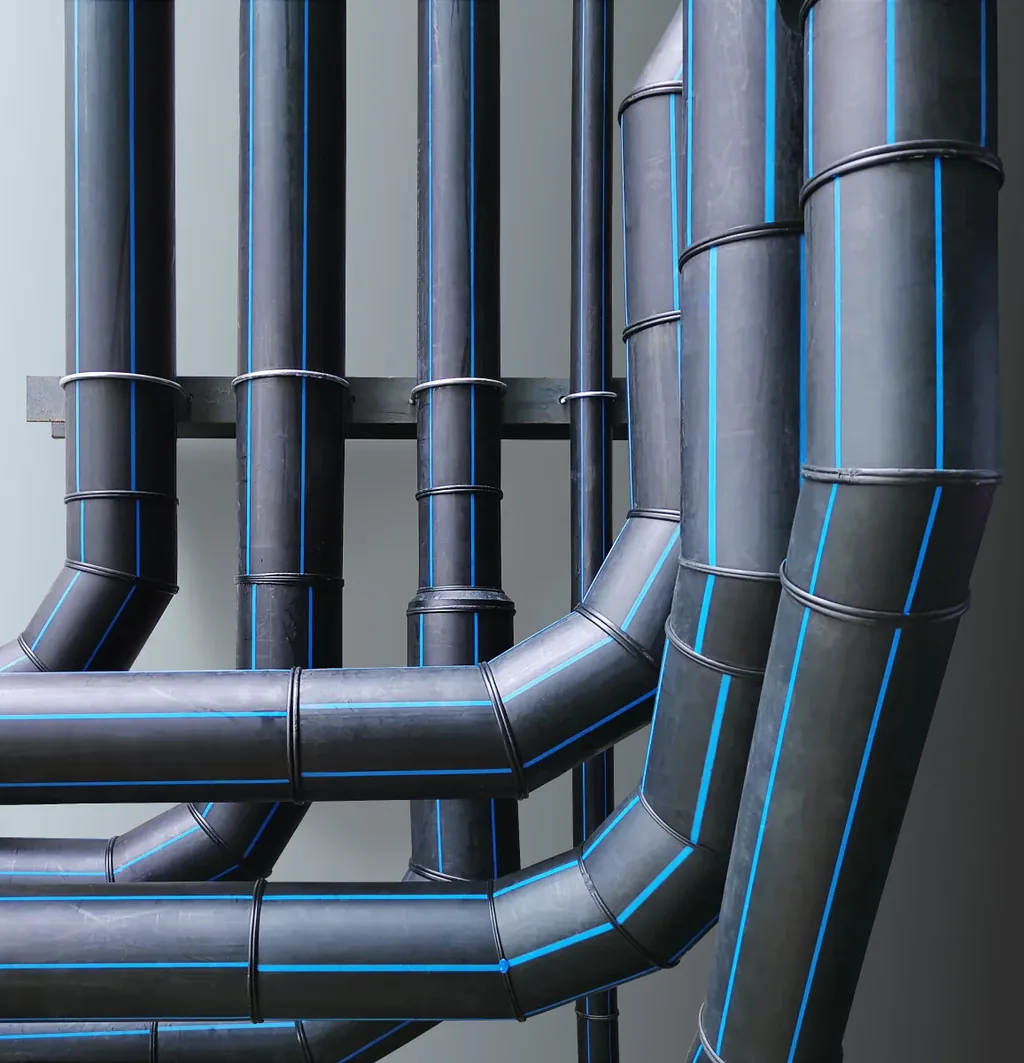
One naming point saves confusion on export enquiries. The same material class is called PE 100-RC in Europe and PE 100-HSCR — high stress crack resistance — in other regions. A supplier offering HSCR is not offering something different or lesser.
Two practical consequences follow. If your tender text still cites PAS 1075 Type 1 or Type 2, it references a withdrawn document and a supplier could reasonably ask what you actually want. And if a supplier’s technical sheet dates its RC claim to PAS 1075 with no reference to the current EN or ISO requirements, that tells you when their documentation was last reviewed. Standards and certification requirements vary by market and by the specifying authority, so confirm the applicable edition with the relevant water authority or certification body before it goes into a contract.
Writing the grade into your enquiry so the quotes come back comparable
Most incomparable quotes are caused by incomplete enquiries. If you send a diameter and a pressure class, you invite four suppliers to answer four different questions. A designation string that pins all the variables takes one extra line to write.
Material and grade, then diameter, then pipe series, then the standard. For example: PE 100, 110 mm, SDR 17 (PN 10), to EN 12201-2 — black with blue stripe, in 6 m straight lengths.
Ask for the marking, not just the certificate
The standards require the pipe itself to be marked, and for diameters above 32 mm the SDR series is part of that required marking. Asking for a photograph of the marking on the production run costs nothing and confirms that the grade and series on the pipe match the grade and series on the invoice. It is a far more useful request than another copy of a certificate, because the marking is applied at extrusion and the certificate is applied in an office.
The commercial terms that shape a first quotation
Pricing on PE pipe moves with resin, so no supplier publishes a fixed per-metre figure that stays true for long. What you can pin down before you commit is the structure around the price. At Bekaatherm a first trial order is normally one 20GP mixed container of pipe, fittings and valves, with 500 kg per size and colour as the practical minimum for a single item. The lead time on regular in-production sizes is 15–25 days, and 30–45 days for an OEM or private-label run. Standard samples are free for up to three items on freight collect. Payment is 30% T/T deposit with the balance of 70% against a copy bill of lading, and pricing is quoted FOB İstanbul or Mersin by default, with CFR and CIF available on request.
A quotation worth comparing states the FOB unit price, the container loading plan and which standards the quoted items are made to — not just a number per metre. Enquiries are answered within 24 hours. If the grade question is the one holding your order up, our breakdown of what actually drives HDPE pipe prices shows where resin, wall thickness and freight each land in the final figure, and our guide to vetting an HDPE pipe manufacturer covers what to verify before the deposit leaves.
Frequently Asked Questions
Is PE 100 always better than PE 80?
Not automatically. PE 100 reaches a given pressure class on a thinner wall, so it usually costs less per metre for the same duty. But PE 80 remains a listed, current grade in the standards, and where an existing network specification calls for it, it is the correct answer.
What does the 100 in PE 100 stand for?
The minimum required strength in megapascals, multiplied by ten. PE 100 means MRS 10.0 MPa, determined by ISO 9080 regression on long-term pressure tests extrapolated to 20 °C and 50 years.
Does PE 100-RC hold more pressure than PE 100?
No. Both carry MRS 10.0 MPa and give the same PN at the same SDR. PE 100-RC differs only in slow-crack-growth performance, which matters for point loading and trenchless installation, not for pressure capacity.
Is PAS 1075 still valid for specifying PE 100-RC?
It was withdrawn in February 2020. PE 100-RC is now a designation inside EN 12201, EN 1555, ISO 4427 and ISO 4437, so specify against the current edition of the product standard instead.
Why does PE 80 show 6,3 MPa design stress instead of 6,4?
Classification rounds the measured long-term strength down onto a standard series before the grade is assigned, so ISO 4427-1 Table 3 tabulates 6,3 MPa. Dividing 8.0 by 1,25 yourself gives 6.4, which the standard does not use.
What is the minimum order for HDPE pipe and fittings?
One 20GP mixed container of pipe, fittings and valves for a trial order, or 500 kg per size and colour for a single item. Regular sizes ship in 15–25 days, OEM runs in 30–45 days.