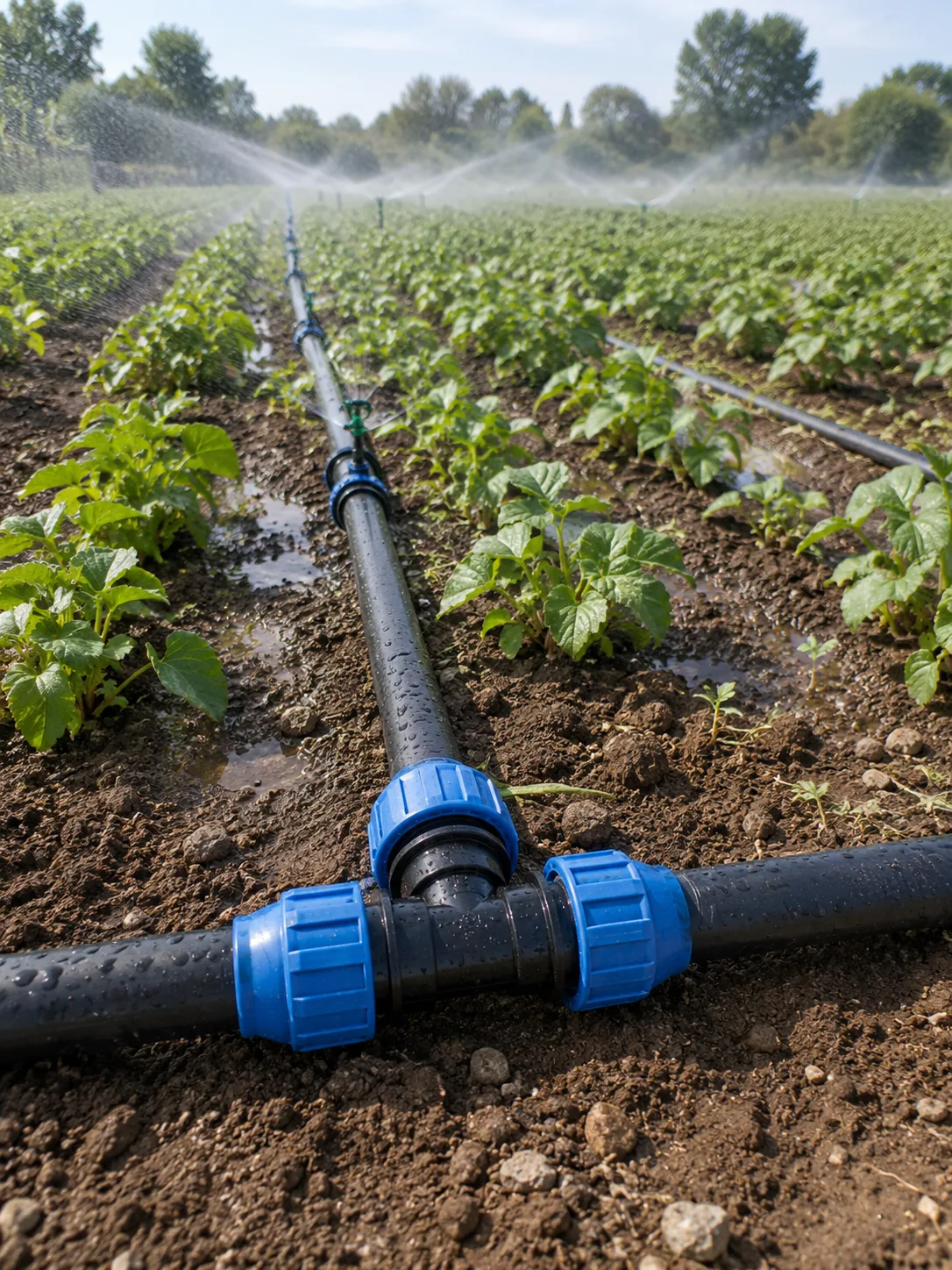
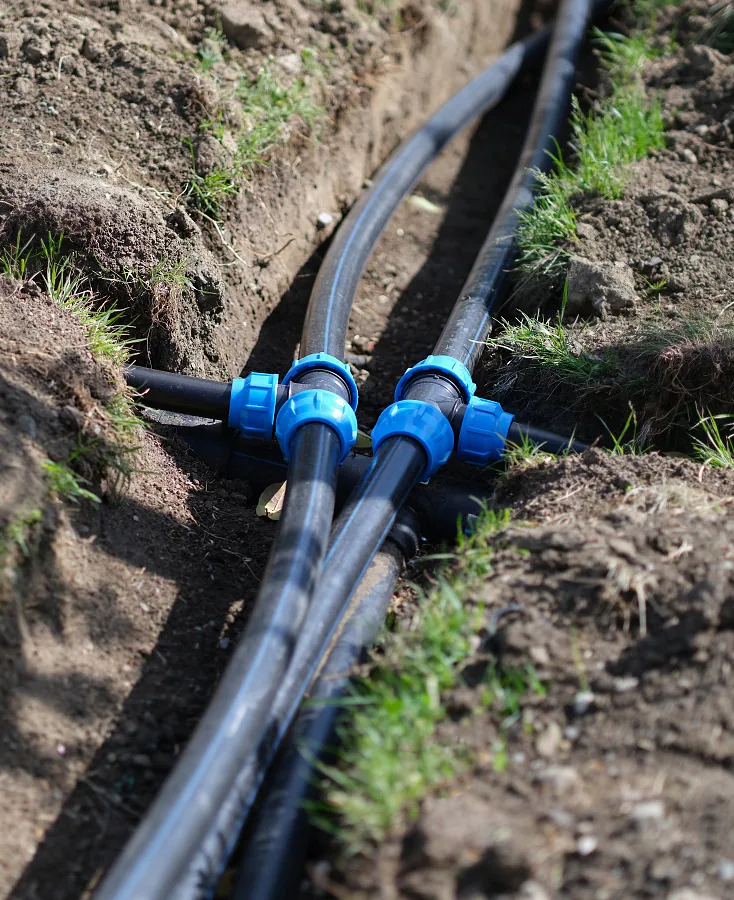
Most of the rework on a buried water line happens at the three places the pipe stops being HDPE. An HDPE pipe connection along the black polyethylene main is the easy part — a compression coupler, a nut, twenty seconds. The hard part is the joint where that main meets a PPR riser going into a building, a galvanised steel stub coming out of a pump house, or a live municipal main nobody is allowed to shut down.
Those three transitions are governed by three different rulebooks, and two of the standard numbers most contractors write on a submittal are out of date. ISO 14236 — printed on a lot of compression fitting boxes — has been withdrawn and superseded by ISO 17885. The EN 12201 series was reissued in 2024. And ISO 17885 carries an exclusion that decides which standard applies to the joint inside your building.
Key Takeaways
- HDPE cannot be fused to PPR. PE and PP are different polyolefins. No PE standard and no PP standard recognises a fused PE-to-PP joint, so the connection must be mechanical or threaded.
- ISO 14236:2000 is withdrawn and superseded by ISO 17885:2021, which explicitly covers transition fittings to metal pipes — the standard that governs an HDPE-to-steel joint.
- ISO 17885 excludes flanges and excludes mechanical fittings for hot and cold water systems inside buildings, which is why an indoor HDPE-to-PPR joint falls to the ISO 15874 side instead.
- EN 12201-3:2024 replaced EN 12201-3:2011+A1:2012, published 30 January 2024. Anyone still citing the 2011 version on a submittal is naming a withdrawn document.
- Thread type decides whether it seals. ISO 7-1 threads seal on the thread itself; ISO 228-1 parallel threads do not and need a gasket or O-ring.
- No fusion machine is needed for the Bekaatherm compression range — 20–110mm fittings, saddle clamps 25×1/2″ to 315×6″, all PN10.
- Overtightening is the dominant failure mode on plastic threaded transitions, not undertightening. Extra PTFE tape splits female threads.
Why HDPE and PPR cannot be welded together
This is the question the search term implies and almost every competing article skips. A crew that welds PPR every day, with a socket fusion tool already hot on the bench, looks at a black HDPE main and reasonably asks why the same tool cannot join the two. It cannot.
HDPE is polyethylene. PPR is polypropylene random copolymer. Both are polyolefins, but they are different polymers with different melt behaviour and they are not compatible in a fusion joint. The evidence is in how the standards are drawn: polyethylene systems live under ISO 4427 and EN 12201, polypropylene systems under ISO 15874, and neither family contains a procedure for fusing one to the other. When a committee wants a joint to exist, it writes that joint into the standard. No PE standard and no PP standard recognises a fused PE-to-PP joint.
So the connection has to be mechanical or threaded. That is not a compromise or a second-best workaround — it is the only route the standards recognise, and it is why the threaded transition fitting exists as a product category at all.
How to connect HDPE to PPR
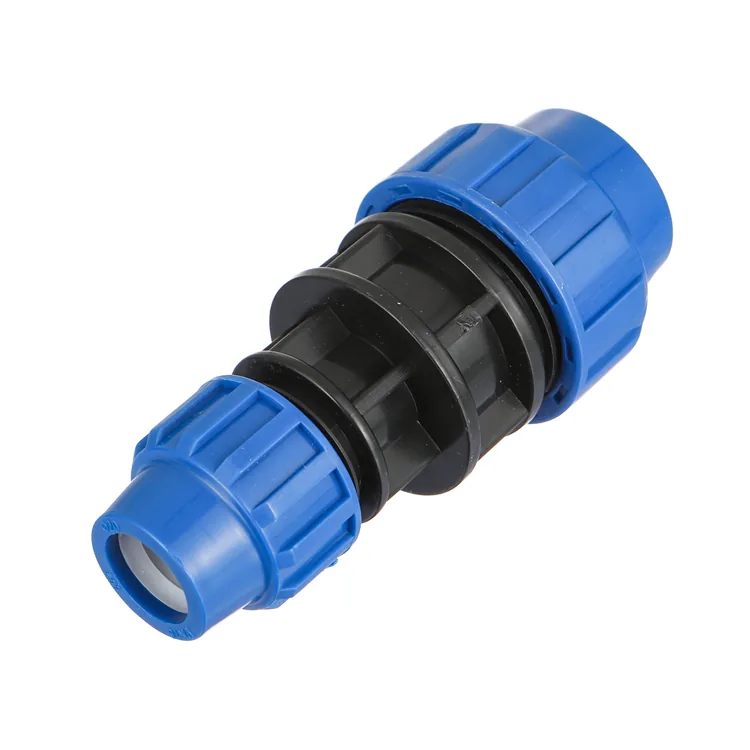
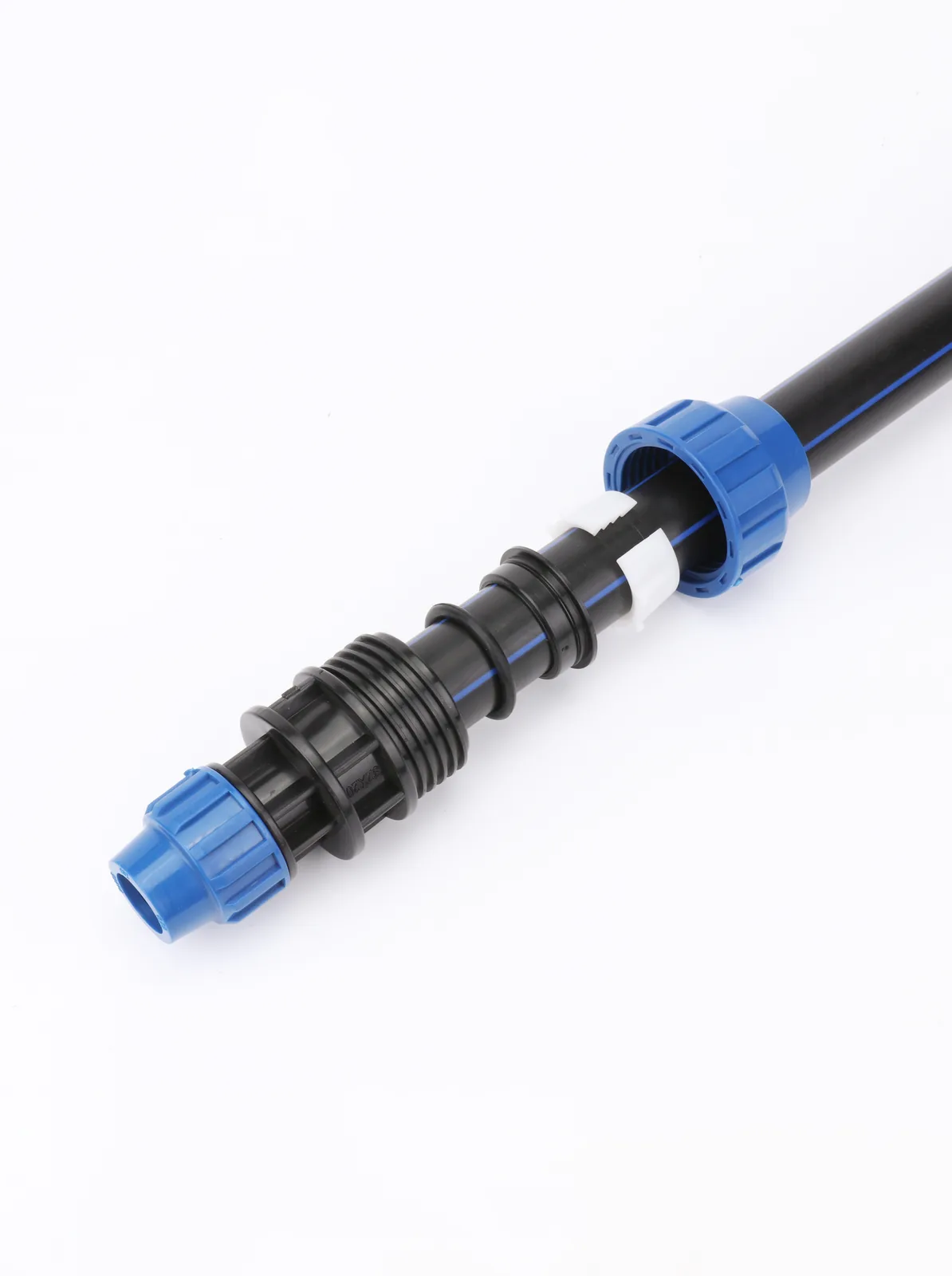
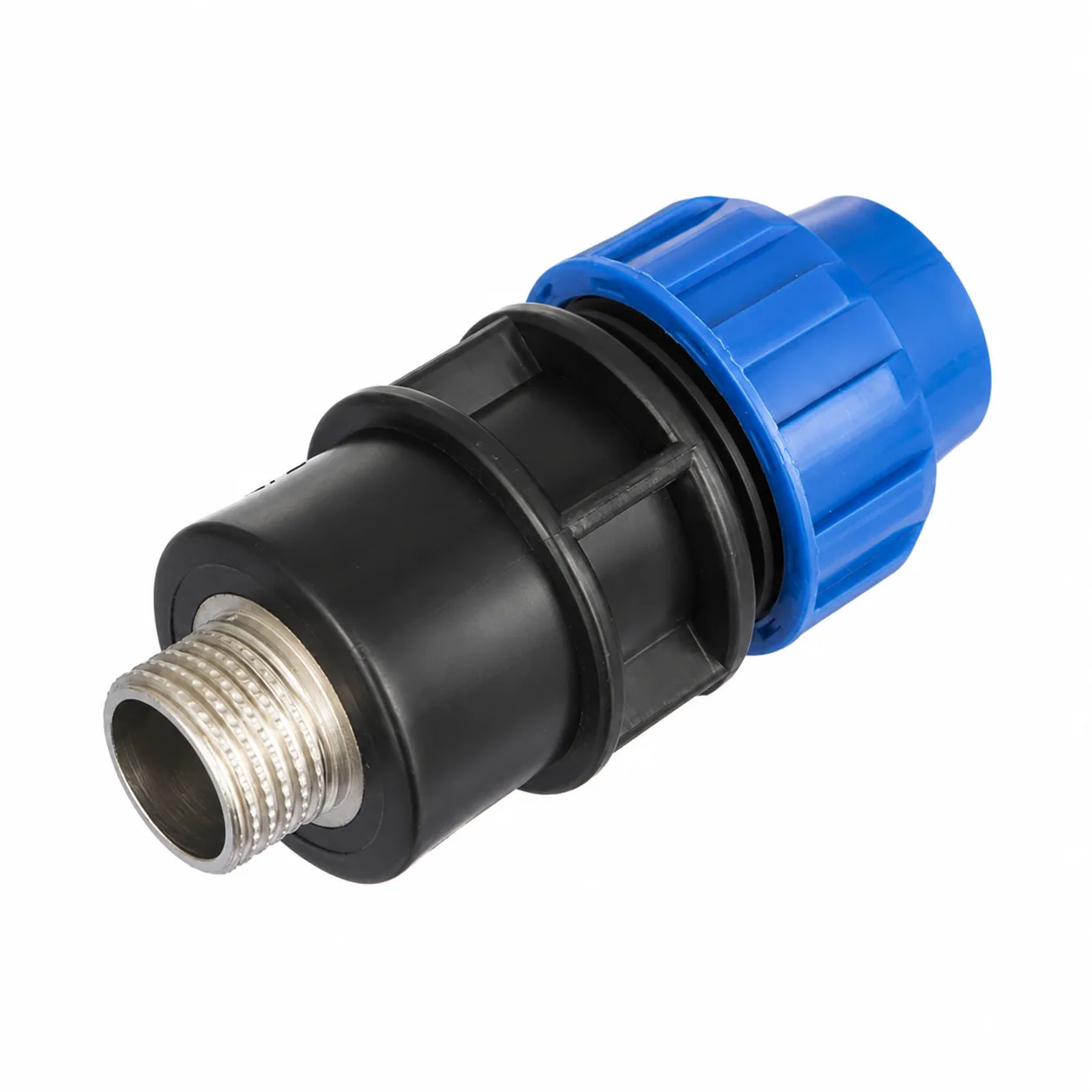
The joint is made through a thread, with each material handling its own side. On the HDPE side you fit a male or female compression transition — the compression end grips the black pipe, the threaded end presents a BSP thread. On the PPR side you fuse a threaded PPR fitting with a moulded-in brass insert, using the socket fusion tool the crew already has. Then the two threads meet. Neither material is asked to do anything it was not designed to do.
Order matters more than people expect. Fuse the PPR threaded fitting first — the socket fusion procedure for PPR is unchanged here — and let it cool completely before you thread anything into the brass. A brass insert that is still hot sits in softened polypropylene, and torque applied at that moment can rotate the insert inside the fitting body. You will not see it. You will find out when the system is pressurised.
Where the joint sits changes the rulebook
Here is the detail that separates a correct submittal from a rejected one. ISO 17885:2021, the current standard for mechanical fittings on pressure piping, excludes flanges and excludes mechanical fittings for hot and cold water systems within buildings and for district heating. So a mechanical transition made outdoors on a buried service is squarely inside ISO 17885’s scope. The same style of joint made indoors on a hot and cold water system is not — that side belongs to ISO 15874, the PPR system standard.
So land the transition outside the building wherever the design allows. Put the changeover in a valve chamber or meter box, run PPR from there inward, and the joint sits in the scope of the standard that contemplates it. A compression-to-PPR transition buried in a wall chase is the arrangement that gets questioned on inspection — and the one you cannot reach when it weeps.
Connecting HDPE to steel and galvanised pipe
HDPE meets metal at pump houses, borehole heads, meter assemblies and old galvanised networks being extended in plastic. There are two routes, and the standards treat them differently.
The threaded route uses a male or female compression transition into the metal thread. ISO 17885:2021 covers mechanical fittings for plastic pressure piping systems and explicitly includes transition fittings to metal pipes, across water for human consumption, irrigation and industrial applications. If your joint is a threaded plastic-to-metal transition on a buried water service, ISO 17885 is the standard that governs it and the one worth naming on the submittal.
The flanged route is different, and this catches people out. ISO 17885 excludes flanges. A flanged connection is not covered by the mechanical-fittings standard at all — you are working to the flange and gasket specification and the relevant system standard instead. That is not a reason to avoid flanges; above a certain size they are the only sensible answer. It is a reason not to write “to ISO 17885” next to a flange on a drawing.
Best for / not for
A threaded compression transition is best for sizes up to about 110mm on the plastic side with threads to 4″, buried or accessible service connections, sites with no power, crews without fusion training, and lines that will be re-worked or extended later. It is the fastest joint on this list and the only one that can be undone and remade with the same parts.
It is not for large-diameter mains where the thread size runs out, indoor hot water systems inside buildings (ISO 17885 excludes them), joints subject to significant end load that has not been restrained, or high-vibration connections directly onto reciprocating pump discharge. For those, use a flanged assembly with proper anchoring, or fuse the plastic side and flange into the metal.
One warning that costs money: an unrestrained transition is where a line pulls apart. A pressurised buried main carries real end load, and that load concentrates at a change of material and stiffness. Thrust blocks and anchor points at transitions are not optional detailing — a joint that passes a hydrostatic test can still walk out of the fitting months later under cyclic pressure.
Getting the thread right: R, G and Rp
A weeping transition is usually a thread problem, not a fitting problem. Two ISO standards cover pipe threads and they do fundamentally different jobs. ISO 7-1 covers threads where the pressure-tight joint is made on the threads themselves — tapered threads that seal by thread interference, normally with a sealant. ISO 228-1 covers threads where the pressure-tight joint is not made on the threads — parallel threads that need a gasket, O-ring or washer to seal.
Read that second one again, because it is the one that causes callbacks. A parallel thread is a mechanical connection, not a seal. Wrapping more tape around a parallel male thread and driving it harder into a female fitting does not turn it into a sealing joint; it just loads the female fitting until it splits.
| Designation | Standard | Form | Seals on the thread? |
|---|---|---|---|
| R (male) | ISO 7-1 | Tapered | Yes, with sealant |
| Rp (female) | ISO 7-1 | Parallel, for tapered male | Yes, with an R male |
| G (male & female) | ISO 228-1 | Parallel | No — needs a gasket or O-ring |
A male tapered R thread can enter a female parallel G or a female tapered Rp thread. What you should not do is rely on a parallel male thread to seal. If the male side is G and there is no gasket seat, you have a mechanical joint waiting to leak, and no amount of tape will fix the geometry.
How tight is too tight
Bekaatherm does not publish a torque table for the compression range, and you should be suspicious of any article that hands you one in ft-lbs without saying which fitting, thread and material it applies to. The rule manufacturers of plastic tapered thread fittings publish is simpler: finger tight, plus one-half to one turn with a wrench. That is general industry installation practice, not a Bekaatherm specification — treat it as the starting point and confirm against your supplier’s instructions.
Two things break plastic female threads. The first is torque carried over from brass habits — plastic is softer, so when a brass male enters a plastic female the wrench effort has to come down. The second is PTFE tape. Tape packs the thread form, increases the effective diameter of the male thread and adds hoop strain to the female fitting as it drives in. Enough wraps and the thread splits, sometimes not immediately. A hairline split under a metre of backfill is the joint the contractor’s fear is actually about.
Tapping an existing main without cutting it
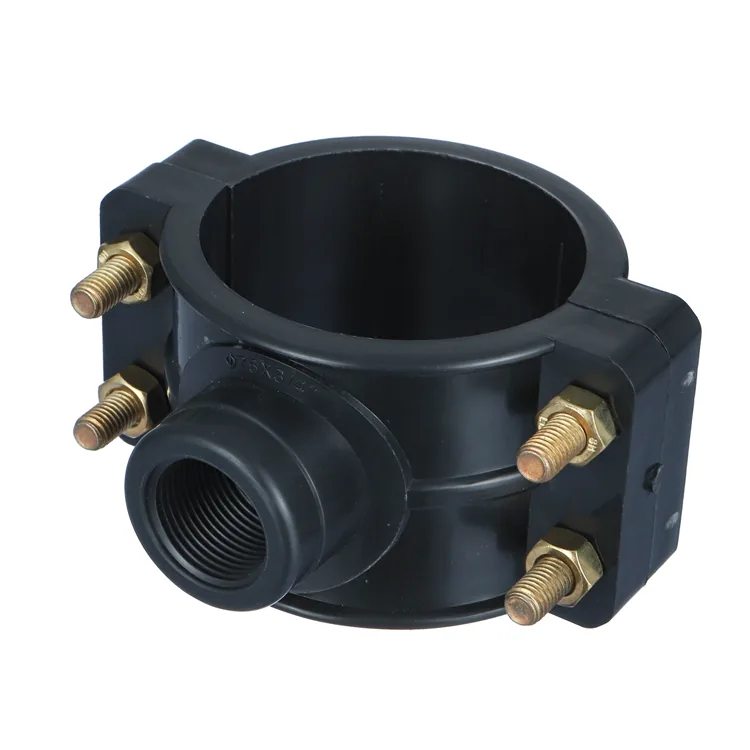
Branching a service off an existing HDPE main is the third transition, and the one where shutting the line down is usually not an option. A saddle clamp wraps the main and provides a threaded outlet, so the branch is taken without cutting the pipe. Bekaatherm supplies single and double saddle clamps, all PN10, from 25×1/2″ up to 315×6″, with a BSP female outlet — catalogue bands BK-542–605 for single and BK-606–669 for double.
The single clamp is the everyday service take-off. The double clamp adds a second body half for a fuller wrap around the pipe, which matters on larger diameters where the clamp is resisting more load and you want the pressure distributed rather than concentrated on one side of the main. Both bands, along with the rest of the HDPE compression fittings range, are listed by article number and size so a clamp can be matched to a main before anything is ordered.
Two site details decide whether the tap holds. First, tighten the bolts evenly in a cross pattern, the same way you would pull down a flange — running one corner fully home first cocks the saddle and the gasket never seats. Second, drill the main only after the clamp is seated and its outlet confirmed, then clear the coupon and swarf. Debris left in a live main fouls the first valve or meter downstream, which turns one job into two.
On pressure class, be careful what you read online. Marketplace listings for generic tapping saddles quote figures up to 16 bar. Bekaatherm’s saddle clamps are PN10, and PN10 is the number to work to on this range. Live tapping under pressure is also a procedure with real safety implications — the utility or asset owner’s own operating procedure governs, and it typically sets who may do it and under what conditions.
When compression stops and fusion starts
Compression is not the answer to everything, and a supplier who tells you it is has stopped being useful. There is a size boundary, and the standards themselves mark roughly where it sits. Which fusion route wins on a given run depends on diameter, site conditions and pressure class, and our HDPE pipe jointing methods comparison sets out that decision.
ISO 14236:2000 — the compression-fitting standard, now withdrawn — was written for mechanical fittings joining polyethylene pressure pipes of nominal outside diameters not greater than 160 mm, in water supply systems carrying potable water and water for general purposes at temperatures up to and including 40 °C. That 160 mm ceiling tells you what the fitting type was designed for. Bekaatherm’s compression fittings run 20–110mm, comfortably inside it, with saddle clamps extending to 315mm because a clamp on a main is a different load case from a coupler carrying full end load.
Above that band, you move to fusion or flanges. Butt fusion and electrofusion produce a monolithic joint in the pipe wall itself, which is what a large transmission main wants. The trade-off is real: fusion needs power, trained operators, calibrated equipment, clean and dry conditions, and time. Compression needs a wrench.
| Method | Site needs | Best use | Reversible? |
|---|---|---|---|
| Compression | Wrench only, any weather | 20–110mm services, irrigation, repairs | Yes |
| Threaded transition | Wrench, correct thread form | HDPE to metal, valves, PPR risers | Yes |
| Saddle clamp | Wrench, drill, clean main | Branch off a main without cutting | Yes, but the main stays drilled |
| Butt / electrofusion | Power, trained operator, dry conditions | Large mains, permanent buried runs | No |
If your project is a rural supply extension, a farm irrigation network or a housing scheme with services to 110mm, compression wins on total installed cost — not because the fittings are cheaper, but because the crew, the equipment hire and the weather risk all disappear from the programme. If your project is a 315mm transmission main, buy fusion and do not argue with it.
Which standard goes on the submittal
This is where the recent changes bite. Two of the numbers most commonly written on plastic pipe submittals are superseded, and an engineer who spots it will bounce the package.
EN 12201-3:2024, covering PE fittings for water supply and for drains and sewers under pressure, was published on 30 January 2024 and replaces EN 12201-3:2011+A1:2012. The BSI adoption is dated 31 March 2024, with a corrigendum in December 2024, and Parts 1, 2 and 4 were reissued in 2024 as well. It covers electrofusion socket and saddle fittings, spigot end fittings, socket fusion fittings, mechanical fittings and fabricated fittings, with maximum allowable operating pressure up to 25 bar at a reference temperature of 20 °C.
On the ISO side, ISO 4427-3:2019 covers PE fittings and applies to fusion fittings, mechanical fittings — compression fittings and flanged fittings are named explicitly — and fabricated fittings, also to 25 bar at 20 °C. A revision project for that part is open, so it is worth re-checking before a long-dated specification is frozen.
And ISO 14236:2000 is withdrawn, superseded by ISO 17885. If your fitting datasheet still cites only ISO 14236, that is not automatically a quality problem — the fittings did not change the day the standard was reclassified — but it is a documentation problem, and on a tendered municipal job documentation problems are what lose the tender.
| Joint / component | Current standard to cite | Watch out for |
|---|---|---|
| HDPE pipe | ISO 4427; EN 12201 (2024 series); DIN 8074 / 8075 | 2011+A1:2012 EN parts are superseded |
| PE fittings generally | EN 12201-3:2024; ISO 4427-3:2019 | ISO 4427-3 revision project is open |
| Mechanical & metal transitions | ISO 17885:2021 | Excludes flanges and in-building hot/cold water |
| Compression fittings (legacy) | ISO 14236 — withdrawn, see ISO 17885 | Datasheets still citing it alone look dated |
| PPR side of the transition | ISO 15874-1, -2, -3, -5; DIN 8077 / 8078 | This is the indoor rulebook, not ISO 17885 |
Approval requirements vary by market, by asset owner and by the role you hold on the contract, so treat this table as the starting point for a submittal rather than a compliance ruling. Where a water authority is involved, confirm the current accepted standard list with that authority before the package goes in.
How we check a transition before it ships
When a buyer sends a drawing with transitions on it, the order does not go straight to production. The checks below are the ones that catch mismatches while they are still cheap to fix.
- Thread form and gender, written out: not “1/2 inch” but male or female, and which form. A drawing that says only “1/2″ BSP” is the drawing that produces a parallel male against a parallel female with nothing to seal on.
- Pipe OD against fitting size: compression fittings are sized to the pipe outside diameter in mm. Where a job mixes an inch-sized existing line with metric HDPE, the transition size gets confirmed against the actual measured OD, not the nominal label on the old pipe.
- Pressure class against the application: the compression range is PN10 throughout. If the drawing calls for a higher class on that leg, we say so before quoting rather than shipping something that will be rejected on site.
- Indoor or outdoor, on every transition: because it decides whether the joint sits under ISO 17885 or on the ISO 15874 side, and sometimes it changes the product.
- Certificate scope against destination: our certification set is SKZ (Germany), ISO, CE and WRAS. Which documents a given market wants is confirmed per order, not assumed.
- Origin confirmed in writing: we supply from Türkiye and from a partner plant, allocated by market. The origin for your specific order is stated on the proforma invoice, and the certificate of origin, packing list and bill of lading are kept consistent with each other.
On the product itself: the compression range is backed by a 50-year warranty against material and manufacturing defects, matched to the 50-year design life at rated pressure and 20 °C under ISO 15874. Warranty on a buried fitting is worth exactly as much as the documentation trail behind it, which is why the paperwork checks above sit alongside the technical ones.
A worked example: farm borehole to a building riser
Take a common job end to end. A borehole pump house feeds a 63mm HDPE buried main across a property to a packhouse, where the water rises into a PPR system inside the building, and a 32mm irrigation lateral branches off the main halfway along. Three transitions, three different answers.
At the pump house, the steel discharge manifold meets the HDPE. A male threaded compression transition takes the 63mm HDPE on one side and the metal thread on the other. Thread forms get confirmed both sides before anyone buys, and the transition is anchored — pump discharge is the worst place on the job for vibration and end load, and an unanchored plastic-to-metal joint on a pump skid is a maintenance visit waiting to happen.
Halfway along the main, the irrigation lateral is taken off with a PN10 saddle clamp rather than cutting the 63mm line and inserting a tee. Cutting means shutting the packhouse down; the saddle does not. Bolts pulled down in a cross pattern, main drilled after the clamp is seated, coupon retrieved.
At the packhouse wall, the changeover to PPR happens outside the building in a valve box, not inside the wall. A female compression transition on the HDPE, a fused PPR threaded fitting with a brass insert on the other side, cooled fully before it is threaded up. PPR then runs inward under ISO 15874 and the mechanical joint stays where a person can reach it. If the indoor side is your scope too, the PPR pipe system comes from the same factory on the same documentation package.
Total fusion equipment required for the outdoor half: none. That is the point of the compression system, and on a farm two hours from the nearest hire depot it is not a small point.
Conclusion
Every HDPE pipe connection that gives trouble later is usually decided at the specification stage, not on site. Getting the thread form right, keeping the transition where someone can reach it, anchoring against end load and citing the standard that is actually current will remove most of the rework from a water services package.
If you are pricing a job now, the useful next step is to match your transition points against real part numbers and size bands before you commit to a design. Our compression fittings run 20–110mm and saddle clamps to 315×6″, all PN10, with regular in-production sizes on a 15–25 day lead time.
Frequently Asked Questions
Can you connect HDPE pipe directly to PPR pipe?
Not by welding. HDPE is polyethylene and PPR is polypropylene random copolymer, and no PE or PP standard recognises a fused joint between them. Use a threaded compression transition on the HDPE side against a fused PPR threaded fitting with a brass insert.
Do I need a fusion machine to connect HDPE pipe?
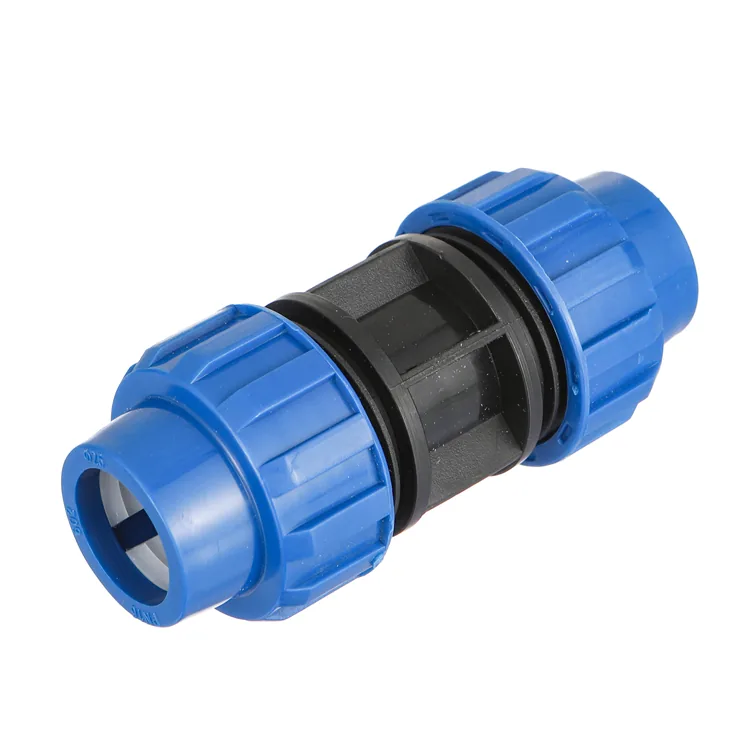
Not for mechanical compression. The joint is made by tightening a compression nut that drives a gripping ring onto the pipe wall, so no butt-fusion machine, electrofusion controller or open flame is needed on site. Fusion becomes the answer on large-diameter mains.
Which standard covers an HDPE-to-steel transition?
ISO 17885:2021 covers mechanical fittings for plastic pressure piping systems and explicitly includes transition fittings to metal pipes. It excludes flanges, so a flanged connection is not covered by it. ISO 14236:2000 is withdrawn and superseded by ISO 17885.
How do I tap into an existing HDPE main without cutting it?
Use a saddle clamp, which wraps the main and provides a threaded branch outlet. Bekaatherm supplies single and double saddle clamps, PN10, from 25×1/2″ to 315×6″. Tapping a live main is governed by the asset owner’s own operating procedure.
What is the difference between R, G and Rp threads?
R and Rp are ISO 7-1 threads where the pressure-tight joint is made on the threads themselves, normally with a sealant. G is an ISO 228-1 parallel thread where the joint is not made on the threads, so it needs a gasket or O-ring to seal.
How tight should a plastic threaded fitting be?
Manufacturer installation guidance for plastic tapered pipe threads is finger tight plus one-half to one turn with a wrench. Reduce wrench effort when a brass male enters a plastic female, and go easy on PTFE tape — excess tape packs the thread and splits female fittings.
What size range do compression fittings cover?
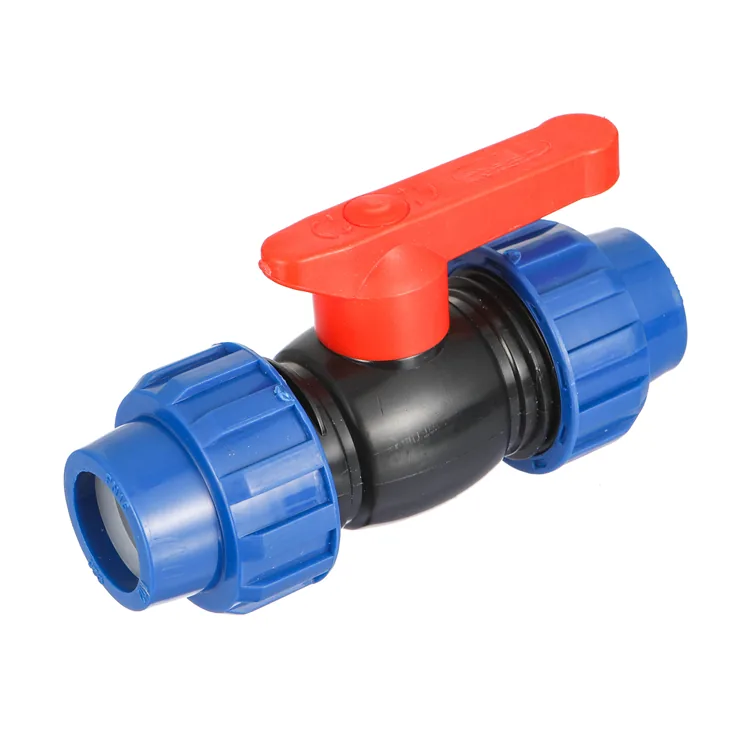
Bekaatherm compression fittings run 20–110mm across sockets, elbows, tees, caps, ball valves and threaded transitions, with saddle clamps to 315×6″. The withdrawn ISO 14236 was written for polyethylene pipes of outside diameter not greater than 160 mm.