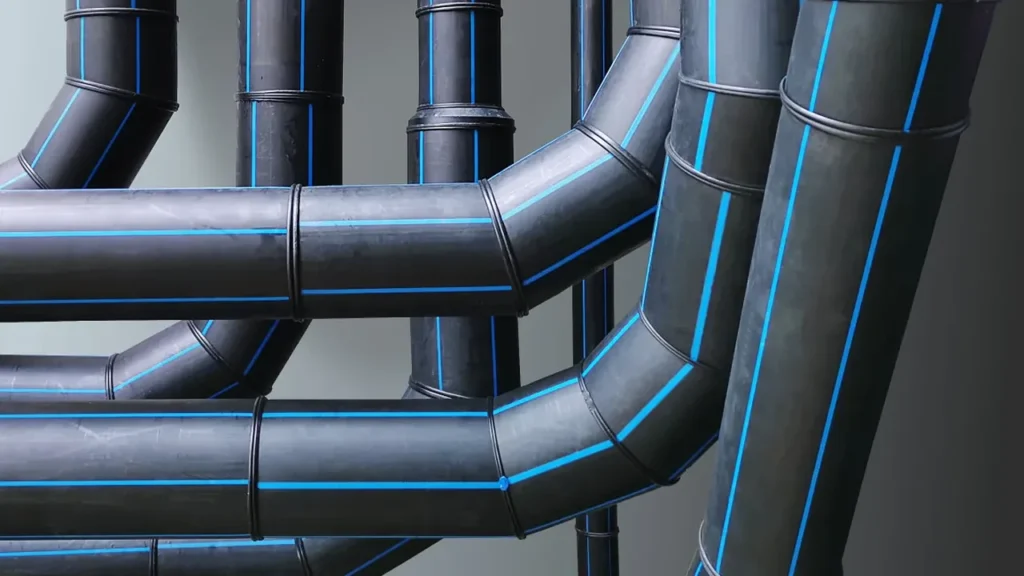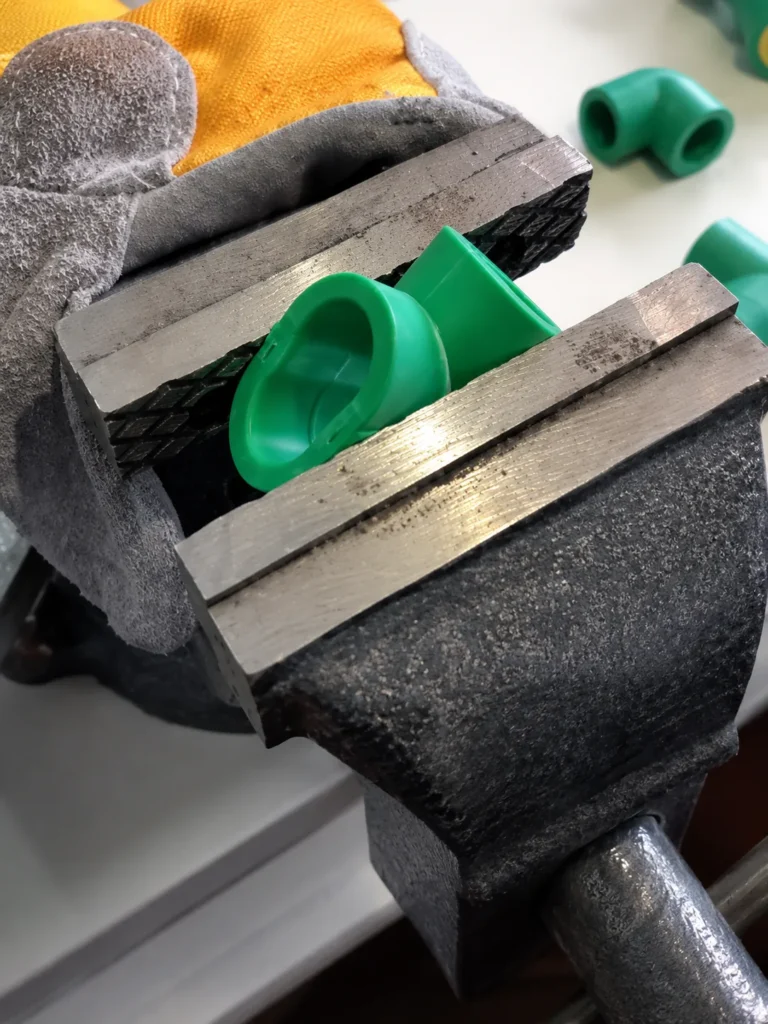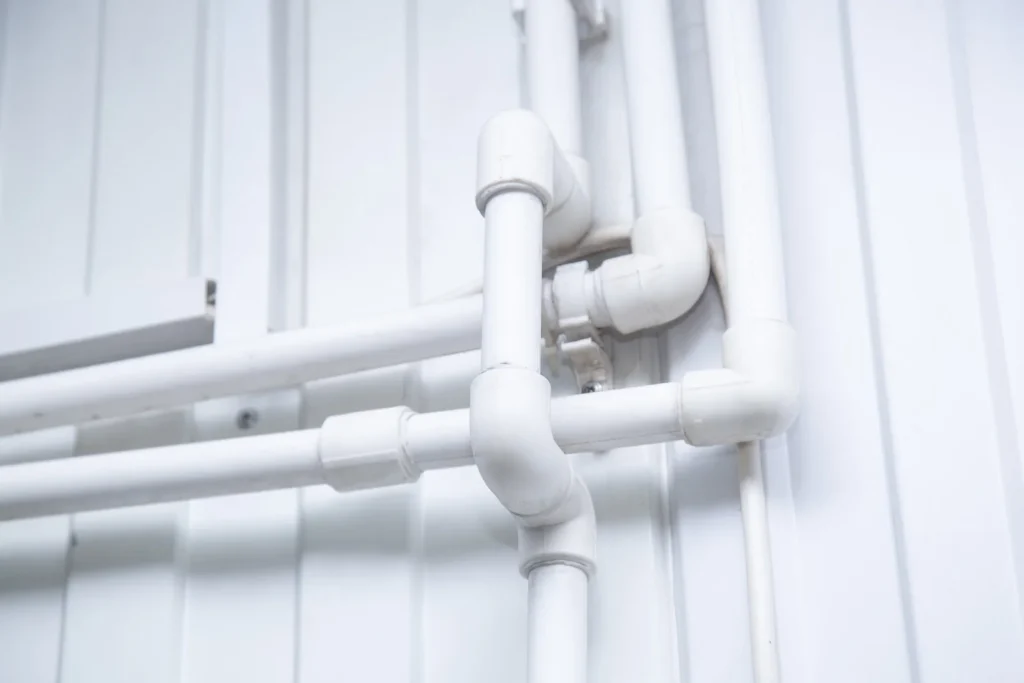
HDPE pipe jointing looks like an installation decision. The welder in the trench treats it as one. In practice the choice is made much earlier. It is made when you pick a fitting range, an equipment plan and a diameter band. That usually means it is made when you place the order.
Every HDPE pipe joint belongs to one of four families: butt fusion, electrofusion, mechanical compression and socket fusion. Two of them melt the pipe ends back into a single piece of polyethylene. The third seals with an elastomeric ring and carries its own pressure rating. The fourth is standardised for PE and almost impossible to buy. That surprises most people who search for it.
This page compares the four HDPE pipe joining methods the way an importer or specifier has to. First by diameter, pressure class, site conditions and failure signature. Then by what each choice does to the fittings you must stock, the minimum order quantities you must clear and the container you fill. That last part is where these decisions actually get made. It is also the part no welding manual covers.
Key takeaways
- Four families close an HDPE joint: butt fusion, electrofusion, compression and socket fusion. Fusion joints are monolithic — the joint performs like the pipe. Compression joints introduce a separate sealing envelope with its own pressure rating.
- Diameter sets the shortlist. Butt fusion is practical from 90 mm OD, or 63 mm in carefully controlled conditions. Electrofusion is most common to 250 mm with no technical upper limit. Our compression range runs 20–110 mm at PN10, with saddle clamps for mains tapping to 315 mm.
- ISO 21307 defines three butt fusion procedures. Single low pressure holds 0.15 MPa. Dual low pressure drops to 0.025 MPa during cooling. Single high pressure runs at 0.517 MPa. Parameters must never be mixed between procedures.
- Electrofusion fails through preparation, not through the weld itself. PIPA calls improper pipe preparation overwhelmingly the leading cause. Machine operating limits run −10 °C to 45 °C, and trenches need 150 mm of clearance around the pipe.
- Compression fittings for pressure piping now follow ISO 17885:2021. ISO 14236 was withdrawn on 25 February 2019. Catalogues that still cite it, including ours, are quoting a dead reference.
- Disclosure: Bekaatherm’s HDPE fittings range is the weld-free compression line. For butt fusion or electrofusion designs we supply the pipe to ISO 4427 and EN 12201. The fusion fittings come from the project’s fusion-fittings supplier. The criteria below are written neutral regardless.
Four Ways to Close an HDPE Joint
The four methods split into two worlds. Butt fusion and electrofusion are fusion processes. They heat polyethylene until it melts, bring the molten faces together, and let them re-form as one piece of material. A correctly made fusion joint performs like the pipe itself. On a butt fusion joint that means full resistance to end loads, so no thrust blocks are needed at bends, tees or closed valves.
Compression fittings work on a different principle. A threaded gland compresses an elastomeric sealing ring onto the pipe outer surface. A gripping ring takes the end load. The joint is a separate pressure envelope with its own rating, its own standard and its own failure modes. That distinction — monolithic joint versus separate envelope — is the first filter every selection decision passes through.
All four families now live inside one European standard. EN 12201-3:2024 covers electrofusion socket and saddle fittings, spigot-end fittings, socket fusion fittings, mechanical fittings and fabricated fittings. Reference pressures run up to 25 bar at 20 °C. The standard treats these as one family of options. Your order cannot.
That is the importer’s stake in this decision. The jointing method fixes the fitting range you buy, the equipment your installer needs and the shape of the container that ships. Pick electrofusion and every coupler size becomes a stocked SKU. Pick butt fusion and you buy machine capability instead of fittings. Pick compression and the fitting count rises while the equipment list collapses to hand tools. A fifth corner exists — flanged and stub-end transitions into valves and steel. It has its own dedicated page, so this article gives it one sentence and moves on.
HDPE Pipe Jointing Methods at a Glance
Most searches in this family land on one question — butt fusion vs electrofusion — but the comparison only works when all four methods sit in the same frame. Read the table in one order. Diameter band first, then site conditions, then pressure class. Diameter eliminates methods before the other two inputs even get a vote.
| Method | Practical diameter band | Joint nature | Equipment | Skill sensitivity | Failure signature | Verdict |
|---|---|---|---|---|---|---|
| Butt fusion | 90 mm and up; 63 mm under controlled conditions | Monolithic; end-load resistant | Butt welding machine, planer, power supply | High — parameters, alignment, records | Grade or wall mismatch; contaminated faces | Default for mains above the floor |
| Electrofusion | Common to 250 mm; no technical upper limit | Monolithic | Control box, mechanical peeler, re-rounding clamps | High — preparation discipline | Insufficient pipe preparation | Repairs, tie-ins, tight trenches |
| Compression | 20–110 mm in our range; couplings on the market to 12 in IPS | Separate sealing envelope | Hand tools only | Low — assembly care still matters | Pull-out where restraint is incomplete | Weld-free small-bore programmes |
| Socket fusion | Standardised for PE; not commonly available | Monolithic | Heated socket tool, spigot-and-socket fittings | Medium | See the PPR fault catalogue, where the method is routine | Do not specify for PE supply |
The verdicts are deliberate, not diplomatic. Butt fusion earns the mains because a pipe-to-pipe joint consumes no fitting at all. Electrofusion earns the repair and tie-in market because a coupler can be lowered into a narrow excavation where a butt machine cannot swing. Compression earns small-bore programmes because it removes welding equipment from the bill entirely. Socket fusion earns a warning, and it gets its own section below.
Butt Fusion Is the Default for Mains
Butt fusion joins two square-cut pipe ends with heat and force. The sequence is fixed. Clean the pipe with lint-free wipes and at least 99% isopropyl alcohol — 70% wipes leave moisture and are not acceptable. Clamp both ends. Plane the oxidised surface off. Check alignment. Heat-soak both faces against an electrically heated plate held at the temperature the procedure standard sets. Then forge the faces together under pressure and let the joint cool undisturbed. The heat soak time depends on diameter and wall thickness, not on habit.
The method has a diameter floor. The PE100+ Association’s guidance puts butt fusion at pipes and fittings of 90 mm OD and larger. Some technical specifications allow it down to 63 mm in carefully controlled conditions. Below that floor the geometry stops cooperating. Smaller diameters are normally fusion welded using electrofusion instead.
The pressure regime is where butt fusion got its discipline. ISO 21307:2017, amended in 2020, defines three procedures. PIPA’s March 2025 guideline spells out the three pressure sets.
| Procedure | Fusion pressure | Cooling pressure | Where it is used |
|---|---|---|---|
| Single low pressure (SLP) | 0.15 MPa | 0.15 MPa held | General practice |
| Dual low pressure (DLP) | 0.15 MPa | Reduced to 0.025 MPa | Primarily UK water industry, wall thickness above 22 mm |
| Single high pressure (SHP) | 0.517 MPa | Held | Extrudes more molten material; allows reduced cooling time |
Parameters must not be mixed between procedures. An SLP heat soak with an SHP forge is not a fourth option. It is a defect recipe. Before production welding starts, the procedure is prequalified with a pilot weld on the actual project pipe. That applies to each machine, diameter and wall combination. Qualification welds are tested to ISO 13953. On production runs every weld gets a number and a record — operator, equipment, pipe DN and SDR, and the actual parameters applied.
Two matching rules decide whether a butt joint is even allowed. Pipes and fittings must be the same diameter, the same wall thickness and the same material type — PE80 to PE80, PE100 to PE100. Where wall thickness varies, use electrofusion, a mechanical fitting, or consult the manufacturer. Skip that rule and the failure signature writes itself. Mismatched walls and contaminated faces are how butt joints fail. The detailed mechanics of each sit in our dedicated comparison of the three PE methods, rather than being re-derived here.
The prize for doing it right is structural. A correct butt fusion joint is fully resistant to end loads, so bends, tees and closed valves need no thrust blocks. The joint performs under pressure like the pipe itself — effectively one continuous pipe. The method is equally at home on coiled and straight lengths. It can also fabricate bends and tees, though that fabrication belongs in a workshop with a fabrication table, not in a trench.
Order consequence. Butt fusion consumes zero fittings on pipe-to-pipe joints. The cost moves from the fittings line to a welding machine, a power supply and a trained crew per gang. PIPA recommends welder reaccreditation every two to three years. A butt-fusion-heavy design keeps your fittings bill light and your equipment bill heavy. That shape repeats in the container, as the order section below shows.
Electrofusion for Repairs, Tie-Ins and Tight Trenches
An electrofusion fitting carries its own heating element: a resistive coil embedded in a coupler, saddle or repair fitting. The pipe ends are prepared, inserted, clamped, and a control box drives current through the coil until the interface melts and fuses. The fitting forms come straight from the PE100+ list — straight couplings, bends, tees, stop ends, reducers, saddle fittings and repair fittings. That is exactly the shape of a repair and tie-in catalogue.
Its home territory is the work butt machines do badly. Think of repairing a burst main, tying a new branch into an existing PE network, or adding services through saddle fittings and tees. Think of excavations too narrow for a butt machine’s clamps to swing. The flexibility runs deeper. Electrofusion can join different nominal diameters and different SDRs with suitable fittings. It can join PE80 to PE100, with the system pressure rating dropping to that of the lowest-rated component in the line.
The discipline is preparation, and this is where the method’s reputation comes from. The oxidation layer must come off by mechanical peeling — hand scrapers are excluded. The ends must be cleaned. Pipe ends entering the socket must be circular within the fitting manufacturer’s tolerances, re-rounded with clamps that stay in place through welding and cooling. PIPA’s position, citing PPI’s guidance, is blunt. Improper pipe preparation is overwhelmingly the leading cause of unsuccessful electrofusion joints. The full parameter set — peel depths, ovality limits, cooling discipline — is documented in our failure-modes comparison, and that page owns the detail.
The site envelope is specific. Electrofusion welding machines operate between −10 °C and 45 °C. Black pipe in direct sunlight can reach 70 °C at the surface and must be shaded back below the limit. In trenches, a minimum clearance of 150 mm around the pipe is required. Power must hold 230 V within ±15% under load, and extension cables must not exceed 50 m, fully unrolled. Cooling must never be shortened with water. An interrupted weld can need up to 24 hours of cooling before it can be handled.
One job electrofusion should not take is trenchless work. The fittings protrude significantly above the pipe surface, which fouls sliplining, pipe bursting and directional drilling pulls. Butt fusion’s low profile and removable external bead suit those installations, and the PE100+ guidance says so explicitly.
Order consequence. Every coupler size, every saddle type, every reducer is a separate SKU. Each one is bound to the same single-specification minimum as everything else you buy. That is the 500 kg per size and colour figure that decides whether an electrofusion-heavy bill is stockable at all. That arithmetic gets its own section below.
Compression Fittings for Small Bores and Fast Programmes
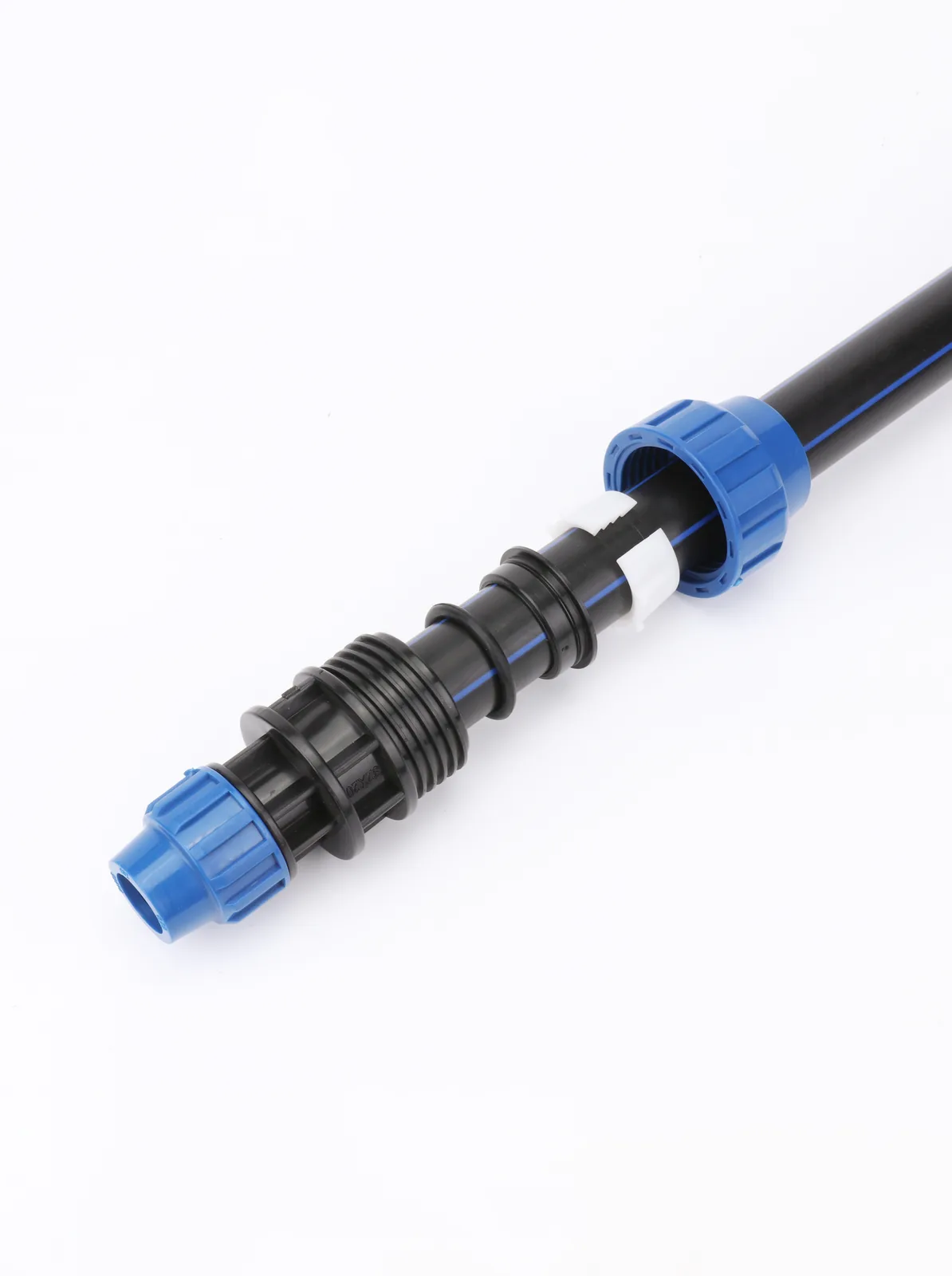
A compression fitting closes the joint with mechanics instead of heat. Tightening the gland compresses an elastomeric sealing ring onto the pipe’s outer surface. A gripping ring resists the end load. The joint holds its own pressure envelope, independent of the pipe wall. No power, no hot work, no cooling time — and the joint is demountable, which no fusion joint ever is. Assembly care still decides the outcome: correct torque, full insertion, and a clean cut face are what keep the seal honest.
The envelope in our range runs as follows. Compression fittings from 20 to 110 mm at PN10 with blue PP bodies. Compression valves. Saddle clamps for tapping mains up to 315 mm. Threaded transitions into other materials. Wider markets push the principle further. Compression couplings are commercially available for OD-controlled pipe through 12 inch IPS. Above roughly 4 inch IPS the joints may not be fully restrained, so large-diameter compression designs need a restraint check before they need a price.
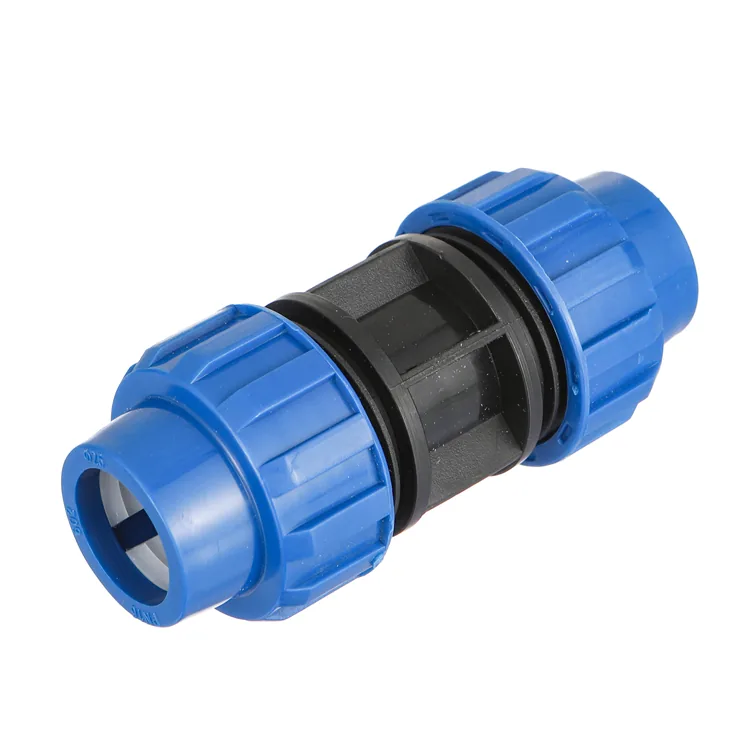
The governing standard changed, and much of the industry has not caught up. Compression and mechanical fittings for pressure piping are specified under ISO 17885:2021. Its application codes cover gas, water for human consumption, pressurised sewerage, irrigation and industrial use. It excludes flanges, in-building hot and cold water, and district heating. The old reference, ISO 14236, was withdrawn on 25 February 2019. Catalogues that still cite it — ours included, until we fix the line — are quoting a dead standard. A tender evaluation that checks references will spot it.
The failure signature is pull-out, and it has a known accomplice: stiffeners. Larger mechanical fittings can include a stiffener inside the pipe or fitting to keep the assembly stable under compression. At small diameters a stiffener is generally not required. Where restraint depends on compressing the pipe wall between an outer sleeve and an inner stiffener, omitting the stiffener hands the joint to its failure mode. The deeper mechanics live with the sibling comparison page. Here the signature is the selection input.
The PE100+ Association places mechanical assembly precisely. It is used where neither fusion method is suitable. Think PE connections to other pipe materials or valves, repairs in wet and dirty excavation bottoms, and remote areas with no power supply or trained operators. One caution travels with it. Gas networks often restrict mechanical fittings, preferring fusion to minimise leakage, while water networks use them freely. Design for the network you actually have. Transitioning from PE into steel, brass or a valve body is a separate skill, and threaded transitions and flange adapters are the hardware that does it.
Order consequence. Compression demands a fitting for every connection, so the fitting count rises with every joint. But the equipment list collapses to hand tools, and commissioning does not wait on cooling or cure. For rural water and irrigation programmes that is the trade in one sentence. More fittings per container, zero machines per crew.
Comparing the weld-free option against the fusion routes?
The Bekaatherm HDPE fittings range is listed by article number. It covers compression fittings 20–110 mm PN10, compression valves, saddle clamps to 315 mm and threaded transitions. Alongside sits the HDPE pipe to ISO 4427 and EN 12201 that every jointing method in this article runs on.
Socket Fusion Is Standardised but Rarely Stocked
Socket fusion is the fourth word in the family, and it deserves an honest answer rather than a catalogue section. The process uses a heated socket tool. The pipe end and a spigot-and-socket fitting are heated on matching tool faces and pushed together. It is the same principle that PPR installers use every day. For polyethylene, the method is genuinely standardised. EN 12201-3:2024 lists socket fusion fittings among the fitting families it covers, and ISO 8085-2 covers spigot fittings for socket fusion using heated tools.
The standardisation does not translate into supply. The PE100+ Association’s assembly guidance is explicit. Other techniques are available — socket fusion and induction fusion — but they are not commonly available, and the guidance does not consider them further. Read that as the industry reading it. If you write socket fusion fittings into a PE specification, you may spend the tender period discovering nobody stocks them.
So where does a buyer searching for HDPE socket fusion fittings land? At small bores, electrofusion couplers give you the fused monolithic joint with a stocked supply chain. Compression gives you the weld-free route with no heating tool at all. Socket fusion as a daily practice lives in PPR systems, not PE, and the socket fusion fault catalogue covers that territory properly. For PE, the boundary is the finding.
The Three Inputs That Actually Decide
Diameter sets the shortlist
Below 90 mm, butt fusion is off the table in normal conditions. The choice is electrofusion versus compression. Between 90 and 250 mm all three viable methods compete, and site conditions break the tie. Above 250 mm, butt fusion owns the work. Electrofusion remains technically possible — the Association is clear there is no upper limit — but fitting cost climbs with diameter, and a mains budget notices.
Pressure class and the weakest component
The pipe’s pressure class comes from its SDR and material grade. Fusion joints inherit it, so a correctly fused joint performs like the pipe around it. Mechanical joints do not inherit anything. They carry their own envelope, which is why our compression range states PN10 across 20–110 mm rather than echoing the pipe’s rating. Electrofusion across mixed components follows the lowest-rated piece. Join PE80 to PE100, or mix SDR classes, and the system pressure becomes the weakest link’s. The SDR and PN arithmetic behind this has a dedicated reference page.
Site conditions decide the rest
- Trench width. Electrofusion needs 150 mm of clearance around the pipe. A butt machine needs clamp swing room on both sides of the joint. A narrow urban trench can decide the method before the specification does.
- Weather. Electrofusion machines stop outside −10 °C to 45 °C, and sun-exposed black pipe must be shaded back under the limit. Butt fusion wants the weld site sheltered from sun and wind. Pipe ends should be blocked against air flow through the bore, because an uneven pipe temperature is a weld defect waiting to happen.
- Power. Electrofusion needs a stable 230 V ±15% supply and cables under 50 m, fully unrolled. No grid, no generator, no electrofusion — which is exactly when compression earns its keep.
- Future access. A joint that may need to open again — a building service connection, a farm take-off — argues for the only demountable option in this article.
- Live tapping. Adding a branch to a pressurised main is saddle territory. Electrofusion saddles give a fused tap; compression saddle clamps give a weld-free one.
What Your Jointing Choice Does to the Order
This is the section a welding manual will never write, and it is where an importer actually wins or loses the decision. Every method reshapes three things: the SKU count, the lead time exposure and the container mix. The numbers below are our published terms, stated plainly so they can be checked against anyone else’s quotation.
SKU count and the MOQ trap. Our single-specification minimum is 500 kg per size and colour. A butt fusion design keeps the fittings line thin — the pipe joints itself — so the MOQ bites on pipe sizes only. A compression design adds a fitting at every connection, but the range is bounded: 20–110 mm fittings, valves, saddles and transitions, a countable set. An electrofusion-heavy design is the one that multiplies. Every coupler diameter, every saddle type, every reducer is its own specification. Each must clear the 500 kg figure or arrive as a non-stock item. That is the hidden cost of an EF-heavy bill, and it appears in the order long before it appears in the trench.
Lead time exposure. Regular in-production specifications run 15–25 days. OEM and private-label runs run 30–45 days, with 7–10 days added for a first colour match or mould. Method choice moves your exposure. A design built on stock-band pipe sizes and a bounded fitting range stays inside the 15–25 day band. A design that forces non-stock fusion fittings joins a production queue you did not plan for.
Container arithmetic. A 20GP gives roughly 33 m³ of usable space against a payload of about 28 tonnes. A typical mixed load runs about 60% pipe, 30% fittings and 10% valves by volume. Pipe stacks; fittings carry air. A butt-fusion-heavy bill loads pipe-heavy and fills cleanly. An electrofusion bill pushes the fittings share and the void space with it. That is how a container can run out of room while still under weight.
Disclosure, stated once and plainly. Bekaatherm‘s HDPE fittings range is the weld-free compression line: fittings 20–110 mm PN10, compression valves, saddle clamps to 315 mm and threaded transitions. We do not supply electrofusion couplers or butt fusion spigot fittings. For a butt or electrofusion design we supply the pipe — to ISO 4427 and EN 12201 — and the fusion fittings come from the project’s fusion-fittings supplier. The criteria table above recommends methods we do not sell fittings for, on purpose. A comparison that only endorses its own shelf is advertising, not selection guidance.
The trial path. One 20GP mixed container can carry pipe, fittings and valves together. That means a first order can test the whole jointing system rather than one product. Terms are the published set. 30% T/T deposit with 70% against the copy B/L. Irrevocable L/C at sight from USD 50,000. FOB İstanbul or Mersin by default, with CFR and CIF on request. Behind the lot stands a 50-year warranty against material and manufacturing defects.
Request a quotation for your method and size mix
Which Method Fits Which Job
The decision table names a first choice and a runner-up for the seven jobs this question arrives as, and it says what breaks when the choice is wrong. No fence-sitting. If your project sits on a boundary, the three inputs above break the tie.
| Job | First choice | Runner-up | Why — and what fails if chosen wrong |
|---|---|---|---|
| New rural water main, 110–315 mm | Butt fusion | Electrofusion at tie-in points | Long runs consume no fittings and need no thrust blocks. An electrofusion-only bill multiplies SKUs against the 500 kg per-spec minimum. |
| Irrigation lateral network, 20–110 mm | Compression | Electrofusion | Weld-free, demountable, no power per joint. Fusion adds machines and training to a low-value network. |
| Urban main replacement in a narrow trench | Electrofusion | Compression, inside its range | A coupler works within the 150 mm clearance. A butt machine cannot swing its clamps in the same trench. |
| Repair of a burst HDPE pipe | Electrofusion repair fitting | Compression coupling | Electrofusion needs a dry, prepared surface. When the pit is wet, dirty or powerless, mechanical assembly is the method designed for exactly that. |
| Tie-in to an existing PE network | Electrofusion saddle or tee | Compression saddle clamp | A fused saddle keeps the network monolithic. Choose compression where weld-free tapping is the requirement — saddles in our range run to 315 mm. |
| Service connections to buildings | Compression | Electrofusion | Demountable joints and threaded transitions into other materials. A fused joint here is permanent where permanence is the wrong call. |
| Trenchless install — HDD, pipe bursting, sliplining | Butt fusion | None of the fitting-based methods | Low profile, external bead removable. Electrofusion fittings protrude and foul the pull. |
Which Method in One Line Each
The four methods do not compete for the same job. A buyer who remembers one line per method will out-specify a buyer who remembers a price list.
- Butt fusion is the mains default above 90 mm. The pipe becomes the fitting, the joint resists end loads, and the cost shows up as a machine and a trained crew rather than as SKUs.
- Electrofusion is the repair, tie-in and tight-trench specialist. Maximum flexibility across diameters, grades and SDRs is paid for in preparation discipline and in coupler SKUs bound to the 500 kg per-spec minimum.
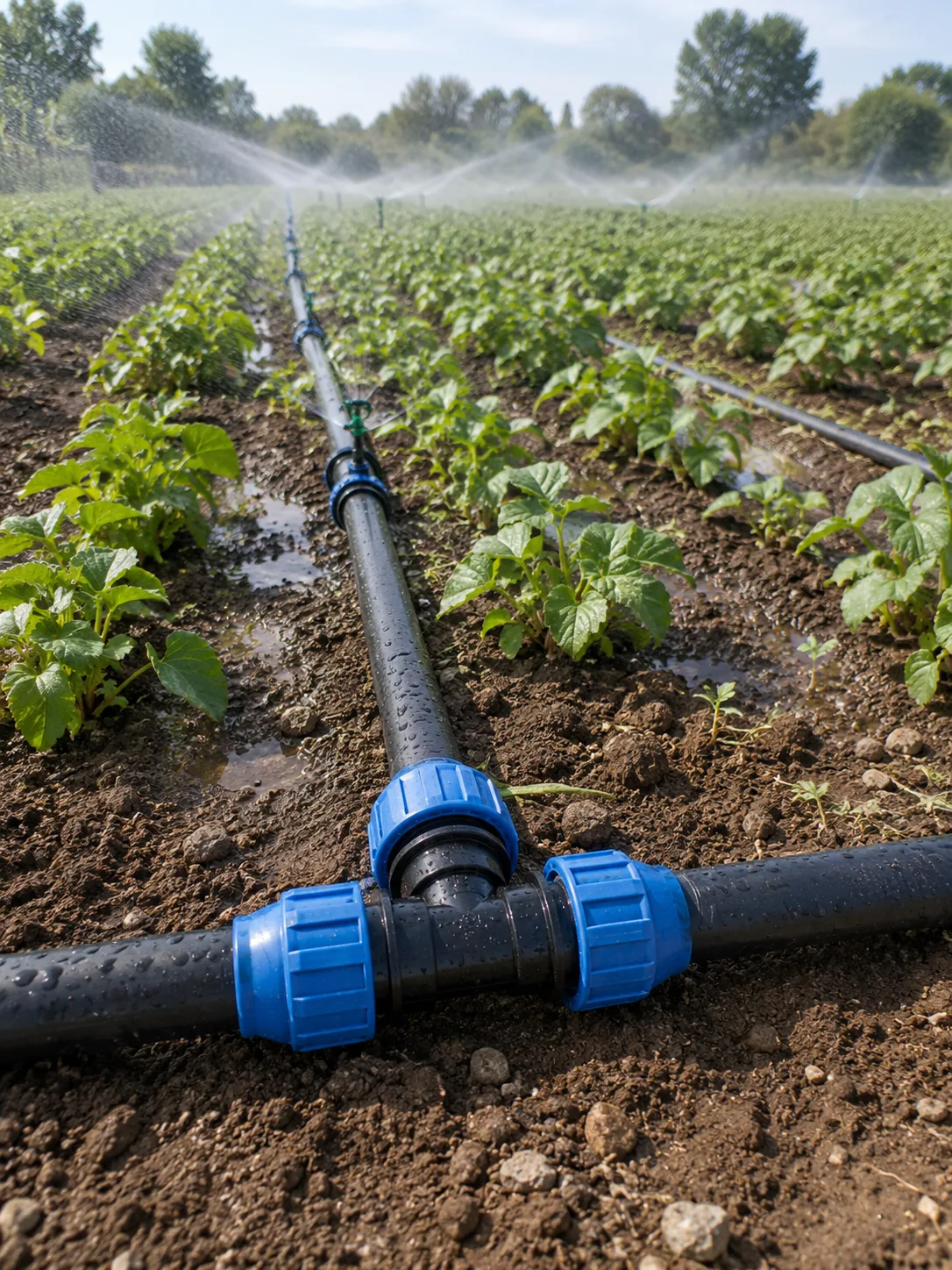
- Compression is the weld-free small-bore workhorse. A fitting at every connection, zero welding equipment, its own PN10 envelope, and the only demountable joint in the family.
- Socket fusion is the honest footnote. It is standardised for PE in EN 12201-3:2024 and ISO 8085-2 but not commonly available. Specify electrofusion or compression at small bores instead.
Then run the decision through the order, not the brochure. Diameter band first, site conditions second, pressure class third. Whatever survives those three filters, check against the SKU count, the 15–25 day lead-time band and the 60/30/10 container mix before you sign. For container-scale requirements that want the mix and terms in writing before shortlisting, the importer and distributor supply programme sets out how that first container is agreed.
Frequently Asked Questions
Which is the best method for joining HDPE pipe?
There is no single best — diameter, pressure class and site conditions decide. Butt fusion is the default for mains from 90 mm up. Electrofusion takes repairs, tie-ins and tight trenches, with no technical upper diameter limit. Compression covers small-bore weld-free work. The comparison table above is the short version of the argument.
What is the difference between butt fusion and electrofusion?
Both are fusion processes producing monolithic joints, but the heat source differs. Butt fusion heats both pipe faces against an external heated plate and forges them together. Electrofusion melts the interface with a coil embedded in the fitting. Butt fusion works from 90 mm up and consumes no fitting. Electrofusion fits tight spaces and mixed diameters and grades, at the cost of a fitting SKU per joint.
Can you use compression fittings on HDPE pipe?
Yes. Our range runs 20–110 mm at PN10, with saddle clamps for mains tapping to 315 mm and threaded transitions. Compression couplings exist on the market up to 12 inch IPS, though joints above roughly 4 inch IPS may not be fully restrained. The governing standard is ISO 17885:2021 — ISO 14236 was withdrawn in February 2019.
What is socket fusion, and does it apply to HDPE?
Socket fusion joins pipe to spigot-and-socket fittings with a heated socket tool. It is standardised for PE — EN 12201-3:2024 and ISO 8085-2 both cover it. But the PE100+ Association states plainly that it is not commonly available, and its guidance does not consider it further. For small-bore PE work, specify electrofusion couplers or compression. Socket fusion is routine in PPR systems, not PE.
Which jointing method is cheapest overall?
Nobody publishes honest unit economics, so compare the mechanism. Butt fusion removes the fitting cost and adds a machine plus a trained crew. Electrofusion moves the cost into fitting SKUs that each face the 500 kg per-spec minimum. Compression adds a fitting per connection while removing welding equipment entirely. Installed-cost detail lives in our dedicated three-method comparison.
Can HDPE pipe be joined without welding equipment?
Yes. Compression fittings assemble with hand tools — no power, no hot work, no cooling time. That is why they carry remote-area and irrigation work. Where the connection is into a valve, a pump or steel pipe, flanged and stub-end transitions are the other weld-free route. They have their own dedicated page on this site.
How does the jointing method affect my pipe order?
Three ways: SKU count, lead time and container mix. Electrofusion-heavy bills multiply fitting specifications against the 500 kg per size and colour minimum. Butt-heavy bills keep fittings thin. Compression stays inside a bounded range. In-production specs run 15–25 days. One 20GP mixed container of pipe, fittings and valves can test the whole jointing system in a single trial order.