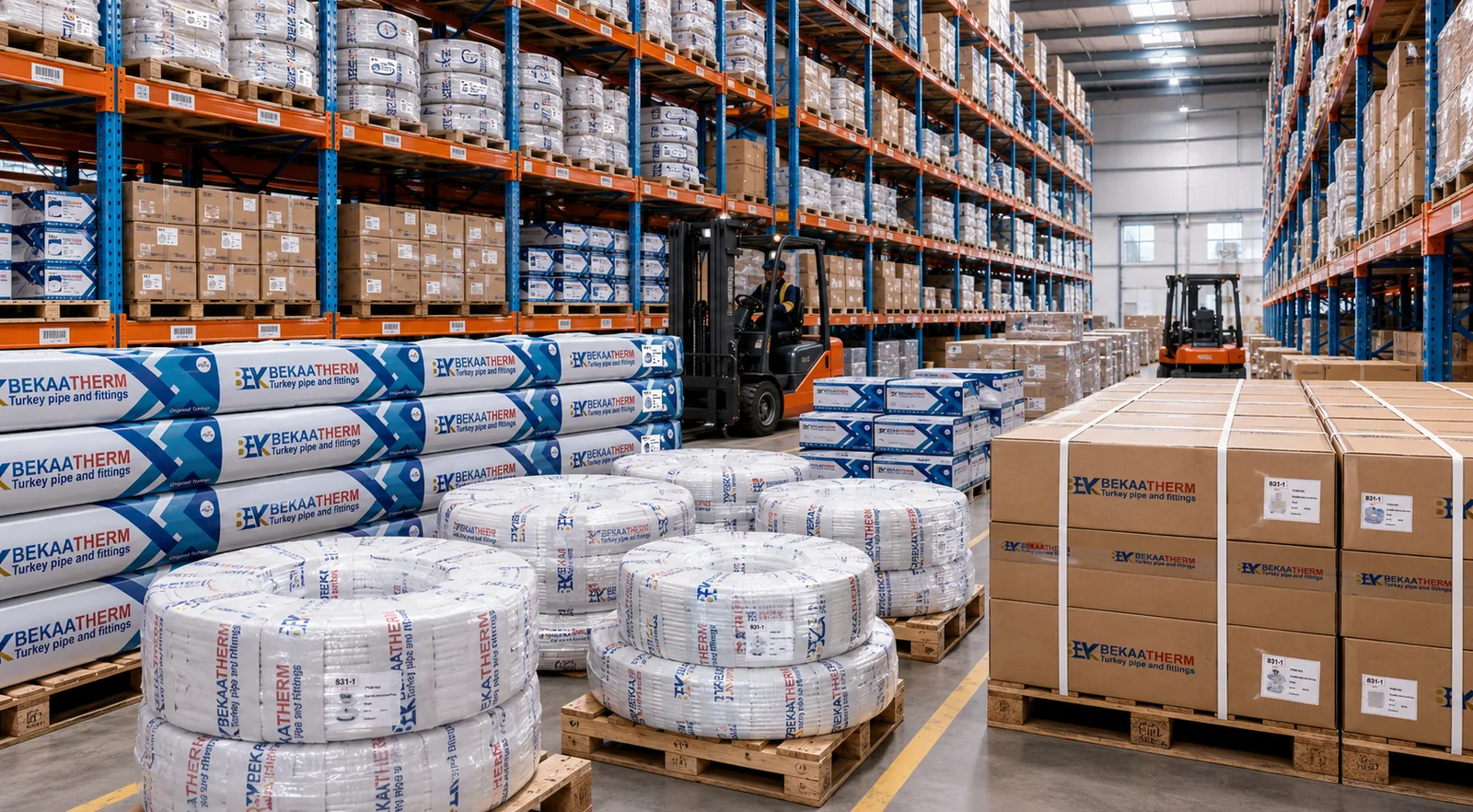
Every supplier claims virgin PPR raw material. Very few can hand you the one document that would prove it, and most buyers never ask for it by name. So the argument gets settled with folklore instead: sniff the weld fumes, look for streaks, squeeze the pipe. None of that is a rejection basis you can put in a claim letter.
There is a real rule, and it is stricter than most people in the trade realise. ISO 15874-1:2013 clause 5.3 bans externally sourced reprocessable material and recyclable material outright in PP hot and cold water pipe. Recycled PPR is not a budget grade of a legitimate product. It is a pipe that does not conform to the standard it is printed with.
Key Takeaways
- ISO 15874-1:2013 clause 5.3 states that “reprocessable material obtained from external sources and recyclable material shall not be used” — while a factory’s own reprocessable material from its own production and works testing is permitted alongside virgin material.
- The strongest lab test for reground content is the melt flow rate delta: ISO 15874-2:2013 Table 11 allows a 30 % maximum difference between the pipe and the compound from the same batch, tested at 230 °C under 2,16 kg per ISO 1133-1.
- That test only works if you demand the compound batch reference on the order. Without it there is nothing to compare the pipe against, and the standard’s most useful limit becomes unusable.
- Specify the calcination temperature when you order an ash test to ISO 3451-1. Running it at 850 °C converts calcium carbonate to its oxide and reports less filler than is really there.
- Colour variation is not a valid rejection basis. ISO 15874-2:2013 clause 5.1 explicitly permits slight variations in appearance of the colour, while banning visible impurities — so cite the impurity clause, not the colour.
- A pressure test on arrival proves almost nothing about ageing. The standard’s thermal stability test runs 8760 h at 110 °C — one full year on a single test piece.
- For EU-facing importers the stakes change on 31 December 2026, when the Article 11 drinking water measures become binding, with a transitional route running to 31 December 2032 at the latest.
The clause that settles the argument
Most articles on this topic treat recycled content as a quality preference. It is not. It is a conformity question, and the wording is short enough to quote in full.
“Reprocessable material obtained from external sources and recyclable material shall not be used. However, the use of the manufacturer’s own reprocessable material obtained during the production and works testing of products conforming to this standard is permitted in addition to the use of virgin material.” — ISO 15874-1:2013, clause 5.3
Read the second sentence carefully — it is where honest and dishonest factories both live. A manufacturer may re-melt its own offcuts, start-up purge and works-test pieces, provided those came from conforming products. What it may not do is buy reground pellets from a trader, or run washed post-consumer material, and still print ISO 15874 on the pipe.
This changes what you are arguing about. A pipe made with external regrind is not merely worse value — it carries a marking it is not entitled to. That is a documentary defect as much as a physical one, and documentary defects are far easier to win on than a subjective argument about surface finish.
A factory also cannot simply re-qualify a cheaper blend and carry on. Under ISO 15874-2:2013 clause 4.2, pipe material must be evaluated to ISO 9080 against the standard’s reference curves, using internal pressure data at 20 °C, 60–70 °C and 95 °C with at least three failure times in each of the 10–100 h, 100–1000 h and 1000–8760 h intervals, plus results beyond 8760 h. At least 97,5 % of results must sit on or above the reference line. That dataset takes years and is tied to one specific material. Change the feedstock and you have invalidated it.
There are four materials here, not two
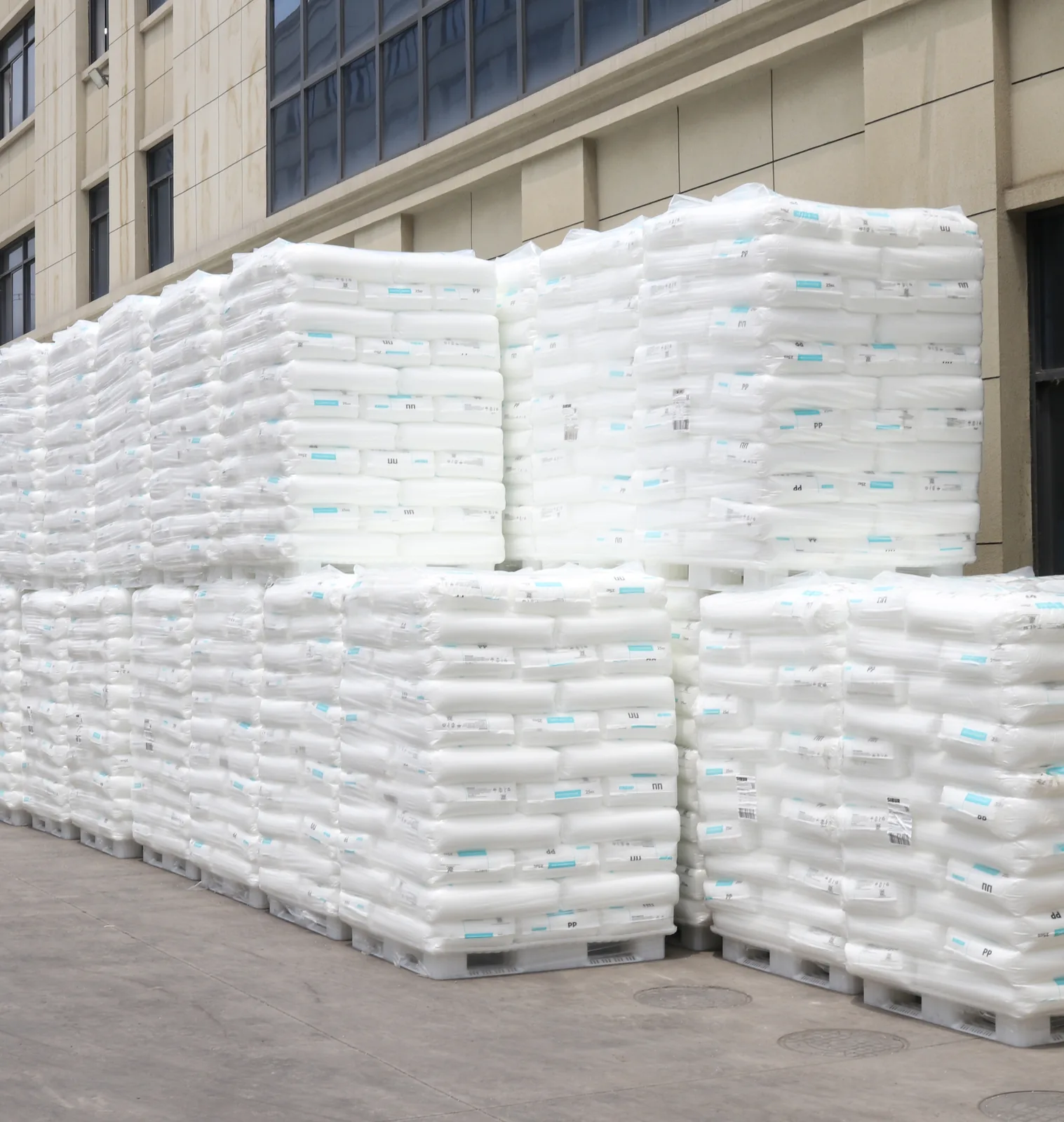
“Virgin or recycled” is the wrong question, and asking it that way is why so many purchase specifications fail to bite. The German certification body DIN CERTCO defines four separate categories in its scheme for plastic pipe system materials (2-PfG-C-0426, section 3). Once you have the vocabulary, you can write a clause that a factory cannot slide past.
| Category | What it is | Allowed in PP-R pressure pipe? |
|---|---|---|
| New material | Not yet used, not mixed with circulating, external reprocessable or recyclable material | Yes — the baseline |
| Material in circulation | Rebuffed, clean, unused pipes and fittings plus own-manufacture blend, recycled in-plant by the same manufacturer | Yes, within clause 5.3 |
| External reprocessable | From unused products made by someone else — Type A quality-marked, Type B other plastic products | No |
| Recyclable | From used products, cleaned and milled — Type A quality-marked pipes, Type B other used plastics | No |
The distinction that trips buyers up sits between rows two and three. A factory grinding its own purge and feeding it back is doing something the standard permits, so a blanket “zero regrind” clause asks a compliant manufacturer to either lie to you or scrap good material. The line to hold is ownership and origin: material from this factory’s own conforming production, or nothing.
Rows three and four are what a trader actually offers when the price looks too good, so name them explicitly in the contract. Type B recyclable — used plastic products that are not even pipe — is the bottom of that market.
What reground material actually costs you
The trade repeats an unsourced figure — impact strength drops by up to 35 % — that nobody can trace. Real controlled data exists and it tells a more useful story, including one part that cuts against the alarmist version.
A 2022 study in Polymers (DOI 10.3390/polym14235232) compounded PP with 10, 20 and 30 m% post-consumer PP packaging recyclate. Melt flow rate climbed from a virgin baseline of 0.23 g/10 min to roughly 0.60–0.75 g/10 min at 30 m% recyclate. Charpy impact strength fell from 21.6 kJ/m² at 10 m% to 17.2 kJ/m² at 30 m% for one base resin, and down to 12.6 kJ/m² at 30 m% for the other.
The damage is dose-dependent, and it lands hardest on impact — exactly the property you need at 0 °C in an unheated riser. Now the honest part: dynamic oxidation induction temperatures in that same study stayed between 267 and 274 °C, decreasing only slightly at higher recyclate content. Controlled recyclate did not collapse the antioxidant package.
So the real argument is not that recycled polymer is chemically cursed. It is that the material in a cheap container is uncontrolled. A laboratory blending characterised packaging recyclate at a known 20 m% is a different universe from a trader’s mixed regrind of unknown heat history, stabiliser package and filler load.
Fillers deserve a number of their own. A 2024 ACS Omega study (DOI 10.1021/acsomega.4c00414) analysed recycled PP samples and found 18 wt % calcium carbonate in one and none at all in a second, with calibration blends run from 10 to 50 wt %. That spread is the point: “recycled PP” is not one material with one property set, and 18 wt % chalk in a pressure pipe is a wall that is one fifth rock.
Site checks that work, and three that waste your time
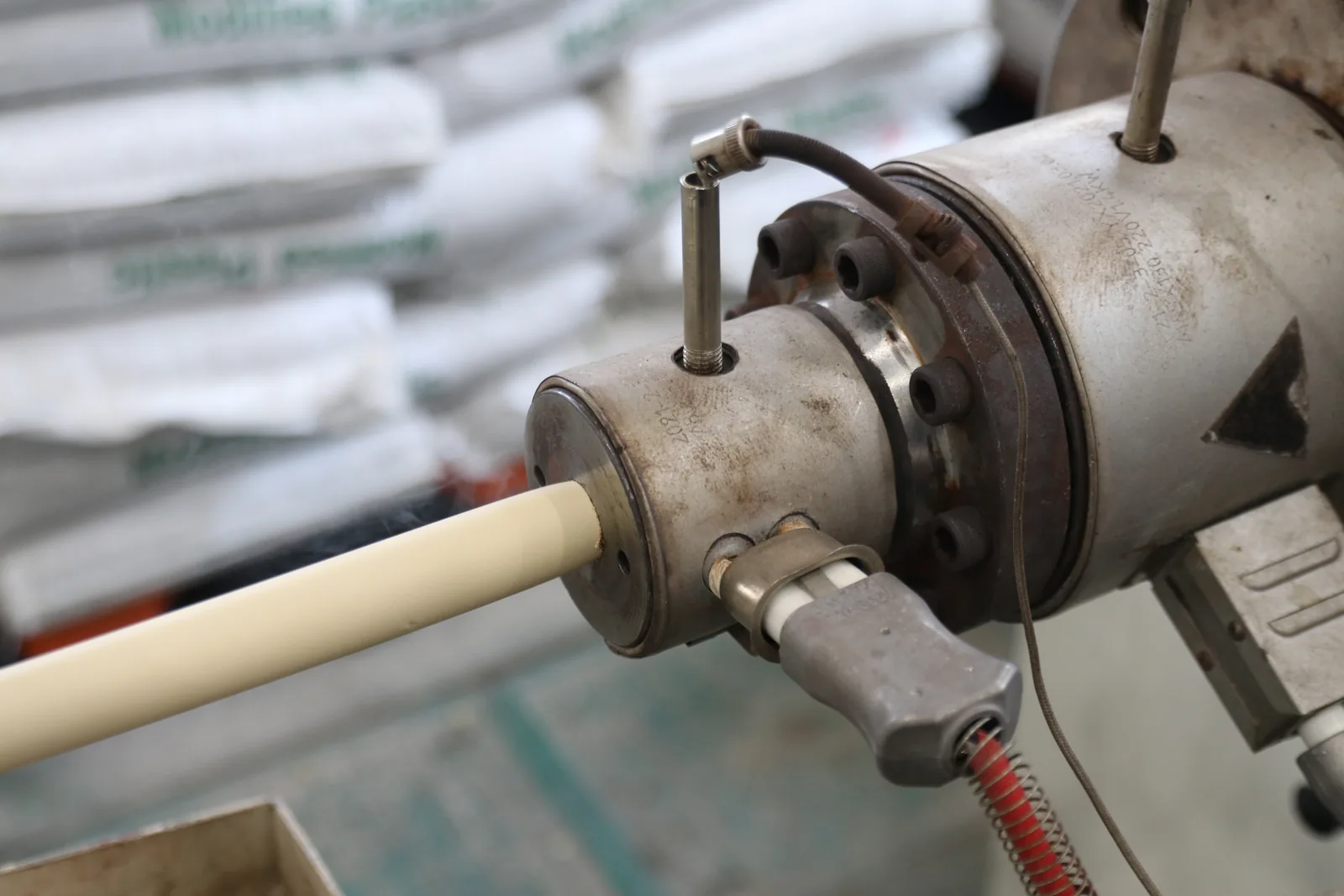
You will not settle a material dispute in a warehouse aisle. You can, though, decide fast whether a container is worth paying a laboratory to look at. Here is what earns its place and what does not.
Worth doing
- Cut and inspect the bore. ISO 15874-2:2013 clause 5.1 requires internal and external surfaces to be smooth, clean and free from scoring, cavities and other surface defects, and states the material shall not contain visible impurities. Black specks, fibres and unmelted particles are a citable finding, not an opinion.
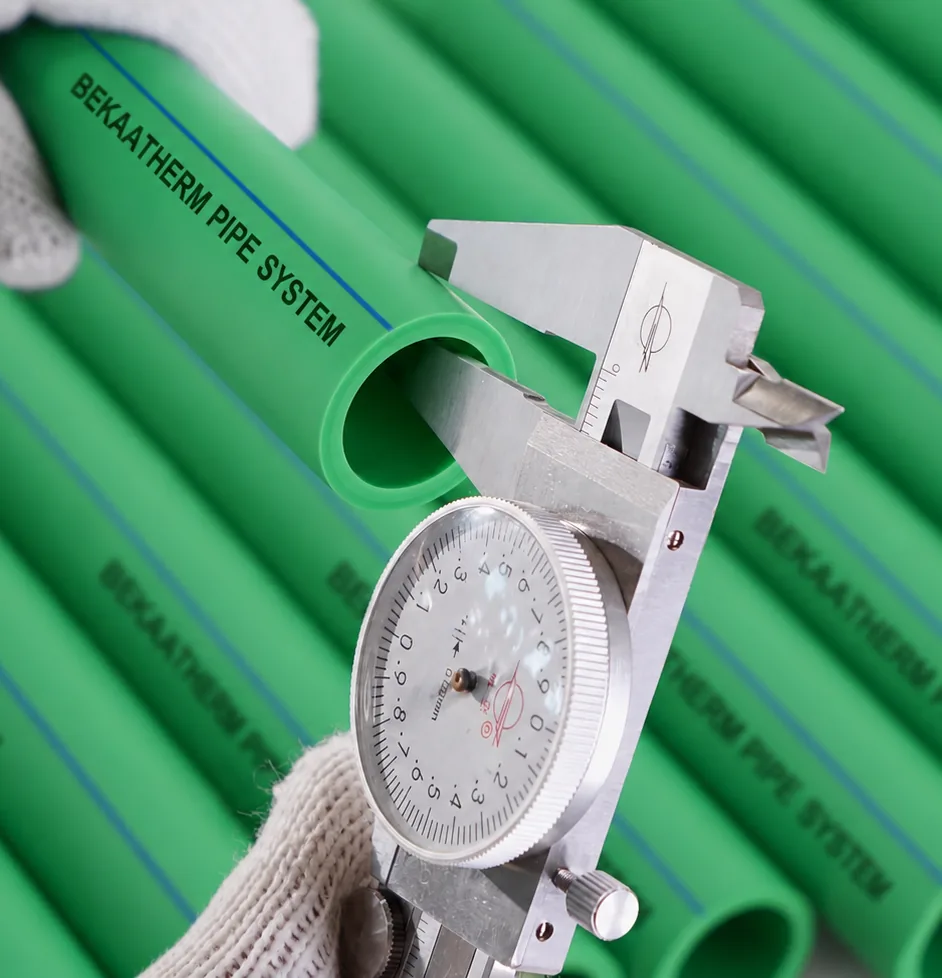
- Weigh a measured length. Cut 1 m samples, measure diameter and wall thickness with a caliper, then weigh. Calcium carbonate is far denser than polypropylene, so a filled wall comes out heavier than geometry predicts. This is directional evidence for ordering a lab test, not a pass or fail on its own.
- Check the marking against the paperwork. If the pipe is printed to ISO 15874 but nobody can produce the material certificate or the compound batch reference behind it, you already have the finding that matters.
- Retain sealed samples. Pull samples from several bundles across the load, seal and label them with bundle markings in front of the surveyor. Without chain of custody, a lab result is arguable.
Not worth doing
- Rejecting on colour. The standard is against you here. ISO 15874-2:2013 clause 5.1 permits slight variations in appearance of the colour. Shade drift between production runs is a cosmetic complaint on a visible riser, and it is a weak basis for a material claim.
- The burn test. Several supplier blogs recommend setting a pipe sample alight and judging the smoke and drip. It is unsafe, it is not a standardised method, and no laboratory or arbitrator will accept the result. Skip it.
- Judging by weld fumes. Fusion welding smells like hot polymer. Odour is affected by tool temperature, dwell time and ventilation long before it is affected by feedstock, and you cannot write it into a claim.
The three lab tests that settle it
One of these is far better than the other two, and almost nobody asks for it correctly.
1. Melt flow rate, pipe against compound
ISO 15874-2:2013 Table 11 sets two separate limits. The compound must have an MFR of 0,5 g/10 min or less, and the finished pipe may differ from the compound of the same batch by a maximum of 30 %. Both are measured at 230 °C under a 2,16 kg mass to ISO 1133-1, on three test pieces.
That 30 % delta is the sharpest instrument you have. Reground material has already been through at least one melt history, so its flow behaviour has shifted before it ever reaches your supplier’s extruder. Pipe carrying a meaningful reground fraction drifts away from its declared compound, and the standard tells you how far is too far.
Here is the catch. The comparison needs the compound from the same batch. Send a laboratory pipe alone and you get one number with nothing to measure it against. Ask for the compound batch reference on the proforma invoice before production starts — that single line decides whether the test settles the matter or produces a footnote.
2. Ash content — and the temperature trap
Mineral filler is quantified by calcination under ISO 3451-1, the general method for determining ash in plastics. It allows calcination at 600 °C, 750 °C, 850 °C or 950 °C to constant mass, and that choice is not a detail: at the higher temperatures calcium carbonate decomposes to its oxide and reports a lower apparent ash value than the chalk actually present.
Write “ash content per ISO 3451-1” on the request and you have handed the temperature to the laboratory. Name it. Specifying 600 °C captures filler you would otherwise lose in the arithmetic, and two suppliers can only be compared if both samples ran at the same temperature.
3. Density
Density to ISO 1183 is the cheap corroborating test. Published values for pipe-grade random copolymer polypropylene sit at roughly 0.90 g/cm³, and calcium carbonate is far denser, so filler loading pushes measured density up in a way that tracks the ash result. Treat it as supporting evidence only: ISO 15874 sets no pass/fail density limit for PP-R, so anyone quoting you a hard threshold has invented it.
| Test | Method & conditions | Limit to cite |
|---|---|---|
| MFR, compound | ISO 1133-1, 230 °C, 2,16 kg, 3 test pieces | ≤ 0,5 g/10 min |
| MFR, pipe vs compound | ISO 1133-1, same batch comparison | 30 % maximum difference |
| Longitudinal reversion | ISO 2505 Method B, PP-R at 135 °C, 3 test pieces | ≤ 2 % |
| Impact resistance | ISO 9854-1 / -2, PP-R at 0 °C, 10 test pieces | ≤ 10 % failure rate |
| Ash content | ISO 3451-1, calcination temperature specified by you | No ISO 15874 limit — compare like for like |
Longitudinal reversion deserves a note, because it is cheap and buyers mix up the conditions. PP-R and PP-RCT are tested at 135 °C; PP-H and PP-B at 150 °C. Exposure runs 1 h for walls up to 8 mm, 2 h from 8 mm to 16 mm and 4 h above 16 mm. Quote the wrong temperature and the report will not mean what you think it means.
Why a pressure test on arrival proves little
A common reassurance ritual: pressurise a sample for a day, watch it hold, sign the release. It tells you the pipe is not grossly defective today. It tells you nothing about how it ages.
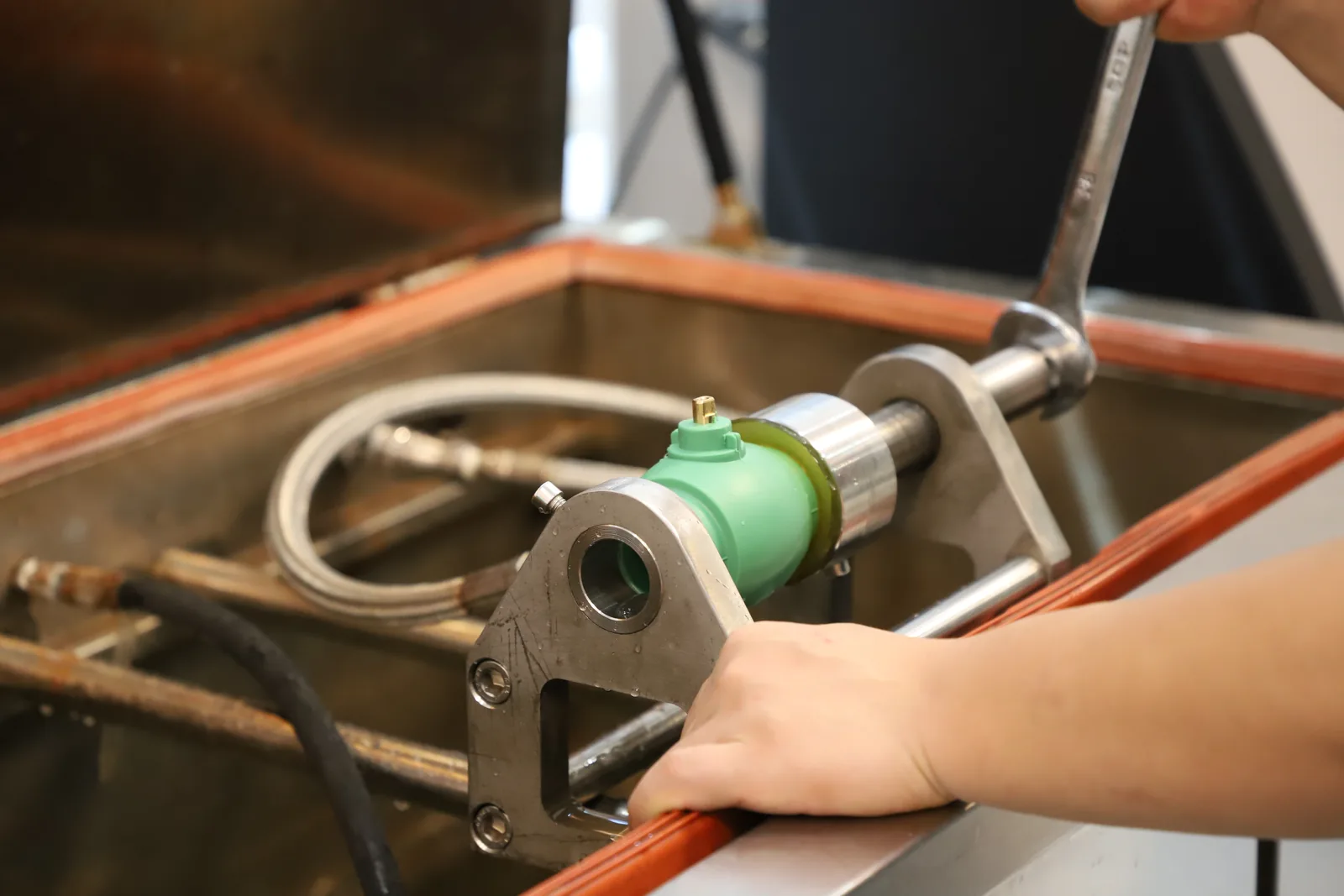
Look at what the standard considers an adequate answer to that question. The thermal stability test in ISO 15874-2:2013 Table 11 is hydrostatic pressure testing with no bursting during the test period, at a hoop stress of 1,9 MPa for PP-R and a test temperature of 110 °C, water-in-air, Type A end cap, per ISO 1167-1 and ISO 1167-2. The test period is 8760 h on a single test piece. That is one full year of continuous loading.
You will not run that on an incoming container, and neither will your supplier. It is a type test belonging to material qualification, not shipment release. That is exactly why material identity and certification history carry the weight: nobody can re-prove long-term performance at the port. What you can verify at the port is that the material is the one already proven — the logic behind a factory’s quality control process sitting upstream of the extruder rather than at the despatch bay.
The failure mode that concerns you does not announce itself early either. Impact loss at 0 °C, the property recyclate hits hardest, shows up when a cold riser takes a knock during fit-out — sometimes years after the pressure test everyone signed off on.
The documents that make traceability enforceable
Ask for “quality documents” and you get a folder proving a factory once made a good pipe. Ask for these five and you can trace the container in front of you.
- The compound batch reference. DIN CERTCO defines a batch as a uniquely identifiable production unit of a material or moulding compound, defined by its amount, production period and accompanying factory production control — noting that production stops under 24 h do not interrupt a batch. This is the reference that makes the 30 % MFR comparison possible.
- The material certificate from the resin producer. Naming a grade, not a category. “PP-R pipe grade” is not a grade.
- Factory production control records covering the run, including batch release testing and process verification testing for the production period your goods came from.
- The third-party certificate with its validity dates. Under the DIN CERTCO scheme a certificate is valid for 5 years, and annual monitoring audits per factory site are required to keep it — covering production, laboratory, factory production control and quality management. An expired certificate is a fair question, not an accusation.
- The link between marking and paperwork. The batch marking on the pipe must resolve to the documents above. If it does not, the rest is decoration.
One caution on certificates in general. Independent bodies such as SKZ inspect production facilities and test products on behalf of certifiers to give continuous quality assurance, but a certificate is a statement about a scheme and a scope, not a guarantee about the pallet in your warehouse. Read the scope line, check the validity date, and match the site named on it to the site that made your goods. If you are unsure what each mark actually covers, our breakdown of what SKZ, CE and WRAS approval each certify sets out where one ends and the next begins.
What changes for EU importers on 31 December 2026
If you sell into the EU, undocumented feedstock stops being a quality risk and becomes a market access risk within months. The measures under Article 11 of Directive (EU) 2020/2184 are binding and directly applicable in all EU Member States from 31 December 2026. Products already compliant with national hygienic requirements on that date may continue under those national systems until 31 December 2032 at the latest. Anything outside that transitional regime needs certification under the new EU framework from 31 December 2026.
The acts worth being able to name, all applicable from 31 December 2026:
- Commission Implementing Decision (EU) 2024/365 — methodologies for testing and acceptance of starting substances
- Commission Implementing Decision (EU) 2024/367 — establishing the European positive lists
- Commission Implementing Decision (EU) 2024/368 — procedures and methods for testing and accepting final materials
- Commission Delegated Regulation (EU) 2024/369 — procedure for inclusion in and removal from the European positive lists
- Commission Delegated Regulation (EU) 2024/370 — conformity assessment procedures and designation of conformity assessment bodies
- Commission Delegated Regulation (EU) 2024/371 — harmonised specifications for the marking of products
The structural problem for recyclate sits in the phrase “positive list of authorised starting substances”. A positive list is a list of things you can name. Post-consumer reground feedstock of mixed origin cannot be resolved back to named starting substances, so it has no obvious route through that door. Requirements vary by product, market and the importer’s role — confirm your own position with your conformity assessment body rather than treating this paragraph as a ruling.
Audit cadence matters if your supplier runs more than one plant. The initial audit must be conducted in person at each production site where multiple sites are used, with annual audits after that. Complete sample testing per CID (EU) 2024/368 is required only every fifth year, with reduced testing in between, though for organic materials a migration test is still required annually. Each site must be checked at least once during certificate validity — so a second sourcing origin is a separate audit scope, not a free rider on the first certificate.
For the UK, WRAS takes a specific position on recycled ingredients. Under its Material Approval guidance (WRAS.Appr-310 v4.0), one batch of the final material containing the recycled ingredient must be tested and shown to conform with all test requirements, and two further random sets of samples must be taken from the manufacturer’s premises by the test laboratory or an accredited quality management assessor and put through the odour and flavour of water test to demonstrate consistency. Material Approval itself is granted only to materials satisfying BS 6920:2000 Parts 1 and 2, plus Part 3 for hot water use — which is the part that applies to PP-R.
Writing the clause so it actually bites
“Pipe shall be manufactured from 100 % virgin material” is the clause almost everyone writes, and it is close to unenforceable. It uses a term the standards do not define, forbids something ISO 15874 permits, and specifies no test, no limit and no document. A supplier can agree to it in full sincerity and you are no better off. A clause that works has four parts.
- Material definition using the right vocabulary. Virgin material and the manufacturer’s own reprocessable material from its own conforming production, per ISO 15874-1:2013 clause 5.3. Externally sourced reprocessable material and recyclable material of any type are excluded.
- Documentation on the proforma invoice. Compound batch reference, resin grade designation and the third-party certificate number with its validity date, stated per order before production starts.
- Named acceptance tests with conditions. MFR to ISO 1133-1 at 230 °C / 2,16 kg with the pipe-vs-compound difference not exceeding 30 % per ISO 15874-2:2013 Table 11; ash to ISO 3451-1 at a stated calcination temperature; density to ISO 1183 as corroboration.
- Who pays and what happens. Third-party testing at your cost if the goods conform, at the supplier’s cost if they do not, with a defined remedy. A clause without a consequence is a wish.
Watch how a supplier reacts to the second bullet in particular. Asking for a compound batch reference is an ordinary request for a factory that buys characterised resin against documented batches. For a factory buying whatever is cheap this month, it is the hardest line in the contract to sign — and the reaction usually arrives before the goods do.
One container, start to finish
Say you are a distributor placing a first mixed trial order — one 20GP with pipe, fittings and valves — and you have been quoted by two factories with a gap you cannot explain from the specification sheets. Assume the pressure class and dimensions already match, so the difference is not a PN20 against PN25 wall thickness difference hiding in the line items.
Before the deposit. Send both suppliers the same four-part clause. Ask each to confirm in writing on the proforma invoice: the resin grade designation, the compound batch reference they will run, the certificate number with validity date, and the production site. The cheaper quote either firms up or starts adding conditions. That answer costs you nothing and arrives before your 30 % T/T deposit does.
During production. Lead time on in-production sizes runs 15–25 days, which is enough room to ask for the factory production control records for your production period while the goods are still on the floor. Requesting them after shipment turns a routine document request into an accusation.
At loading. Have samples pulled from bundles across the load, not from one pallet by the door, then sealed and labelled against bundle markings. Payment terms of 70 % against copy B/L give you a short, real window in which paperwork and goods must agree.
On arrival. Cut and inspect the bore against clause 5.1, and weigh measured lengths. If anything looks off, send pipe and the compound reference to a laboratory for the MFR comparison plus an ash test at a stated temperature. One test round on a first container is cheap insurance, and it sets the tone for every order after it.
The commercial logic is uncomfortable but simple. Reground feedstock saves a fraction of the material cost on one container. A wall failure inside a screed costs the finishes, the labour, the drying time and the relationship — and it lands years later, when nobody is holding a retention. The saving sits with whoever sold you the pipe; the failure sits with you.
How we control feedstock, including the origin question
Our own position includes a detail most suppliers would rather not raise in an article about traceability. Bekaatherm operates dual-origin supply: a plant in Türkiye and a partner plant in China, with origin allocated by market. Origin is confirmed in writing per order on the proforma invoice, and the certificate of origin, packing list and bill of lading are kept consistent. The material specification does not change with the plant that runs the order. If you need a specific origin for tariff, tender or labelling reasons, agree it in writing before the deposit — an article arguing for documented material control cannot then ask you to take origin on trust.
The rest is ordinary discipline behind 30 years of manufacturing across a 120,000 m² site: incoming resin received against batch documentation, in-line dimensional control on the extrusion lines, and batch testing before release to the warehouse. The certification set is SKZ (Germany), ISO 15874, CE and WRAS. We do not publish certificate numbers in blog articles — ask for the current certificates with their validity dates and check the scope lines yourself, which is what this article has told you to do with every other supplier.
One last connection worth making. The 50-year warranty against material and manufacturing defects is matched to the 50-year design life at rated pressure and 20 °C under ISO 15874, and that design life is not a marketing number — it comes from the ISO 9080 evaluation described earlier, which is tied to a specific qualified material. A warranty of that length is only underwritable on a feedstock you control and document. Any supplier offering a long warranty on material they cannot name is writing a cheque against someone else’s account.
Conclusion
Recycled content in PP-R pressure pipe is not a grade choice, it is a conformity failure under ISO 15874-1 clause 5.3 — and the sensory tests the trade relies on cannot prove it either way. What proves it is the pipe-versus-compound MFR comparison, an ash test at a temperature you specified, and a batch reference that ties the container to a documented material. From 31 December 2026 that same documentation stops being good practice for EU-facing shipments and starts being a condition of sale.
If you are drafting your next supply contract, start with the four-part clause above and ask your current supplier for a compound batch reference on the next order. You will learn more from how that request is answered than from any certificate in the folder.
Frequently Asked Questions
Is recycled material allowed in PPR pipe under ISO 15874?
No. ISO 15874-1:2013 clause 5.3 states that reprocessable material obtained from external sources and recyclable material shall not be used. Only virgin material and the manufacturer’s own reprocessable material from its own conforming production are permitted.
Can a factory legally re-melt its own offcuts?
Yes, within limits. Clause 5.3 permits the manufacturer’s own reprocessable material obtained during production and works testing of conforming products. Material bought in from other producers or recovered from used products is excluded.
Which single lab test best detects reground content?
The melt flow rate comparison between pipe and its compound. ISO 15874-2:2013 Table 11 allows a 30 % maximum difference against compound from the same batch, tested at 230 °C under 2,16 kg per ISO 1133-1. You must have the compound batch reference for it to work.
Can I reject a shipment because the colour is inconsistent?
Not on the colour alone. ISO 15874-2:2013 clause 5.1 permits slight variations in appearance of the colour. The same clause does require surfaces free from defects and material free from visible impurities, so cite impurities or surface defects instead.
What ash test temperature should I specify?
Name one on the test request. ISO 3451-1 allows calcination at 600 °C, 750 °C, 850 °C or 950 °C, and higher temperatures convert calcium carbonate to its oxide, giving a lower apparent ash value. Comparing two suppliers requires the same temperature for both.
How much does recyclate reduce impact strength?
A 2022 study in Polymers measured Charpy impact strength falling from 21.6 kJ/m² at 10 m% post-consumer recyclate to 17.2 kJ/m² at 30 m% for one base resin, and to 12.6 kJ/m² at 30 m% for another. The effect is dose-dependent.
Does a 24-hour pressure test on arrival prove the pipe is sound?
It only proves the pipe is not grossly defective now. The thermal stability test in ISO 15874-2:2013 Table 11 runs 8760 h at 110 °C and 1,9 MPa hoop stress for PP-R — a type test that cannot be reproduced at the port.
What changes for EU importers on 31 December 2026?
The Article 11 measures under Directive (EU) 2020/2184 become binding and directly applicable in all Member States. Products meeting national hygienic requirements on that date may continue under those systems until 31 December 2032 at the latest. Confirm your own position with your conformity assessment body.