Open ISO 15874, the international standard that governs PP-R plumbing systems, and look for the chilled water pipe application class. It is not there. The standard defines Class 1 and Class 2 for hot water supply, Class 4 for underfloor heating and low-temperature radiators, and Class 5 for high-temperature radiators. There is no cooling class, no HVAC class, and no Class 3 at all. That absence is the single most useful thing a specifier can know about PP-R in a chilled water loop, and almost no supplier page mentions it.
Here is why it matters. Chilled water enters ISO 15874 only through the cold-water leg, where the design stress for PP-R at 20 °C over a 50-year service life is 6.93 MPa. The Class 1 hot-water figure is 3.02 MPa and the Class 5 figure is 1.89 MPa. So a PN-marked PP-R pipe running at 6 °C is operating at roughly 2.3 times the allowable stress it was sized for in hot water, and roughly 3.7 times the Class 5 value. Pressure is not the problem in a chilled loop. It is the easiest question on the list. The four that actually bite are condensation, contraction, plenum fire code, and what happens on site when the material gets cold and someone drops a bundle.
Key Takeaways
- ISO 15874-2:2013 scopes PP-R for “hot and cold water installations within buildings” and “heating systems”. It never names chilled water, cooling or HVAC. ASTM F2389 does name chilled water and hydronic cooling in its scope, so the standard you cite depends on your jurisdiction.
- PP-R design stress at 20 °C for a 50-year life is 6.93 MPa, against 3.02 MPa for Class 1 hot water (ISO 15874-2 Table A.2). Cold duty is the gentlest service PP-R ever sees.
- PP-R does not prevent condensation. A PP-R manufacturer’s own catalogue states that below 10 °C “insulation against condensation is necessary”. Any page telling you PP-R stops sweating is wrong.
- Plain PP-R moves 0.15 mm per metre per kelvin. A 30 m run installed at 35 °C and operated at 6 °C shortens by roughly 130 mm. Fibre-reinforced grades at 0.035–0.040 mm/m·K cut that to about 30 mm.
- Return-air plenums are a listing question, not an opinion. US model code requires a flame spread index of 25 or less and a smoke developed index of 50 or less, or a UL 2846 listing. Ask for the listing document, not a reassurance.
- Charpy notched impact strength falls from 20 kJ/m² at 23 °C to 4 kJ/m² at 0 °C. The cold-weather risk is handling damage on a scored pipe, not pressure failure.
- Glycol loops and sub-zero service sit outside the temperature range ISO 15874 reference curves cover. Get written fluid compatibility from the manufacturer or use another material.
Why there is no chilled water class in ISO 15874
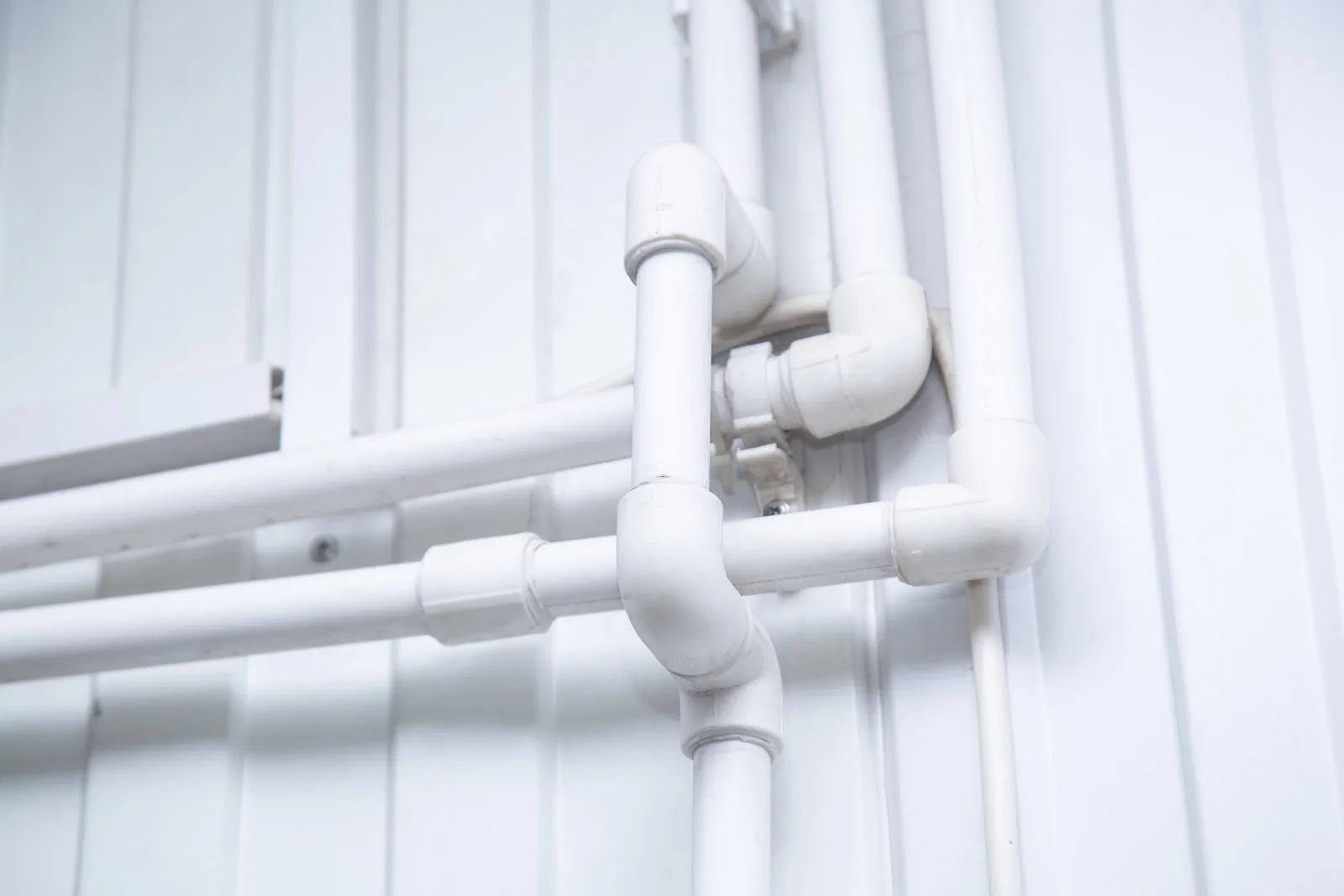
The scope clause of ISO 15874-2:2013 covers “pipes made from polypropylene (PP) for piping systems intended to be used for hot and cold water installations within buildings for the conveyance of water whether or not intended for human consumption (domestic systems) and for heating systems”. Read it twice. Hot water, cold water, heating. Cooling is absent, and so is any mention of HVAC.
A missing class is not a prohibition. In the standard’s terms a chilled water circuit is a cold water installation inside a building, served by the cold-water leg of the design maths, and that leg sits in every pipe the standard covers. What you cannot do is write “PP-R to ISO 15874 Class 3 for chilled water” on a drawing, because there is no Class 3. Specifiers do write it. It comes back from the reviewer.
The four classes, and what each one is actually for
| Application class | Duty | PP-R design stress | Relevance to chilled water |
|---|---|---|---|
| Class 1 | 60 °C hot water supply, 50-year life | 3.02 MPa | None directly, but it is what most PN20 stock is marked to |
| Class 2 | 70 °C hot water supply, 50-year life | 2.12 MPa | None |
| Class 4 | Underfloor heating, low-temp radiators | 3.29 MPa | None |
| Class 5 | High-temperature radiators | 1.89 MPa | None |
| Cold water leg | 20 °C, 50-year service life | 6.93 MPa | This is the one your chilled loop lives under |
Design stress figures are from ISO 15874-2:2013 Annex A, Table A.2, converted from the standard’s comma decimals. Class definitions follow the marking convention published by ISO 15874-2 and summarised by European PP-R makers. The four hot and heating classes exist because polypropylene creeps under sustained stress at elevated temperature, and the classes are just different lifetime temperature profiles. Cool the fluid and that clock slows down.
The pressure question is the easy one
Buyers ask whether PN20 is overkill for a 4 bar chilled loop. Look at how ISO 15874 actually sizes the wall. The standard takes the maximum calculated pipe series as the smaller of two ratios: one driven by the hot design stress for the chosen class, and one driven by sigma-cold, defined as “the design stress at 20 °C relative to a service life of 50 years”, against a design pressure of 10 bar.
Two limits, and the smaller wins. Now the detail that separates people who have read the standard from people who have read a supplier blog. In Table A.5 for PP-R, the 4 bar values for Class 1 and Class 4 are both 6.9, and both carry a footnote saying they are based on sigma-cold over the design pressure. At low design pressure the cold case governs wall thickness, not the hot case. The cold-water condition is not an afterthought bolted onto a hot-water standard — it is one of the two governing limits behind every wall thickness in the tables.
There is no separate chilled water pipe because the cold case was never removed from the calculation. Every PP-R pipe on the market is already a cold-water pipe.
Where the naive version of this reasoning breaks is wall thickness. A designer who concludes that cold duty is easy and a thin wall will do runs into clause 6.2.2, which states that “pipes intended to be joined together by fusion shall have a minimum wall thickness of 2,0 mm”. That floor exists for jointing, not for pressure. Socket fusion needs enough material to melt and fuse without collapsing the bore. You cannot value-engineer your way under it, and a supplier who offers to is telling you something.
So the practical answer on PN selection for chilled water is undramatic. PN20 in a 4 to 6 bar chilled circuit carries a very large margin at the fluid temperature involved. Choose the class for pressure and the reinforcement for movement, which is the section below. If you want the pressure-class trade-off in detail, our breakdown of PN20 versus PN25 pressure ratings works through the wall thickness and bore consequences size by size.
Condensation: the myth that rots ceilings
Search for PP-R and chilled water and you will be told, repeatedly, that PP-R “resists condensation” or “prevents sweating” because of its low thermal conductivity. This is the most damaging false claim in the category, and it is contradicted by PP-R manufacturers themselves. Vesbo’s technical catalogue states plainly: “For VESBO piping systems working with chilled water of temperatures less than 10°C, insulation against condensation is necessary but thickness is reduced considerably as compared with metal pipes.”
Necessary. Not optional. Low conductivity slows the rate at which the outer surface reaches fluid temperature. It does not stop it. Run a 6 °C line through a warm ceiling void and the outer wall equilibrates near the fluid temperature, drops below the dew point, and water forms on it. The pipe material changes how fast that happens and nothing about whether it happens.
What the conductivity number actually is
A figure of 0.15 W/m·K circulates across PP-R marketing pages with no test method attached. Datasheets that do cite a method give higher values: 0.24 W/m·K at 20 °C to DIN 52612, and 0.22 W/m·K at 23 °C for a polypropylene copolymer by the same method. Use 0.22 to 0.24 W/m·K depending on grade and test temperature. That is still far below copper, which is a real advantage. It is not a substitute for insulation.
The related claim, that PP-R saves chilled-water energy through its low conductivity, deserves the same treatment. Once both a PP-R line and a steel line are correctly insulated, the insulation dominates the thermal resistance of the assembly and the pipe wall contributes a small fraction of it. Any energy-saving figure quoted without an ambient condition, a humidity assumption and an insulation baseline is a number someone made up.
How thick, then?
Insulation thickness is a dew-point calculation for your climate, not a table you copy. Local design relative humidity drives it, which is why a Gulf coastal site and a temperate inland one get different answers for the same pipe at the same fluid temperature. For an order-of-magnitude anchor, Vesbo’s published table of recommended insulation for exposed pipes in chilled water systems runs roughly 23 to 42 mm of polyurethane across 20 to 125 mm pipe sizes. Those are one manufacturer’s pre-made pipe-in-pipe assemblies sized to standard jacket diameters, not ISO values and not a smooth engineering curve. Treat them as a sanity check on your own calculation.
One site-level warning that costs more than any of the above. Insulation continuity at fittings and supports is where chilled systems fail, regardless of pipe material. A PP-R socket fusion joint has a raised shoulder at every fitting, and insulation crews routinely butt the jacket up to that shoulder and leave the fitting bare. Every exposed elbow then becomes a condensation point directly above a ceiling tile. Specify continuous vapour-sealed insulation over fittings and hangers, and inspect it before the ceiling closes.
Contraction, not expansion, on a chilled riser
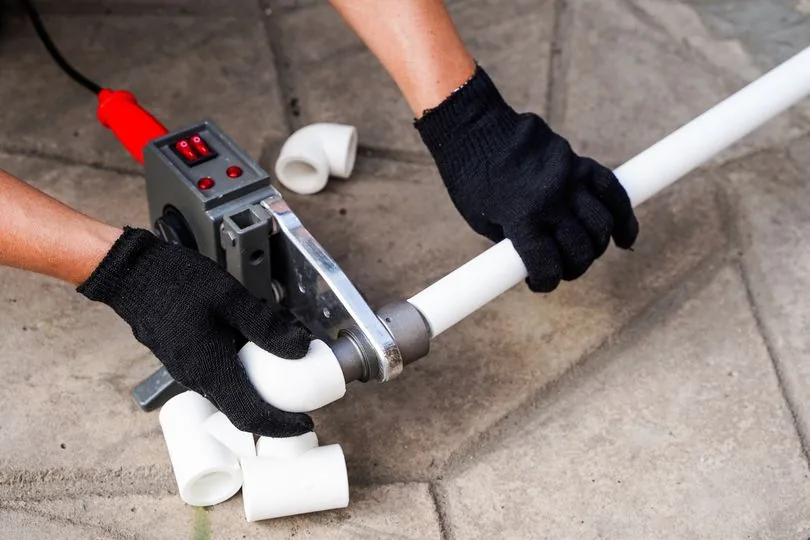
Plain monolayer PP-R has a linear thermal expansion coefficient of 0.15 mm per metre per kelvin. Two Turkish PP-R manufacturers publish figures that agree closely: 0.15 for plain, 0.035 to 0.040 for glass-fibre reinforced, and 0.025 to 0.030 for aluminium-foil reinforced. One of them also expresses the plain value as 1.5 × 10⁻⁴ K⁻¹ to DIN 53752, which is the same number in different units.
In a chilled loop the movement runs the other way, and the temperature difference is bigger than people expect because it is measured from the installation temperature, not from 20 °C. Take a 30 m run installed on a summer site at 35 °C and commissioned at 6 °C — a 29 K difference. Plain PP-R at 0.15 mm/m·K shortens by roughly 130 mm. A glass-fibre reinforced pipe at 0.035 gives roughly 30 mm. That is arithmetic on published coefficients under stated conditions, a worked example rather than a measurement, but 130 mm of shortening is not something a rigid clamp absorbs quietly.
The catalogue advice that gets copied onto the wrong drawing
Here is a genuine trap. The same Vesbo catalogue states that “expansion joints are not necessary as VESBO cold water pipes have practically no linear expansion. Vertical support is however necessary like any other piping system.” That is sound guidance for a domestic cold water riser sitting near ambient temperature all year, where the temperature difference is a few kelvin and the movement is millimetres.
It is not sound for a chilled water riser at 5 to 7 °C installed in a hot plant room. The catalogue’s own formula, ΔL = α × L × ΔT, contradicts the blanket statement as soon as ΔT becomes real. Cold water advice gets lifted onto chilled water drawings because both say “cold”, and that is exactly where movement gets missed. Chilled water is not cold water. It is a controlled low temperature maintained against a warm ambient, which is a different design case.
The practical route: use a fibre-reinforced or aluminium-composite grade on long chilled runs and risers, which cuts movement by roughly a factor of four to six, and design in the offsets or loops for what remains. Our comparison of fibreglass versus aluminium composite PP-R covers where each construction earns its cost. Support spacing helps you here too: span tables tighten as temperature rises, so a chilled loop sits at the favourable end of the table. Use the spacing table for the exact product and temperature rather than a generic one.
Plenums, UV and the code that rejects your design
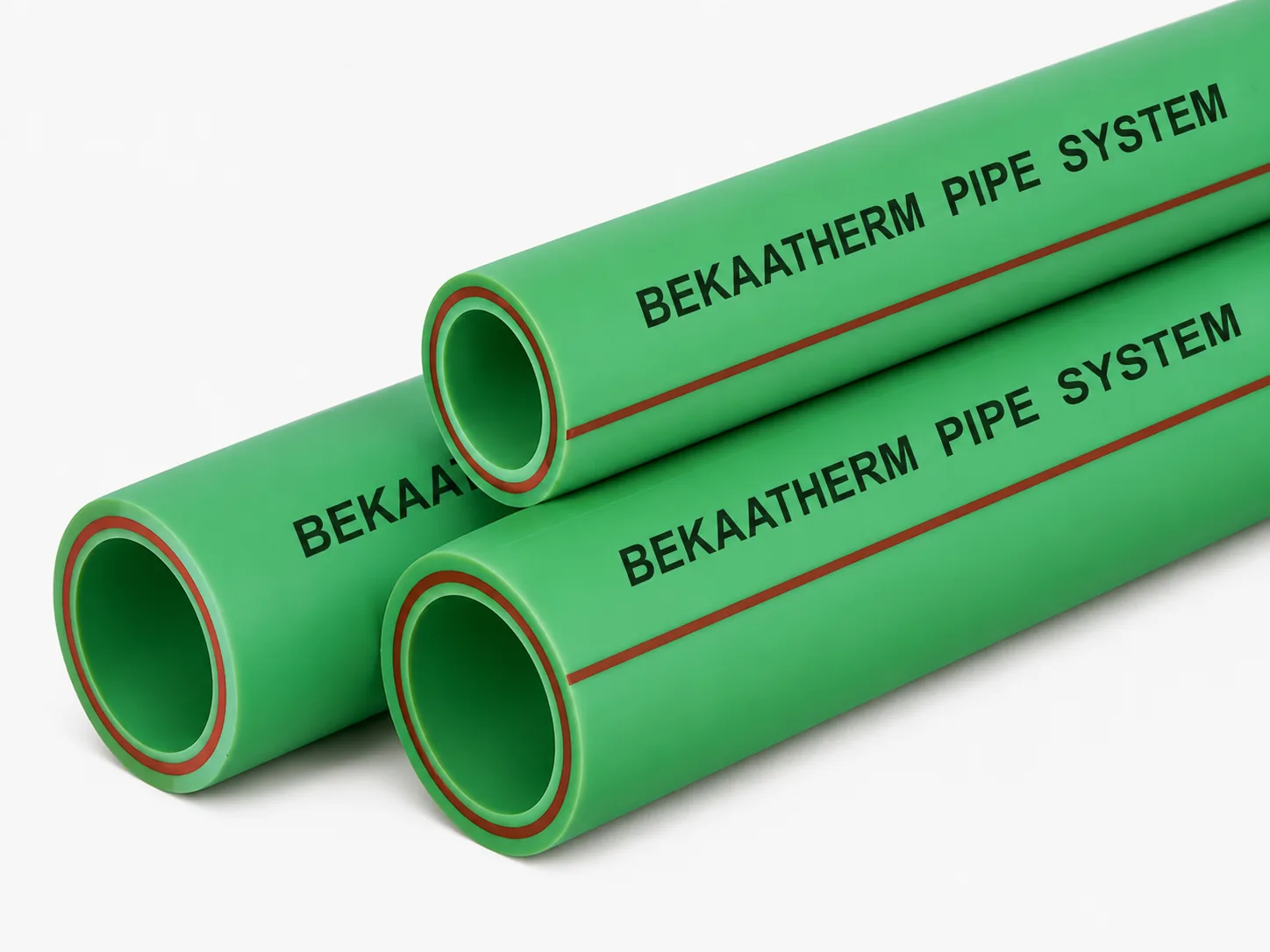
This is the section that decides whether a mechanical inspector signs off, and it is missing from the vendor pages that rank for this query. Under the International Mechanical Code, materials inside a return-air plenum must be noncombustible, or have a flame spread index of 25 or less and a smoke developed index of 50 or less when tested to ASTM E84 or UL 723. Plastic plumbing piping sits at IMC 602.3.8, which opens an alternative route: piping listed and labelled to UL 2846 with a peak optical density no greater than 0.50, an average optical density no greater than 0.15, and a flame spread distance no greater than 5 feet (1524 mm), installed per its listing.
Note what that means in practice. It is a product listing question, not a material question. Neither “PP-R is fine in plenums” nor “PP-R is banned in plenums” is a true statement. The correct answer depends on the specific product’s test listing, and the only acceptable evidence is the listing document itself. So when a route passes through a return-air plenum, ask any supplier, ours included, for the listing paperwork rather than an assurance over email. A supplier who answers that question with reassurance instead of a document has answered it.
Two caveats. This is a US model code provision, so readers elsewhere should check their own national fire and building code rather than assume these numbers apply. And Bekaatherm holds SKZ, ISO 15874, CE and WRAS certification, which does not include a plenum flame-spread listing — if your route needs one, raise it at enquiry stage. Note also that WRAS is a potable water approval and means nothing for HVAC duty, whatever a supplier’s certificate wall implies.
Sunlight, and why chilled work mostly dodges it
Prolonged UV exposure discolours bare PP-R and weakens the polymer over time. The mechanism is well established. The specific numbers circulating on SEO blogs, such as “brittle in 6 to 12 months” or “strength drops 50%”, have no test method behind them and should be ignored. The mitigation is a UV-protected grade or an opaque jacket, not paint.
Chilled water work solves this almost by accident, because the lines are insulated and jacketed anyway. The exposure that actually happens is on rooftop and plant room runs left bare while the insulation package is delayed, which on a slipping programme means months in direct sun. If your sequence installs pipe well before lagging, that is the gap to close. A related standards point fits chilled systems specifically: ISO 15874-2 requires pipes declared opaque to transmit no more than 0.2 % of visible light, tested to ISO 7686. Light through a pipe wall feeds algae and biofilm, and a cool, often stagnant chilled circuit suits both.
PP-R vs steel, copper, HDPE and PVC
Material selection for a chilled loop turns on four things: corrosion behaviour in a wet, cool, oxygenated system, joint reliability above a ceiling, movement, and code acceptance. Cost matters, but it stops mattering the first time a joint leaks over a fit-out.
| Material | Strongest argument | Where it loses |
|---|---|---|
| PP-R | Does not corrode; fused joints have no gasket or thread to fail; 6.93 MPa cold design stress | Plenum listing must be proven; high movement unless reinforced; large diameters get impractical |
| Black steel | The default basis of design for large chilled plant; every AHJ accepts it; any diameter | Corrodes under wet insulation; heavy; welding and painting labour |
| Copper | Compact, well understood, noncombustible for plenum routes | Material cost and theft exposure; brazing above a finished ceiling is hot work |
| HDPE | Butt-fused, tough, good for buried site distribution between buildings | Very high expansion; bulky above ground; fusion equipment on site |
| PVC / CPVC | Cheap, light, easy solvent jointing | Solvent joints are workmanship-sensitive; impact behaviour and code limits vary widely by market |
Our position, stated plainly. For secondary chilled water distribution in the 20 to 160 mm range, above a ceiling, in a building whose post-handover maintenance budget is thin, PP-R beats black steel — and the reason is corrosion under insulation, not pressure. A chilled steel line sits permanently below ambient with condensation forming inside a jacket nobody opens for a decade. PP-R removes that failure mode. For primary plant room headers above 160 mm, for anything the engineer wants welded and radiographed, and for plenum routes without a listing, steel or copper stays the right answer. A supplier whose material wins every case is selling, not specifying. Our PP-R versus PVC, PEX and copper comparison goes deeper on the plumbing side of that decision.
PP-R or PP-RCT?
PP-RCT is a modified-crystallinity polypropylene with a higher design stress: 8.25 MPa at 20 °C over 50 years against PP-R’s 6.93 MPa, and a maximum calculated series of 3.6 at 10 bar against 3.0 for PP-R, per ISO 15874-2 Tables A.2 and A.6. That is roughly 19% more cold design stress, which buys thinner walls and more bore for the same outside diameter. On a large chilled distribution main where pump head and pipe size both matter, PP-RCT is a genuinely better material. Bekaatherm’s documented range is PP-R, including fibreglass and aluminium composite constructions, so if PP-RCT is what your design needs, that is not a product we list. Better you know now than after the drawings are issued.
Best for, and definitely not for
Best for
- Secondary chilled water distribution, 20–160 mm: fan coil branches, riser drops and floor loops, where fused joints above a ceiling beat threaded or grooved ones.
- Condenser water in humid coastal climates: corrosion under insulation is the dominant long-run failure mode there, and PP-R has none.
- Refurbishments in occupied buildings: socket fusion is not hot work in the brazing sense, and lighter pipe means fewer people on an access platform.
- Projects where 20 °C is the actual duty: the ISO 15874 50-year design life is defined at rated pressure and 20 °C, which sits close to a chilled circuit’s real condition rather than well above it.
Not for
- Return-air plenums without a product listing: the 25/50 flame spread and smoke developed limits, or a UL 2846 listing, decide this and nothing else does.
- Glycol-charged and sub-zero loops, absent written confirmation: below roughly 10 °C, and for any glycol concentration, you are outside the temperature range the ISO 15874 reference curves cover. Get chemical and temperature compatibility for your specific fluid and concentration in writing from the manufacturer. A supplier who answers that verbally is a red flag.
- Large primary headers and plant room mains: above 160 mm the handling, support and fitting economics turn against PP-R.
- Long unsupported straight runs with no allowance for movement: 0.15 mm/m·K on plain pipe over a 29 K difference is not a rounding error.
- Cold-weather sites with rough handling: Charpy notched impact strength falls from 20 kJ/m² at 23 °C to 4 kJ/m² at 0 °C and 3 kJ/m² at −10 °C, tested to ISO 179/1eA. Unnotched samples show no failure at any of those three temperatures, so the material is not brittle. It is notch-sensitive. A scored or scratched pipe is a different pipe once it is cold, which makes site handling, not pressure, the winter risk.
How to verify what was actually delivered
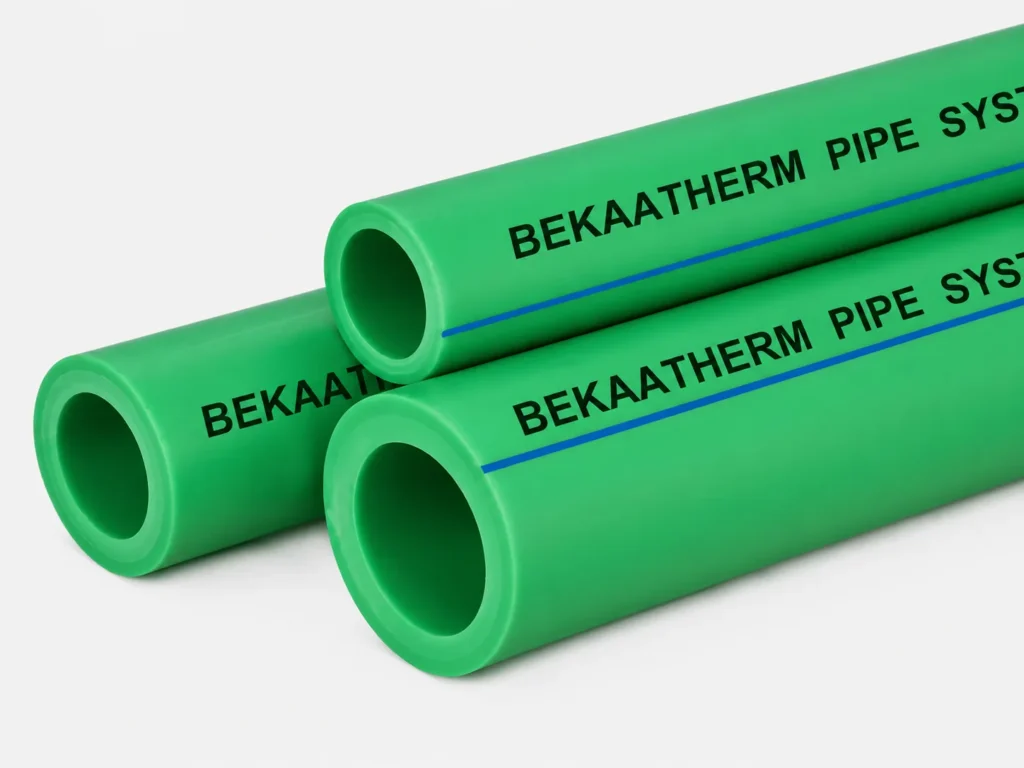
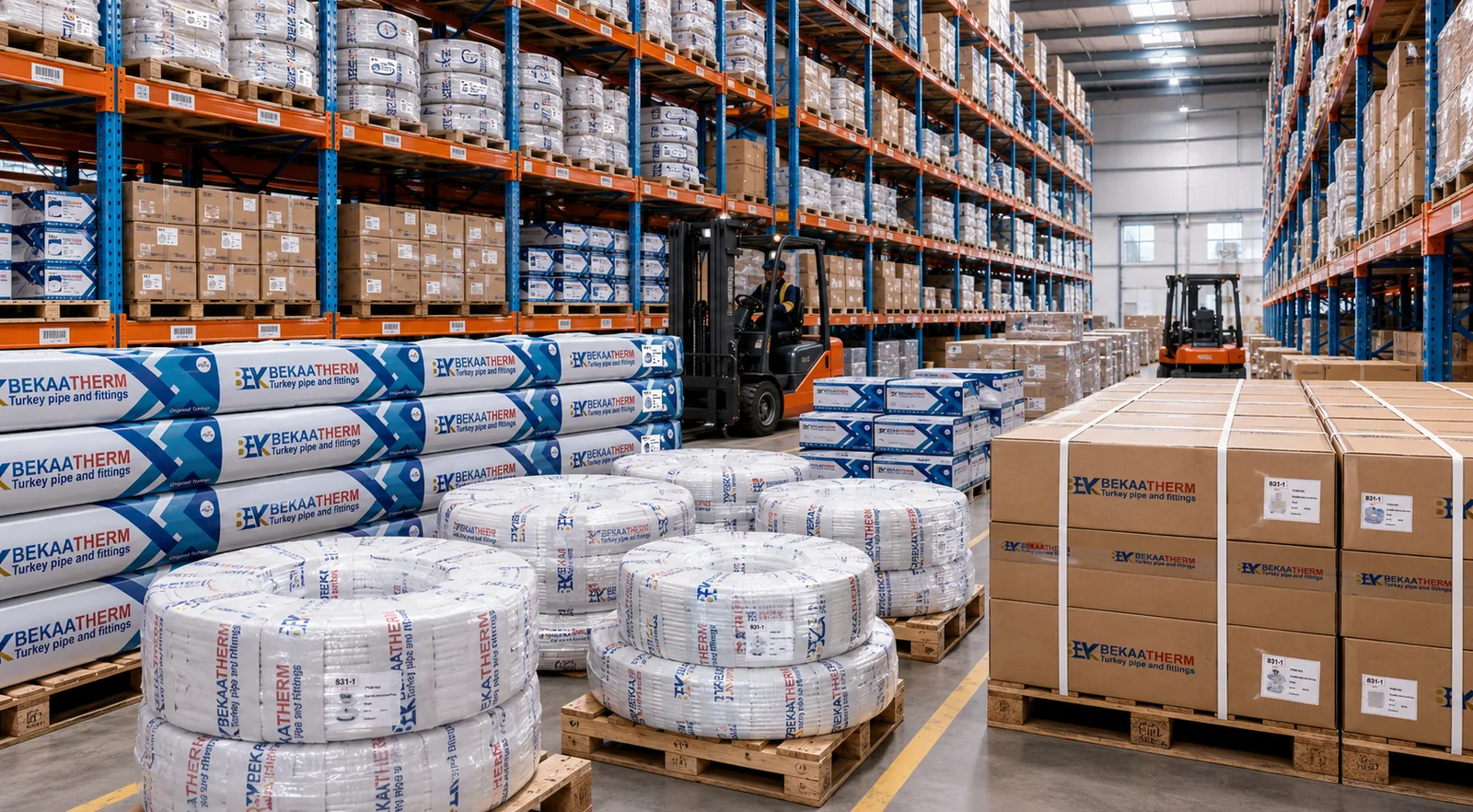
A specification is only as good as what arrives on the pallet. ISO 15874-2 clause 10.2 sets out what must be printed on the pipe wall, which turns a site inspection into a 30-second check. The minimum marking includes “ISO 15874”, the manufacturer’s name or trade mark, nominal outside diameter and wall thickness such as 16 x 2,2, the pipe dimension class, the material designation such as PP-R, the application class with operating pressure such as Class 1/10 bar, opacity, plus the production period and production site code.
Two of those items do the heavy lifting. The wall thickness printed next to the diameter lets you confirm you received the PN class you paid for, which is the substitution most commonly attempted on a price-driven order. The production site code is the standard’s own traceability mechanism, and it matters more than most buyers realise on a global supply chain.
What we check before an order ships
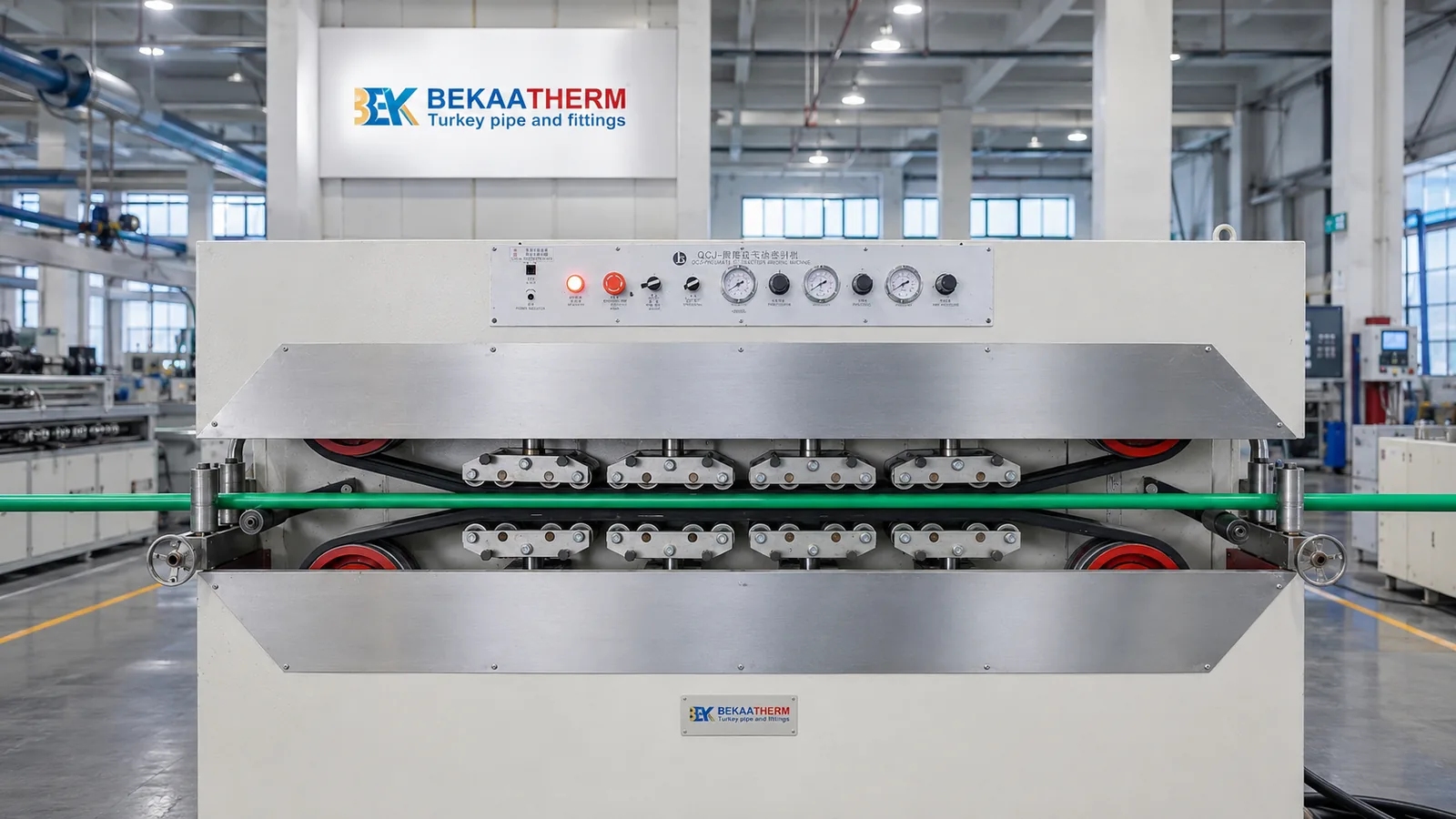
Bekaatherm supplies from two origins: our own plant in Türkiye and a partner plant in China, with origin allocated by market. Rather than leave that vague, origin is confirmed in writing per order on the proforma invoice, and the certificate of origin, packing list and bill of lading are kept consistent. The standard already expects site-level traceability through the production site code, so this is the marking clause working as designed. If your tender requires a single stated origin, say so at enquiry and it is fixed on the proforma before any deposit moves.
One check belongs on a chilled water commissioning plan and rarely appears on one. Pressure testing PP-R is temperature sensitive: a 10 °C change in the test medium corresponds to a pressure change of 0.5 to 1.0 bar, so the medium must be held as close to constant as possible. Fill a chilled circuit with cool water inside a warm building and the gauge drifts on its own. Contractors then spend a day hunting a leak that does not exist. Use a gauge readable to 0.1 bar at the lowest point, per DIN 1988 Part 2 or BS 6700, and record medium temperature alongside pressure.
On the paperwork side, our PP-R system is manufactured to ISO 15874-1, -2, -3 and -5, with dimensions and wall thickness to DIN 8077 and general quality requirements to DIN 8078, and certified by SKZ in Germany, plus CE and WRAS. The material and manufacturing defects warranty runs 50 years, matched to the 50-year design life at rated pressure and 20 °C under ISO 15874. Worth noticing for a chilled water reader: that design life is defined at 20 °C, so unlike a hot-water application you are being quoted the headline figure at close to your actual operating condition rather than a derated one.
If a project reaches procurement, the entry point is one 20GP mixed container of pipe, fittings and valves, or 500 kg per size and colour on single-size orders. Lead time is 15–25 days on in-production sizes and 30–45 days for private-label runs. Payment is 30% T/T deposit, 70% against copy B/L, with irrevocable L/C at sight accepted from USD 50,000. Default terms are FOB İstanbul or Mersin, CFR and CIF on request. Prices are quoted per enquiry, and a quotation covers the FOB unit price, a container loading plan and the certificate pack.
Conclusion
PP-R belongs in a lot of chilled water systems and does not belong in some of them, and the line between those two cases has almost nothing to do with pressure. At 6.93 MPa cold design stress against 3.02 MPa for hot water Class 1, the hydraulics are the easy part. What decides the job is whether the insulation is continuous and vapour-sealed over every fitting, whether the movement from installation temperature down to operating temperature has somewhere to go, and whether the route touches a return-air plenum you have no listing for.
If you are at basis-of-design stage, the useful next step is to settle the plenum question and the reinforcement grade before you settle the material, because those two constrain everything downstream. You can compare the constructions and pressure classes on the PP-R system pages, and if the answer for your project turns out to be steel or PP-RCT, that is a real answer too.
Frequently Asked Questions
Can PP-R pipe be used for chilled water systems?
Yes, and it is structurally the gentlest duty PP-R sees, with a design stress of 6.93 MPa at 20 °C over 50 years against 3.02 MPa for Class 1 hot water. ISO 15874 has no dedicated cooling class, so a chilled circuit is designed under the standard’s cold-water leg.
Does PP-R pipe need insulation for chilled water?
Yes. A PP-R manufacturer’s own catalogue states that below 10 °C insulation against condensation is necessary, though the thickness is considerably less than for metal pipe. Low conductivity of around 0.22–0.24 W/m·K slows the surface reaching dew point; it does not prevent it.
Is PN20 overkill for a chilled water loop?
PN20 carries a large margin at chilled water temperatures, but you cannot simply go thinner. ISO 15874-2 sets a hard floor of 2.0 mm wall thickness for any pipe intended to be fusion jointed, independent of pressure.
How much does PP-R contract on a chilled line?
Plain PP-R moves 0.15 mm per metre per kelvin, measured from installation temperature to operating temperature. A 30 m run installed at 35 °C and run at 6 °C shortens roughly 130 mm; a fibre-reinforced grade at 0.035 mm/m·K gives about 30 mm.
Can PP-R run through a return-air plenum?
Only if the specific product carries the listing. US model code requires a flame spread index of 25 or less and smoke developed index of 50 or less to ASTM E84 or UL 723, or a UL 2846 listing. Ask your supplier for the listing document, and check your national equivalent outside the US.
Can PP-R handle glycol in a low-temperature loop?
Treat it as unresolved until the manufacturer confirms in writing. ISO 15874-2 derives its reference curves over 10 °C to 95 °C, so sub-zero and glycol-charged service falls outside what the standard underwrites. Request compatibility for your exact fluid and concentration as a document.
Which standard covers PP-R for chilled water, ISO 15874 or ASTM F2389?
Both, differently. ISO 15874 covers hot and cold water and heating without naming cooling, while ASTM F2389 names chilled water and hydronic cooling directly in its scope. Cite whichever governs your jurisdiction; Bekaatherm is certified to ISO 15874, not ASTM.