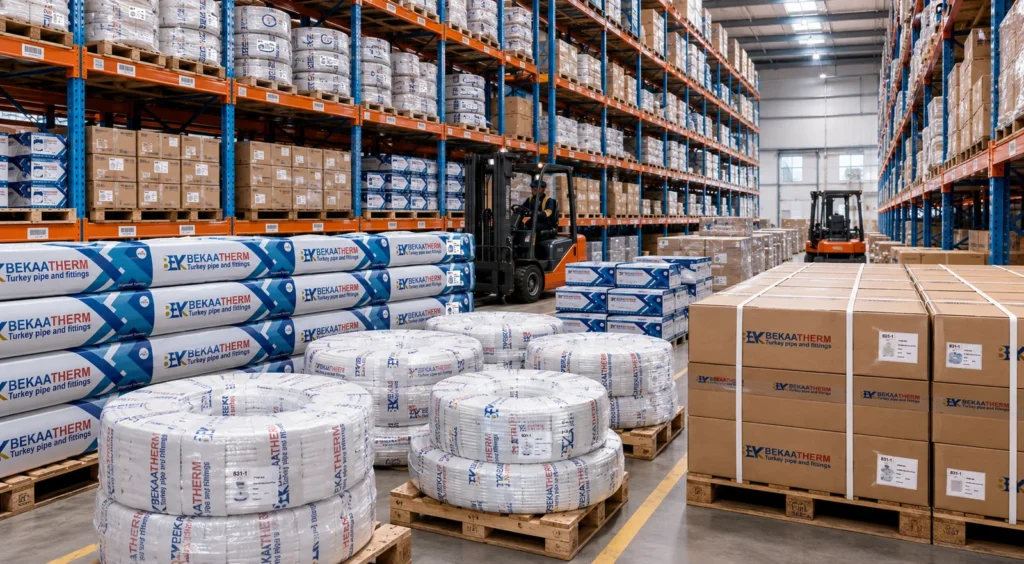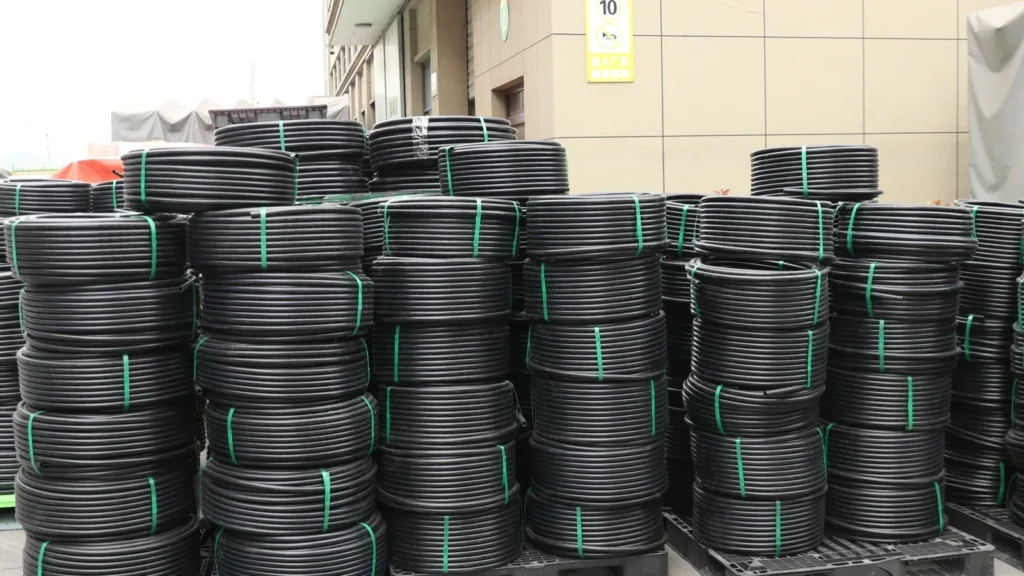
A container of black pipe lands at Mersin. The packing list says DN 110 SDR 11, the pipe measures 110.6 mm across the outside, and the buyer’s site engineer calls the office to say the supplier has shipped oversize pipe. He has not.
That pipe is inside the tolerance ISO 4427-2 allows, and the number he expected to see — a clean 110.0 mm — is a minimum, not a target. The argument that follows costs three days and a lot of goodwill. It happens because almost every HDPE pipe size chart on the internet prints one number per column where the standard publishes two.
This page is the chart with the missing columns put back. Outside diameter with its real tolerance band, wall thickness as the minimum and maximum the standard actually specifies, the out-of-roundness limit that decides whether a fitting will seat, and mass per metre — which is the unit HDPE pipe is genuinely priced and shipped in, whatever the quote says.
Key Takeaways
- HDPE is sized by outside diameter, and the nominal size is the minimum: a compliant DN 110 pipe measures between 110.0 and 110.7 mm. There is no minus tolerance.
- ISO 4427-2 gives wall thickness as a pair, not a figure. DN 110 SDR 11 is 10.0 mm minimum and 11.1 mm maximum — which is why two compliant pipes can differ in weight by about 10%.
- SDR alone is not a pressure rating. SDR 11 is PN 16 in PE 100, PN 12.5 in PE 80 and PN 10 in PE 63. Quote the grade or you have not specified the pipe.
- Out-of-roundness is a separate limit and it nearly doubles between DN 250 (5.0 mm) and DN 280 (9.8 mm). For coiled pipe the standard sets no limit at all — it is whatever you agreed in writing.
- “4 inch” has two answers. Metric DN 110 is 110.0 mm; US IPS 4 in is 114.3 mm. The 4.3 mm gap means fittings from one series will not work on the other.
- Moving from SDR 17 to SDR 11 at the same diameter adds roughly 45–47% to mass per metre — that is the real cost of the extra pressure class, and it is what fills your container.
- Specify the edition: ISO 4427-2:2019 with Amendment 1:2023, or EN 12201-2:2024. A catalogue that names no edition cannot be dated.
How HDPE pipe sizes are actually defined
HDPE pipe is outside-diameter controlled. The number in the size — DN 110, DN 63, DN 315 — is the nominal outside diameter, and everything else about the pipe is derived from it. That is the opposite of steel pipe, where a nominal bore is the reference and the outside diameter follows, and it is the reason a DN 110 pipe stays 110 mm on the outside whether it is a thin SDR 26 gravity line or a heavy SDR 9 pumping main. Only the bore moves.
The part that catches buyers out is the tolerance. In ISO 4427-2, the nominal outside diameter and the minimum mean outside diameter are the same number, and the tolerance runs one way only — upward. A DN 110 pipe may measure anywhere from 110.0 mm to 110.7 mm and be fully compliant; a DN 400 pipe runs from 400.0 mm to 402.4 mm.
Nothing in the standard permits a pipe to measure under its nominal size. That is why a caliper reading of 109.8 mm on a DN 110 pipe is a rejection and a reading of 110.6 mm is not.
Why the bore is a consequence, not a specification
There is no internal diameter column in ISO 4427-2. Bore is what is left after two wall thicknesses are subtracted from an outside diameter that itself has a tolerance band, and both walls have their own bands. Ask for pipe by internal diameter and you are asking the extruder to hit a dimension the standard never controls. Specify DN and SDR, and the bore lands where the arithmetic puts it.
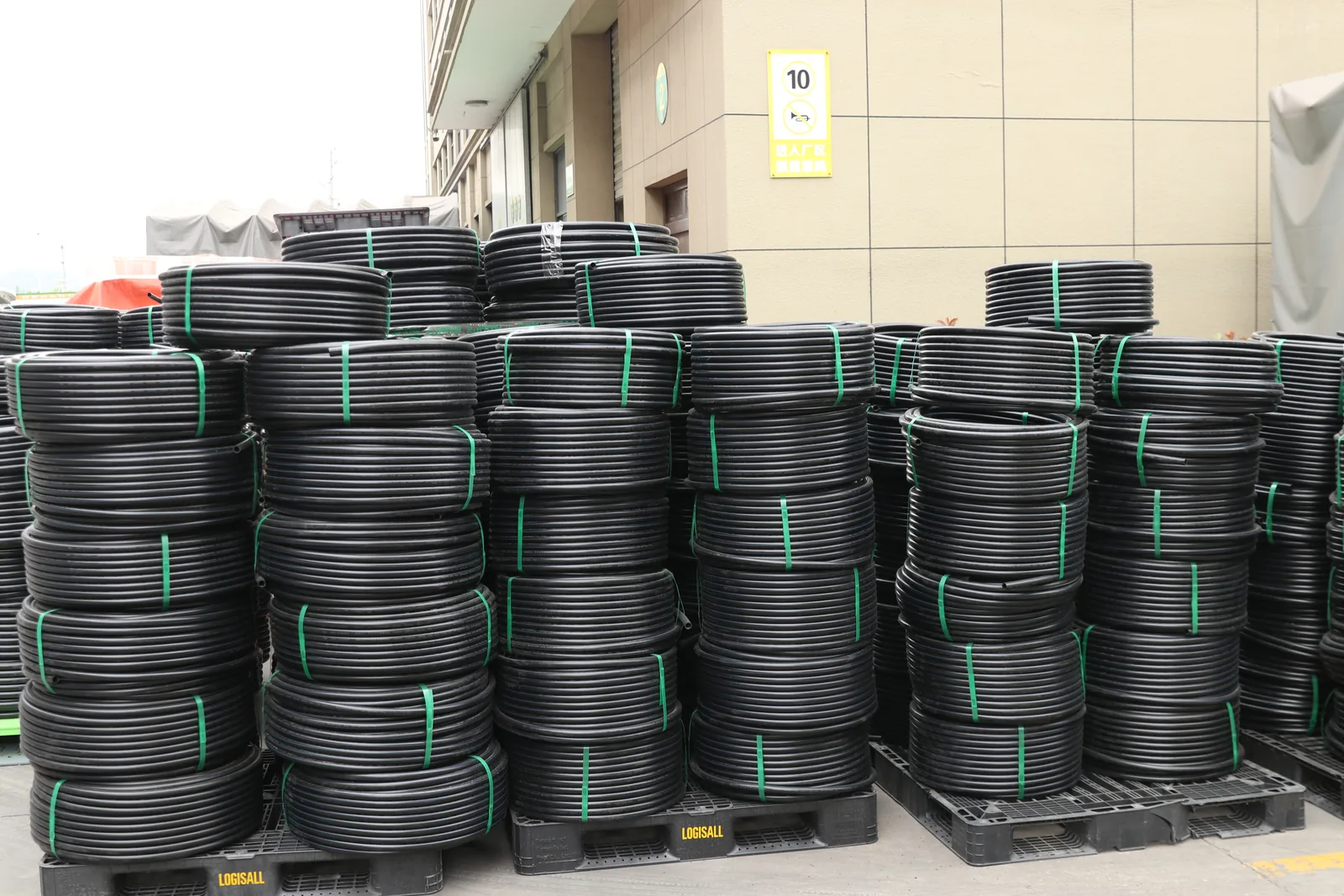
HDPE pipe size chart: OD, wall thickness and weight
The table below is the metric DN/OD series for PE 100, covering the two classes that account for most water and irrigation work: SDR 11 (PN 16) and SDR 17 (PN 10). Diameter and wall figures are from ISO 4427-2. Mass per metre is from a PE 100 technical data sheet conforming to ISO 4427 and DIN 8074 at a design stress of 8 MPa, cross-checked against the standard’s wall thicknesses at every row shown.
| DN / OD | OD min–max (mm) | Max ovality (mm) | SDR 11 wall min–max (mm) | SDR 11 kg/m | SDR 17 wall min–max (mm) | SDR 17 kg/m |
|---|---|---|---|---|---|---|
| 20 | 20.0–20.3 | 1.2 | 2.0–2.3 | 0.118 | — | — |
| 25 | 25.0–25.3 | 1.2 | 2.3–2.7 | 0.173 | — | — |
| 32 | 32.0–32.3 | 1.3 | 3.0–3.4 | 0.282 | 2.0–2.3 | 0.198 |
| 40 | 40.0–40.4 | 1.4 | 3.7–4.2 | 0.434 | 2.4–2.8 | 0.299 |
| 50 | 50.0–50.4 | 1.4 | 4.6–5.2 | 0.673 | 3.0–3.4 | 0.458 |
| 63 | 63.0–63.4 | 1.5 | 5.8–6.5 | 1.06 | 3.8–4.3 | 0.728 |
| 75 | 75.0–75.5 | 1.6 | 6.8–7.6 | 1.48 | 4.5–5.1 | 1.03 |
| 90 | 90.0–90.6 | 1.8 | 8.2–9.2 | 2.14 | 5.4–6.1 | 1.47 |
| 110 | 110.0–110.7 | 2.2 | 10.0–11.1 | 3.18 | 6.6–7.4 | 2.19 |
| 125 | 125.0–125.8 | 2.5 | 11.4–12.7 | 4.12 | 7.4–8.3 | 2.79 |
| 140 | 140.0–140.9 | 2.8 | 12.7–14.1 | 5.13 | 8.3–9.3 | 3.50 |
| 160 | 160.0–161.0 | 3.2 | 14.6–16.2 | 6.74 | 9.5–10.6 | 4.57 |
| 180 | 180.0–181.1 | 3.6 | 16.4–18.2 | 8.51 | 10.7–11.9 | 5.77 |
| 200 | 200.0–201.2 | 4.0 | 18.2–20.2 | 10.5 | 11.9–13.2 | 7.12 |
| 225 | 225.0–226.4 | 4.5 | 20.5–22.7 | 13.3 | 13.4–14.9 | 9.03 |
| 250 | 250.0–251.5 | 5.0 | 22.7–25.1 | 16.3 | 14.8–16.4 | 11.1 |
| 280 | 280.0–281.7 | 9.8 | 25.4–28.1 | 20.5 | 16.6–18.4 | 13.9 |
| 315 | 315.0–316.9 | 11.1 | 28.6–31.6 | 25.9 | 18.7–20.7 | 17.6 |
| 355 | 355.0–357.2 | 12.5 | 32.2–35.6 | 32.9 | 21.1–23.4 | 22.4 |
| 400 | 400.0–402.4 | 14.0 | 36.3–40.1 | 41.7 | 23.7–26.2 | 28.3 |
| 450 | 450.0–452.7 | 15.6 | 40.9–45.1 | 52.8 | 26.7–29.5 | 35.8 |
| 500 | 500.0–503.0 | 17.5 | 45.4–50.1 | 65.2 | 29.7–32.8 | 44.2 |
| 560 | 560.0–563.4 | 19.6 | 50.8–56.0 | 81.7 | 33.2–36.7 | 55.4 |
| 630 | 630.0–633.8 | 22.1 | 57.2–63.1 | 103 | 37.4–41.3 | 70.2 |
Diameter, ovality and wall thickness from ISO 4427-2. Mass per metre from a PE 100 technical data sheet conforming to ISO 4427 and DIN 8074, MRS 10, design stress 8 MPa. Dashes indicate a class the standard does not publish at that diameter.
Read a row across and it answers a different question at each column. The OD band tells the goods-in inspector what a caliper may legitimately show. The ovality figure tells him how much the coil is allowed to have gone out of round. The wall pair tells the engineer what he is entitled to and what he may receive. The kg/m tells the buyer what 500 kg actually buys and what a container will hold before it hits its weight limit.
Why wall thickness is a band, not a number
Almost every size chart online prints a single wall thickness. ISO 4427-2 does not. It publishes a minimum and a maximum for every combination of diameter and SDR, and the gap between them is wider than most buyers assume. At DN 110 SDR 11 the range is 10.0 to 11.1 mm — an 11% spread. At DN 315 SDR 11 it is 28.6 to 31.6 mm. At DN 630 SDR 11 it runs from 57.2 to 63.1 mm, nearly 6 mm of legitimate variation on a single specification.
This is not a loophole. Extrusion cannot hold a single dimension across a production run, so the standard sets a floor that guarantees the pressure rating and a ceiling that stops a manufacturer overbuilding into the next class. But it has a direct commercial consequence, and it is the one that generates the most disputes on arrival.
Why two honest quotes weigh different amounts
Two suppliers quote DN 110 SDR 11. One runs the line near the minimum, the other targets the middle of the band. Both ship compliant pipe. The second supplier’s pipe is heavier per metre, costs more to make, and — if the price was struck per kilogram — costs the buyer more for the same number of metres. The reflex is to assume the heavier pipe is the better product. Often it is simply a different extrusion target, and paying a premium for wall thickness that the design never required is money spent on nothing.
The reverse error is more dangerous. A pipe consistently at the bottom of the band is compliant, but it has no margin left for the scoring, ovalisation and squeeze that happen on site. Where the line will be pulled through a trench, ploughed in or handled roughly by an inexperienced crew, specifying a mid-band target is a defensible engineering decision rather than a luxury.
What to put on the purchase order
- The material grade, not just the SDR — “PE 100, SDR 11” rather than “SDR 11”.
- The standard and its edition: ISO 4427-2:2019 or EN 12201-2:2024.
- Where wall matters, a target inside the band, not just “per standard” — for example “wall thickness 10.4 mm nominal, ISO 4427-2 tolerance”.
- Whether the price is per metre or per kilogram. On a mass-priced order the wall target and the invoice are the same conversation.
- For coils, the agreed out-of-roundness limit, because the standard leaves that to the parties.
SDR, PN and the material grade that links them
SDR is the outside diameter divided by the wall thickness. It is a shape, not a pressure. The pressure a given shape will hold depends on how strong the plastic is, and that is set by the material grade — which is why the same SDR number lands on a different PN depending on what the pipe is made of. Treat “SDR 11” as shorthand for “PN 16” and eventually a quote arrives in PE 80 and the line is rated for 12.5 bar instead of 16.
| Pipe series | PE 100 | PE 80 | PE 63 | PE 40 |
|---|---|---|---|---|
| SDR 7.4 | PN 25 | PN 20 | — | PN 10 |
| SDR 9 | PN 20 | PN 16 | — | PN 8 |
| SDR 11 | PN 16 | PN 12.5 | PN 10 | — |
| SDR 13.6 | PN 12.5 | PN 10 | PN 8 | PN 5 |
| SDR 17 | PN 10 | PN 8 | — | PN 4 |
| SDR 21 | PN 8 | PN 6 | PN 5 | PN 3.2 |
| SDR 26 | PN 6 | PN 5 | PN 4 | PN 2.5 |
Pressure classes are quoted at 20 °C for water. Above that the derating is real and it is steep, so a surface irrigation line running through a Gulf summer is not operating at its catalogue rating. For the derivation behind this table — how minimum required strength and the design coefficient produce the pressure figure — see our companion piece on HDPE pipe specifications: SDR, PN and wall thickness, which works through the formula rather than repeating the chart.
The small-diameter floor nobody mentions
Ask for DN 25 in SDR 17 and no compliant supplier can make it. ISO 4427-2 simply does not publish SDR 17 below DN 32, because the wall would fall under the minimum the standard allows. SDR 21 starts at DN 40 and SDR 26 starts at DN 50, for the same reason. The practical effect is that below about DN 32 the choice of pressure class disappears — the pipe is heavy-walled whether the application needs it or not, and a specification asking for a thin small-bore line is asking for something that does not exist.
Ovality: the size tolerance that decides whether fittings fit
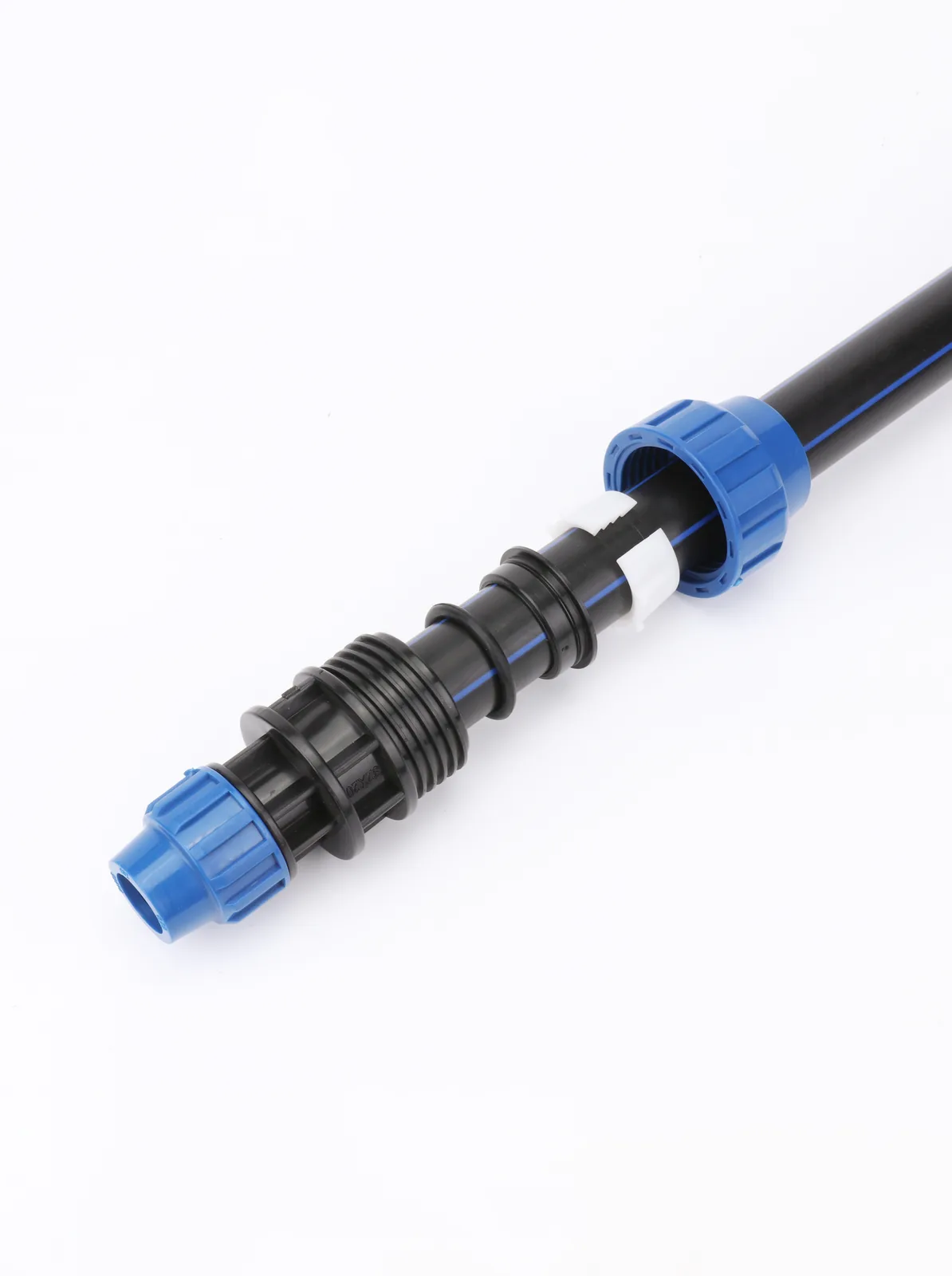
Diameter tolerance describes the average. Out-of-roundness describes how far the pipe departs from a circle, and it is a separate limit with its own column in the standard. A pipe can have a perfectly correct mean outside diameter and still refuse a fitting, because the compression ring or the electrofusion coupler has to close on a round section and the pipe arrived oval. This is the tolerance that matters most on a mechanical system: the PP compression fittings used across the smaller HDPE sizes seal by tightening a gripping ring onto the pipe wall, so they are less forgiving of an oval section than a butt-fused joint that is melted flat and reformed.
The allowance scales with diameter, but not smoothly. It runs 1.2 mm at DN 20, 2.2 mm at DN 110 and 5.0 mm at DN 250 — then jumps to 9.8 mm at DN 280. That is a 96% increase in permitted ovality for a 12% increase in diameter, in one size step. Anyone specifying across that boundary should know the tolerance regime effectively changes there, and that a DN 280 pipe arriving 9 mm out of round is not defective by the standard’s own measure.
Coiled pipe is outside the table
Here is the clause that matters most to anyone importing coils, and it appears in no competing size chart: for coiled pipe, and for straight lengths of DN 710 and above, ISO 4427-2 does not set a maximum out-of-roundness at all. The standard states it is to be agreed between the manufacturer and the purchaser. Coiling ovalises pipe by its nature, which makes the ovality your coils arrive with a contractual matter rather than a compliance one.
If nothing was agreed, nothing was breached — which is exactly the position an importer does not want to be in when a crew is standing over a trench with fittings that will not seat. The figures in the table above are measured at the point of manufacture, before coiling. Buying coils without an agreed ovality limit means buying a dimension nobody has committed to.
Metric DN or inch IPS: the 4 inch problem
Search for “4 inch HDPE pipe” and most of what comes back is written for the North American market, where pipe follows the IPS series and a 4 in pipe has an outside diameter of 114.3 mm. The metric answer to the same request is DN 110, at 110.0 mm. Those are different pipes. The 4.3 mm difference is far outside any tolerance in either system, and a compression fitting or electrofusion coupler made for one will not seal on the other.
| Spoken size | Metric DN / OD | US IPS OD | Difference |
|---|---|---|---|
| 1 inch | DN 32 — 32.0 mm | 33.4 mm | 1.4 mm |
| 2 inch | DN 63 — 63.0 mm | 60.3 mm | 2.7 mm |
| 3 inch | DN 90 — 90.0 mm | 88.9 mm | 1.1 mm |
| 4 inch | DN 110 — 110.0 mm | 114.3 mm | 4.3 mm |
| 6 inch | DN 160 — 160.0 mm | 168.3 mm | 8.3 mm |
| 8 inch | DN 200 — 200.0 mm | 219.1 mm | 19.1 mm |
Metric DN figures are the nominal outside diameters from ISO 4427-2; the IPS figures are the outside diameters the North American charts are built on. Notice the gap widens as size increases, and that at 2 inch and 3 inch the metric pipe is actually the larger of the two. There is no consistent direction to the error, which is why it survives so long undetected — a buyer who compensates in one size gets it wrong in the next.
How to write the request so it cannot be misread
Never order in inches. Write the outside diameter in millimetres and name the series: “DN 110 (OD 110 mm), PE 100, SDR 11, to ISO 4427-2:2019”. A supplier reading that cannot ship IPS pipe by accident. If a project drawing is in inches and the supply is metric, do the conversion once, at the specification stage, and put the millimetre figure on every subsequent document.
Across most of the MENA, African, European and Central Asian markets the metric DN series is the default. But a project financed or engineered from North America can arrive with IPS drawings attached to a metric bill of quantities, and that mismatch is discovered at the trench rather than in the office.
Pinning a metric size before you order?
For importers and distributors buying by the container who are sizing an outdoor, irrigation or municipal network in the 20–110 mm range: our HDPE page sets out the black HDPE pipe and blue PP compression fitting system as it is actually supplied — sockets, elbows, tees, ball valves and saddle clamps, all PN 10 and weld-free, with fittings from 20 to 110 mm and saddle clamps up to 315 mm. If your line runs heavier than PN 10 or larger than that fitting window, say so in your enquiry and it will be quoted against the pipe series instead. This is a wholesale range, not single-item retail.
Which standard and which edition your chart came from
A size chart with no edition on it is an undated document, and undated documents are how obsolete dimensions stay in circulation. Two standards govern this series in most of the markets served from Türkiye. Internationally it is ISO 4427-2, currently in its second edition of 2019, which cancelled and replaced the 2007 edition and has since been amended by Amendment 1:2023. In Europe it is EN 12201-2:2024, published in January 2024.
A further revision of the ISO document is at committee draft stage. It has not superseded anything, and a supplier who tells you the 2019 edition is out of date is either mistaken or managing a stock problem. Specify the 2019 edition with its amendment, or the 2024 European edition, and you are current as of this year.
What actually changed between editions
For the sizes most buyers deal in, less than the version numbers suggest. Comparing the diameter table row by row across the two editions, every value from DN 16 to DN 630 is unchanged — the same nominal diameters, the same upward-only tolerances, the same ovality allowances.
What the 2019 edition did was extend and tighten at the margins. The published series now continues past DN 2000 to DN 2250, 2500, 2800 and 3000, and ovality figures appear for DN 710 (24.9 mm) and DN 800 (28.0 mm) where the older edition simply printed a dash and left them to agreement.
The underlying tolerance reference also moved, from ISO 11922-1:1997 to ISO 11922-1:2018, with the same grade letters applied — grade B for sizes up to 630 and grade A from 710, grade N for ovality. For a buyer, the useful conclusion is that a chart quoting the older edition is not automatically wrong on the sizes you are buying, but a supplier who cannot say which edition his chart follows has told you something about how his documentation is maintained.
Dating a supplier’s catalogue in ninety seconds
- Find the standard reference. No edition year printed anywhere is the first warning.
- If it cites ISO 4427-2:2007 as current, the document predates 2019 or has never been revised.
- Check whether wall thickness is given as one number or as a min–max pair. One number means the chart was simplified for marketing, not copied from the standard.
- Look for an ovality column. Its absence is normal in marketing material and unacceptable in a technical submittal.
- Ask which edition the type-test reports were issued against. That is the answer that is hardest to improvise.
Bekaatherm references ISO 4427, EN 12201 and the DIN 8074 / 8075 dimensional standards for HDPE and PE pipe, and ISO 14236 for PP compression fittings. What those references are worth depends entirely on the certificates behind them, which is a separate check — our quality control page sets out what is tested and documented, and the approach to vetting any supplier’s paperwork is covered in how to vet an HDPE pipe manufacturer.
From the size chart to a real order
The kg/m column is where a dimension chart turns into an order. HDPE pipe is made, priced and shipped by mass, and every commercial constraint an importer meets is expressed in kilograms while every drawing is expressed in metres. The conversion is the whole job, and the chart above is what does it.
What the minimum order actually looks like in metres
The minimum for a single specification here is 500 kg per size and colour. That sounds abstract until it is divided by the mass per metre. At DN 110 SDR 11, 3.18 kg/m, 500 kg is about 157 m of pipe.
Take the same 500 kg in DN 110 SDR 17 at 2.19 kg/m and it becomes about 228 m — the lighter class buys 45% more length for the same minimum. Go up to DN 250 SDR 11 at 16.3 kg/m and 500 kg is roughly 31 m, which for a mains project is a single drum and change.
That arithmetic changes how a first order is planned. A buyer who wants three diameters in two pressure classes is looking at six separate 500 kg minimums, which on small sizes is a great deal of pipe and on large sizes is barely a delivery. Consolidating to fewer sizes, or accepting one pressure class across the range where the hydraulics permit it, is usually the difference between a workable first container and a warehouse full of DN 32.
A worked example: filling the first container
Take a distributor opening an irrigation range with DN 63, DN 90 and DN 110, all PE 100 SDR 11, at the 500 kg per size minimum. That is 1,500 kg of pipe: roughly 472 m of DN 63 at 1.06 kg/m, 234 m of DN 90 at 2.14 kg/m and 157 m of DN 110 at 3.18 kg/m.
A 20GP offers roughly 33 m³ of usable space against a payload of about 28 tonnes, so 1.5 tonnes of pipe is nowhere near the weight limit. HDPE pipe fills a container by volume long before it fills it by mass — the empty bore is what is being shipped.
This is the reason a trial order here is structured as one 20GP mixed container of pipe, fittings and valves rather than pipe alone. Fittings and valves are dense and small; they occupy the space pipe cannot use, and they are what the buyer needs anyway to sell a system rather than a commodity. Where a private-label run is involved the minimum moves up to one 40HQ — roughly 76 m³ — or 3 tonnes per colour on a first branded run, because a dedicated colour batch has its own economics.
| Order shape | Minimum | Lead time | Best for |
|---|---|---|---|
| Single specification | 500 kg per size and colour | 15–25 days on regular sizes | Topping up a range, or a project with a fixed bill of quantities |
| Mixed trial container | One 20GP, pipe + fittings + valves | 15–25 days on regular sizes | A distributor testing a new range without committing to one size |
| Private label / OEM | One 40HQ, or 3 tonnes per colour on a first branded run | 30–45 days, plus 7–10 days for a first colour match or new mould | Brands building their own range with regional exclusivity |
What a quote contains, since there is no price list
HDPE pipe is not sold from a published price list here, and any supplier who quotes a firm per-metre figure before knowing the size mix, the class and the destination is quoting something he will need to revise. Pricing follows the resin, and resin moves.
What a quote should contain is the FOB unit price against your actual size and SDR list, the loading plan that says what fits in the container you are paying for, and the compliance documents your destination market requires at customs. Terms here are FOB İstanbul or Mersin by default with CFR and CIF on request, payment at 30% T/T deposit and 70% against copy B/L, and an irrevocable L/C at sight is accepted from USD 50,000.
Ask for physical material before the deposit, and know the terms before you ask. Standard items are supplied at no charge up to three pieces with freight collect; branded items take 7–10 days, and that cost is credited against the first bulk order. There is no self-serve request form for this — it is agreed in the enquiry thread along with the sizes.
What it buys you is the one check this entire article is built around: put a caliper on the pipe, measure the wall, weigh a known length and see whether what is in your hand matches the row in the chart. The pipe carries a 50-year warranty against material and manufacturing defects, which is worth exactly as much as the dimensional discipline behind it. Measure first, and treat the warranty as what it is — a commercial term, not a substitute for verification.
What to check on arrival, and where a size chart stops
Every figure on this page is checkable with a caliper, a tape and a scale, which is unusual in B2B specification and worth exploiting. The procedure below is the documented dimensional check the standard itself implies — not a proprietary method, and deliberately written so it can be run against any supplier’s pipe, including ours.
The goods-in dimensional check
- Measure the outside diameter at two points 90° apart. Both readings must sit inside the OD band for that size, and the difference between them is your ovality figure.
- Compare that difference against the ovality column — remembering it applies at the point of manufacture, so coils will read worse and that is contractual, not a defect.
- Measure wall thickness at four points around the same cut end. Every reading must be at or above emin; none should exceed emax.
- Weigh a measured length and divide. The result should land near the kg/m in the chart — a figure well under it, with the wall still passing, points to the extrusion sitting at the bottom of the band.
- Read the pipe marking: it should carry the dimensions as dn × en, the SDR series, the material grade and the standard. A marking missing the grade is the same incomplete specification discussed above.
Where this stops is worth saying plainly. Dimensions are the cheapest thing to verify and the least of what can go wrong. None of the checks above says anything about the resin — whether it is genuine PE 100, whether regrind is present, or how the pipe will behave in year twenty. That requires type-test reports and batch certificates against the standard, which is a documentary check rather than a dimensional one, and it is the reason a chart like this is a starting point for a specification rather than a substitute for one.
Is this range right for your project?
| Best for | Not ideal for |
|---|---|
| Importers and distributors buying by the container for outdoor water, irrigation and municipal networks | Single-item retail or site-quantity top-ups below the per-size minimum |
| Metric DN/OD markets across MENA, Africa, Europe and Central Asia | Projects specified in the North American IPS series |
| Buyers who want a weld-free compression system in the smaller sizes rather than fusion equipment on site | Gas distribution, which is a different standard family and a different approval regime |
| Private-label brands wanting regional exclusivity agreed in writing per market | Buyers needing a published price list before any technical conversation |
Where the size list is settled and the question is commercial rather than dimensional, the importers and distributors page covers how partnerships are structured, and the seven numbers a real HDPE spec sheet shows is the companion check to run on any supplier’s documentation before you commit.
Have a size list already?
For buyers who have their sizes and pressure classes settled and need them costed: send the list as DN and SDR with the quantity in metres or kilograms, name the destination market, and you will get an FOB unit price against those exact lines, a loading plan for the container, and confirmation of which compliance documents can be issued for that market. There is no published price list — the resin moves, so the number is made against your list. Response within 24 hours.
Before you sign off on a size list
The failures that come from this subject are rarely dramatic. Nobody specifies a wildly wrong pipe. What happens is quieter: a size list written in inches against a metric supply, a coil order with no agreed ovality limit, a wall thickness accepted as “per standard” when the standard permits an 11% spread, an SDR quoted without the material grade behind it. Each one passes every casual review and each one surfaces at the trench, where the cost of being wrong is a crew standing idle and a container that cannot be sent back.
Check three things before a size list leaves your desk. That every diameter is written in millimetres with the series named, so IPS pipe cannot arrive against a metric drawing. That the material grade sits beside every SDR, because SDR 11 is four different pressure ratings depending on what follows it. And that anything arriving coiled has an ovality limit written into the order, because the standard deliberately does not supply one. Those three lines cost nothing to add and they close the gaps that this chart exists to expose.
Frequently asked questions
What are the standard HDPE pipe sizes in mm?
The metric DN/OD series runs 16, 20, 25, 32, 40, 50, 63, 75, 90, 110, 125, 140, 160, 180, 200, 225, 250, 280, 315, 355, 400, 450, 500, 560 and 630 mm, continuing to 3000 mm in the current edition of ISO 4427-2. The number is the outside diameter.
Is HDPE pipe measured by inside or outside diameter?
Outside diameter. ISO 4427-2 controls the outside diameter and the wall thickness; the bore is simply what remains and has no column in the standard. Ordering by internal diameter asks for a dimension nobody controls.
What is the outside diameter of 4 inch HDPE pipe?
It depends on the series. Metric DN 110 is 110.0 mm. North American IPS 4 in is 114.3 mm. The 4.3 mm difference means fittings are not interchangeable, so always write the request in millimetres.
What is the wall thickness of DN 110 HDPE pipe?
In SDR 11 it is 10.0 mm minimum and 11.1 mm maximum. In SDR 17 it is 6.6 mm minimum and 7.4 mm maximum. ISO 4427-2 publishes both limits, so any single figure you see is one end of a band.
What is the difference between SDR 11 and SDR 17?
SDR 11 has a thicker wall for the same outside diameter, giving PN 16 in PE 100 against PN 10 for SDR 17. It also weighs about 45 to 47% more per metre, which affects both price and how much length fits in a container.
How much does HDPE pipe weigh per metre?
For PE 100 at a design stress of 8 MPa, DN 110 is about 3.18 kg/m in SDR 11 and 2.19 kg/m in SDR 17. DN 160 is about 6.74 and 4.57 kg/m respectively. Actual mass varies within the wall tolerance band.
Why can I not get SDR 17 in small diameters?
ISO 4427-2 publishes no SDR 17 below DN 32 because the wall would fall below the standard’s minimum. SDR 21 begins at DN 40 and SDR 26 at DN 50, so small-bore pipe is heavy-walled by necessity.
Which edition of the HDPE pipe standard should I specify?
ISO 4427-2:2019 with Amendment 1:2023 internationally, or EN 12201-2:2024 in Europe. A revision is at committee draft stage but has superseded nothing, so the 2019 edition remains current.
Does the standard limit ovality on coiled pipe?
No. For coiled pipe, and straight lengths from DN 710 up, ISO 4427-2 leaves the maximum out-of-roundness to agreement between manufacturer and purchaser. Put a figure in the order or none applies.
How many metres of pipe is a 500 kg minimum order?
Divide 500 by the mass per metre. At DN 110 SDR 11, 3.18 kg/m, that is about 157 m. The same 500 kg in DN 110 SDR 17 gives roughly 228 m, and at DN 250 SDR 11 about 31 m.
Written by Thomas, Export Manager at Bekaatherm — a Turkish manufacturer of PPR, HDPE, PP silent drainage and UPVC systems, with 30 years of manufacturing across a 120,000 m² plant and 1000+ staff, supplying 98 items across 4 systems to 118+ countries. Dimensional data on this page is cited to ISO 4427-2; commercial terms are Bekaatherm’s own. Published 11 August 2026.