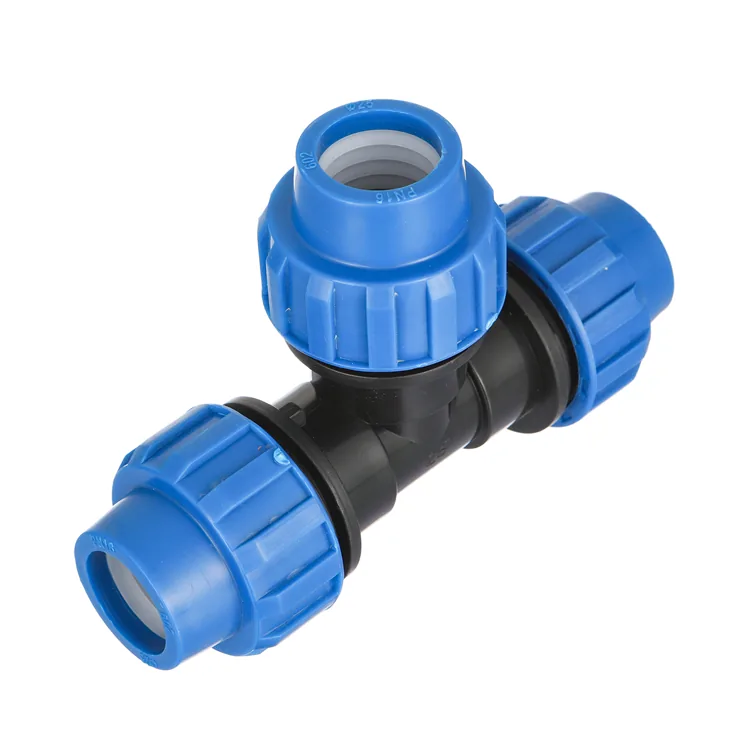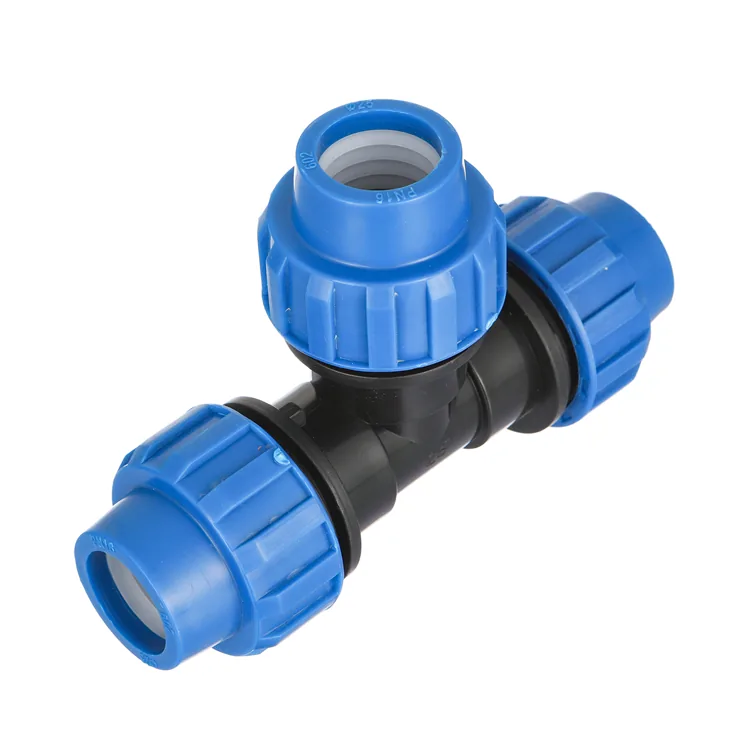
Three ways exist to join a polyethylene water line, and the choice is usually made by the site rather than the engineer. PE compression fittings win where there is no power, no trained welder, and a trench with water in the bottom. Butt fusion wins on long runs of one diameter. Electrofusion wins where the pipe cannot move and the diameters do not match. Picking the wrong one is how a joint ends up failing inside a wall or under a road.
One detail decides more of these arguments than pressure class does: two of the three methods refuse to join pipes of different wall thickness. Butt fusion needs identical diameter and wall thickness on both sides. Electrofusion will happily bridge a PE80 pipe to a PE100 pipe at a different SDR — but the whole system then drops to the pressure rating of the weakest component in it. That single rule quietly re-rates a lot of networks that nobody re-rated on paper.
Key Takeaways
- ISO 14236:2000 is withdrawn. It was withdrawn on 25 February 2019 and superseded by ISO 17885, now in its second edition, ISO 17885:2021. If a compression fitting datasheet still cites ISO 14236, it is citing a dead document.
- ISO 17885 excludes hot and cold water inside buildings. Its application areas are gaseous fuels, water for human consumption, pressure sewerage, irrigation and industrial use — buried and external work, not indoor plumbing.
- Butt fusion needs matching wall thickness. Default practice is to butt weld only pipes and fittings of the same diameter and wall thickness. Where wall thickness varies, use electrofusion or a mechanical fitting.
- Mixed grades drop the system rating. Electrofusion can join PE80 to PE100 and different SDRs, but the system PN then equals that of the lowest-rated component.
- Pipe preparation causes most electrofusion failures. Improper preparation is the overwhelmingly leading cause of unsuccessful electrofusion joints. Minimum peel depth is 0.2 mm for DN25–DN225 and 0.3 mm above DN225, using mechanical peeling tools only.
- Compression joints pull out without a stiffener. A compression coupling needs a rigid insert in the pipe bore to resist pullout. Above 4″ IPS, couplings may not be fully restrained at all.
- Size bands overlap but do not match. Bekatherm compression fittings run 20–110 mm at PN10, with saddle clamps to 315 mm. Butt fusion starts around 90 mm OD; electrofusion is common to 250 mm with no technical upper limit.
The three methods side by side
All three methods are legitimate. EN 12201-3:2024, the current European standard for PE fittings, covers electrofusion socket fittings, electrofusion saddles, spigot fittings for butt fusion, socket fusion fittings, mechanical fittings and fabricated fittings inside one document. So the choice is not a quality ranking. It is a question of what the site can support.
| Factor | Compression | Butt fusion | Electrofusion |
|---|---|---|---|
| Typical size band | 20–110 mm; saddles to 315 mm | 90 mm OD and up; some specs allow 63 mm | Common to 250 mm; no technical upper limit |
| Site power needed | None | Yes, plus a machine on level ground | Yes, 230 V ±15% stable under load |
| Joins mixed SDR / grade | Yes, within the fitting’s OD range | No — same diameter and wall thickness | Yes, but system PN drops to the lowest part |
| Wet or dirty trench | Workable | No | No — surfaces must be clean and dry |
| Consumable per joint | A fitting | None | A fitting with an embedded coil |
| Joint test standard | Per ISO 17885 fitting specification | ISO 13953 tensile and failure mode | ISO 13954, 13955, 13956, 21751 |
| Suits trenchless work | No | Yes — low profile, bead can be removed | Poorly — fittings protrude above the pipe |
Read the bottom two rows together and a pattern appears. Butt fusion produces the only joint that is essentially the same shape as the pipe, which is why pipe bursting, directional drilling and sliplining all specify it. Electrofusion fittings sit proud of the pipe wall, so pulling one through a bore is asking for trouble. Compression fittings sit proud too, and they need access to tighten. Neither belongs on a trenchless pull.
Which standard actually applies (and one that no longer does)
Check the standard number on your compression fitting datasheet. If it says ISO 14236, that reference is dead. ISO 14236:2000, the old specification for mechanical-joint compression fittings on PE water pipes, was withdrawn on 25 February 2019. Its replacement is ISO 17885, Plastics piping systems — Mechanical fittings for pressure piping systems — Specifications, whose second edition was published on 21 June 2021 and replaced the 2015 edition.
A withdrawn standard number on a submittal is not a technicality. It tells a reviewing engineer that nobody has opened the specification in six years.
ISO 17885 sorts fittings by application area code, and the codes matter when you write a specification. It covers gaseous fuels (GAS), water for human consumption (W), sewerage under pressure (P), irrigation (I) and industrial applications (IS). It explicitly excludes flanges, district heating, and — the one that catches people — mechanical fittings for hot and cold water systems inside buildings. A compression fitting is the correct answer for a buried service connection and the wrong answer for a riser in a plant room.
Two more currency checks are worth running on your own documents. EN 12201-3:2024 was published on 30 January 2024 and superseded EN 12201-3:2011+A1:2012, adding PE 100-RC materials and allowing operating pressures up to 25 bar at a 20 °C reference temperature. For pipe itself, the live ISO references are ISO 4427-1:2019 with Parts 2 and 3, Part 2 carrying Amendment 1:2023. Plenty of tender documents still quote the 2011 and 2007 editions.
Butt fusion has its own procedure standard, ISO 21307:2017, with Amendment 1:2020, reviewed and confirmed in 2023. Fusion equipment falls under the ISO 12176 series: Part 1 for butt fusion equipment, Part 2 for electrofusion control units, Part 3 for the operator’s badge and Part 4 for traceability coding.
PE compression fittings: best for, not for
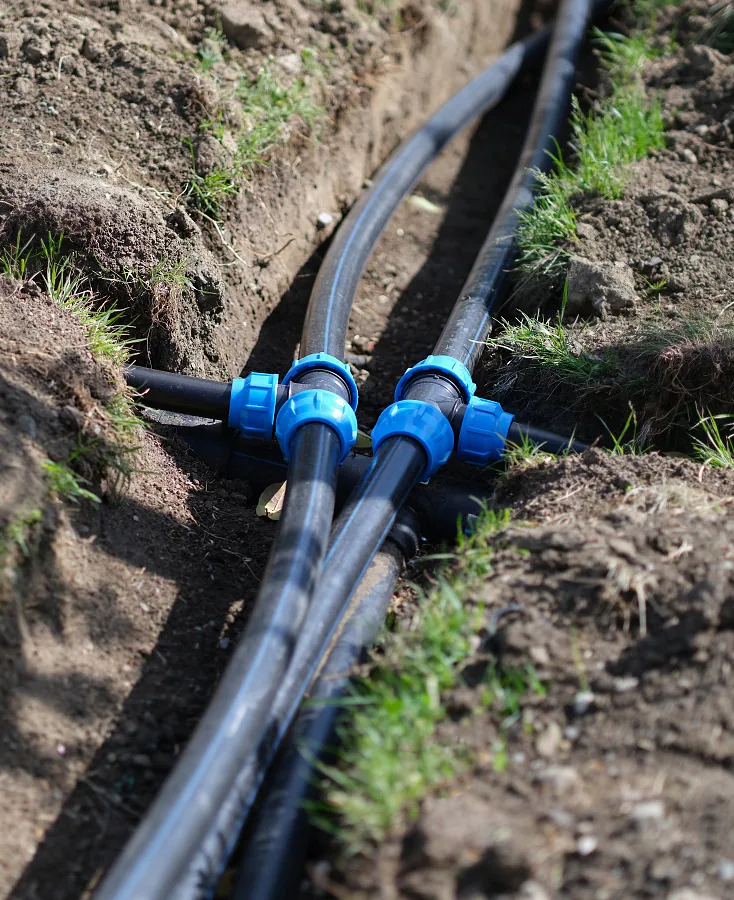
The honest case for mechanical assembly does not come from fitting suppliers. The PE100+ Association, an industry body of material producers, puts it plainly: mechanical assembly is used when fusion is unsuitable — connecting PE to other pipe materials, or where site conditions prevent fusion, such as wet and dirty conditions in the bottom of an excavation, or areas lacking a power supply and trained operators.
Best for
- Service connections and small mains up to 110 mm. Bekatherm’s compression range runs 20–110 mm at PN10, with saddle clamps up to 315 mm and threaded transitions from 1/2″ to 4″.
- Sites with no reliable power. Rural irrigation, remote pump houses, and any job where a generator is one more thing to hire and fuel.
- Repairs and tie-ins under time pressure. There is no cooling cycle, so the line can be pressure tested as soon as the joint is made up.
- Transitions to metal. Threaded transition fittings put the thread on the fitting body, where it belongs.
- Crews without a welding certificate. Assembly is a mechanical task with a torque and insertion check, not a qualified welding operation.
Not for
- Hot and cold water inside buildings. ISO 17885 excludes that application from its scope.
- Large-diameter mains. Compression couplings are commercially available for OD-controlled pipe through 12″ IPS, but sizes above 4″ IPS may not be fully restrained. That restraint threshold is roughly why practical compression ranges stop near 110 mm.
- Trenchless installation. The fitting profile and the need for access rule it out.
- Joints you can never reach again. A mechanical joint is a serviceable joint by design. Encasing one in concrete removes the only advantage it has over a weld.
One more thing about threads, because it causes real failures. Pipe threads are not recommended for joining OD-controlled polyethylene pipe. Threaded PE pipe strips or cross-threads easily, and cutting a thread reduces the wall thickness at exactly the point carrying the load. The thread belongs on a moulded fitting body; it should never be cut into the pipe itself.
Butt fusion: best for, not for
Butt fusion consumes no fitting at all. Two pipe ends are faced, heated against a plate and pushed together, producing a homogeneous joint with the same bore as the pipe. On a long single-diameter run, nothing beats it on consumable cost. The catch is everything around it: a machine sized for the diameter, level ground, clean conditions, power, and an operator who knows which of three procedures he is running.
ISO 21307 defines three distinct procedures, and their parameters must not be mixed. Single pressure low (SLP) holds 0.15 MPa through the fusion and cooling cycle. Dual pressure low (DLP) fuses at the same pressure but drops to 0.025 MPa during cooling, used mainly by the UK water industry on wall thickness over 22 mm. Single pressure high (SHP) works at 0.517 MPa — roughly three times the low-pressure figure — which extrudes more molten material and allows a reduced cooling time.
That reduced cooling time is the actual speed argument for butt fusion, and it is worth stating as a mechanism rather than a slogan. SHP does not heat faster. It shortens the part of the cycle where the crew stands and waits. A European evaluation project run from 2008 to 2011, reported at Plastics Pipes XVI in Barcelona in 2012, concluded that good performance welds can be obtained by all three procedures for thickness up to 70 mm — though SHP weld test samples appeared less ductile.
The rule that decides most jobs
Default practice is that only pipes and fittings of the same diameter and the same wall thickness should be butt welded together. Where wall thickness varies, the guidance is to switch to electrofusion fittings, mechanical fittings, or ask the manufacturer. This is the hinge of the whole comparison. A contractor who has 110 mm SDR11 on one side and 110 mm SDR17 on the other does not have a butt fusion decision to make — he has an electrofusion or compression decision, whatever the programme says.
Butt fusion is best for runs of 90 mm OD and larger where one diameter repeats hundreds of times, and for trenchless work where the bead can be removed. It is not for tie-ins to pipe of unknown SDR, confined trenches the machine will not fit, or repairs where the line cannot be pulled apart to admit a clamp.
Electrofusion: best for, not for
Electrofusion moves the cost into the fitting and buys back flexibility. The fitting contains a resistance coil; the control unit reads a barcode and applies the right energy. Because the pipe ends do not have to be forced together by a machine, electrofusion works in tight trenches and on repairs where the pipe cannot move. It also does the one thing butt fusion cannot: it joins pipes made from different PE material grades, such as PE80 to PE100, and different SDRs.
There is a price for that flexibility, and it is easy to miss on a drawing. Where different materials or SDRs are joined, the pressure rating of the system equals that of the lowest-rated component in it. A PE100 SDR11 main tied into an older PE80 section is now a PE80 system at that point, whatever the newer pipe is stamped with. If the design pressure was set by the new pipe, the design is wrong.
Weather is the other constraint that catches planners. Electrofusion welding machines have upper and lower temperature operating limits of −10 °C to 45 °C. Black pipe sitting in direct sun can reach a surface temperature of 70 °C, so it must be shaded down to 45 °C or less before welding. On a Gulf or inland Anatolian summer job, that turns electrofusion into early-morning work or shade-tent work — a scheduling fact, not a footnote.
Electrofusion is best for repairs, tie-ins, mixed-SDR connections and saddle branches on live networks. It is not for trenchless pulls, unstable power, or a crew working in rain without shelter. In a trench, a minimum clearance of 150 mm is required around the pipe — if the excavation is tighter, the joint cannot be made properly no matter who holds the control unit.
How each method fails on site
Each method has one dominant failure mode, and knowing which one you are exposed to beats any general reliability claim. What follows carries no failure-rate percentages, because no authoritative source publishes them. What the industry bodies do publish is the cause.
Compression: pullout, and the missing stiffener
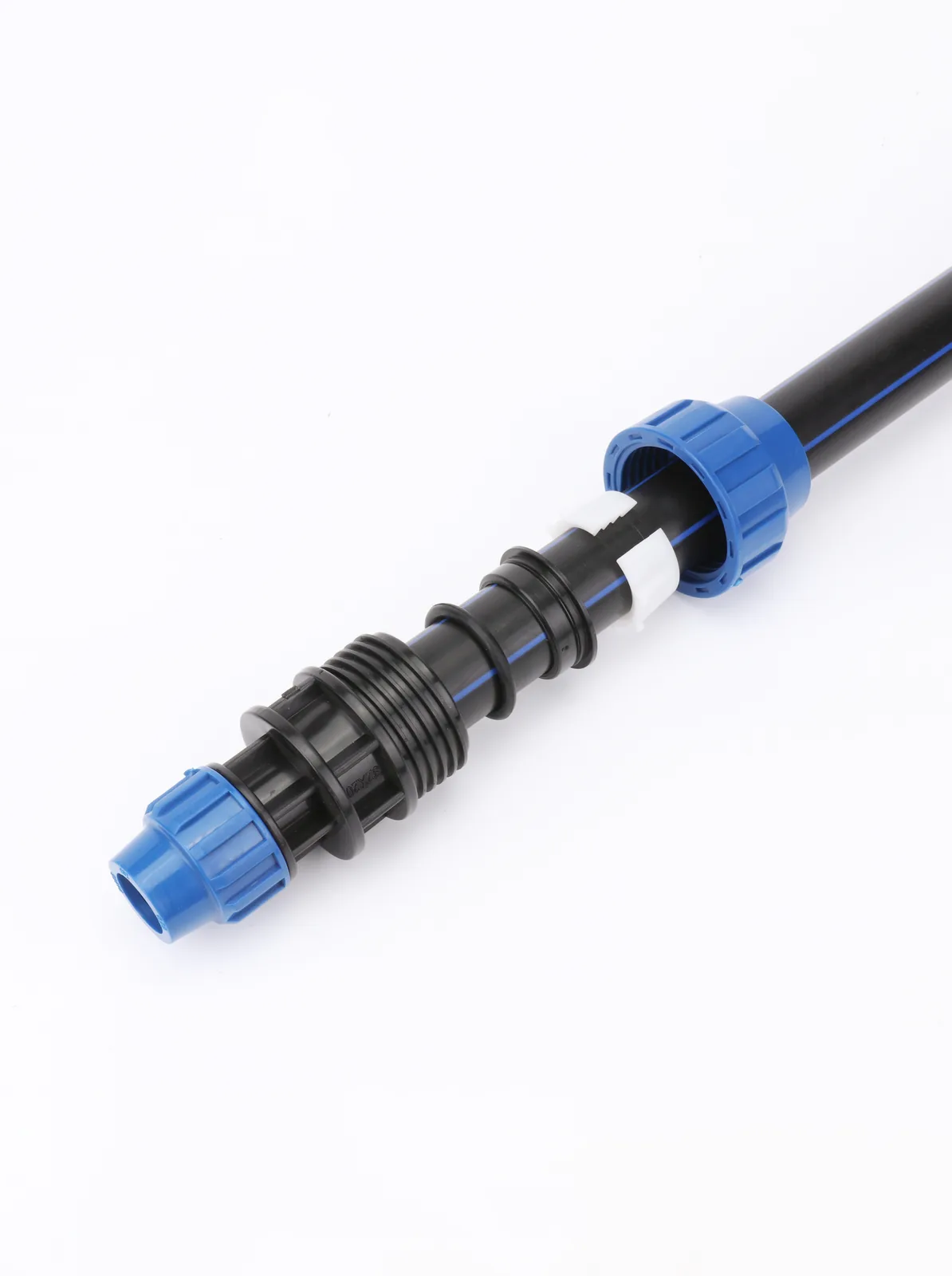
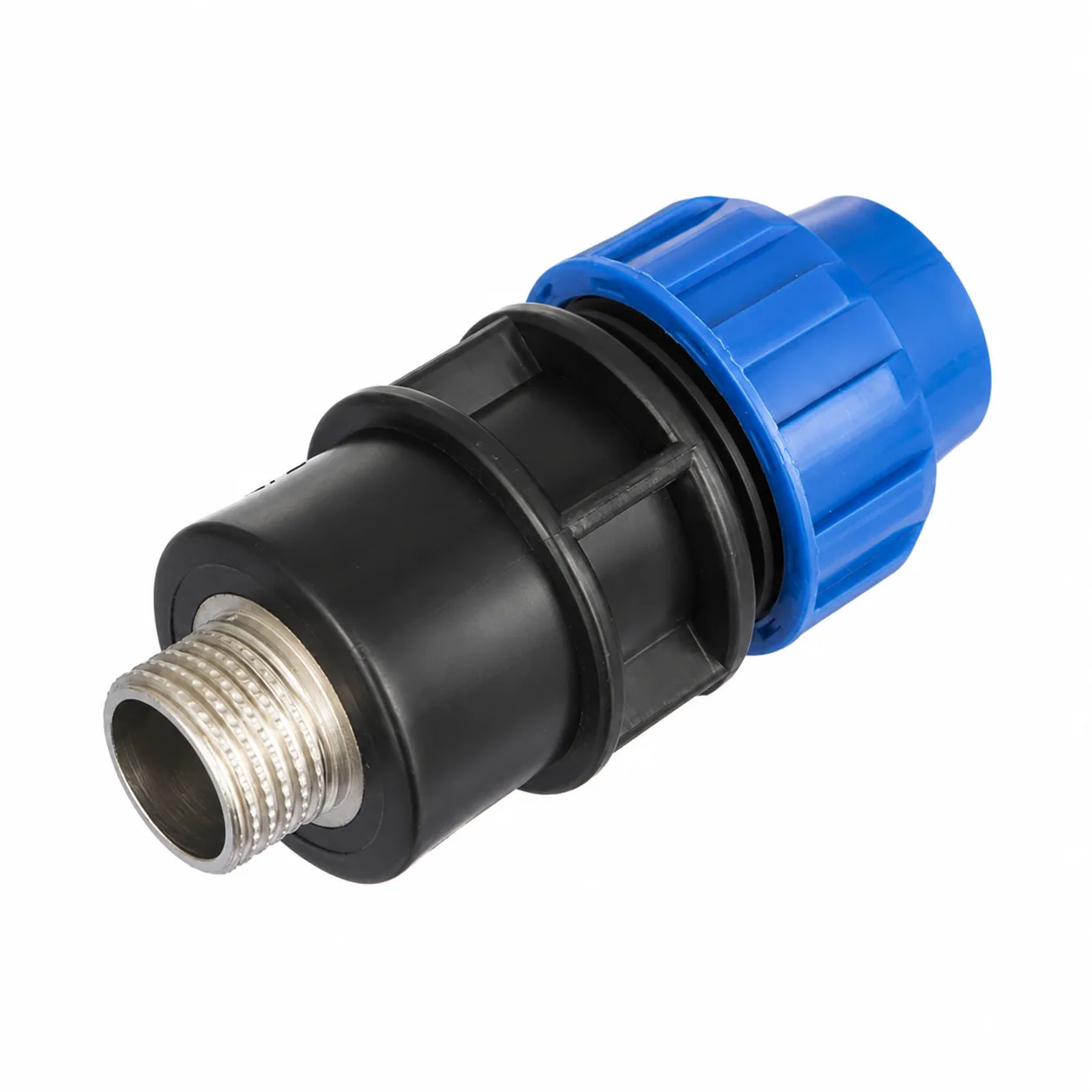
Compression couplings require a stiffener in the pipe bore for pullout resistance. Pullout-resistant mechanical joints work by compressing the pipe wall between an external compression sleeve and a rigid tube or stiffener inside the pipe. Leave the stiffener out and the nut simply squeezes a flexible tube that deforms away under longitudinal load. The joint may pass a pressure test on the day and walk apart months later under thermal movement or ground settlement.
Partially restrained couplings are a separate trap. These clamp the pipe end without an insert stiffener, and they may withstand some longitudinal tensile load without completely preventing pullout. On a buried main with an unanchored bend, “some” is not a design value. Check whether the coupling you have specified is fully restrained before you rely on it to hold a thrust load.
Electrofusion: preparation, not the weld
Industry guidance is blunt about this. Pipe preparation is described as perhaps the most important and least understood aspect of making a correct electrofusion joint, and improper pipe preparation is overwhelmingly the leading cause of unsuccessful electrofusion joint attempts. The oxidised skin on the pipe surface must be removed, not polished.
- Peel depth: minimum 0.2 mm for DN25–DN225, and 0.3 mm above DN225. Hand scrapers must not be used — mechanical peeling tools only.
- Ovality: below DN315, the difference between the two measured diameters must stay under 1.5% of DN or 3 mm, whichever is smaller. At DN315 and above it is 1% of DN or 5 mm, whichever is smaller. Maximum flat spot depth is 3 mm.
- Re-rounding: re-rounding tools must stay in place during welding and throughout cooling, not just while the coil is energised.
- Power: keep 230 V ±15% under load at a stable 50–60 Hz. Extension cables must not exceed 50 m and must be fully unrolled. Most machine errors trace back to an inadequate or unstable supply.
- Cooling: clamps stay on through fusion and cooling, and cooling must never be shortened by pouring cool water over the fitting.
The last one has a schedule consequence people rarely price in. If a weld is interrupted partway through, the assembly has to cool below 45 °C before another attempt, and depending on fitting size and conditions that can take up to 24 hours. One aborted weld on a large fitting can cost a day. That is the real speed comparison — not minutes per joint, but what happens when something goes wrong.
Butt fusion: mismatched ends and mixed parameters
Butt fusion fails when the two ends were never compatible or when the operator blends parameters from two procedures. Running SHP pressure with an SLP cooling time is not a shortcut; it is a different weld from the one the standard validated. Proof is a destructive test to ISO 13953, which measures tensile strength and failure mode. For electrofusion the equivalents are ISO 13954 for peel decohesion at DN90 and above, ISO 13955 for crushing decohesion, ISO 13956 for saddle fusion tear tests and ISO 21751 for strip-bend decohesion. Naming the right test standard per joint type in your ITP signals a specification written by someone who has done this.
Operator competence sits behind all of it. Industry practice recommends reaccrediting welders every two to three years, and putting butt fusion supervisors with at least three years of relevant experience on major projects. Certification schemes are region-specific, so treat that as good practice to write into a subcontract rather than a universal legal requirement — confirm what your own market’s water authority actually mandates.
Where the cost really sits
Anyone quoting a fixed percentage difference between these methods is guessing. Fitting prices move with resin, diameter, region and order size, and per-joint minute figures depend on diameter, wall thickness and what the fitting barcode tells the control unit. The structure of the cost is stable, though.
Butt fusion has zero consumable cost per joint and a high fixed cost: the machine, its transport, its calibration, the power to run it and the certified operator standing next to it. Electrofusion inverts that — a modest control unit, but every joint consumes a fitting with copper wire moulded into it. Compression sits closest to electrofusion on consumables and lowest on everything else, since the tooling is a spanner and the labour is unqualified for welding purposes.
So the crossover is driven by joint count, not by unit price. A 4 km main of one diameter amortises a fusion machine over hundreds of welds and butt fusion wins easily. Forty service connections scattered across a village never amortise anything, and the machine mobilisation alone can exceed the entire fitting spend. Count your joints and your mobilisations before you compare any two catalogue prices.
A worked decision: 4 km irrigation main
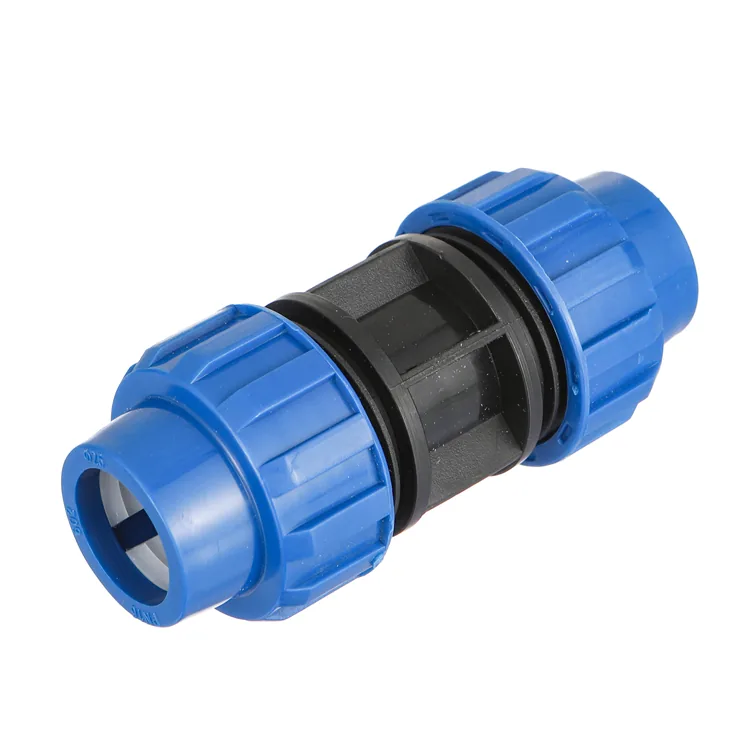
Take a farm irrigation scheme: a 4 km buried main at 110 mm, plus 60 lateral branches down to 32 mm feeding sprinkler lines, plus a tie-in to an existing PE80 section of unknown SDR at the pump house. Grid power reaches the pump house only. Summer daytime temperatures put black pipe well above 45 °C in the open. Here is how the three methods sort themselves out.
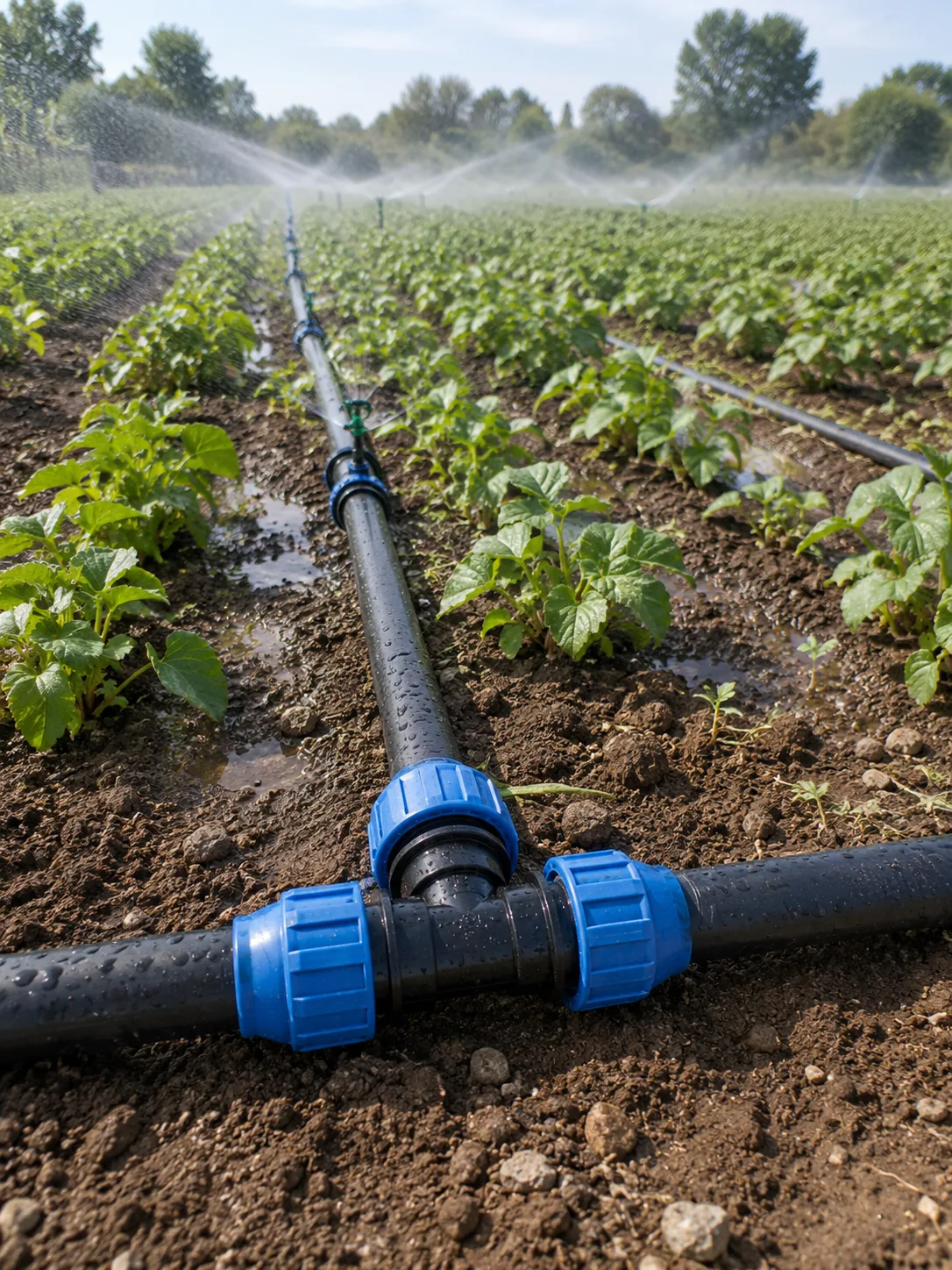
The 4 km main is one diameter with a repeating joint, so butt fusion is the right call for the trunk if a machine and generator can reach the route. At 110 mm it is comfortably above the 90 mm OD threshold where butt fusion becomes practical. If the route is inaccessible to a machine, the trunk falls back to compression couplers at PN10, which the duty in an irrigation main normally allows.
The 60 laterals are a different problem. Each one is a small-diameter branch in an open trench, spread over kilometres, with no power. Dragging a fusion setup to 60 separate points is the mobilisation cost that kills the budget. Compression tees and saddle clamps are the answer, and ISO 17885 covers irrigation explicitly under application code I. Saddle clamps up to 315 mm mean the branch method still works if the trunk diameter grows in a later phase.
The pump house tie-in is where the rules bite. Existing PE80 of unknown SDR rules out butt fusion outright — the wall thicknesses will not match and nobody can confirm them. Electrofusion can join PE80 to PE100 across SDRs and power exists at that one location, so it is viable. But the system is then rated at the lowest-rated component, so the design pressure at that node must be recalculated on the PE80 side, not the new pipe. If shading cannot bring the summer surface temperature under 45 °C, that weld waits for early morning. A restrained compression coupling removes both the temperature window and the recalculation ambiguity, provided thrust loads at that point are anchored.
How we check a compression fitting before it ships
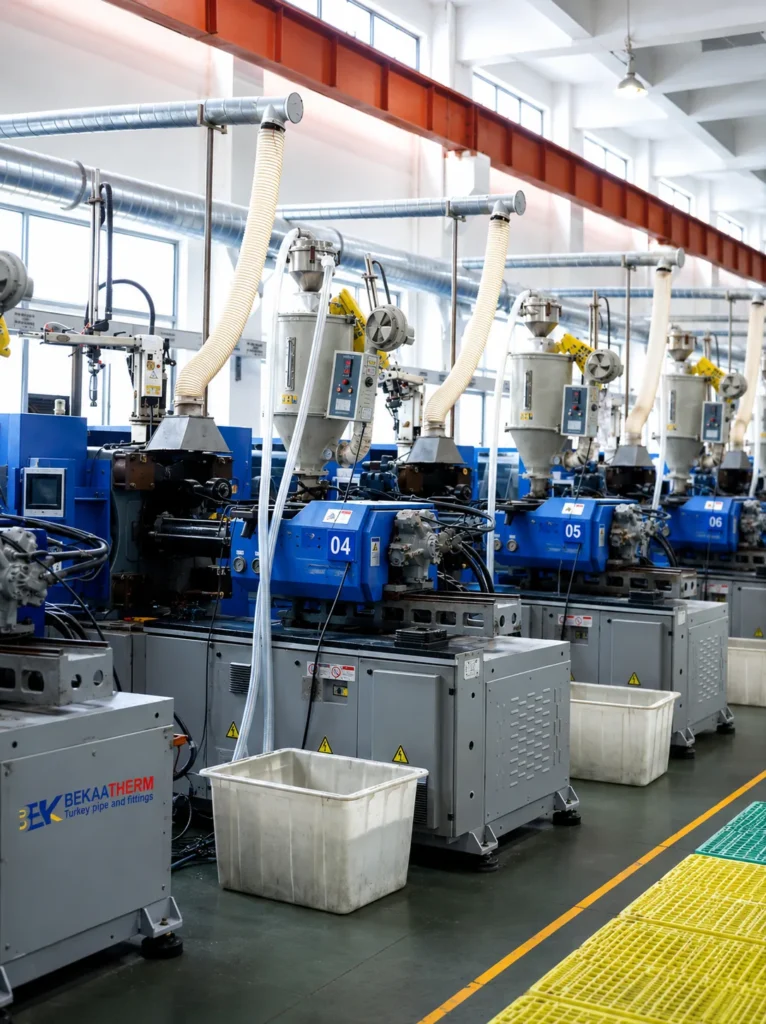
Bekatherm manufactures across 120,000 m² with 1000+ staff and 10,000 moulds, running 98 items across 4 systems into 118+ countries over 30 years. Scale on its own proves nothing about the box that lands on your site, so here is what actually gets verified on a compression order.
- Component count per fitting. Body, compression nut, sealing ring, grip ring and internal stiffener. The stiffener is the part that gets dropped from a cheap bill of materials, and it is the part that resists pullout.
- Pressure class marked on the body. The compression line is PN10 across the range. Where a stated rating differs by size, it is confirmed in writing on the proforma invoice rather than left to a catalogue page.
- Standard reference on the documentation. ISO 17885 for mechanical fittings, since ISO 14236 is withdrawn. Certification is held against SKZ (Germany), ISO, CE and WRAS.
- Origin documents agreed before shipment. Supply runs from Türkiye and a Chinese partner factory, allocated by market. The origin for your order is confirmed in writing on the proforma invoice, and the certificate of origin, packing list and bill of lading must agree.
- Thread form on transition fittings. Threads 1/2″ to 4″ are moulded onto the fitting body. No thread is ever cut into the PE pipe.
On design life, the correct technical anchor for a PE line is the material’s MRS value. PE100 and PE100-RC have an MRS of 10.0 MPa and PE80 an MRS of 8.0 MPa, determined by regression analysis under ISO 9080 on long-term pressure test data, predicting minimum strength at 20 °C over a 50-year design lifetime. Bekatherm’s 50-year warranty against material and manufacturing defects sits alongside that basis. It covers material and manufacture, not installation error — and on the evidence above, installation is where most joint failures start.
If the route will be laid without a full sand bed, or pulled through ground with sharp fill, ask about PE100-RC specifically. The notched pipe test under ISO 13479 requires more than 500 hours for conventional PE100, but more than 8760 hours — a full year — for PE100-RC. That difference in slow crack growth resistance is the entire reason the grade exists.
Ordering terms
Compression fittings are dense and awkward, and pipe is bulky, so the two rarely fill a container at the same rate. Mixing them is normally the only sensible first order. Prices are quoted on request against a specific size list — what a quotation contains is the FOB unit price, the container loading plan and the certificate package.
| Term | Value |
|---|---|
| Trial order | One 20GP mixed container (pipe + fittings + valves) |
| Single size minimum | 500 kg per size and colour |
| Lead time, in-production sizes | 15–25 days |
| Lead time, private label | 30–45 days |
| Payment | 30% T/T deposit, 70% against copy B/L |
| Trade terms | FOB İstanbul or Mersin by default; CFR and CIF on request |
| 20GP capacity | Roughly 33 m³ usable against a ~28 tonne payload |
| 40HQ capacity | Roughly 76 m³ |
The 20GP number is the one worth planning around. At roughly 33 m³ usable against a 28 tonne payload, a compression fitting order fills the weight allowance long before the volume on small sizes, and the reverse is true for coiled pipe. Send the size list rather than a target container count, and let the loading plan come back from that.
Conclusion
The method is chosen by the joint, not by the project. Repeating joints at one diameter with power and access go to butt fusion. Mixed SDRs, repairs and congested trenches go to electrofusion, with the system re-rated to the weakest component. Everything scattered, unpowered, wet or bound for a metal thread goes to compression — inside the size and application limits that ISO 17885 actually sets, which do not include hot and cold water inside buildings. For the wider four-method frame — including where socket fusion fits and what each choice does to the order — see our HDPE pipe jointing methods comparison.
Before your next PE order, check two things on your own documents: whether any datasheet still cites ISO 14236, and whether the compression couplings you specified are fully restrained with an internal stiffener at every size you bought. Both take ten minutes and both prevent the kind of failure that surfaces long after handover.
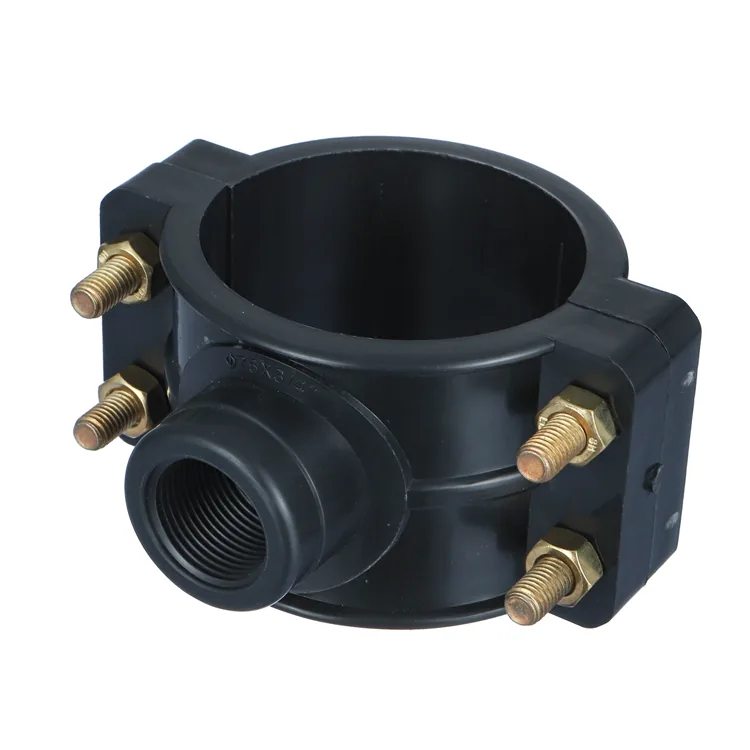
If certification wording is the gate on your tender rather than the fitting itself, the certifications page lists what is held and against which body. For sizing across the wider system, the PPR pipe range covers the indoor hot and cold water side that ISO 17885 excludes, and the socket fusion guide explains the welding method that applies there instead.
Frequently Asked Questions
Do PE compression fittings need an internal stiffener?
Yes. Compression couplings require a stiffener in the pipe bore for pullout resistance, because the joint works by compressing the pipe wall between an external sleeve and a rigid insert. Without it, the pipe deforms and can walk out under longitudinal load.
Which standard replaced ISO 14236 for compression fittings?
ISO 17885 replaced it. ISO 14236:2000 was withdrawn on 25 February 2019, and the current edition of the replacement is ISO 17885:2021, covering mechanical fittings for pressure piping systems.
Can I butt fuse two pipes with different wall thickness?
No. Default practice is to butt weld only pipes and fittings of the same diameter and wall thickness. Where wall thickness varies, use electrofusion fittings, mechanical fittings, or consult the pipe manufacturer.
How deep must I scrape pipe before electrofusion, and can I use a hand scraper?
Minimum peel depth is 0.2 mm for DN25 to DN225 and 0.3 mm above DN225. Hand scrapers must not be used; mechanical peeling tools only, because a hand scraper cannot deliver a controlled depth across the fusion zone.
Can compression fittings be used for hot and cold water inside a building?
ISO 17885 explicitly excludes mechanical fittings for hot and cold water systems inside buildings from its scope. Indoor pressurised hot and cold water systems are normally specified under a different standard family, so confirm the applicable code with your local authority.
What pressure rating do I get if I join PE80 to PE100 with electrofusion?
The system pressure rating equals that of the lowest-rated component in the joint. Electrofusion can join different PE grades and different SDRs, but the design pressure at that node must be recalculated on the weaker side.
Can electrofusion be done in hot weather or direct sun?
Electrofusion machines operate between −10 °C and 45 °C. Black pipe in direct sunlight can reach 70 °C at the surface and must be shaded down to 45 °C or below before welding, which often means scheduling summer joints for early morning.
Which jointing method suits directional drilling or pipe bursting?
Butt fusion. Its joint has a low profile and the external bead can be removed, so the pipe passes through the bore. Electrofusion fittings protrude significantly above the pipe surface, which makes them poorly suited to trenchless installation.