A proposed dip beneath an obstruction is a force-main profile change, not an automatic acceptance or rejection based on a universal sag limit. Before changing the pipe order, separate the revised hydraulic profile, low-point maintenance access and the pipe’s supported or unsupported geometry. Have the responsible designer and owner resolve those changes against the actual project requirements.
Key Takeaways
- Distinguish a deliberate buried dip from an unsupported span that sags.
- Review the approach and departure profile, not only the lowest point.
- A new low point raises a different question from a new high point.
- Do not use a gravity-drain slope rule to approve a pumped-main change.
- Revise the supply schedule from accepted geometry and material details.
First decide what “sag” means on this job
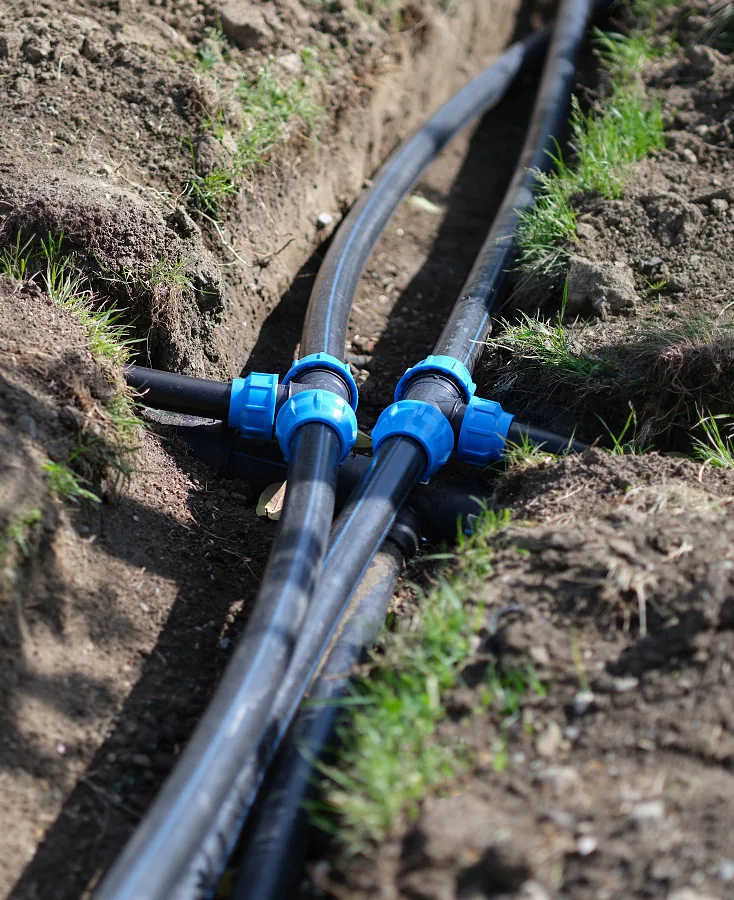
Two drawings can show the same downward curve and describe different engineering problems. One shows a pipe deliberately buried below an existing utility with continuous support. The other shows pipe bridging an opening and deflecting between supports. Calling both a belly hides which evidence is missing. Mark the support condition on the revision sketch before asking for a permissible amount of movement.
A real public engineering question from October 2023 asks about taking a small wastewater force main below an obstruction. It illustrates the uncertainty; it is not a project approval or a design standard. The question does not identify the pipe material, and its forum reply cannot be transferred into a universal PE support-spacing or deflection allowance.
For a supported buried diversion, give the designer the proposed installed profile, cover, trench arrangement and crossing constraints. For an unsupported crossing, also identify the clear span, supports, pipe system and operating conditions. A material change from a rigid pipe to PE changes the evidence needed; a support detail for one material is not a purchasing substitute for another.
The immediate output is a classified change: buried profile revision, unsupported-span assessment, or both. If the sketch cannot establish which it is, return it for that clarification before altering lengths or fittings. This resolves a useful procurement question even before a design calculation is available: the supplier should quote a defined arrangement, rather than infer a support condition from a curved line.
Review the whole approach and departure profile
A low point alone does not describe what the pumps must overcome or where air may collect. Put the original and proposed profiles on the same elevation basis. Include the approach to the obstruction, the lowest point, the recovery slope and the connection back to the original route. A survey of only the crossing depth can miss an intermediate crest created at either end.
The US EPA’s force-main technology fact sheet treats vertical alignment as a design issue and advises avoiding low and high points. That is a reason to review an unavoidable diversion, not a declaration that every dip is prohibited. It also does not turn a pumped wastewater main into a gravity sewer with a single minimum-fall test.
A concrete example of the missing hydraulic evidence appears in WSSC’s dated 2008 force-main design section. Its profile requirements call for the hydraulic grade line to be shown and discuss keeping the main below it at the minimum pumping rate. These are named-owner requirements, not proof of the current rules for another utility. They show why a normal-duty pump figure, without the revised profile, cannot close the review.
Ask the designer to identify the operating cases used for the changed route. Which pumping condition governs the profile review? Does the revised route introduce a crest requiring an air-management assessment? Does the owner require a transient review for the change? Record the answered questions on the accepted revision. Do not answer them by borrowing a forum velocity or assuming that a line full during one operating condition remains so in every condition.
A low-point drain and a high-point air valve solve different tasks
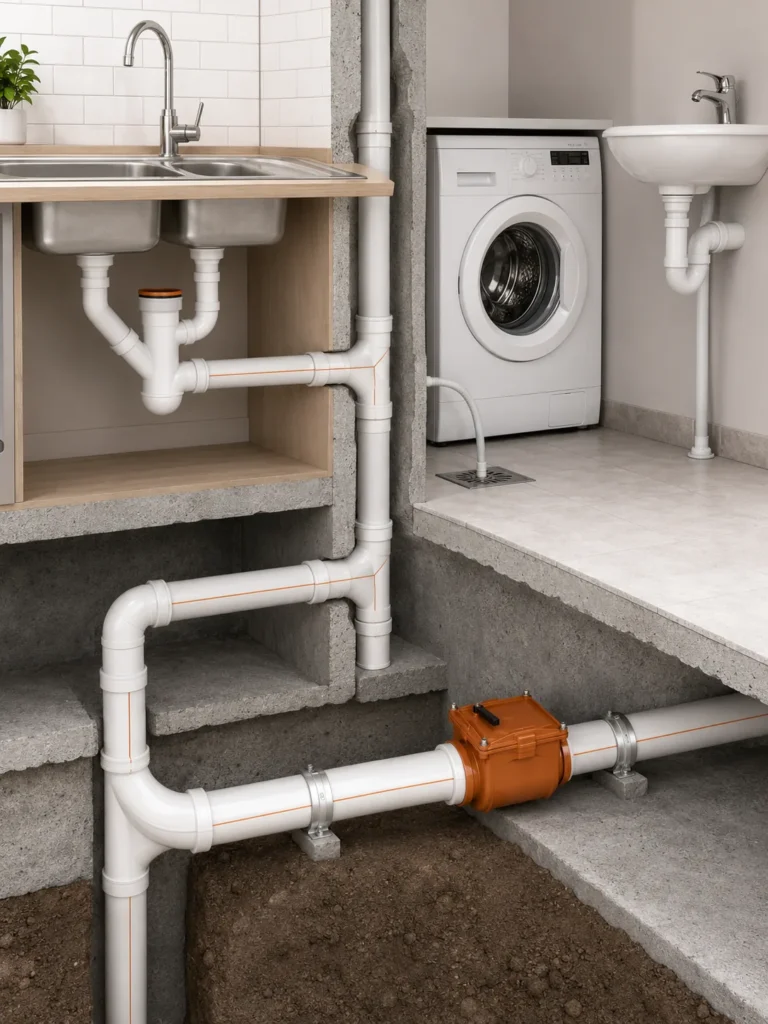
The maintenance question is what happens when the line must be emptied, cleaned or repaired. A downward diversion may change where contents remain after isolation. The operations team needs the proposed low-point location and a practicable maintenance arrangement; an installer saying that sewage will be pumped through the dip does not answer how that portion will later be drained.
CVWD’s October 2024 Development Design Manual, section 6.8.2, provides a useful contrast. It calls for wastewater air-release and air/vacuum valves at high points, and manually controlled drain valves at major low points for cleaning or draining. Those are separate duties and a project-specific example. The document does not establish which points on your proposed route count as major or authorize copying its detail into another owner’s system.
Ontario’s sewage-pumping-station guidance likewise discusses air relief at high points to prevent air locking. It supports asking the air-management question; it supplies neither a universal acceptable dip depth nor permission to omit the actual owner’s review. A catalogue entry for an air valve does not establish a safe place to discharge drained wastewater.
| Change found | Question to close | Useful recorded answer |
|---|---|---|
| New low point | How will the isolated section be drained or cleaned? | Owner-reviewed maintenance arrangement and access |
| New crest on the recovery | What does the revised operating profile require? | Designer-reviewed hydraulic and air-management decision |
| Unsupported length | What supports this exact pipe and duty? | Material-specific accepted support detail |
Send one revision request that separates the decisions
The following is an illustrative project request, not a real Bekatherm job or an approved design. Assume the original route conflicts with an existing utility. The proposed revision lowers a continuously supported section and returns to the original alignment. The pipe material and final crossing elevations still need confirmation.
Proposed obstruction crossing: please review the attached original and revised profiles on the same datum. Confirm the pipe material and support arrangement, the operating cases and hydraulic grade line used for the revised alignment, and whether the recovery introduces an air-management requirement. Confirm how the new low point will be isolated, accessed and drained for maintenance. Return an accepted revision with the resulting fitting and pipe schedule, or identify the geometry that must change.
This request produces separate answerable decisions. The designer can return a revised route instead of a sag allowance. The owner can require a different maintenance arrangement. Procurement can then distinguish an accepted geometry with outstanding supply confirmation from an unaccepted drawing. None of those outcomes requires pretending that the pipe supplier approves the civil design.
Change the assumed condition and the request must change too. If excavation leaves the crossing unsupported, the “continuously supported” assumption is no longer available. Add the actual span and support detail to the review. If the recovery creates a crest, a response dealing only with low-point draining is incomplete. This countercheck keeps a convenient answer to one part of the drawing from being treated as acceptance of the entire change.
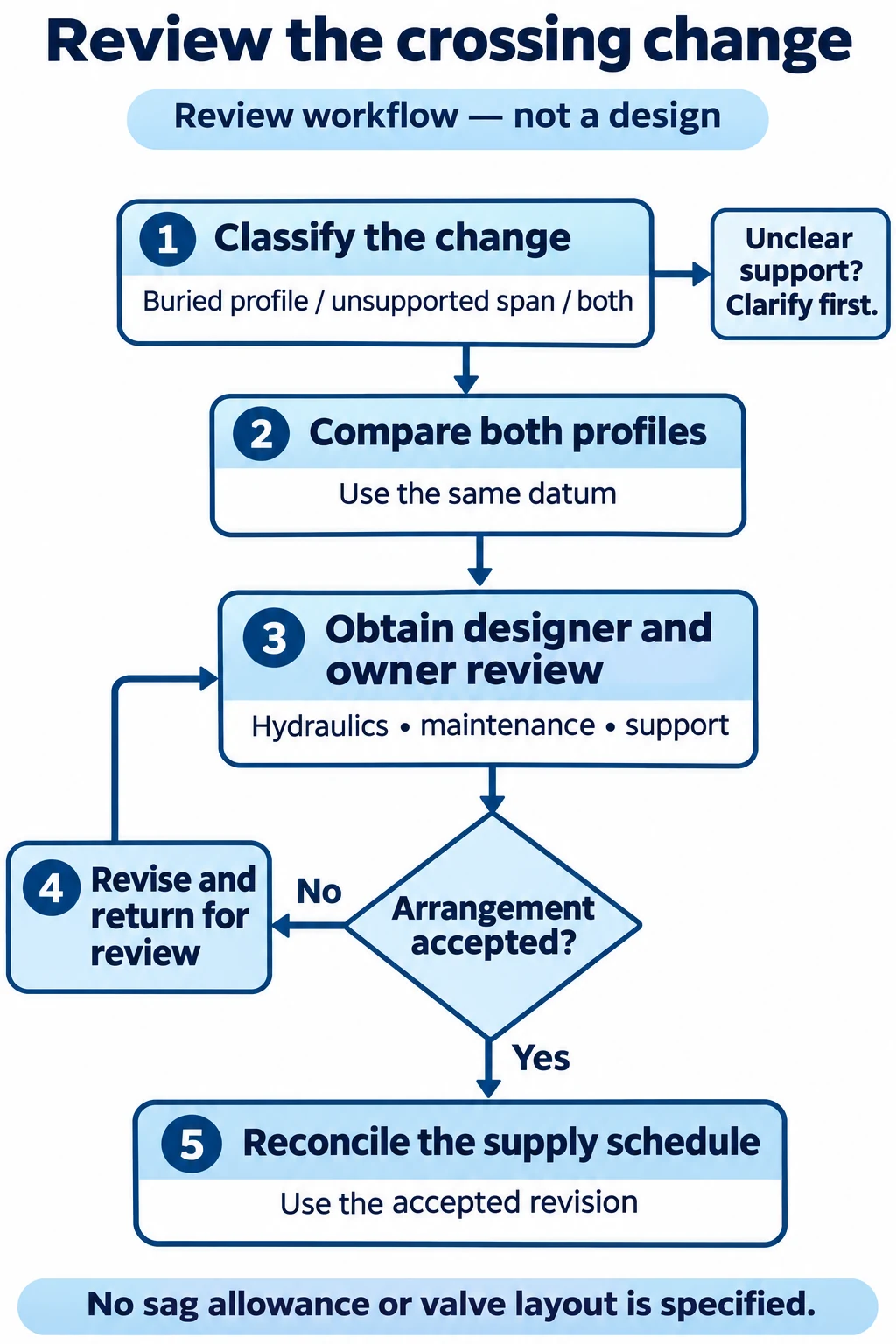
- Classify the change: buried profile, unsupported span, or both.
- Compare original and proposed profiles on the same datum.
- Obtain designer and owner review of hydraulics, maintenance and support.
- If the arrangement is not accepted, revise and return for review.
- Reconcile the accepted revision with the pipe and fitting schedule.
Turn the accepted revision into a pipe enquiry
Once the responsible parties accept the arrangement, reconcile it with the supply schedule. Identify the exact system, sizes, pipe class, jointing method, revised lengths and fitting geometry. Include the document revision that controls the enquiry. Keep items needing project-specific confirmation visible rather than letting the supplier choose a different fitting angle or material to make the quantities balance.
The Bekatherm trench and bedding guide addresses the broader installation context. It does not replace the changed-profile assessment. For the supply stage, send Bekatherm the accepted pipe schedule and crossing requirements with quantity and destination, asking which items and documents can be included in an actual offer. This guide establishes no project-specific PE product availability, engineered crossing service, price or dispatch commitment.
| Enquiry field | What to attach |
|---|---|
| Controlling geometry | Accepted profile and revision identifier |
| Pipe and joints | Specified material, dimensions, class and joint system |
| Changed quantities | Reconciled pipe lengths and fitting schedule |
| Scope boundary | Who supplies supports, valves and maintenance access; unresolved items clearly listed |
Conclusion
A crossing dip is ready for procurement when the accepted profile, operating review, maintenance arrangement and pipe schedule describe the same configuration. A drawing with only a sag dimension cannot establish that. Resolve the changed route first, then ask a supplier to confirm its actual supply scope against that revision.
Frequently Asked Questions
Is every dip in a wastewater force main unacceptable?
No universal conclusion follows from the word dip. Apply the actual owner’s criteria to the revised profile, operating conditions, support and maintenance arrangements.
Can I use a gravity-sewer slope rule?
That alone cannot assess a pumped-main profile change. The relevant review includes the force-main operating profile and project requirements.
Does a high-point air valve drain the low point?
The duties differ. Obtain the owner-reviewed draining and access arrangement rather than assuming one valve resolves both tasks.
Published by Bekaatherm Technical & Export Team · Bekatherm piping content