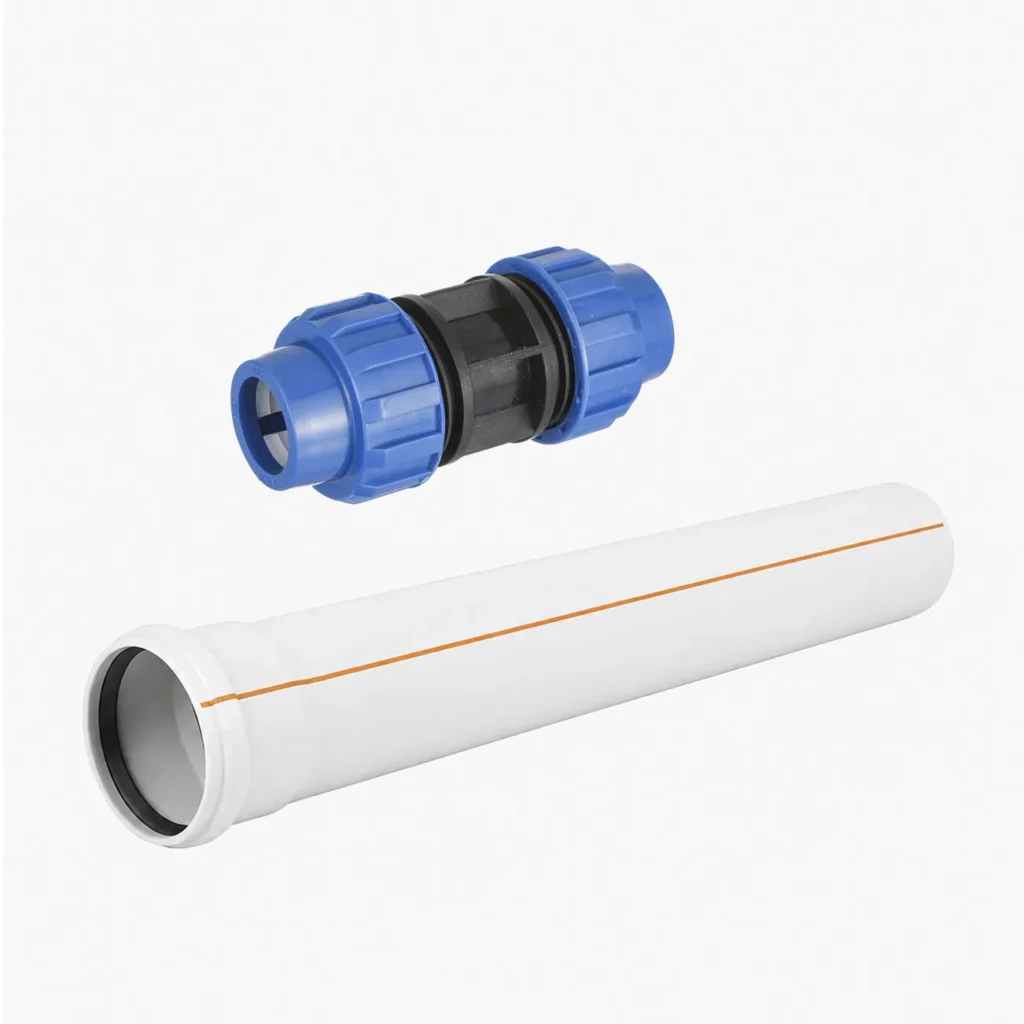
Do not release a previously kinked PE pressure pipe for installation simply because it looks round again. Separate normal coil curvature from a local crease or buckle, identify the pipe and service, and obtain a documented disposition from the responsible manufacturer or system operator. A recovered outline or a leak-free observation does not supply that acceptance decision.
The practical question is what happens to the affected section now. This guide provides a receiving and installation hold process. It does not prescribe heat straightening, approve an in-service repair or turn a visual assessment into a statement about remaining pressure life.
Key Takeaways
- A smooth intended curve and a local kink are different conditions.
- Record what happened before the pipe was straightened.
- Keep the affected length identifiable.
- Use the actual pipe and fitting instructions for the proposed route.
- Do not apply PEX heat-repair advice to PE pressure pipe.
- Change the route or fitting arrangement if it recreates the same local bend.
Watch the background explainer
Identify the local condition before naming a remedy
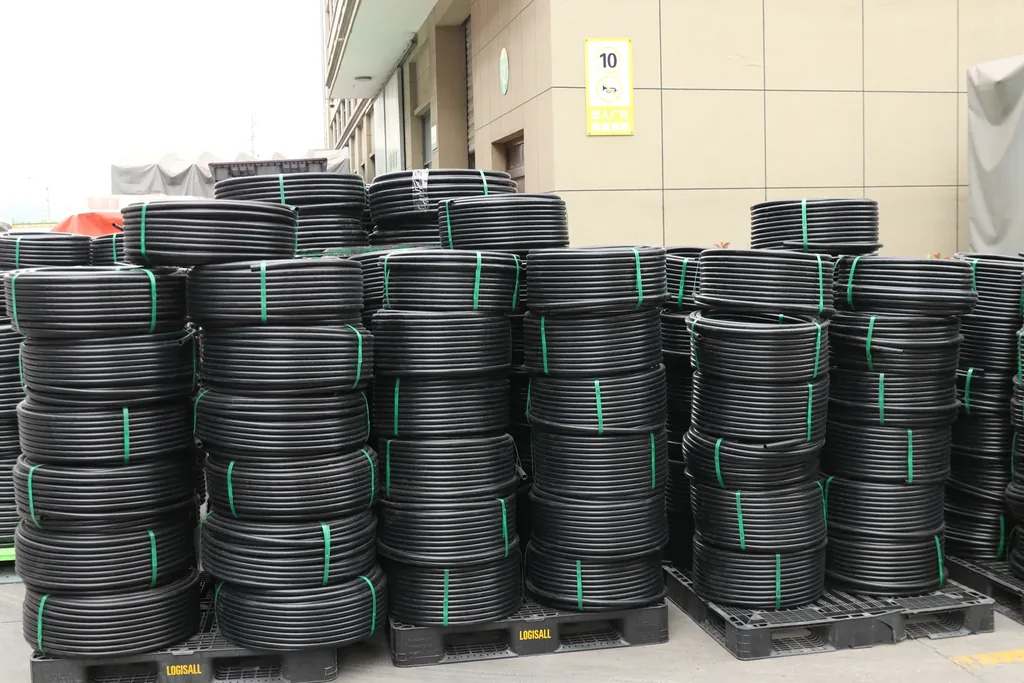
PE pipe can be supplied in coils and can follow an intended curve within the applicable installation limits. That flexibility does not mean every sharply bent section is acceptable. A gradual change in direction along the pipe is a different observation from a local fold, flattened crease or abrupt change in shape around a point.
Record the condition rather than trying to diagnose its remaining strength from a photograph. Note the location, visible shape, whether the pipe was bent around a sharp object, and whether someone has already pushed or heated it back toward its original outline. Photograph the affected location in context and close up, where it is safe to do so. Retain any earlier picture showing the original deformation.
A pipe can look better after the load is removed without establishing that its history has become irrelevant. That is the central acceptance problem. The person inspecting the recovered surface may see less than the person who watched the kink occur. Keep both observations in the record so the responsible reviewer does not mistake “looks round now” for “was never kinked.”
Do not mix this decision with a scratch-depth check. A surface gouge, a pipe-end geometry problem and a local buckle concern different conditions. The scratch-acceptance guide explains why depth alone is not a universal release criterion; it is not permission to use that criterion to clear a kink.
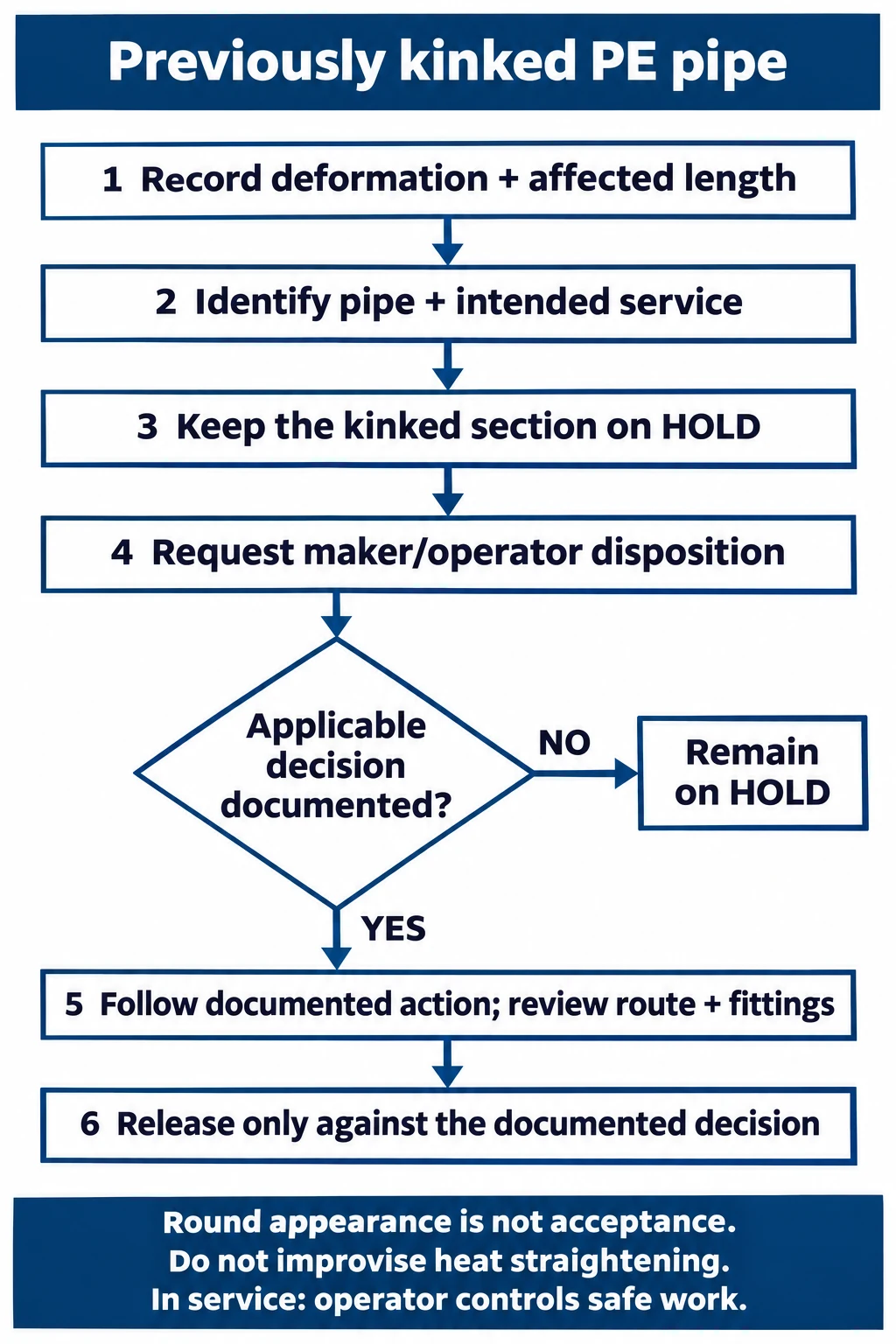
- Record the local deformation and affected length
- Identify the actual pipe and intended service
- Previously kinked? Keep the section on hold
- Request manufacturer or operator disposition
- Review the proposed route and fittings
- Release only on the applicable documented decision
Use current curved-alignment guidance at its proper scope
PIPA POP202, Issue 3, February 2024 provides guidance for PVC, PP and PE pipe installation on curved alignments. Its PE section states that curving should be gradual and that the pipe must not be kinked or bent around a corner, sharp object or star picket. It also describes progressive support while forming a curve.
Read this as guidance about forming an acceptable alignment, together with the relevant standards, agency requirements and manufacturer instructions. It is not a universal workshop procedure for restoring pipe that has already been damaged. A warning against kinking cannot be turned into evidence that a kink is acceptable after an improvised reshaping method.
The document makes another important distinction: permissible curvature depends on the pipe diameter, SDR and temperature, and a fitting in the curve can require a different assessment from plain pipe. Its general guidance should not be copied into an order as one radius for every PE product and every site condition.
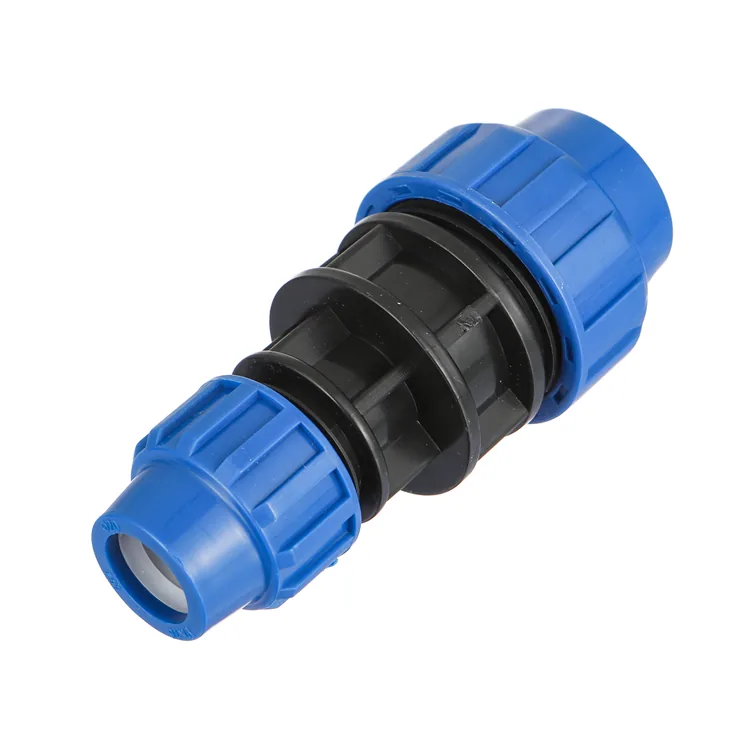
In particular, a pipe-only bend figure does not automatically clear a bend beside a mechanical, electrofusion or flanged connection. Local stresses and fitting capability need consideration. PIPA directs installers to seek fitting-manufacturer advice where appropriate. Identify the actual fitting and assembly instead of assuming that a pipe’s general flexibility settles the joint question.
Keep product families separate. Instructions describing a permitted recovery method for a particular PEX product do not establish permission for a PE water main. Nor does a method used for non-pressure duct establish acceptance for a pressure service. The material, application and exact procedure have to match the pipe under review.
Put the affected section on an identifiable hold
For uninstalled pipe, prevent the affected length from being selected for installation while its disposition is unresolved. Use the site’s identification and material-control process so the location remains clear. Avoid an informal “someone will remember” arrangement that can fail when the coil is moved or another crew takes over.
Keep the distinction between a material hold and a live-system action. If the pipe is already in service, do not release restraint, cut it or open a connection to investigate. The responsible operator and competent personnel need to determine the safe system condition and the applicable repair or replacement procedure. This article does not authorize work on a pressurized main.
Do not use an improvised heating method to make the inspection problem disappear. Without a procedure applicable to that exact material and condition, restoring the shape is not a documented remedy. Record any heating or reshaping that already occurred, including what is known and what is unknown. A reviewer needs that history rather than only the final appearance.
Similarly, do not substitute an ad hoc pressure check for an acceptance decision. A lack of immediate leakage answers a limited observation about that test or exposure. It does not, by itself, establish that the previously kinked section meets the project’s requirements or has the intended long-term performance.
| Observation | What it establishes | What remains unresolved |
|---|---|---|
| A local kink was seen during handling | A deformation event needs recording | Disposition of the affected length |
| The pipe looks round after unloading | Its visible outline changed | Acceptance after the recorded event |
| No leakage is observed | No leakage under the observed conditions | Compliance and remaining service performance |
| A replacement route bends beside a fitting | The assembly contains more than plain pipe | Applicable fitting and pipe limits |
Give the reviewer a usable disposition record
Identify the manufacturer, pipe marking, material designation, diameter and wall or SDR information, batch reference where available, and intended service. State whether the affected pipe is new material awaiting installation or part of an existing system. Those inputs help the manufacturer or operator choose the applicable requirements instead of answering a generic “is plastic pipe flexible?” question.
Describe the event in ordinary terms: what the pipe was being moved around, where the local deformation appeared, whether it was constrained, and what happened afterward. Do not invent a temperature, force or bend radius if nobody measured it. Unknown inputs should remain unknown. A clear description of missing information is more useful than an unsupported precise number.
Ask for the disposition of that section and the basis for it. If the response requires removal and replacement, obtain the applicable assembly and installation procedure from the responsible party. If a different disposition is proposed, it should identify the covered product and condition, the permitted work and the evidence required before release. Do not extend it to other coils by analogy.
Keep the response linked to the material identification and affected location. A generic catalogue statement about flexibility does not answer a case-specific damage inquiry. Neither does a message approving a different pipe size, product family or service. Check the match before the hold is closed.
Check that the installation will not recreate the problem
Once the material disposition is settled, review the alignment that produced or would reproduce the local bend. A replacement length forced around the same corner may repeat the handling problem. Ask whether the layout should use a broader curve or a suitable fitting arrangement, following the pipe and fitting instructions and the project requirements.
PIPA’s distinction between plain pipe and a curve containing fittings is particularly useful here. An arrangement can pass a broad pipe-radius check yet concentrate movement at a short fitting zone. Record which part of the assembly each instruction covers and obtain maker advice where the applicable joint conditions are uncertain.
Consider the safe method of forming and supporting the curve as a separate planning task. Curved pipe can store energy; the guideline calls for safe methods of curving and restraint. Do not remove a restraint or handle a loaded coil merely to obtain a better inspection photograph. The crew’s safe system of work comes first.
| Available information | What it establishes | What remains open |
|---|---|---|
| The pipe appears round after handling | Its present visible shape | Disposition of the known kink event |
| A documented applicable disposition is available | The action directed for that affected length | Any conditions and limits stated in that decision |
Work through two receiving decisions
Illustrative case: an uninstalled PE coil was sharply folded during movement. After the handling load was removed, the pipe mostly returned to a round outline. The receiving decision remains a hold on that identifiable section. Preserve the event description and pictures and request the applicable manufacturer disposition. “Round again” is recorded as an observation, not as approval.
Now change the condition: there was no local fold; the pipe follows a broad smooth curve, and the task is whether the intended alignment is permitted. That is a curved-installation review. Identify the pipe, temperature conditions and fittings, then compare the proposed layout with the applicable instructions. A passing route review for this second case does not retrospectively approve the kink in the first.
Conclusion
Keep the deformation history visible and the affected length identifiable. Use current installation guidance to understand the route, and obtain a disposition applicable to the actual pipe and service before release. A smoother outline, a generic bend figure and an immediate leakage observation each answer less than the full acceptance question.
FAQ
Can I accept the pipe because the kink disappeared?
No acceptance is established by appearance alone. Keep the recorded event in the manufacturer or operator disposition request.
Does a pressure test clear a previous kink?
Not by itself. Test observations and material acceptance are separate decisions under the applicable project and manufacturer requirements.
Can a PEX heat-repair instruction be used on PE pipe?
Do not transfer a procedure between materials or products. The procedure must expressly cover the actual pipe and condition.
Is normal coil curvature a kink?
Not necessarily. Distinguish a gradual intended curve from a local crease or buckle, and assess the actual installation limits.
By Bekaatherm Technical & Export Team. Public installation guidance and a documented disposition process; no claimed field test or repair authorization.