An HDPE pipe welding machine of the butt fusion type is sold by one number: the outside-diameter band its clamps cover.
Three published examples show the spread. The McElroy Rolling 28 fuses 63 mm to 225 mm, the TracStar 618i fuses 160 mm to 450 mm, the TracStar 500 Series 3 fuses 180 mm to 500 mm. So selection runs in two steps. Take the band covering every diameter on the schedule, then let the specification set the machine class. WIS 4-32-08 Issue 4 calls for fully automatic machines on all sizes up to and including 630 mm and permits no manual ones.
Bekaatherm makes PE and PPR piping systems, not welding equipment, so nothing below recommends a brand. What follows is clamp range, pressure control, record keeping and the hire checks, as the documents state them.
Key Takeaways
- Clamp bands overlap in the middle and stop at the bottom. Published examples run 63–225 mm, 160–450 mm and 180–500 mm, so a machine for a 400 mm main will not clamp the 110 mm branches.
- WIS 4-32-08 clause 3.2 requires fully automatic machines up to and including 630 mm and does not permit manual machines. Clause 3.3.1 sends all equipment to BS ISO 12176-1.
- The gauge does not read interfacial pressure. It reads hydraulic pressure, and the conversion needs pipe OD, pipe ID, the total piston area and the drag factor, which starts around 30 psi and can reach several hundred on long pipe strings.
- Three regimes publish three plate windows: 225–240 °C under WIS, 400–450 °F (204–232 °C) in the ASTM F2620 parameter set, 210–240 °C as typical from the PE100+ Association. Pick one and stay in it.
- On a hired machine, ask for three documents and one demonstration: calibration to BS EN ISO 10012, service records kept seven years, a plate with no spray-on release agent, and a dummy joint made in front of you.
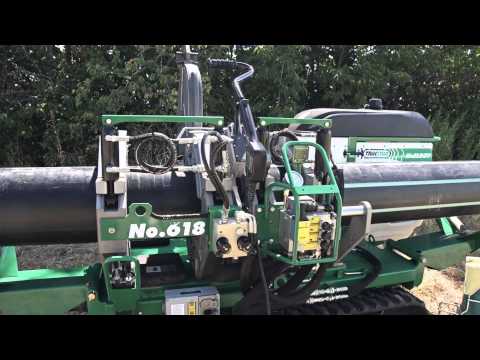
Before the detail, the cycle itself: McElroy University films a full joint on the TracStar 618, the mid-band machine in the table below, from clamping and facing through to cooling under pressure.
Start from the pipe schedule, not the machine catalogue
List every outside diameter the job will weld before looking at a machine. The published bands overlap in the 160–225 mm region and separate hard at the ends, so a fleet decision that looks like one machine is often two. A contractor laying a 400 mm PE100 main with 110 mm service branches cannot do both on a 160–450 mm machine. The published band is what the builder’s own clamp inserts cover, so a stated minimum is already the with-inserts minimum; below it no document read offers an insert, and none says one exists.
There is a floor. The PE100+ Association puts butt fusion at 90 mm OD and above, with 63 mm allowed under carefully controlled conditions in some specifications, and sends everything smaller to electrofusion. Confirm the diameters against the OD and SDR chart first, because the wall thickness that comes with the SDR later decides which pressure procedure applies. The same schedule sets the HDPE pipe and fittings the machine will be joining.
| Published clamp band (mm) | Worked example | Best for |
|---|---|---|
| 63–225 mm | McElroy Rolling 28, 1,750 W heater | Service connections, irrigation laterals, in-building risers |
| 160–450 mm | McElroy TracStar 618i, DataLogger controlled | Distribution mains and trunk work with logged joints |
| 180–500 mm | McElroy TracStar 500 Series 3, 157.6 bar | Large transmission mains and thick-wall low SDR pipe |
| End of the published clamp band | Rolling 28 (mm) | TracStar 618i (mm) | TracStar 500 S3 (mm) |
|---|---|---|---|
| Smallest OD the clamps cover | 63 | 160 | 180 |
| Largest OD the clamps cover | 225 | 450 | 500 |
Source: McElroy Rolling 28 spec summary, TracStar 618 product page and TracStar 500 Series 3 Automatic spec summary, all read 2 September 2026. Values transcribed, not converted.
Manual, semi-automatic or fully automatic: what the specification decides for you
Three classes are in circulation. A manual machine leaves every step to the operator. Semi-automatic machines manage hydraulic pressure through a controller. Fully automatic machines run the sequence from heating through cooling. Buyers treat this as a budget question, and on many projects it is not.
WIS 4-32-08 clause 3.2 states that fully automatic machines shall be used for all sizes up to and including 630 mm, prefers fully automatic above that size, allows semi-automatic there, and permits manual machines nowhere.
Clause 3.3.1 then sends all butt fusion equipment to BS ISO 12176-1, whose fourth edition of June 2017 sets performance requirements for electrically powered heater-plate equipment and adds an annex for machines with automatic controllers. Buy below that line and the machine is unusable on any job written to a specification of that family, whatever it cost. Our own quality-control practice reads the same way on the pipe side.
Pressure control is arithmetic, not a dial
The number the procedure specifies is interfacial pressure at the pipe faces. The number on the machine is hydraulic pressure in the cylinders. They are related by geometry, and the relationship is published: PG = [(OD² − ID²) × PI] / (4 × AP) + DF, where AP is the total effective piston area and DF is the drag factor. Two crews on the same machine and the same pipe will weld at different interfacial pressures if only one of them measures drag.
Drag is the pressure needed to move the carriage and the pipe hanging off it. The generally accepted minimum is 30 psi, and on long strings it can reach several hundred psi, which is why it is measured on every joint rather than set once.
Both parameter windows are narrow. The F2620 parameter set, as restated in 2012 and 2018, gives 60–90 psi interfacial. WIS gives 0.15 ± 0.02 MPa of interface stress for walls up to 22 mm, dropping to 0.025 MPa during cooling on the dual-pressure procedure used above that wall. ISO 21307:2017, amended in 2020, is the document that defines those procedures.
Heater plate temperature, and how it is verified
There is no single industry figure here, and averaging the published ones invents a number nobody wrote. Work to the regime the project names, and hold the machine to that regime’s verification routine, not to its own display. WIS asks for a probe accurate to ±2 °C across the working range, twenty minutes of stabilisation before any reading, and sixty seconds of probe contact. PPI TR-33 (2012 edition) asks for an independent pyrometer check before the first joint of the day and periodically after it.
Plate condition matters as much as the reading. WIS clause 3.3.5 prohibits additional spray-on release agents, on the reasoning that a clean coated plate has to show contamination clearly. A plate that has been sprayed, or whose coating has worn through to bare metal in the middle, hides the one thing an operator is meant to see.
One currency note on the third regime below. The live ASTM practice is F2620-24, while the 400–450 °F and 60–90 psi figures here are quoted as restated in a manufacturer procedure of August 2018 and in TR-33 (2012). Read them as the industry parameter set, not as the current ASTM text.
| Regime | Plate window (°C) | Interface pressure as published | Verification it asks for |
|---|---|---|---|
| WIS 4-32-08 Issue 4 | 225–240 (230 +10/−5) | 0.15 ± 0.02 MPa, 0.025 MPa on cooling above 22 mm wall | Probe ±2 °C, 20 min stabilisation, 60 s contact |
| ASTM F2620-24, values as restated 2012 and 2018 | 204–232 (400–450 °F) | 60–90 psi interfacial, plus measured drag | Pyrometer before the first joint, periodically after |
| PE100+ guidance (typical) | 210–240 | Held by the machine hydraulics, value set by the procedure | Not specified; defers to the procedure in force |
Buying or hiring: what rental units get wrong
Hiring is right on a single crossing and wrong on a two-year framework, and the deciding factor is rarely the day rate. It is whether the unit arrives with the evidence the specification expects. WIS clause 7.5 requires equipment serviced and calibrated by authorised agents to the manufacturer’s recommendations, calibration held to BS EN ISO 10012, and records kept a minimum of seven years.
Check which edition your inspector means: the base document was ISO 10012:2003 until ISO withdrew it on 12 February 2026 and replaced it with ISO 10012:2026. A hire desk that cannot produce that record for the serial number has handed you an unqualified machine.
Three failures recur, and each maps to a clause. A worn or sprayed heater plate defeats clause 3.3.5. An uncalibrated gauge makes the pressure arithmetic meaningless, because every joint inherits the error. And crews skip dummy joints, which clauses 4.3f and 4.3g require at the start of a session, again above 180 mm, and again whenever the plate has cooled below 180 °C or the size changes. Large fusion-equipment fleets publish that their machines are inspected, calibrated and field-tested before shipment, so asking for that paperwork is routine.
Check alignment on that dummy joint while it is still clamped. WIS allows under 1 mm of misalignment to 180 mm, and under 10% of wall thickness above it. Worn clamp inserts show up here, not in a failed weld.
What moves the price, and what else to ask the hire desk
No honest single number exists. What moves it is the clamp band, the automation class, whether a data logger is fitted, and a self-propelled track against a skid carriage. For one dated anchor, McElroy publishes list pricing on its own product page: the TracStar 618i starts at USD 117,169, or USD 126,453 with hydraulic clamping, read on 2 September 2026. Hire desks quote by the week against the band; no hire rate is claimed here, because none was verified.
Three questions belong on the same call. Which insert sizes ship in the crate, because a band on paper without the inserts on site is not that band. What the machine draws: the heater alone is 1,750 W on the small unit and 5,000 W on the 500 Series, and the generator carries that plus the hydraulic power unit, so ask for the total rating.
And whether the hire includes an operator, after reading the specification for an operator clause beside the equipment one. WIS logs operator identification as preferable, so inspectors expect to know who welded it.
For contractors and distributors buying PE pipe and fittings by the container rather than by the piece.
Bekaatherm produces to ISO 4427, EN 12201 and DIN 8074 / 8075. A mixed trial shipment is one 20GP container of pipe, fittings and valves, and regular in-production sizes run 15–25 days.
Data logging: the record a project can ask for
A logger is a datasheet feature and an acceptance instrument. WIS clause 3.3.6 sets what the record must hold: unique identification of each joint, the parameters specified and achieved, and the ram area with the calculation of actual jointing pressures. Operator identification is preferable rather than required. That ram-area line is worth quoting, because it forces the machine to show its working on the pressure conversion instead of printing a cylinder reading.
Two acceptance numbers the log should support, both from TR-33 (2012). Cooling under pressure runs roughly 30 to 90 seconds per inch of diameter. Melt bead is 3–5 mm above 3 in through 8 in, 5–6 mm above 8 in through 12 in, and 6–11 mm above 12 in through 24 in. The same traceability argument runs on the fitting side, where electrofusion control boxes carry it, and it is one reason to read the jointing methods compared before fixing a method.
The pipe side has its own numbers, worth having before the machine is booked. At Bekaatherm the minimum order is one 20GP mixed container of pipe, fittings and valves, or 500 kg per size and colour. Lead time is 15–25 days on regular in-production sizes and 30–45 days on OEM runs. Standard samples are free up to three items, freight collect, which is the cheap way to check wall thickness and marking against ISO 4427 first.
For importers and procurement teams closing a tender: pipe to ISO 4427 and EN 12201, quoted FOB İstanbul or Mersin, with the container loading plan and the test documents priced into the offer rather than added later.
Conclusion
The trade-off runs one way. A wider clamp band and a fully automatic controller cost more up front and remove the two variables behind disputed joints: operator judgement on pressure, and an unrecorded cycle. A narrower manual unit is cheaper and shifts that risk onto the crew, and on any job written to WIS 4-32-08 it is not admissible at all.
So decide in order. Diameters set the band. The specification sets the class. The pressure arithmetic decides whether the operator needs a controller or a calculator.
Then write the enquiry, to the hire desk or the builder, with six lines in it. The diameter range on the schedule. The specification in force and its machine-class clause. Whether an operator comes with the machine. Which insert sizes ship in the crate. The total electrical rating, for generator sizing. And the calibration certificate for that serial number. A supplier who answers all six in one reply is the one to deal with.
Frequently Asked Questions
What size HDPE pipe welding machine do I need?
Take the largest and smallest outside diameters on the schedule and find a published clamp band covering both. Worked examples run 63–225 mm, 160–450 mm and 180–500 mm. The published band is what the builder’s own clamp inserts cover, so a stated minimum is already the with-inserts minimum; below it no document read offers an insert, and none says one exists. A mixed schedule of mains and service branches therefore usually needs two machines.
Is a manual butt fusion machine acceptable on a water project?
Not under WIS 4-32-08 Issue 4. Clause 3.2 requires fully automatic machines for all sizes up to and including 630 mm, and above that size allows semi-automatic while preferring fully automatic. Manual machines are not permitted at any size. Other national specifications differ, so read the one the project names.
Why does the machine gauge not show the fusion pressure?
Because it reads hydraulic pressure in the cylinders. Interfacial pressure at the pipe faces is derived from PG = [(OD² − ID²) × PI] / (4 × AP) + DF, using the total piston area and the measured drag factor. Drag starts near 30 psi and reaches several hundred psi on long strings.
What should I check on a hired butt fusion machine?
Calibration and service records for that serial number, held to BS EN ISO 10012 and retained seven years under WIS clause 7.5. Then the heater plate, which must carry no additional spray-on release agent. Then a dummy joint, checked for misalignment under 1 mm up to 180 mm diameter.
Can 63 mm HDPE pipe be butt fused?
The PE100+ Association places butt fusion at 90 mm OD and above, and notes that some technical specifications allow 63 mm under carefully controlled conditions. Below that, electrofusion is the usual route, and it stays the usual route wherever the pipe cannot be moved into alignment.